
Why B2B Expansion Fails Early: 6 Root Causes
Why B2B Expansion Fails Early: 6 Root Causes
TL;DR:
- Early B2B expansion fails when companies replicate their domestic sales model in new markets without adapting to local buyer behavior and ecosystems. Success depends on redesigning go-to-market strategies, validating customer profiles, and integrating international considerations early in product and sales planning. Monitoring customer health signals enables timely expansion, reducing wasted effort and improving pipeline durability.
Early B2B expansion failure is defined by a single structural problem: companies port their domestic go-to-market model into a new market without redesigning it for that market’s buyer behavior, trust dynamics, or commercial ecosystem. This is why b2b expansion fails early at such a predictable rate. The failure is not a sales talent problem or a product problem. It is a systems problem, and it shows up fast. US companies expanding into Europe illustrate this most clearly, where over 80% fail because they replicate volume-driven outbound tactics in markets that require relationship-based credibility. Understanding where the model breaks down is the first step toward building an expansion that actually holds.
Why b2b expansion fails early: the structural mismatches
The most common early B2B expansion challenges are not random. They follow a pattern rooted in three structural mismatches: the wrong go-to-market model, the wrong timing, and the wrong ecosystem approach.
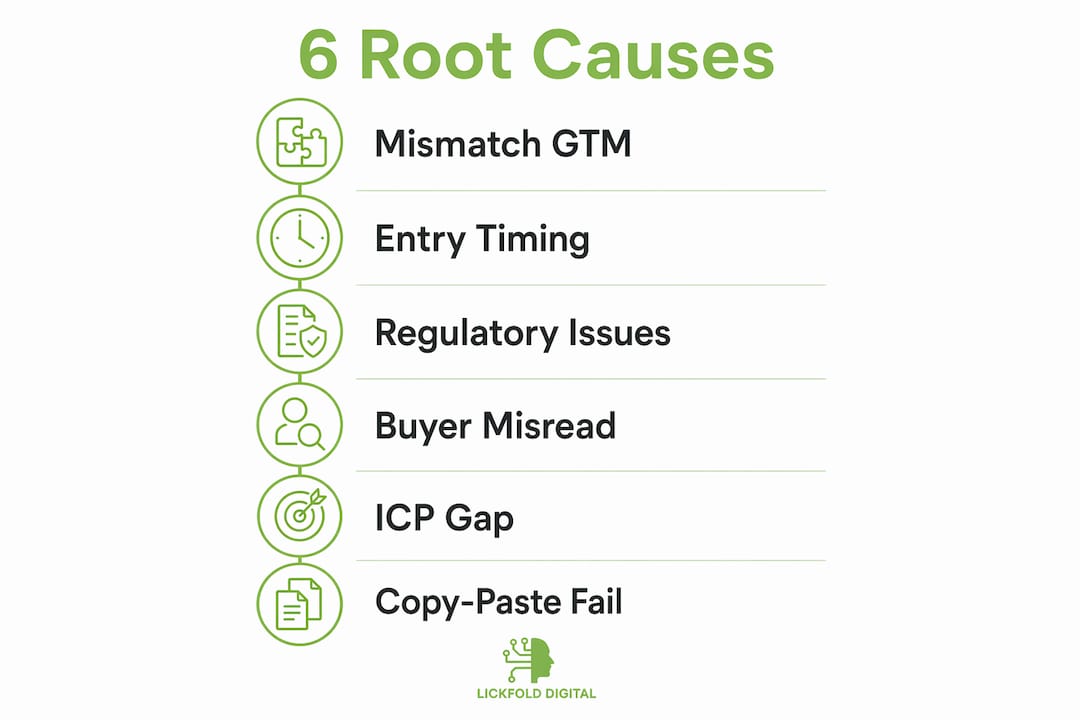
The GTM model mismatch
US B2B companies typically scale through high-volume outbound, short sales cycles, and direct conversion. That model works in a market where buyers are conditioned to evaluate vendors quickly and independently. European markets, and many emerging markets, operate differently. Trust-based ecosystems require ecosystem credibility, longer evaluation cycles, and multi-stakeholder consensus before a deal closes. Dropping a volume-driven outbound machine into that environment produces noise, not pipeline.

Timing the entry wrong
Entering too early means the product lacks the localization, compliance, or case studies needed to earn credibility. Entering too late means a local competitor has already defined the category. Both errors are expensive. The companies that get timing right treat market entry as a research phase, not a sales phase. They spend the first months building ecosystem presence, not chasing quota.
Ignoring regulatory and operational differences
Regulatory environments like GDPR in the EU or BaFin oversight in German financial services are not just compliance checkboxes. They reshape how buyers evaluate risk, how procurement processes work, and how long contracts take to close. Companies that treat these as administrative hurdles rather than commercial factors consistently underestimate their impact on sales velocity.
“Treating international growth as a growth hack leads to ignoring critical local ecosystem relationships, regulatory hurdles, and extended sales cycles needed for success.”
The fix is not to slow down growth. The fix is to diagnose the operating model before scaling outbound efforts. A scalable outbound sales process built for a new market looks different from one built for your home market, and that difference is intentional.
How does buyer behavior misreading cause growth to stall?
Misreading buyer behavior is one of the most consistent early B2B failure causes, and it is also the hardest to detect from the inside.
The ICP validation gap
Growth stalls post-product-market fit when companies outgrow founder-led sales and fail to formally codify a validated ideal customer profile (ICP) for repeatable demand generation. This is especially damaging during expansion, when the ICP assumptions built in the home market no longer apply. A SaaS company that sold to mid-market US tech firms cannot assume the same buyer profile exists in Germany or Singapore. The job titles are different, the decision-making units are larger, and the purchase justification process involves more departments.
- Audit your ICP against the new market. Map the actual decision-making unit in target accounts, not the one you assumed.
- Validate messaging with local buyers before scaling. Run discovery calls with 10–15 prospects in the new market before building a full outbound sequence.
- Identify the language gap. The terminology your sales team uses may not translate, literally or commercially, into the new market’s vocabulary.
- Segment your pipeline by market maturity. Treat new-market leads as a separate cohort with different conversion benchmarks.
Loss of language and market fit is a documented root cause of stagnated growth. When your sales messaging uses category language that buyers in the new market do not recognize, your conversion rates drop and your team assumes the product is the problem. It is not. The messaging is the problem.
Pro Tip: Before launching outbound in a new market, run your top three sales email sequences past a local sales professional in that market. Ask them to flag any phrase that sounds foreign, aggressive, or confusing. You will find at least five.
Only about 5% of target accounts are actively in-market at any given time. That statistic means your outbound volume needs to be matched by precision targeting, not just increased. A well-defined customer profile targeting approach becomes the difference between wasted outreach and qualified pipeline.
Why do copy-and-paste expansion strategies fail?
The copy-and-paste approach to international B2B growth is the single most expensive mistake companies make. It feels efficient. It is not.
What “shifting left” actually means
International expansion fails when treated as an add-on rather than integrated early in product design and GTM planning. The industry term for the correct approach is “shifting left,” which means integrating international expertise at the product and commercial model design stage, not after launch. Companies that bolt on localization after building a US-centric product face expensive rework, delayed launches, and poor market alignment.
| Approach | Outcome |
|---|---|
| Copy domestic GTM to new market | Messaging mismatch, low conversion, wasted budget |
| Localize only the language | Surface-level fit, still fails on buyer behavior |
| Redesign commercial model for market | Higher upfront cost, but durable pipeline and credibility |
| Shift left: integrate early | Lowest rework cost, fastest time to repeatable revenue |
The table above reflects a pattern seen repeatedly in US-to-Europe SaaS expansions. The companies in the bottom two rows consistently outperform those in the top two within 18 months of entry.
Distribution channel differences
Distribution channels in new markets rarely mirror the home market. In the US, direct outbound and inbound content marketing dominate B2B acquisition. In many European markets, channel partnerships, industry associations, and referral networks carry more weight. Ignoring these channels means ignoring the fastest path to credibility.
Pro Tip: Map the top three distribution channels in your target market before writing a single outbound sequence. Talk to five local sales leaders or consultants. Their answers will reshape your entire entry strategy.
What role do customer health signals play in expansion timing?
Expansion revenue is the highest-margin revenue source a B2B company has. It costs far less to expand within an existing account than to acquire a new one. Yet most companies underinvest in the systems that tell them when and how to expand.
Why marketing ownership of expansion revenue matters
Stage 4 revenue marketing programs attribute 20–35% of expansion revenue to marketing. That number matters because most B2B companies assign expansion entirely to customer success, leaving marketing attribution and demand generation out of the equation. The result is slower expansion cycles and missed signals about account readiness.
Key signals that indicate an account is ready for expansion:
- Product usage depth: The account is using core features at high frequency across multiple users.
- Support ticket patterns: Tickets shift from “how do I” to “can it also do,” signaling appetite for more capability.
- Stakeholder breadth: New departments or executives are engaging with the product or your team.
- Renewal behavior: Early renewals or multi-year commitments signal high satisfaction and expansion potential.
The median time to first expansion in B2B SaaS is 12–18 months. Targeted adoption programs launched in months 3–6 can reduce that window significantly. Companies that wait for customer success to surface expansion opportunities are leaving revenue on the table.
Pro Tip: Build a simple health score for your accounts using three inputs: product usage frequency, stakeholder engagement breadth, and support ticket type. Review it monthly. Accounts scoring high on all three are your expansion targets for the next quarter.
Segmenting accounts into at-risk and healthy cohorts before running expansion sequences prevents the most common timing mistake: pushing expansion to an account that is quietly churning. That mistake damages trust and accelerates churn rather than preventing it.
Key takeaways
Early B2B expansion fails because companies scale a domestic operating model into a new market without redesigning it for that market’s buyer behavior, trust dynamics, and commercial ecosystem.
| Point | Details |
|---|---|
| GTM model mismatch is the root cause | Volume-driven outbound fails in trust-based markets; redesign the model before scaling. |
| ICP validation is non-negotiable | Audit your ideal customer profile against the new market before building outbound sequences. |
| Language and market fit must be localized | Messaging that works at home often fails abroad; validate terminology with local buyers first. |
| Shift left on international integration | Build localization into product and GTM design early to avoid expensive rework post-launch. |
| Customer health signals drive expansion timing | Monitor usage depth, stakeholder breadth, and ticket patterns to time expansion correctly. |
What i’ve learned about why expansion really fails
Most early B2B expansion failures I have seen trace back to a leadership mindset problem, not a market problem. The team believes the product is strong enough to sell itself in a new market, so they replicate the playbook that worked at home and expect similar results. When the pipeline stalls, they blame the market or the sales hire. The real issue is that nobody redesigned the commercial model.
The companies that succeed treat international expansion as a full commercial redesign. They ask different questions before entry: Who are the actual decision-makers here? What does a buying committee look like in this market? What ecosystem relationships do we need before we can credibly sell? These questions feel slow. They are not. They save 12 months of wasted outbound spend.
Patience is not a soft skill in B2B expansion. It is a competitive advantage. The companies willing to spend three to six months building ecosystem credibility before scaling outbound consistently outperform those that launch full outbound on day one. The pipeline they build is more durable, the relationships are deeper, and the churn rate is lower.
My strongest advice: listen to the market before you talk to it. Run discovery before you run outbound. The signals are always there. Most companies are just too eager to pitch to hear them.
— Duarte
How Lickfold helps b2b leaders avoid early expansion failure
Expansion failure is predictable, and so is the fix. Lickfold builds AI-driven outbound systems designed specifically for B2B companies entering new markets or scaling beyond founder-led sales. The platform deploys dedicated AI agents that identify decision-makers matching your validated ICP, execute personalized multi-touch outreach, and qualify replies before they reach your sales team.

Lickfold’s approach is built around the exact failure points this article covers: precise targeting instead of volume spray, localized messaging instead of copy-and-paste templates, and systematic follow-up that respects longer evaluation cycles. If your expansion pipeline is stalling or you are preparing to enter a new market, reach out to Lickfold to explore how an AI-powered outbound system can replace guesswork with a repeatable, qualified pipeline.
FAQ
What is the main reason b2b expansion fails early?
Early B2B expansion failure is caused by replicating a domestic go-to-market model in a new market without redesigning it for that market’s buyer behavior and commercial ecosystem. Over 80% of US B2B companies fail in European markets for exactly this reason.
How long does it typically take for b2b expansion to generate revenue?
The median time to first expansion revenue in B2B SaaS is 12–18 months. Targeted adoption programs launched in months 3–6 can reduce this window significantly.
Why do copy-and-paste international strategies fail?
Copy-and-paste strategies fail because they carry home-market assumptions about buyer behavior, distribution channels, and messaging into markets where those assumptions do not hold. The fix is integrating international expertise early in product and GTM design, not after launch.
How does a weak ICP contribute to early expansion failure?
A weak or unvalidated ICP means outbound efforts target the wrong buyers with the wrong message. Growth stalls post-product-market fit when companies fail to formally codify and validate their ICP for each new market they enter.
What signals indicate an account is ready for expansion?
The strongest signals are high product usage frequency across multiple users, support tickets that shift from basic questions to capability requests, and growing stakeholder engagement across departments. Accounts showing all three are strong expansion candidates for the following quarter.