
Build a Scalable Outbound Sales Process in 2026
Build a Scalable Outbound Sales Process in 2026
TL;DR:
- Building a scalable outbound sales process requires documented stages, clear qualification criteria, and automation to ensure consistency and repeatability. Implementing multi-channel sequences with personalized, varied touches significantly improves engagement, while technology automation frees reps to focus on high-value conversations. Regular data analysis and process audits are essential to optimize conversion rates, adapt to changing buyer behaviors, and sustain predictable growth.
Most B2B sales teams already know outbound works. What breaks down is everything that happens at scale. Reps work disconnected sequences, leads fall through the cracks, and what worked for a 3-person team collapses under the weight of a 15-person org. Building a scalable outbound sales process means designing something repeatable and measurable from day one. Companies with structured processes see 18% higher revenue growth and faster onboarding, not because they work harder, but because they work from a system.
Table of Contents
- Key takeaways
- Building your scalable outbound sales process foundation
- Designing multi-channel outreach sequences
- Using technology to automate and scale outreach
- Measuring and optimizing your outbound process
- What I’ve learned building outbound processes that actually scale
- How Lickfold helps you scale outbound faster
- FAQ
Key takeaways
| Point | Details |
|---|---|
| Scalability starts with structure | Document every sales stage with entry and exit criteria before adding headcount or automation. |
| Multi-channel sequences outperform | Combining email, LinkedIn, and phone in structured sequences produces dramatically better engagement than any single channel. |
| Automation frees your best people | Automate lead routing, follow-ups, and reminders so reps focus on conversations that close. |
| Measure what actually moves the pipeline | Track conversion rates by stage and pipeline contribution from outbound, not just activity volume. |
| Iteration beats perfection | Run quarterly process audits and adjust playbooks based on real performance data, not instinct. |
Building your scalable outbound sales process foundation
Before you automate anything or hire another SDR, you need a working definition of what “scalable” actually means for outbound sales. A process is scalable when adding more input (reps, leads, channels) produces proportional output without requiring you to rebuild how things work. That requires three things: repeatability, consistency, and ownership.
Repeatability means any rep, new or experienced, can follow the same steps and get predictably similar results. Consistency means leads move through defined stages on documented criteria, not gut feel. Ownership means every step has a clear responsible party so nothing disappears into a shared inbox.
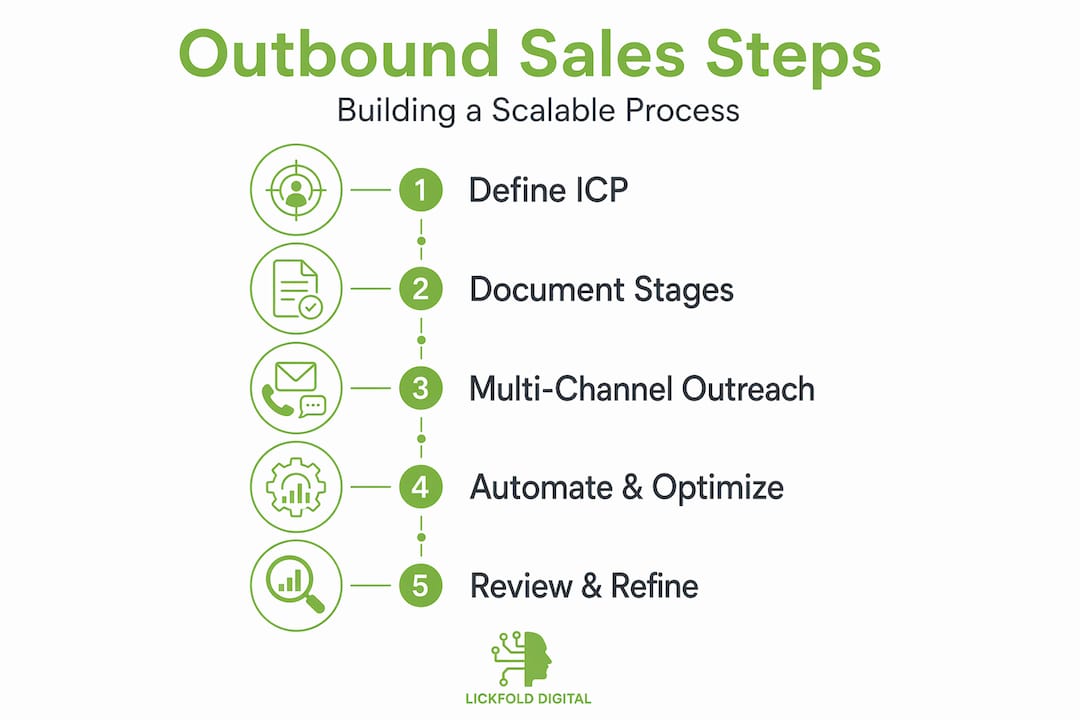
Most teams skip the prerequisites. They buy a sales engagement tool before they have documented stages, or they hire SDRs before they have a stable lead source. Clear stage definitions with documented entry and exit criteria enable pipeline forecasting within 5 to 10% accuracy and prevent the most common form of pipeline drag: stalled deals that no one notices until it’s too late.
Here is what your foundation needs to look like before you scale:
| Element | What it includes | Why it matters |
|---|---|---|
| ICP definition | Firmographics, technographics, buying triggers | Prevents wasted outreach on unqualified accounts |
| Lead source | Verified contact database, intent data | Feeds consistent, workable pipeline |
| CRM setup | Defined stages, fields, and ownership rules | Enables tracking and forecasting |
| Qualification criteria | BANT, MEDDIC, or custom framework | Standardizes handoff between SDR and AE |
| Sequence library | Approved messaging per persona and segment | Ensures brand and quality consistency at volume |
Getting this right before you scale is not optional. It is the difference between controlled growth and a team that hits quota one quarter and collapses the next.
Designing multi-channel outreach sequences
Single-channel outbound is a relic. Structured multi-channel outreach combining email, LinkedIn, and phone produces up to 287% higher engagement versus email alone. That number reflects a fundamental shift in how buyers interact with outreach: they need multiple signals of legitimacy before they respond.
The mechanics of a repeatable sequence matter here. For mid-market targets, 10 to 12 touches over 4 to 6 weeks performs best. For enterprise accounts, you need 12 to 18 touches spread over 8 to 12 weeks because more stakeholders are involved and decisions move slowly.
A well-structured multi-channel sequence typically looks like this:
- Day 1: Personalized email with a specific, relevant hook tied to the prospect’s business
- Day 3: LinkedIn connection request with a short context note
- Day 5: Phone call with a voicemail referencing the email
- Day 8: LinkedIn message with a short piece of value (case study, insight, or event reference)
- Day 11: Follow-up email with a different angle or a direct ask for a conversation
- Day 15 onward: Continue alternating touches with varied content types until response or sequence end
One thing most teams get wrong: they treat LinkedIn as a cold outreach channel. It works far better as a social proof layer and research tool. Connect first, engage with content second, pitch third. Prospects who see your profile and content before receiving an email respond at higher rates because you feel familiar, not random.
Most outbound deals need five or more touches before any meaningful engagement happens. Giving up after three emails is one of the most common and most expensive mistakes in outbound sales.
Pro Tip: Set your sequence to pause automatically when a prospect opens an email three or more times without replying. That behavior signals intent worth a direct phone call, not another automated touch.
For teams exploring multi-channel outreach strategies in more depth, the underlying structure of timing and message variation is where most of the performance gains live.
Using technology to automate and scale outreach
Technology does not replace good process. It multiplies it. If your process is broken, automation makes the mess happen faster. But when your foundation is solid, automation tools that manage lead routing and follow-up reminders free your reps for the conversations that actually require a human.

Here is how technology needs look by team size:
| Team size | Priority tools | What to automate first |
|---|---|---|
| 1 to 5 SDRs | CRM + email sequencer + LinkedIn Sales Navigator | Follow-up reminders and basic lead routing |
| 6 to 14 SDRs | Add email verification + call recording | Sequence enrollment, stage updates, meeting scheduling |
| 15+ SDRs | Add data orchestration + analytics layer + AI prioritization | Account scoring, intent signal alerts, performance reporting |
Email deliverability is the variable that most teams underinvest in until it blows up. Launching campaigns without proper mailbox warmup damages your sender reputation in ways that take months to recover from. Warming up a mailbox over 4 to 6 weeks before sending at volume is not a nice-to-have. It is the infrastructure that keeps your entire outbound effort alive.
The first specialized tool any growing outbound team should add is dedicated email verification. Without it, your bounce rates climb, your domain reputation falls, and your entire sequence library becomes less effective.
AI adds real value at the prioritization layer. AI tools that analyze buyer signals and past deals help reps focus on accounts showing intent right now, not accounts that looked good three months ago when the list was built. AI can also analyze recorded sales conversations to identify talk tracks that lead to productive calls, so new reps start with proven opening approaches instead of guessing. Teams looking to understand how AI drives outbound efficiency can get specific about which parts of the workflow to automate first.
Pro Tip: Roll out automation in phases rather than all at once. Start with follow-up reminders and meeting scheduling. Add sequence automation in week three. Layer in AI prioritization only after reps are comfortable with the base workflow. Rushed rollouts create adoption problems that take longer to fix than the time saved.
For teams that want to go deeper on AI-powered B2B prospecting, the signal-based approach to account prioritization is where the biggest efficiency gains tend to show up.
Measuring and optimizing your outbound process
Activity metrics are a trap. Calls made, emails sent, LinkedIn messages delivered. None of those tell you whether your process works. Data-driven teams outperform peers by 19% in quota attainment because their forecasts reflect real conversion data, not optimism dressed up as a pipeline number.
The metrics that actually matter for a scalable outbound sales process are:
- Stage conversion rates. What percentage of prospects move from first touch to first meeting? From meeting to qualified opportunity? Each stage tells you where the process breaks.
- Sales cycle length. If your average deal takes 90 days from first touch to close, your pipeline needs to reflect 90 days of active outreach coverage, not 30.
- Pipeline contribution from outbound. What share of total pipeline originates from outbound activity? This tells you whether your process generates real revenue or just fills a CRM.
- Sequence reply rates by channel. Email, phone, and LinkedIn all perform differently. Knowing which channel drives replies in your segment tells you where to invest sequence time.
- Outbound-sourced win rate. Outbound-sourced deals often close at lower rates than inbound. Tracking this helps you calibrate expectations and sequence quality.
Run a formal process audit quarterly. Pull your stage conversion data, compare it to your documented playbook, and look for the gap between what reps are supposed to do and what they actually do. That gap is usually where deals die.
Outsourcing sales development is worth examining when outbound pipeline demand consistently exceeds internal capacity. Bringing in an external team to run SDR functions lets senior reps close more deals rather than prospecting. Paired with a well-instrumented process, it is a legitimate way to scale sales capacity without proportionally increasing fixed headcount costs.
When data reveals a bottleneck, resist the instinct to add more reps or more touches. Most bottlenecks are messaging problems or targeting problems, not volume problems. Fix the messaging first. Then test. Then scale.
What I’ve learned building outbound processes that actually scale
I have watched teams make the same mistake over and over: they scale the motion before they scale the foundation. They hire five SDRs, buy a sequencing tool, and wonder why the pipeline looks busy but nothing closes. The process feels like it’s working because there’s a lot of activity. It isn’t working because the activity isn’t structured around a repeatable system.
The teams that build durable outbound engines do one thing differently. They treat outbound as a product, not a function. They document it, test it, version it, and make incremental improvements based on data. They don’t chase volume. They chase conversion rate at each stage, knowing that improving reply rate by 2% across 500 prospects per month is worth more than adding 200 more contacts to a broken sequence.
I’ve also seen how much faster things move when automation is introduced correctly. The teams that adopt it in phases, with clear ownership and training, see adoption stick. The ones that deploy everything at once end up with a tech stack nobody uses and a process that looks documented but isn’t followed.
One more thing: buyer behavior changes. What worked in your sequences 18 months ago may be wearing out now. Audit your messaging twice a year minimum, not just your process. The best outbound operators I know treat their message library the same way a product team treats a product: always testing, always shipping small improvements.
— Duarte
How Lickfold helps you scale outbound faster
If this guide gave you a clear picture of what your outbound process needs, Lickfold does the heavy lifting of building and running it for you.
Lickfold deploys AI agents that identify decision-makers within your ideal customer profile, execute personalized multi-touch campaigns across email and LinkedIn, and pass only qualified, human-reviewed replies to your sales team. Infrastructure setup, mailbox warmup, reputation management, and sequence optimization are all handled for you. B2B teams that work with Lickfold get a consistent outbound pipeline without building the system from scratch. If you want to see what a fully built outbound engine looks like for your market, reach out to Lickfold and start the conversation.
FAQ
What makes an outbound sales process scalable?
A scalable outbound sales process is repeatable and consistent at higher volumes without requiring a complete rebuild. It requires documented stages, clear qualification criteria, a stable lead source, and technology that automates routine tasks so reps focus on conversations.
How many touches does effective B2B outbound require?
Most outbound deals require five or more meaningful touches before a prospect engages. For mid-market targets, 10 to 12 touches over 4 to 6 weeks works best. Enterprise accounts typically need 12 to 18 touches over 8 to 12 weeks.
Which metrics matter most for outbound sales performance?
The most telling metrics are stage-by-stage conversion rates, sales cycle length, and pipeline contribution from outbound activity. These tell you whether your process generates real revenue or just creates the appearance of activity.
When should outbound teams add AI to their process?
AI works best as a prioritization layer once your base CRM and sequencing tools are running consistently. Use AI to identify high-intent accounts and personalize messaging at scale, but only after reps are comfortable with the existing workflow.
How often should you audit your outbound process?
Quarterly process audits and bi-annual messaging reviews are a solid baseline. Compare actual rep behavior against your documented playbook each quarter, and refresh your sequence messaging every six months to stay relevant to current buyer behavior.