
What Is a B2B Value Proposition? A 2026 Guide
What Is a B2B Value Proposition? A 2026 Guide
TL;DR:
- A B2B value proposition explains the specific measurable benefits a solution delivers to targeted buyers. It should include five core elements: target buyer, high-stakes problem, transformation, quantified outcome, and credible differentiator. Regular validation with real buyers and risk addressing are essential to create a credible, effective message that moves deals forward.
A B2B value proposition is defined as a concise, evidence-based statement that explains the specific value your solution delivers to a business buyer, grounded in measurable outcomes and credible differentiation. It is not a tagline, a mission statement, or a list of features. A strong proposition answers one question for the buyer: “Why should my organization choose you over every other option?” Understanding what is a b2b value proposition separates companies that win complex deals from those that stall in the evaluation stage. The five core elements of an effective proposition are a specific target buyer, a high-stakes problem, a clear transformation, a quantified outcome, and a credible differentiator.
What key elements make up a strong B2B value proposition?

A strong B2B proposition requires five components, and missing any one of them produces a statement indistinguishable from thousands of others. Each element does a specific job in the buyer’s mind.
The five components
- Specific ideal customer profile (ICP). Name the exact buyer: industry, company size, role, and situation. “Mid-market SaaS CFOs managing multi-currency payroll” is a target. “Finance leaders” is not.
- Highest-stakes problem. Identify the one problem that costs the buyer the most, whether in revenue, time, or risk. Feature lists do not substitute for naming the real pain.
- Clear transformation. Describe the before and after. The buyer should see their current situation and the improved state your solution creates.
- Quantified outcome. Anchor the transformation in a number. “Reduce onboarding time by 40%” is credible. “Faster onboarding” is forgettable.
- Credible differentiator. Explain why your solution delivers this outcome when others cannot. This is not “we have great support.” It is a structural or methodological reason tied to your product or process.
Pro Tip: Name the tradeoff the buyer will not have to make. Removing buyer tradeoffs explicitly, such as “you get enterprise-grade security without a six-month implementation,” neutralizes hesitation faster than any benefit claim.
The table below shows the difference between weak and strong versions of each component.
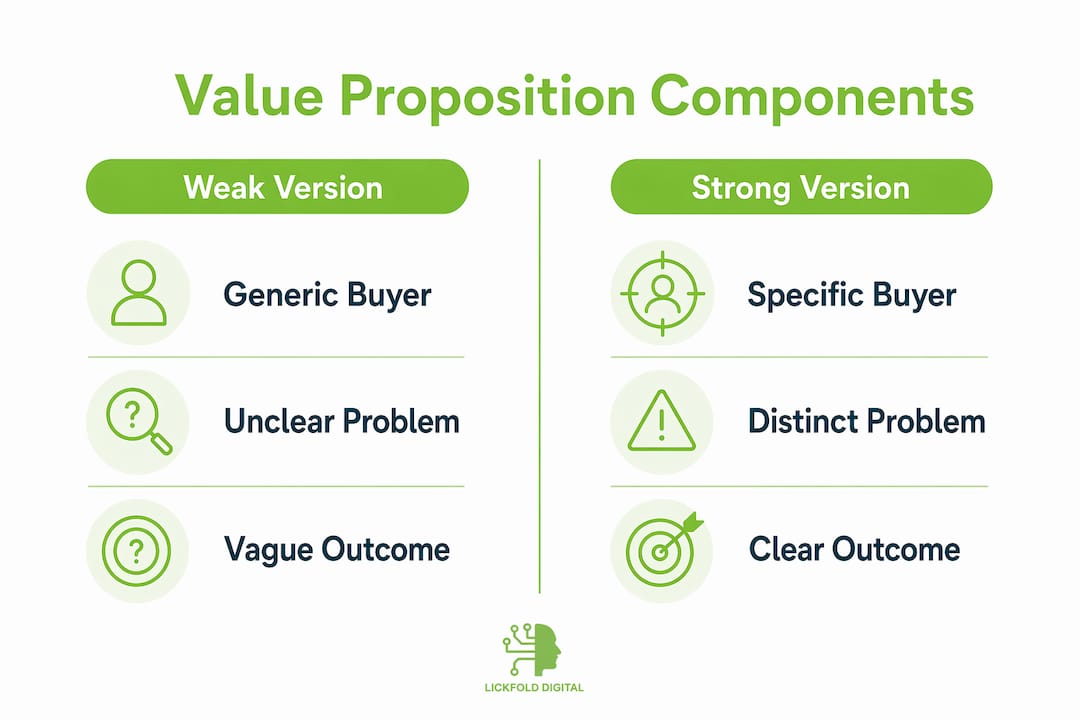
| Component | Weak version | Strong version |
|---|---|---|
| Target buyer | “B2B companies” | “Series B SaaS ops teams with 50–200 employees” |
| Problem | “Inefficient processes” | “Manual reporting costs 12 hours per analyst per week” |
| Transformation | “Better visibility” | “From spreadsheet chaos to a live dashboard in 14 days” |
| Outcome | “Save time” | “Cut reporting time by 60% in the first quarter” |
| Differentiator | “Easy to use” | “Pre-built integrations with your existing stack, no dev work needed” |
Buyers evaluate propositions quickly. A weak version gets ignored. A strong version gets forwarded to the next stakeholder in the buying group.
How does a B2B value proposition reduce risk in complex buying decisions?
Effective B2B propositions function as risk-management tools first and capability showcases second. Buyers in complex purchases are not primarily asking “Can this product do the job?” They are asking “What happens if this goes wrong?” Skipping risk-mapping in your proposition reduces conversion because the buyer never feels safe enough to move forward.
Why risk comes before capability
Addressing buyer risk before showing capabilities replicates the natural decision-making process. A buyer who sees a feature list before their fears are addressed will mentally catalog reasons to delay. A buyer who sees their specific risk named and neutralized will engage with the capability evidence that follows.
The risks buyers weigh most heavily fall into three categories:
- Financial risk. “Will this cost more than projected?”
- Operational risk. “Will this disrupt our current workflows?”
- Political risk. “Will I look bad internally if this fails?”
Your proposition must address at least the most prominent risk for your ICP before it earns the right to list benefits.
“A proposition that leads with capabilities before addressing risk is like a surgeon explaining the procedure before asking the patient what they are afraid of. The order matters as much as the content.”
Buyer groups average 13 stakeholders, and each stakeholder carries a different risk profile. That number matters because a single-message proposition rarely gains consensus across a group that large. The CFO fears budget overrun. The IT lead fears integration failure. The end-user team fears disruption. Your core proposition must translate into stakeholder-specific risk reductions without losing its central claim.
Pro Tip: Map your three most common buyer roles and write one risk-reduction sentence for each. Use these as supporting statements in proposals and sales decks, anchored to your core proposition.
How does a value proposition differ from positioning and taglines?
Value propositions, positioning statements, and taglines serve different functions, and confusing them produces one-size-fits-all messaging that misses buyer-specific needs. Each tool answers a different question.
A value proposition answers: “What specific value do we deliver to this buyer, and how do we deliver it?” It is buyer-facing, specific, and tied to outcomes. It changes based on the segment or use case.
A positioning statement answers: “Why are we the best choice within our competitive category?” It is internally oriented, used to align product, marketing, and sales on where the company sits in the market. It rarely appears word-for-word in buyer communications.
A tagline answers: “What is the one memorable phrase that captures our brand?” Taglines like “Work smarter, not harder” are useful for brand recall but carry zero weight in a complex B2B purchase. No procurement team approved a six-figure contract because of a tagline.
The practical difference shows up in go-to-market execution. Mixing these roles leads to sales teams using brand-level language in buyer conversations, which creates confusion and stalls deals. Marketing professionals who treat these as interchangeable tools produce messaging that sounds polished but converts poorly.
The rule is simple: use your value proposition in every direct buyer interaction, use your positioning to guide internal strategy, and use your tagline only for brand awareness contexts.
How to create a B2B value proposition: a practical framework
Treating value proposition creation as a creative exercise rather than an analytical one causes failure. The process requires buyer data, not internal brainstorming. A proposition built purely from internal assumptions is a hypothesis. It only becomes credible after validation with real buyers.
Step-by-step process
- Conduct outcome discovery interviews. Talk to 8–12 current customers and ask what business result they were trying to achieve before they bought. Do not ask what they like about your product. Ask what changed in their business after using it.
- Score outcomes for frequency and specificity. Interview-derived outcome data should be scored for how often a result appears across interviews and how specifically buyers describe it. Vague outcomes like “better marketing” score low. “Reduced cost per qualified lead by 35%” scores high.
- Draft the proposition using buyer language. Write the proposition in the exact words buyers used in interviews. Avoid internal jargon. If three buyers said “we stopped wasting time on unqualified leads,” use that phrase, not “improved pipeline efficiency.”
- Test with real buyers. Share the draft with five prospects who have not yet bought. Ask them to rate how accurately it describes their situation. Revise based on their reactions, not internal preferences.
- Validate against the five-element checklist. Confirm the final draft includes a specific ICP, a named problem, a transformation, a quantified outcome, and a differentiator. Remove any sentence that does not serve one of these five functions.
- Audit and update regularly. Value propositions should evolve as markets and competitor offerings change. What differentiated your solution 18 months ago may be table stakes today. Schedule a quarterly review.
The table below summarizes each step and its most common failure mode.
| Step | Action | Common pitfall |
|---|---|---|
| Outcome discovery | Interview 8–12 customers | Asking about features instead of business results |
| Score outcomes | Rank by frequency and specificity | Choosing outcomes that sound impressive internally |
| Draft in buyer language | Use exact customer phrasing | Reverting to product or marketing jargon |
| Test with prospects | Gather reactions from 5 non-customers | Skipping this step and going straight to launch |
| Validate structure | Check all five elements are present | Omitting the differentiator or quantified outcome |
| Audit regularly | Review every quarter | Treating the proposition as a one-time deliverable |
Pro Tip: Build your messaging for B2B conversion around the single outcome that scored highest in your interviews. One sharp claim outperforms three vague ones every time.
Buyers care about business outcomes as pre-existing value drivers. Successful propositions translate your offering into those terms rather than listing product features. The buyer does not care how your product works. They care what their business looks like after it works.
A well-validated proposition also reduces friction across the entire decision-maker engagement process. When every stakeholder hears the same core claim translated into their specific risk language, consensus builds faster.
Key Takeaways
A B2B value proposition is only as strong as the buyer evidence behind it: specific outcomes, named risks, and validated language beat internal assumptions every time.
| Point | Details |
|---|---|
| Five elements are non-negotiable | Every proposition needs a target buyer, problem, transformation, outcome, and differentiator. |
| Risk reduction comes first | Address the buyer’s primary fear before presenting capabilities or features. |
| Validate with real buyers | Internal brainstorming produces a hypothesis; buyer interviews produce a credible proposition. |
| Separate from positioning and taglines | Use the value proposition in buyer conversations; keep positioning for internal strategy. |
| Audit every quarter | Markets shift, and a differentiator from 18 months ago may now be standard across your category. |
The mistake I see B2B teams make most often
Most B2B marketing teams treat value proposition work as a writing project. They book a workshop, fill a whiteboard with sticky notes, and produce a polished sentence that everyone internally agrees sounds good. Then it lands flat with buyers.
The problem is not the writing. The problem is the source material. A proposition built from internal assumptions reflects what the team believes buyers care about, not what buyers actually say when they describe their own problems. I have reviewed dozens of propositions that were grammatically clean, structurally sound, and completely disconnected from buyer reality.
The fix is not complicated, but it requires discipline. You need to sit in buyer interviews and listen for the specific language people use to describe their pain. Not “inefficiency” or “lack of visibility.” The actual words: “I spent three hours last Tuesday rebuilding a report my manager deleted.” That specificity is what makes a proposition feel true rather than generic.
The second mistake is treating the proposition as finished. Propositions must evolve as markets change. A differentiator that was genuinely rare two years ago may now appear in every competitor’s homepage. If you are not auditing your proposition against the current market, you are competing with outdated ammunition.
The teams that get this right treat their value proposition as a living document, updated with fresh buyer data every quarter, tested against real prospects, and refined based on what actually moves deals forward.
— Duarte
How Lickfold helps B2B teams put their value proposition to work
A sharp value proposition only creates results when it reaches the right buyers with the right message at the right time. Lickfold builds AI-powered outbound systems that carry your proposition directly to decision-makers who match your ideal customer profile.
Lickfold’s AI agents research your target market, identify the relevant decision-makers, and execute personalized multi-touch outreach campaigns built around your core value claim. Every message is tailored to the recipient’s role and risk profile, not sent from a generic template. The system handles infrastructure, warm-up, reputation management, and human qualification of replies before passing opportunities to your sales team. If you want your value proposition tested against a real market at scale, reach out to Lickfold and start building a pipeline that reflects what your buyers actually care about.
FAQ
What is a B2B value proposition in simple terms?
A B2B value proposition is a clear statement that explains what specific outcome a business buyer gets from your solution, why it matters to them, and why your offering delivers it better than the alternatives.
How is a value proposition different from a positioning statement?
A value proposition tells the buyer what value they receive and how. A positioning statement explains why your company is the best choice within its competitive category and is used primarily to align internal teams.
How many elements does a strong B2B value proposition need?
A strong proposition requires five elements: a specific target buyer, a high-stakes problem, a clear transformation, a quantified outcome, and a credible differentiator. Missing any one element produces a generic statement that fails to move buyers.
How often should a B2B value proposition be updated?
Value propositions should be reviewed and updated at least quarterly. What differentiated your solution 18 months ago may now be standard across your category, making regular audits a competitive necessity.
Why do most B2B value propositions fail?
Most fail because they are built from internal assumptions rather than buyer interviews. A proposition that reflects what your team believes buyers care about, rather than what buyers actually say, will not resonate in real sales conversations.