
What Is a B2B Catalog Strategy? A Practical Guide
What Is a B2B Catalog Strategy? A Practical Guide
TL;DR:
- A B2B catalog strategy manages product data, pricing rules, and buyer-specific visibility to support complex sales. It relies on centralized data governance, real-time ERP integration, and personalized segmentation to improve ordering and customer trust. Without proper management, catalogs often become outdated, confusing, and fail to generate revenue.
A B2B catalog strategy is the deliberate management of product data, pricing rules, and customer-specific visibility to support complex business buying scenarios and improve sales outcomes. Unlike B2C catalogs that show uniform pricing to all visitors, a B2B catalog delivers role-based access, negotiated rates, and contract-specific assortments to each buyer account. The discipline spans Product Information Management (PIM) systems, ERP integration, and structured data governance. Marketing and sales teams that treat catalog management as an operational priority, not a design exercise, close deals faster and generate higher-quality leads.

What is a B2B catalog strategy and why does it matter?
A B2B catalog strategy is defined as the systematic approach to centralizing, personalizing, and managing product data and pricing to meet the requirements of business buyers. The core difference from consumer catalogs is the managed layer of customer-specific rules. Each buyer sees only the products, prices, and availability that match their contract terms and account permissions.
This managed layer does more than organize products. Self-service access to minimum order quantities, bulk pricing, and contract-specific availability shifts routine ordering tasks from sales reps to buyers. That shift accelerates order cycles and frees sales teams to focus on high-value, complex selling scenarios.
Experts describe a B2B catalog strategy as the commercial operations “central nervous system,” requiring structured data governance and clear ownership of every product and pricing update. Without that structure, pricing errors, inventory discrepancies, and buyer confusion multiply quickly. The strategy is the foundation that makes every other sales and marketing effort more effective.
What are the key components of a successful B2B catalog strategy?
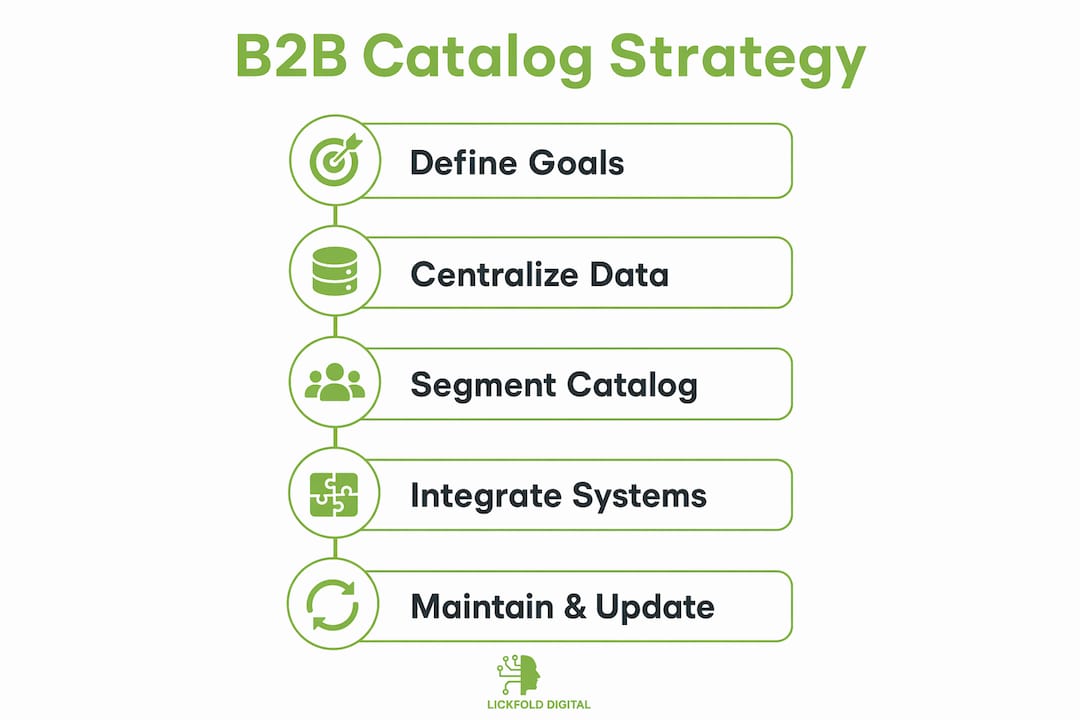
A successful B2B catalog strategy rests on five interconnected components. Each one addresses a specific failure point that undermines catalog performance in practice.
- Centralized product data. A single source of truth for product specs, imagery, and descriptions prevents version conflicts across channels. PIM systems serve this role by consolidating data that would otherwise live in spreadsheets, email threads, and disconnected databases.
- Customer segmentation and role-based visibility. Each buyer account sees only the products and prices relevant to their contract. A distributor in one region should not see pricing negotiated for a different geography or industry segment.
- Contract-specific and volume-tiered pricing rules. B2B pricing is rarely flat. Volume tiers, negotiated rates, and contract expiry dates must be encoded directly into the catalog so buyers always see accurate numbers without calling a sales rep.
- ERP and PIM integration. Real-time synchronization between the catalog and backend systems prevents the most common catalog failure: a buyer ordering a product at a price that no longer applies, or ordering stock that does not exist.
- Governance and approval workflows. Clear accountability for spec and pricing updates is critical before launching a digital catalog. Without assigned ownership, data decays fast.
Pro Tip: Assign a named catalog owner for each product category before go-live. Teams that skip this step spend months correcting errors that a single accountable person would have caught in days.
Moving away from spreadsheets to a unified PIM system as the single source of truth for product specs, pricing, and imagery is the single highest-impact structural decision a B2B team can make. Discipline in data entry and consistent hierarchy design improve search speed and procurement decisions across every buyer segment.
How does personalized catalog segmentation improve buyer experience?
Personalized catalog segmentation reduces buyer confusion and ordering errors by showing only relevant SKUs, prices, and availability per contract. The result is a faster procurement process and fewer support calls from buyers who cannot find what they need.
The most effective segmentation approach maps product structures to buyer evaluation steps, not to internal ERP codes. Catalog structure should reflect customer buying logic so buyers can search, filter, and self-serve without needing to understand how your warehouse organizes inventory. A buyer-centric taxonomy reduces the steps needed to find and order the correct SKU.
Segmentation works across several dimensions:
- Contract terms. Show only products covered under a buyer’s active agreement, with the negotiated price displayed by default.
- Geography. Restrict visibility to products available in the buyer’s region, including local compliance requirements or shipping constraints.
- Industry vertical. Surface product configurations that match the buyer’s use case, reducing irrelevant options that slow decision-making.
- Buyer role. A procurement manager may see full catalog access and pricing, while a department requester sees only pre-approved items within a budget threshold.
Pro Tip: Build your catalog hierarchy around the questions buyers ask during evaluation, not around your internal product codes. If buyers search by application or industry, your top-level categories should reflect that logic.
Personalized catalogs arise not just from technology but from combining ERP integration with a deep understanding of buyer evaluation logic and purchasing steps. The technology enables the segmentation; the buyer understanding determines whether it actually reduces friction. Teams that skip the buyer research phase build technically correct catalogs that buyers still find confusing.
Connecting catalog personalization to broader outreach is where B2B personalization compounds its impact. When the catalog mirrors the messaging a buyer received during prospecting, the entire purchase experience feels coherent.
What technology and tools enable effective B2B catalog management?
The technical infrastructure behind a B2B catalog strategy determines whether the strategy scales or collapses under its own complexity. Three capability layers matter most: data management, pricing logic, and buyer-facing search.
| Capability layer | What it does | Why it matters |
|---|---|---|
| PIM system | Centralizes product specs, images, and descriptions | Eliminates version conflicts across channels and teams |
| ERP integration | Syncs real-time pricing and inventory | Prevents orders at wrong prices or for unavailable stock |
| Pricing rules engine | Manages volume tiers, negotiated rates, and contract expiry | Automates complex pricing without manual intervention |
| Search and navigation | Matches buyer search logic to catalog structure | Reduces time to find correct SKUs and lowers support load |
| Governance workflows | Routes updates through approval before publishing | Maintains data accuracy as products and contracts change |
Automation syncing ERP data with catalogs prevents pricing errors and inventory discrepancies, which are the most common failures in manual update cycles. Manual processes introduce lag between a price change in the ERP and the price a buyer sees in the catalog. That lag creates disputes, erodes trust, and costs sales teams time they should spend selling.
A centralized content publishing platform can also support catalog distribution across channels, ensuring that enriched product data reaches buyers through the right touchpoints. Enterprise content management tools that integrate with PIM systems reduce the manual effort of pushing catalog updates to multiple buyer-facing surfaces.
Wholesalers should treat catalog segmentation as infrastructure, designing hierarchies around procurement validation steps to reduce buyer friction at every stage of the purchasing workflow.
How to create and maintain a B2B catalog strategy that scales
Building a catalog strategy that holds up as your product range and customer base grow requires deliberate process design from the start. The following practices separate catalogs that scale from those that require constant firefighting.
- Establish data governance before launch. Define who owns each data field, who approves changes, and how often data is audited. Governance is not a bureaucratic layer. It is the mechanism that keeps the catalog accurate as products, prices, and contracts change.
- Align catalog hierarchy with buyer purchasing processes. Map your top-level categories to the decisions buyers make, not to your internal product codes. Mapping catalog hierarchies according to buyer evaluation and decision-making processes improves product discovery and reduces friction at every step.
- Implement approval workflows and version control. Every pricing or spec change should pass through a defined review step before going live. Version control lets you roll back errors without disrupting active buyer sessions.
- Enrich product data continuously. Catalog data decays. Specs change, images become outdated, and new compliance requirements emerge. Schedule regular enrichment cycles and assign them to named owners, not to “the team.”
- Measure catalog performance through buyer interaction analytics. Track search queries that return no results, pages with high exit rates, and SKUs that generate support calls. These signals tell you where the catalog is failing buyers before those buyers stop ordering.
A well-maintained catalog also supports long-term client relationships by giving buyers consistent, accurate information every time they return. Buyers who trust the catalog data order more frequently and with less sales rep involvement.
Key Takeaways
A B2B catalog strategy succeeds when it combines centralized data governance, buyer-centric structure, and real-time ERP integration to deliver accurate, contract-specific product information at every touchpoint.
| Point | Details |
|---|---|
| Define the strategy clearly | A B2B catalog strategy manages product data, pricing rules, and buyer-specific visibility as an operational system. |
| Prioritize data governance | Assign named owners for each product category and pricing field before launching any digital catalog. |
| Build for buyer logic | Structure catalog hierarchies around how buyers evaluate and purchase, not around internal ERP codes. |
| Automate ERP and PIM sync | Real-time integration prevents pricing errors and inventory discrepancies that erode buyer trust. |
| Measure and enrich continuously | Track buyer interaction data and run regular enrichment cycles to keep catalog accuracy high over time. |
Why most B2B catalogs fail before they go live
The most common mistake I see is teams spending months on catalog design and almost no time on data governance. They build a visually polished catalog that runs on stale pricing data and misaligned product hierarchies. Buyers find it, get confused, and call a sales rep anyway. The catalog becomes a cost center instead of a revenue driver.
B2B catalog management is not a marketing asset but an operational engine. Buyers value technical accuracy and availability information far more than visual appeal. A catalog that shows the wrong price or hides a product behind an internal SKU code fails the buyer at the exact moment they are ready to order.
The second failure I see consistently is fragmented systems. Teams maintain pricing in one spreadsheet, product specs in another, and inventory in a third. No automation connects them. The result is a catalog that is accurate on launch day and wrong by the end of the first quarter.
The fix is not a bigger budget. It is assigning clear ownership, integrating ERP and PIM systems from day one, and designing the catalog hierarchy around the questions buyers actually ask. Teams that do this work upfront build catalogs that accelerate sales cycles and generate leads that close faster. Teams that skip it spend years patching a system that was broken at the foundation.
— Duarte
How Lickfold helps B2B teams turn catalog clarity into pipeline
A well-structured catalog creates the conditions for outbound sales to work. When buyers can self-serve accurate product and pricing information, sales conversations shift from answering basic questions to closing deals.

Lickfold builds AI-driven outbound systems that identify decision-makers, run personalized multi-touch campaigns, and deliver qualified opportunities directly to your sales team. When your catalog gives buyers the right information and Lickfold’s outreach puts your offer in front of the right people, the pipeline becomes predictable. If you want to see how that combination works for your business, reach out to the Lickfold team and start a conversation about building a more efficient B2B growth system.
FAQ
What is a B2B catalog strategy in simple terms?
A B2B catalog strategy is the system a company uses to manage product data, pricing rules, and buyer-specific visibility so each business customer sees only what applies to their contract and account.
How is a B2B catalog different from a B2C catalog?
B2B catalogs deliver negotiated pricing, role-based product visibility, and contract-specific assortments, while B2C catalogs show uniform pricing and the same product range to every visitor.
What does PIM stand for in B2B catalog management?
PIM stands for Product Information Management. A PIM system serves as the centralized repository for product specs, images, and descriptions, eliminating version conflicts across sales channels and buyer touchpoints.
How often should a B2B catalog be updated?
Catalog data should sync with ERP systems in real time for pricing and inventory, while product specs and imagery should go through a scheduled enrichment review at least quarterly to prevent data decay.
What is the biggest risk in B2B catalog management?
The biggest risk is manual update cycles. When pricing and inventory data are not automatically synced from the ERP, errors accumulate quickly and buyers lose confidence in the catalog’s accuracy.