
What Is Technical Sales in B2B: A 2026 Guide
What Is Technical Sales in B2B: A 2026 Guide
TL;DR:
- Technical sales bridges complex product capabilities with customer needs, increasing win rates in B2B deals. Early involvement of technical experts helps resolve objections and builds buyer confidence before the final approval stage. Integrating technical sellers at the start of the sales process significantly improves outcomes by addressing technical risks upfront.
Technical sales in B2B is the commercial process that translates complex product capabilities into clear business outcomes for buyers who cannot evaluate those products without expert guidance. Unlike standard sales roles, technical sales requires both deep product knowledge and the ability to connect that knowledge to a client’s specific operational challenges. Technical sales bridges product technology and customer needs, reducing purchase risk and improving customer satisfaction in the process. Teams that integrate technical experts earlier in the B2B sales cycle see 25–30% higher win rates in complex deals. That single statistic explains why technical sales has moved from a support function to a core revenue driver.
What is technical sales in B2B and why does it matter?
Technical sales is the specialized commercial function where sellers with deep product or domain expertise guide buyers through evaluating and validating complex solutions. The industry term for this role varies across organizations. You will hear “sales engineer,” “solutions consultant,” “pre-sales specialist,” and “technical account executive” used interchangeably. All of these describe the same core responsibility: making technically complex products commercially accessible.

The importance of technical sales becomes clear when you look at where deals stall. Buyers of enterprise software, industrial equipment, or specialized services face real evaluation risk. They need to know a product will integrate with their existing systems, meet their security requirements, and deliver the outcomes their business needs. Technical sellers address 80–90% of technical objections during the pre-sales phase. That means the majority of deal-killing questions get resolved before a contract ever reaches legal review.
Technical sales also builds buyer confidence in ways that standard sales cannot. A quota-carrying account executive can describe a product’s value proposition. A technical seller can prove it. That proof, delivered through live demonstrations, architecture reviews, and documented integration plans, is what moves cautious buyers from evaluation to commitment.
How does technical sales function within the B2B sales process?
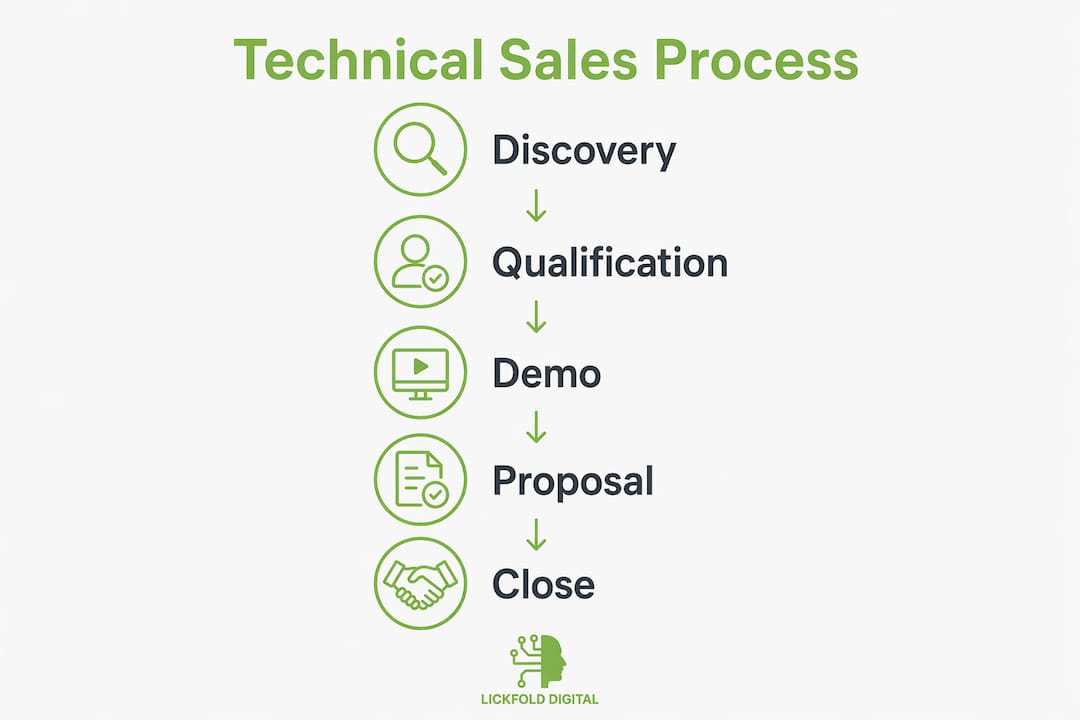
The B2B technical sales process runs parallel to the commercial sales cycle. Account executives own the relationship and the commercial negotiation. Technical sellers own the evaluation. The two roles work together, with the technical seller entering the process once a prospect has shown genuine interest and needs to validate the solution before committing.
Technical sales activities typically include:
- Technical discovery: Asking structured questions to understand the buyer’s existing environment, integration requirements, and success criteria
- Product demonstrations: Running live or recorded demos tailored to the buyer’s specific use case, not a generic feature tour
- Proof of concept (POC): Building a working prototype or sandbox environment that lets the buyer test the product against their real data or workflows
- Objection handling: Addressing integration, security, architecture, and compliance questions that the account executive cannot answer credibly
- Documentation: Producing technical responses to RFPs, security questionnaires, and architecture diagrams
One of the most common failures in the B2B technical sales process is involving technical experts too late or too broadly. A defined “Deal Readiness Gate” clarifies exactly when a technical seller should enter a deal and which questions they are responsible for answering. Without that gate, product and engineering teams end up on every sales call, regardless of deal stage, which wastes their time and dilutes the quality of technical engagement.
Pro Tip: Build a shared question inventory with your account executives. Categorize every common buyer question as either “commercial” or “technical.” Route each category to the right person from the first discovery call. This alone reduces wasted calls and sharpens your technical seller’s focus.
Early involvement also matters for qualifying leads effectively. When technical sellers join discovery calls before a POC is requested, they can identify mismatches in requirements early, saving weeks of evaluation work on deals that were never going to close.
How does technical sales differ from sales engineering and application engineering?
Role confusion is common in B2B sales organizations. The titles overlap, the skills overlap, and the activities overlap. The distinction lies in orientation and timing.
| Role | Primary orientation | Typical entry point | Core responsibility |
|---|---|---|---|
| Technical sales | Commercial outcomes enabled by technical credibility | Early to mid sales cycle | Progressing deals by resolving technical blockers |
| Sales engineering | Technical validation and solution design | Mid to late sales cycle | Proving the product works in the buyer’s environment |
| Application engineering | Post-sale implementation and optimization | Post-contract | Deploying and configuring the product for the customer |
Technical sales professionals focus on moving deals forward. Their job is commercial, even though their toolkit is technical. They ask diagnostic questions, run tailored demos, and handle objections. Their success metric is win rate and pipeline velocity.
Sales engineers go deeper into solution design. They build POCs, write technical specifications, and answer architecture questions. Their success metric is technical validation quality.
Application engineers take over after the contract is signed. They configure, integrate, and train. Their success metric is time to value and customer satisfaction.
The practical implication for B2B decision-makers is this: if your technical sellers are spending most of their time on post-sale implementation, you have a role definition problem. Technical sales talent is most valuable when it is concentrated at the point of evaluation, not deployment.
What are the key technical sales strategies to succeed in complex B2B markets?
The most common failure mode for technical sellers is feature-dumping. They know the product deeply, so they explain it deeply, walking buyers through every capability whether it is relevant or not. Buyers disengage. Deals stall. The technical seller concludes the product needs more features, when the real problem is the conversation.
Successful technical sellers use curiosity over detail. They ask diagnostic questions that connect product capabilities to specific business outcomes. “What does your current integration process look like, and where does it break down?” is more powerful than a 40-slide architecture deck.
The top technical sales strategies that produce results in 2026:
- Outcome-first questioning: Start every discovery with the buyer’s desired business outcome, then work backward to the technical requirements that support it
- Asynchronous validation resources: Buyers increasingly evaluate using self-serve tools like interactive demos, sandbox environments, and security documentation. Build these resources and share them proactively
- Tailored demonstrations: Never run a generic demo. Map every feature you show to a specific challenge the buyer named in discovery
- Documented technical responses: When a buyer asks a complex integration or security question, respond in writing with a structured answer. This builds credibility and creates a reference document the buyer can share internally
- Stakeholder mapping: Complex B2B deals involve multiple technical evaluators. Identify each one and understand their specific concerns. The IT security lead has different questions than the engineering manager
Pro Tip: Before any demo, send the buyer a one-page agenda that maps each section of the demo to a challenge they mentioned in discovery. This signals preparation, keeps the demo focused, and gives the buyer a document to share with colleagues who could not attend.
Technical expertise is the entry ticket, not the differentiator. The behavioral shift from product specialist to trusted advisor is what separates average technical sellers from top performers. Advisors ask better questions. They listen more than they present. They connect features to outcomes the buyer actually cares about.
For teams looking to sharpen their outbound approach alongside technical sales, AI sales strategies can help identify and engage the right technical evaluators before the first conversation even begins.
How does integrating technical sales earlier impact B2B deal success?
Early technical sales involvement is the single highest-leverage change most B2B sales organizations can make. The data is clear: teams that bring in technical experts early see significantly better outcomes across win rate, cycle length, and deal size.
| Integration timing | Typical win rate impact | Common stall point prevented |
|---|---|---|
| Technical seller joins at first discovery call | 25–30% higher win rate | Misaligned requirements identified before POC |
| Technical seller joins at POC request | Moderate improvement | Integration objections surface late |
| Technical seller joins at proposal stage | Minimal improvement | Technical objections block final approval |
| No dedicated technical seller | Baseline | Deals stall at security and architecture review |
The reason early involvement works is simple. Buyers form technical opinions early. If a competitor’s technical seller has already answered the buyer’s architecture questions and run a tailored POC, your account executive walking in with a slide deck at the proposal stage is not going to reverse that impression.
Early involvement also helps identify decision-makers within the buying committee who have technical authority. In complex B2B purchases, the person who signs the contract is rarely the person who validates the technical fit. Finding and engaging the technical evaluator early is what prevents a “yes” from the business sponsor from turning into a “no” from the IT team.
Organizational models that enable early technical sales involvement include dedicated pre-sales teams, “pod” structures where a technical seller is assigned to a set of account executives, and hybrid models where senior technical sellers carry a small commercial quota alongside their evaluation responsibilities.
Key Takeaways
Technical sales in B2B is the commercial function that determines whether complex deals close, and integrating technical experts early in the sales cycle produces the highest measurable impact on win rates.
| Point | Details |
|---|---|
| Define the role clearly | Technical sales focuses on commercial outcomes through technical credibility, not post-sale implementation. |
| Involve technical sellers early | Early integration produces 25–30% higher win rates by resolving objections before they block deals. |
| Use a Deal Readiness Gate | A defined entry point for technical sellers prevents wasted calls and improves engagement quality. |
| Shift from features to outcomes | Diagnostic questioning that links product capabilities to business results outperforms feature-heavy presentations. |
| Build asynchronous resources | Interactive demos, sandbox environments, and documented responses let buyers self-validate and accelerate decisions. |
The uncomfortable truth about technical sales talent
The hardest part of building a strong technical sales function is not the process. It is the people. I have seen organizations hire brilliant engineers into technical sales roles and watch them fail within six months. Not because they lacked product knowledge. Because they could not have a commercial conversation.
The dual demand for technical aptitude and commercial accountability makes technical sales one of the scarcest talent pools in B2B. Most engineers do not want to carry a quota. Most salespeople cannot credibly answer an architecture question. The candidates who can do both command significant compensation, and they know it.
What I have observed is that the best technical sellers are not the deepest technical experts on the team. They are the ones who are genuinely curious about how their buyers’ businesses work. They ask questions that no one else thinks to ask. They translate complexity into clarity without dumbing it down.
The other shift I see accelerating is the move toward asynchronous buyer evaluation. Buyers no longer want to schedule five calls to get their questions answered. They want a sandbox environment they can explore on their own schedule. Technical sellers who build and curate these self-serve resources are multiplying their own effectiveness. One well-built interactive demo can do the work of a dozen live calls.
The organizations winning in technical sales right now are the ones treating it as a strategic commercial function, not a support role. They give their technical sellers commercial accountability, invest in their development as advisors, and build the asynchronous tools that let buyers validate on their own terms.
— Duarte
How Lickfold helps B2B teams reach the right technical buyers
Building a strong technical sales function only pays off when your pipeline contains the right prospects. If your technical sellers are spending time on deals that were never a fit, the best process in the world will not move your win rate.

Lickfold uses AI-driven prospecting to identify decision-makers and technical evaluators within organizations that match your ideal customer profile. The platform executes personalized outreach campaigns, qualifies replies, and delivers warm opportunities directly to your sales team. That means your technical sellers spend their time on deals worth winning, not on cold outreach that belongs earlier in the funnel. If you want a pipeline that your technical sales team can actually close, reach out to Lickfold and see what a focused outbound system looks like in practice.
FAQ
What is technical sales in B2B?
Technical sales in B2B is the commercial process where sellers with deep product or domain expertise help buyers evaluate and validate complex solutions. The role focuses on resolving technical objections and connecting product capabilities to specific business outcomes.
How does technical sales differ from regular sales?
Technical sales requires both product expertise and commercial skill, while regular sales focuses primarily on relationship management and negotiation. Technical sellers run demonstrations, answer architecture questions, and build proofs of concept that standard account executives cannot credibly deliver.
When should a technical seller join the B2B sales process?
Technical sellers produce the most impact when they join at the first discovery call, not at the proposal stage. Early involvement prevents misaligned requirements from advancing and stops technical objections from blocking final approval.
What skills does a successful technical seller need?
The most effective technical sellers combine product knowledge with curiosity-driven questioning that links features to business outcomes. Commercial accountability, the ability to communicate clearly with non-technical buyers, and skill in building self-serve evaluation resources are equally critical.
Why do technical sales win rates improve with earlier involvement?
Teams that integrate technical experts early in the sales cycle see 25–30% higher win rates because buyers form technical opinions early and competitors who engage technical evaluators first gain an advantage that is difficult to reverse later.