
Agency Market Positioning: What It Is and Why It Matters
Agency Market Positioning: What It Is and Why It Matters
TL;DR:
- Agency market positioning defines who your agency serves, what problems it solves, and why clients choose you. It influences pricing, client mix, and growth, requiring operational decisions and clear messaging to succeed. Regular audits help agencies refine their position and attract higher-quality clients with better margins.
Agency market positioning is the strategic decision that defines exactly who your agency serves, which problems it solves, and why clients choose you over every other option. This is not a tagline or a color palette. Positioning is the foundational business choice that shapes your pricing, your client mix, your sales conversations, and your long-term growth. Branding is how your agency looks and feels; positioning is the strategic layer underneath that drives all of it. Agencies that confuse the two often invest in polished websites while struggling to attract clients worth keeping.
What is agency market positioning, and why does it matter?
Agency market positioning is defined as the deliberate choice of where your agency stands in the market relative to client needs, competitor offerings, and the specific problems you are built to solve. The industry term for this concept is strategic positioning, and it predates modern marketing by decades. What makes it urgent for agencies right now is the speed at which automation is eliminating the value of generalist work.

Weak positioning masked by good branding consistently fails to generate growth or high-quality leads. That pattern repeats across agency categories because branding creates perception while positioning creates preference. Preference is what closes deals.
Positioning also determines your pricing ceiling. Agencies with no clear position compete on price by default. Agencies with sharp positioning compete on outcomes, expertise, and fit. That distinction separates a 10% margin business from a 60% margin business.
What are the main positioning lanes agencies can choose?
Four viable positioning lanes exist for agencies in 2026, and each carries a different margin profile and competitive risk level.
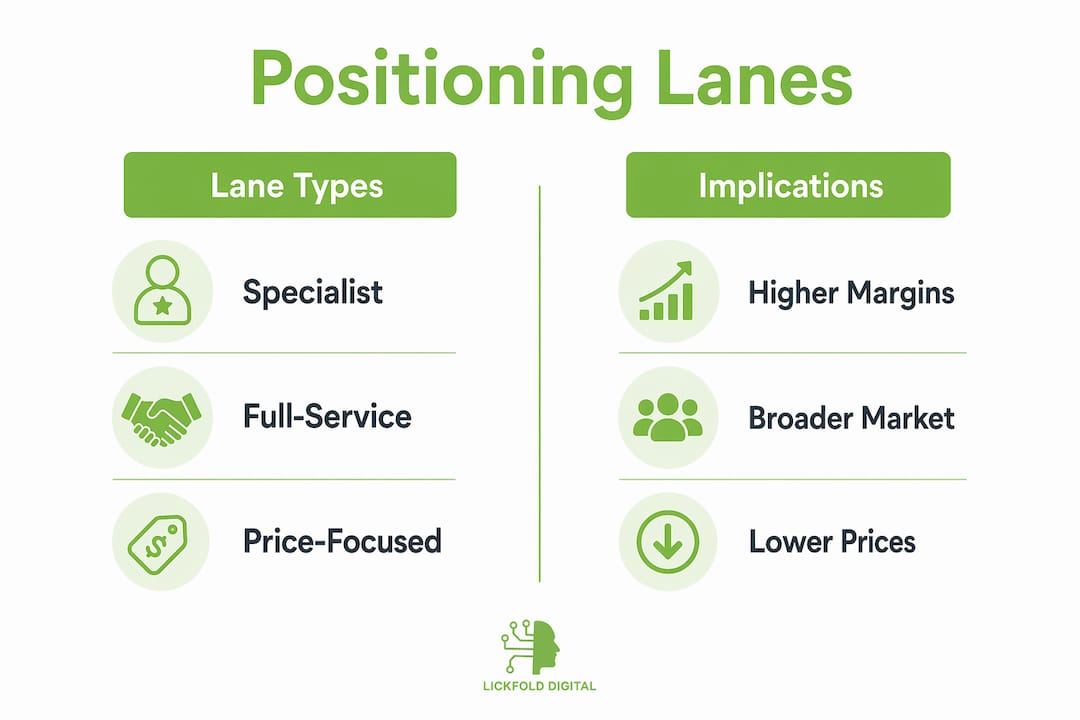
Niche Specialist agencies focus on a specific industry vertical, such as healthcare SaaS or e-commerce logistics. They command premium fees because their knowledge is not transferable to a generalist. AI Implementation Shops build and deploy AI workflows for specific business functions, a lane with high demand and limited supply of credible practitioners. Premium Strategy agencies sell thinking, not execution, and charge accordingly. Accountable Outcomes agencies tie their fees to measurable client results, which requires confidence in delivery and strong client selection.
The lane most agencies default to is the Commodity Generalist. Commodity generalists carry margins of 5–12% and face direct replacement by automation tools. Specialized lanes, by contrast, can reach margins up to 70%. That gap is not a rounding error. It reflects the fundamental difference between selling time and selling expertise.
- Niche Specialist: High credibility, faster sales cycles, strong referral networks within the vertical
- AI Implementation Shop: High demand, growing fast, requires genuine technical depth
- Premium Strategy: Smallest client volume, highest fees, requires a track record of measurable outcomes
- Accountable Outcomes: Attracts growth-focused clients, demands rigorous scoping and delivery discipline
- Commodity Generalist: Low barriers to entry, low margins, high vulnerability to price competition and automation
Pro Tip: Pick your lane based on where you have already won, not where you wish you could win. Your project history is more honest than your ambitions.
How do agencies identify their optimal positioning?
The most reliable method is an audit of your last 15–20 projects. Auditing recent projects reveals real positioning signals based on client type, problems solved, and margin contribution. This approach produces evidence-backed positioning rather than aspirational choices that collapse under pressure.
Run the audit in four steps:
- List every project from the past 18 months. Include client industry, project scope, fee, margin, and your honest assessment of the outcome quality.
- Identify the patterns. Which client types generated the highest margins? Which problems did you solve repeatedly and well? Where did referrals come from?
- Define the problem, not the deliverable. Agencies get hired to fix a $40,000-per-month churn conversion bottleneck, not to build a React app. Clients pay for outcomes, not outputs. Reframe every past project in terms of the business problem it solved.
- Name the buyer, not the market. Targeting a VP of Product at a Series B SaaS company is more powerful than targeting “the SaaS industry.” Buyers make decisions, not categories. Precise buyer targeting sharpens your messaging and improves conversion at every stage of the sales process.
The biggest obstacle agencies face during this process is fear. Fear of losing existing clients who fall outside the new positioning. Fear of narrowing too far and missing revenue. Both fears are real and both are manageable. Segmenting clients into tiers during repositioning allows you to focus on ideal clients while phasing out others gradually. You protect core revenue while shifting your agency’s identity.
Pro Tip: Test your positioning with outbound messaging before you rewrite your website. If a cold email to your target buyer generates replies, your positioning is working. If it generates silence, adjust before committing.
Why does clear positioning help agencies charge more and close faster?
Sharp positioning produces three concrete business outcomes: higher fees, faster sales cycles, and better referrals. Each outcome compounds the others.
Specialized agencies report charging roughly 30% higher fees compared to generalists serving the same client type. That premium exists because specialists carry less perceived risk. A client hiring a generalist is gambling. A client hiring a specialist is buying certainty.
Positioning also changes who shows up to your sales calls. When your website, outreach, and referral network all communicate a specific focus, prospects self-qualify before they contact you. You spend less time on discovery calls with the wrong clients and more time closing deals with the right ones. That shift alone can double your close rate without changing your sales process.
“Being indistinguishable from many generalists is the greatest growth risk for agencies in 2026.” The agencies that grow fastest are the ones prospects can describe in one sentence to a colleague.
Referral quality also improves with clear positioning. A satisfied client who understands exactly what you do will refer you to the right people. A satisfied client who sees you as a generalist will refer you to anyone, which wastes your time and dilutes your brand.
Talent attraction follows the same logic. Specialists want to work with other specialists. A clearly positioned agency attracts team members who are motivated by depth, not breadth. That internal alignment reduces turnover and raises delivery quality.
How does positioning translate into operations and marketing?
Positioning is not a marketing decision. Effective positioning is operational, involving decisions on which clients to accept or refuse and how to scope projects. Messaging follows those decisions. If your operations contradict your positioning, your messaging is fiction.
The table below shows how positioning decisions flow into specific operational and marketing choices:
| Positioning decision | Operational implication | Marketing implication |
|---|---|---|
| Serve Series B SaaS companies only | Decline e-commerce and enterprise clients | Website copy targets SaaS growth challenges |
| Solve conversion rate problems | Scope projects around funnel metrics, not design deliverables | Case studies lead with revenue impact, not aesthetics |
| Charge premium fees | Require minimum engagement sizes | Outreach targets buyers with budget authority |
| Focus on one industry vertical | Build vertical-specific delivery frameworks | Content addresses industry-specific pain points |
Your website copy, pitch narrative, and service design must all reflect the same positioning. When they do not align, prospects sense the inconsistency and disengage. When they do align, the sales process feels effortless because the prospect already believes you before the first call.
Positioning also requires ongoing refinement. Markets shift, buyer priorities change, and your agency’s capabilities evolve. The most successful agencies treat positioning as a living decision, not a one-time exercise. Revisit your positioning audit annually and adjust based on where you are winning and where you are losing.
Pro Tip: Align your agency business development workflow with your positioning before you scale outreach. Outreach built on unclear positioning generates volume without quality.
Key takeaways
Agency market positioning is the single most consequential strategic decision an agency makes, because it determines pricing power, client quality, and long-term growth trajectory.
| Point | Details |
|---|---|
| Positioning is not branding | Branding shapes perception; positioning shapes which clients choose you and why. |
| Four viable lanes exist | Niche Specialist, AI Implementation Shop, Premium Strategy, and Accountable Outcomes each offer margins up to 70%. |
| Audit your history first | Analyzing your last 15–20 projects reveals evidence-backed positioning, not wishful thinking. |
| Specialists charge more | Clearly positioned agencies command roughly 30% higher fees than generalists in the same market. |
| Operations must match messaging | If your client acceptance decisions contradict your positioning, your marketing will not convert. |
The positioning mistake I see agencies repeat most
Most agency owners I work with treat positioning as a messaging problem. They rewrite their tagline, refresh their website, and wonder why nothing changes. The real problem is almost always upstream. They have not made the hard operational decisions that positioning requires.
Positioning demands courage. Saying no to a client who falls outside your focus feels like leaving money on the table. It is not. Every off-target client you accept dilutes your positioning, consumes delivery capacity, and sends the wrong signal to your market. The agencies that grow fastest are the ones willing to be specific about who they are not for.
The most powerful positioning I have seen comes from agencies that looked honestly at their own project history and found a pattern they had not noticed before. They were already specialists. They just had not committed to it publicly. Making that commitment changed everything: their pricing, their referrals, their team’s sense of purpose, and their ability to attract ideal clients without chasing them.
Positioning is not a marketing exercise. It is a business identity decision. Make it deliberately, back it with operational commitments, and revisit it every year.
— Duarte
How Lickfold supports agencies building their market position
Positioning without outreach is a strategy that stays on paper. Lickfold helps agencies put their positioning to work by building AI-driven outbound systems that reach the exact decision-makers their positioning targets.

Once your positioning is clear, Lickfold’s platform identifies buyers who match your ideal client profile, builds personalized outreach sequences, and delivers qualified conversations to your sales team. The system handles prospecting at scale so your team focuses on closing, not searching. If you are ready to turn your positioning into a predictable pipeline, reach out to Lickfold to see how the system works for your agency.
FAQ
What is agency market positioning in simple terms?
Agency market positioning is the strategic decision that defines who your agency serves, what problem it solves, and why clients choose it over alternatives. It is the foundation beneath your branding and messaging.
How is positioning different from branding?
Branding is how your agency looks, sounds, and feels to the outside world. Positioning is the underlying strategic decision that determines which clients you serve and what value you deliver to them.
How do I know if my agency’s positioning is too broad?
If prospects cannot describe what your agency does in one sentence, or if you regularly compete on price, your positioning is too broad. Being indistinguishable from generalists is the clearest signal that repositioning is needed.
Can a small agency afford to narrow its positioning?
Yes. Narrow positioning reduces wasted sales effort and attracts higher-quality clients faster. Segmenting existing clients into tiers during repositioning protects revenue while the agency shifts its focus.
How often should an agency revisit its positioning?
Agencies should audit their positioning at least once a year. Market conditions, buyer priorities, and agency capabilities all change, and positioning that worked in one year may underperform in the next.