
Agency Business Development Role: 2026 B2B Guide
Agency Business Development Role: 2026 B2B Guide
TL;DR:
- An agency business development role focuses on creating systems, relationships, and pipelines to drive sustainable client growth. It involves strategic planning, prospecting, nurturing leads, and collaborating across teams to build repeatable growth processes. Effective BD management leads to predictable revenue and higher agency valuation over time.
An agency business development (BD) role is defined as the function responsible for driving sustainable agency growth through client acquisition, pipeline management, and partnership building. This is not a sales role with a different title. BD professionals create the systems, relationships, and market positioning that make sales possible in the first place. The role spans strategic planning, outbound prospecting, inbound lead nurturing, and cross-functional collaboration with sales, marketing, and delivery teams. If your agency struggles with unpredictable revenue or a feast-or-famine client cycle, the absence of a dedicated BD function is almost certainly the cause.
What is an agency business development role, exactly?
An agency business development role sits at the intersection of strategy and execution. The person in this role does not simply close deals. They build the conditions under which deals become possible, repeatable, and predictable. The agency business development definition covers three core activities: identifying growth opportunities, creating systems to pursue them, and managing the relationships that convert prospects into long-term clients.

BD professionals work across multiple growth channels simultaneously. They manage outbound prospecting campaigns, cultivate referral networks, develop partnership agreements, and support content and thought leadership efforts that generate inbound interest. The role requires both the patience to build relationships over months and the discipline to track every touchpoint in a CRM like HubSpot or Salesforce.
What makes this role distinct is its systemic focus. A BD professional is not chasing individual deals. They are building a repeatable motion that the agency can run quarter after quarter. That distinction matters enormously when you are trying to forecast revenue or plan hiring.
What are the primary responsibilities in an agency business development role?
The day-to-day responsibilities of business development in agencies are broader than most people expect. Here is what a high-performing BD professional manages on a weekly basis:
- Pipeline management: Maintaining a structured prospect pipeline with defined stages, qualification criteria, and exit conditions for each stage. Healthy agencies maintain pipeline coverage of 3x to 5x their quarterly revenue target. That ratio requires constant attention to keep the top of the funnel full.
- Outreach strategy execution: Running outbound campaigns via email, LinkedIn, and events while also managing inbound leads from content and referrals. Each channel requires a different cadence and message.
- Relationship building: Nurturing prospects over weeks or months, not just responding to RFPs. New logo acquisition and account expansion both depend on trust built before a contract is ever discussed.
- Cross-functional collaboration: Working with marketing to align messaging, with sales to hand off qualified opportunities cleanly, and with delivery to understand what the agency can realistically promise.
- Pipeline reviews and forecasting: Running weekly pipeline reviews with specific action items and accountable owners to prevent stale data and improve revenue predictability.
- Ideal client profiling: Continuously refining who the agency should and should not pursue, based on delivery capacity, margin, and strategic fit.
Pro Tip: Block a minimum of two hours every morning for BD activities before client work begins. BD tasks are easy to defer and nearly impossible to recover once a week slips by.
The responsibilities of business development in agencies also include protecting the agency from bad-fit clients. Taking on work that does not fit the agency’s strengths creates delivery strain and damages reputation. A BD professional who qualifies ruthlessly protects the entire organization.
How does agency business development differ from sales and marketing?
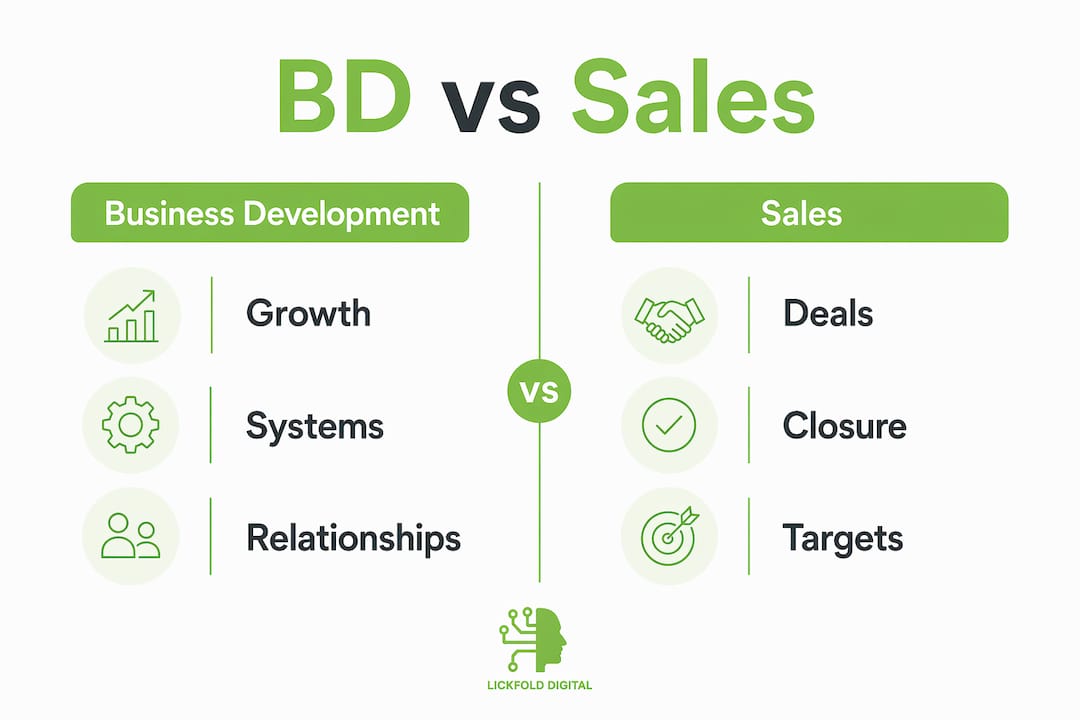
This is the question that causes the most confusion in agencies, and the answer has real operational consequences. BD builds repeatable processes that enable sales, while sales focuses on closing existing deals. Marketing drives awareness and generates inbound leads. These are three distinct functions that work in sequence, not in parallel.
The table below shows where each function begins and ends in a typical agency context:
| Function | Primary Focus | Key Activities | Success Metric |
|---|---|---|---|
| Business Development | Growth opportunity creation | Prospecting, partnerships, account expansion, thought leadership | Pipeline volume and quality |
| Sales | Deal closing | Proposals, negotiations, contract finalization | Win rate and revenue closed |
| Marketing | Awareness and inbound demand | Content, SEO, events, paid media | Lead volume and brand reach |
A BD professional might spend three months building a relationship with a target account before a single proposal is written. Once the prospect is qualified and ready to engage, the BD professional hands off to a sales lead or agency principal to close. Marketing supports this entire process by ensuring the agency has visible credibility in the market before the first conversation happens.
The overlap between BD and sales is where most agencies create confusion. When one person handles both functions, prospecting suffers because closing urgent deals always takes priority. Separating the roles, even partially, produces better outcomes in both areas.
What skills and qualities are essential for agency BD success?
The skills required for an agency business development role are a specific combination that few professionals naturally possess in full. The good news is that most of them are learnable with deliberate practice.
- Communication and relationship building: BD professionals spend most of their time in conversations, written and verbal. The ability to listen carefully, ask the right questions, and follow up without being pushy is the foundation of the role.
- Strategic thinking: BD is not a reactive function. It requires setting quarterly targets, mapping market segments, and making resource allocation decisions based on data, not intuition.
- CRM proficiency: Tools like HubSpot, Pipedrive, or Salesforce are not optional. A BD professional who does not live in their CRM will lose track of prospects, miss follow-ups, and produce unreliable forecasts.
- Ruthless qualification: Defining the ideal client profile prevents wasted time and reduces delivery challenges. The ability to say no to a prospect who does not fit is one of the most valuable skills in the role.
- Disciplined time management: BD work is easy to crowd out. Protecting dedicated time for prospecting and relationship building requires personal discipline and organizational support.
- Collaboration mindset: BD professionals who operate in silos fail. The role requires constant coordination with marketing, sales, and delivery to function correctly.
Pro Tip: Build a one-page ideal client profile and review it monthly. Markets shift, agency capacity changes, and the clients you should be targeting in Q1 may not be the right targets in Q3.
The importance of agency business development becomes clearest when you look at agencies that lack these skills at the BD level. Inconsistent prospecting, poor qualification, and weak pipeline data are the direct causes of the revenue volatility that plagues most small and mid-sized agencies.
How do agencies structure an effective business development system?
An agency new business development system is a structured, repeatable process that moves prospects from first contact to signed contract through defined stages. Without this structure, BD activity is just activity. With it, BD activity becomes a growth engine.
A well-designed pipeline typically runs through six or seven stages:
- Intake: A prospect enters the pipeline through outbound outreach, a referral, an inbound inquiry, or a partnership introduction.
- Qualification: The BD professional applies the ideal client profile criteria. Prospects who do not meet the threshold are removed immediately.
- Discovery: A structured conversation to understand the prospect’s goals, budget, timeline, and decision-making process.
- Proposal: A tailored proposal is developed based on discovery findings. Generic proposals at this stage signal a weak BD process.
- Negotiation: Terms, scope, and pricing are refined. The BD professional stays involved to protect the agency’s position.
- Close: Contract is signed and the account is handed to delivery. A documented handoff system between BD and delivery prevents information loss and protects client commitments.
- Expansion: Closed clients become targets for account growth, referrals, and case study development.
Each stage must have explicit exit criteria. A prospect does not move to Discovery simply because a call was scheduled. They move when specific qualification conditions are confirmed. Documented stage definitions reduce forecast error by 30–50%, which is the difference between planning confidently and guessing.
The most common structural failures in agency BD systems are the founder bottleneck and stale CRM data. When the agency founder is the only person who can advance a deal, the system collapses whenever the founder is busy. And when CRM records are not updated after every interaction, pipeline reviews become fiction exercises rather than planning tools.
Agencies with structured pipeline management grow revenue by 20–35% annually, compared to 5–15% for those without discipline. That gap compounds over time. An agency that builds its BD system in year one will be dramatically larger by year three than one that relies on founder relationships and word of mouth.
Building this system takes time. A high-performing new business system takes 3–6 months to implement, with full compounding effects appearing over 12–24 months. Agencies that expect immediate results abandon their systems before they work. Setting realistic expectations at the outset is itself a BD leadership responsibility.
What are the career paths for agency BD professionals?
The career trajectory in agency business development is well-defined once you understand how agencies scale. Entry-level BD professionals typically start as BD coordinators or representatives, handling research, CRM management, outreach sequencing, and meeting scheduling. These roles build the operational habits that separate strong BD professionals from weak ones.
From there, the path moves toward BD manager or lead roles, where the professional owns a portion of the pipeline and begins making strategic decisions about target segments and outreach channels. At the director or head of growth level, the role shifts toward system design, team management, and board-level reporting on pipeline health and revenue forecasts.
A few dynamics shape this progression:
- Agency size matters: In agencies under 20 people, BD professionals often wear multiple hats, covering sales and some marketing functions. In agencies above 50 people, the roles separate and specialize.
- Founder involvement decreases: Founders in small agencies should protect at least 6 hours weekly for dedicated BD until a dedicated BD lead is appointed. As the BD function matures, the founder’s direct involvement in prospecting should decrease.
- BD impacts agency valuation: Agencies with documented, repeatable BD systems command higher multiples in acquisitions because buyers can see a growth engine that does not depend on one person’s relationships.
For professionals looking to build a predictable client growth track record, the BD career path offers both strategic depth and measurable impact. Every quarter, your pipeline data tells a clear story about what you built and what it produced.
Key takeaways
An agency business development role is the function that converts strategic intent into predictable revenue by building systems, qualifying prospects, and managing pipelines with discipline.
| Point | Details |
|---|---|
| BD is not sales | BD creates growth conditions and repeatable systems; sales closes the deals BD enables. |
| Pipeline structure drives growth | Agencies with structured pipelines grow revenue 20–35% annually versus 5–15% without discipline. |
| Qualification protects the agency | Ruthless ideal client profiling prevents bad-fit clients that drain delivery capacity and damage reputation. |
| Systems take time to compound | Expect 3–6 months to build a BD system and 12–24 months to see its full revenue impact. |
| Career growth is measurable | BD professionals advance by owning larger pipeline segments, then designing and leading the full growth function. |
The uncomfortable truth about agency business development
Most agencies treat business development as a task they do when they are scared, not a system they run when they are confident. I have seen this pattern repeat across dozens of agencies. When revenue is strong, BD gets deprioritized. When a major client churns, everyone panics and starts spraying outreach with no strategy behind it.
The agencies that grow consistently do the opposite. They run pipeline reviews when the pipeline is healthy. They qualify prospects out when they have capacity to take on work. They invest in BD infrastructure before they need it. That discipline feels counterintuitive when you are busy, but it is the only thing that breaks the feast-or-famine cycle permanently.
The other blind spot I see constantly is confusing activity with progress. Sending 200 cold emails a week is not business development. Business development is knowing exactly which 20 companies you want to work with, understanding their business well enough to have a real conversation, and building a relationship over time that makes the eventual proposal feel like a natural next step. Volume without targeting is just noise. The agencies that master this distinction are the ones that build genuine market authority, not just a full calendar.
— Duarte
How Lickfold helps agencies build a BD system that performs
Building a high-performing agency BD system requires more than a CRM and good intentions. It requires a disciplined outbound engine that runs continuously, targets the right decision-makers, and converts conversations into qualified opportunities.

Lickfold deploys AI-driven prospecting and outbound automation specifically built for B2B agencies that want predictable pipeline growth without hiring a large outbound team. The platform identifies decision-makers within your ideal client profile, executes personalized multi-touch outreach campaigns, and passes only human-qualified replies to your BD or sales team. If you are ready to build a scalable outbound system that compounds over time, Lickfold is built for exactly that outcome.
FAQ
What is the agency business development definition?
An agency business development role is the function responsible for creating and managing the systems, relationships, and pipelines that drive sustainable client acquisition and revenue growth. It is distinct from sales, which focuses on closing deals that BD has already qualified.
How many hours per week should BD get?
Founders in small agencies should protect at least 6 hours weekly for dedicated BD activities. Dedicated BD professionals typically spend 60–70% of their time on prospecting, pipeline management, and relationship building.
What is a healthy pipeline coverage ratio for agencies?
Healthy agencies maintain pipeline coverage of 3x to 5x their quarterly revenue target. That ratio gives the agency enough opportunities in play to hit targets even when some deals slip or stall.
How long does it take to build an agency new business development system?
A high-performing new business system takes 3–6 months to implement, with full compounding effects appearing over 12–24 months. Agencies that expect results in the first 90 days typically abandon their systems before they mature.
What is the difference between BD and sales in an agency?
BD builds repeatable processes and qualifies opportunities. Sales closes the deals BD delivers. When one person handles both, prospecting suffers because closing urgent deals always takes priority over building future pipeline.