
Agency Business Development Workflow: Your 2026 Guide
Agency Business Development Workflow: Your 2026 Guide
TL;DR:
- An agency business development workflow is a six-stage standardized process moving prospects from first contact to contract with clear ownership and timing. Implementing this structured process increases revenue growth and pipeline predictability compared to disorganized methods.
An agency business development workflow is a standardized, six-stage process that moves prospects from first contact to signed contract with defined ownership, timing, and exit criteria at every step. Without this structure, agencies lose deals at handoff, misqualify leads, and grow revenue unpredictably. Agencies with disciplined pipelines grow revenue 20–35% annually, while those without structured workflows grow just 5–15% with significant volatility. That gap is not a talent problem. It is a process problem. The business development process covered here reflects 2026 best practices for B2B marketing and sales professionals who need pipeline efficiency, not guesswork.
What are the six stages of an agency business development workflow?
Experts recommend a standardized six-stage BD workflow running from Intake to Close. Each stage has a defined time window, a clear owner, and an exit criterion that gates the deal forward. Without those three elements, deals stall, accountability disappears, and pipeline data becomes meaningless.
| Stage | Target Time | Owner | Exit Criterion |
|---|---|---|---|
| Intake | Under 24 hours | BD coordinator | Lead logged and acknowledged |
| Qualification | Under 3 days | BD lead | Fit score assigned |
| Discovery | 1–2 weeks | Account lead | Problem, budget, and decision process confirmed |
| Pitch/Proposal | 1 week | Account lead + strategist | Priced scope delivered |
| Negotiation | 1–2 weeks | BD lead | Commercial terms agreed |
| Close | 1 week | BD lead + legal | Contract signed |
Stage 1: Intake. Every inbound lead gets logged in your CRM and acknowledged within 24 hours. Speed signals professionalism and prevents cold leads from going cold faster.
Stage 2: Qualification. A fit scoring rubric assesses budget range, decision-making authority, timeline, and strategic alignment. Deals that fail the rubric get disqualified early, protecting your team’s time.
Stage 3: Discovery. This is the most underinvested stage. The account lead runs structured conversations to confirm the client’s core problem, available budget, and who controls the final decision. Skipping this stage produces proposals that miss the mark entirely.
Stage 4: Pitch and Proposal. The proposal is a priced scope, not a capabilities deck. It reflects exactly what was learned in Discovery. Proposals disconnected from Discovery conversations lose at a much higher rate.
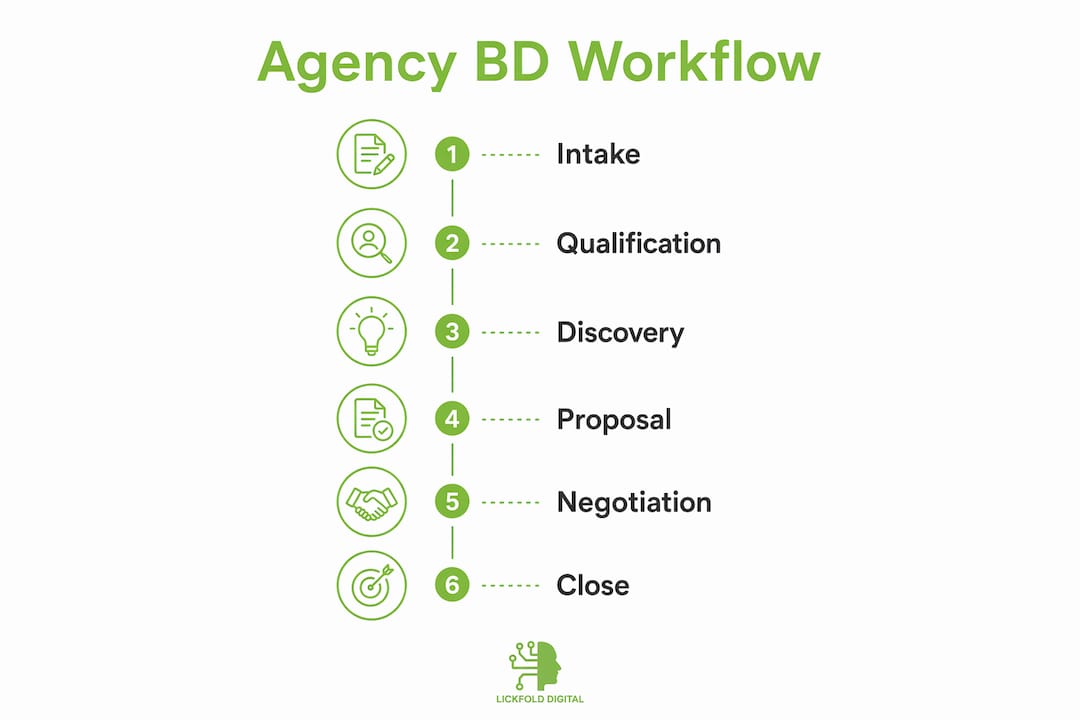
Stage 5: Negotiation. Commercial terms get agreed here. This stage requires a clear owner who has authority to make concessions without escalating every decision.
Stage 6: Close. Contract signed, kickoff scheduled. The deal does not count as closed until both conditions are met.
Pro Tip: Set a maximum stage age for each phase. Any deal sitting in Discovery for more than 14 days without a scheduled next action should trigger a review, not a follow-up email.
How can agencies optimize lead intake and qualification?
Pipeline quality starts at intake. A lead that enters your workflow without proper qualification wastes Discovery time, Proposal effort, and Negotiation capital. The fix is a scoring rubric applied consistently at Stage 2, not after a two-hour discovery call.

Effective qualification frameworks assess four dimensions: budget fit, authority level, timeline urgency, and strategic alignment with your agency’s core offer. Leads that score below threshold get a polite, fast exit. Leads that score above threshold move forward with a scheduled Discovery call within 48 hours.
Most agency deals require 4–5 touches across multiple channels before a prospect agrees to a Discovery conversation. That means single-touch outreach fails by design. A weekly outreach rhythm, covering email, LinkedIn, and phone where appropriate, is the minimum standard for moving qualified prospects forward.
Automation handles the scheduling and sequencing. Human judgment handles the scoring. AI qualification methods can flag high-fit accounts from your CRM data before a human ever touches the record. That combination cuts qualification time without sacrificing accuracy.
Key practices for intake and qualification:
- Log every lead in your CRM within 24 hours of first contact, no exceptions.
- Apply a written scoring rubric before any Discovery call is scheduled.
- Use multi-touch outreach sequences across at least two channels.
- Run weekly pipeline hygiene reviews to remove stalled or disqualified leads.
- Assign a single owner to each lead from Intake through Qualification.
Pro Tip: Build your qualification rubric directly from your last 20 closed-won deals. The patterns in budget, industry, and decision-making structure will tell you exactly what a high-fit lead looks like for your agency.
For a detailed breakdown of lead qualification frameworks built specifically for B2B sales teams, Lickfold’s resource library covers the full process.
Which tools and metrics drive measurement in the BD workflow?
Measurement is where most agencies fail after building a good process. They track activity, not outcomes. Activity metrics like calls made and emails sent tell you what your team did. Outcome metrics tell you whether the process is working.
The core metrics for an agency BD workflow are:
- Pipeline velocity: How fast deals move from Intake to Close on average.
- Stage conversion rate: The percentage of deals that exit each stage successfully.
- Loss reasons by stage: Where deals die and why, tracked consistently.
- ROAS (Return on Ad Spend): For agencies running paid media, this is the client retention metric that matters most in QBRs.
- Deal aging: How long deals sit in each stage before moving or dying.
Top agencies in 2026 report ROAS figures 30–60% higher than baseline by consolidating delivery stacks and automating reporting. Presenting improved ROAS in quarterly business reviews increases client retention by 15–20%. That retention improvement directly reduces the pressure on new business acquisition.
Unified data layers and automated reporting are now standard for growth-stage agencies. Centralizing your reporting stack reduces analyst hours and gives BD leads real-time visibility into pipeline health. Tools like HubSpot, Salesforce, and purpose-built agency CRMs all support stage-level tracking when configured correctly.
Structured weekly pipeline reviews covering stage-by-stage status, lost and stalled deal analysis, and capacity alignment are the operational habit that turns metrics into decisions. Without a weekly review cadence, metrics become a reporting exercise rather than a management tool.
Pro Tip: Track loss reasons in a shared document, not just your CRM dropdown. The qualitative context behind a lost deal reveals patterns that dropdown fields never capture.
What common mistakes occur in agency BD workflows and how do you avoid them?
Most workflow failures are not random. They cluster around four predictable failure points that agencies repeat across growth stages.
-
Skipping the handoff document. The handoff between sales and delivery is the most common failure point causing client churn. A formal handoff document captures discovery insights, agreed goals, success metrics, and communication preferences. Without it, delivery teams start from scratch and clients feel the gap immediately.
-
Relying on single-touch outreach. One email does not move a qualified prospect. Multi-channel, multi-touch engagement over several weeks is the standard. Agencies that schedule outreach in weekly rhythms convert at higher rates than those running ad hoc campaigns.
-
Ignoring stage velocity. Deals that sit in one stage too long are usually dead. Pipeline velocity metrics and stage aging tracking give BD leads the signal they need to act before a deal goes cold.
-
Over-indexing on new acquisition. Winning new clients while losing existing ones is a treadmill. Account management and expansion revenue belong inside the BD workflow, not outside it.
“BD professionals develop access, credibility, and strategic relationships before sales conversations begin.” — BD Pros
The fix for all four mistakes is the same: a written process with named owners, defined timing, and a weekly review that holds the team accountable to both.
Pro Tip: Run a joint kickoff meeting within five business days of contract signing. It resets client expectations, introduces the delivery team, and dramatically reduces early churn.
Key Takeaways
A disciplined agency business development workflow, built on six defined stages with named owners and weekly reviews, is the single most reliable driver of predictable revenue growth for B2B agencies.
| Point | Details |
|---|---|
| Six-stage structure | Define Intake, Qualification, Discovery, Proposal, Negotiation, and Close with time limits and exit criteria. |
| Qualification rubric | Score every lead on budget, authority, timeline, and fit before scheduling a Discovery call. |
| Multi-touch outreach | Most deals require 4–5 touches across multiple channels; single-touch outreach fails by design. |
| Handoff discipline | A formal handoff document at the sales-to-delivery transition prevents client churn and delivery gaps. |
| Weekly pipeline reviews | Stage velocity tracking and loss reason analysis turn pipeline data into revenue decisions. |
What I’ve learned about BD workflows that most guides won’t tell you
The six-stage framework is correct. But the reason most agencies still struggle after implementing it is not the framework. It is the upstream conditions that make the framework work.
Business development is relationship-first, not sales-first. The agencies I have seen grow fastest are not the ones with the most aggressive outreach. They are the ones that built access, credibility, and trust before they ever needed a sale. By the time a prospect enters Stage 1, the best BD teams have already done months of positioning work that makes qualification almost automatic.
The second thing most guides skip is productizing services. When your offer is a custom engagement every time, your BD workflow carries the full weight of scoping, pricing, and justifying value on every deal. When your offer is a defined product with a clear deliverable and price, the Proposal stage shrinks from a week to a day. That compression compounds across every deal in your pipeline.
Simply adding headcount to an unstructured BD team produces expensive failure. The leverage is in the system, not the headcount. A two-person team with a clean CRM, a scoring rubric, and a weekly review will outperform a five-person team operating without those tools.
The last thing I will say: automate the scheduling and sequencing, but never automate the judgment. The moment a prospect replies to an outreach sequence, a human needs to read that reply and respond with context. That transition from automated to human is where most AI-assisted workflows break down, and where the best ones win.
— Duarte
How Lickfold supports your agency’s BD pipeline
Building a structured BD workflow is one challenge. Filling it with qualified prospects consistently is another.
Lickfold deploys AI-driven prospecting and outbound automation to identify decision-makers that match your ideal client profile, execute personalized multi-touch outreach campaigns, and pass human-qualified replies directly to your sales team. The system handles infrastructure, warm-up accounts, and reputation management so your BD team focuses on Discovery and Close, not cold outreach. If your pipeline needs more qualified opportunities at the top of the funnel, reach out to Lickfold to see how the system fits your workflow.
FAQ
What is an agency business development workflow?
An agency business development workflow is a standardized process with defined stages, owners, and timing that moves prospects from first contact to signed contract. The six-stage model runs from Intake to Close and is designed to reduce ambiguity and improve pipeline predictability.
How long does each BD workflow stage take?
Intake takes under 24 hours, Qualification under 3 days, Discovery 1–2 weeks, Proposal 1 week, Negotiation 1–2 weeks, and Close 1 week. These are target windows, not hard deadlines, but deals that exceed them consistently signal a process or fit problem.
What metrics should agencies track in their BD workflow?
The core metrics are pipeline velocity, stage conversion rates, deal aging, and loss reasons by stage. For agencies running paid media, ROAS tracked in quarterly business reviews is also a key client retention indicator.
Why do agency BD workflows fail at the handoff stage?
The sales-to-delivery handoff fails when discovery insights, agreed goals, and client preferences are not documented and transferred. A formal handoff document and a joint kickoff meeting within five business days of signing are the two most effective fixes.
How many touches does it take to convert a B2B agency prospect?
Most agency deals require 4–5 touches across multiple channels before a prospect agrees to a Discovery conversation. A weekly outreach rhythm across email and LinkedIn is the minimum effective cadence.