
AI prospecting guide: automate B2B leads in 2026
AI prospecting guide: automate B2B leads in 2026
TL;DR:
- Cold email reply rates have fallen below 1% with 88% of prospects ignoring suspected AI emails.
- Effective AI prospecting requires clean data, a focused ICP, and clear human review to ensure quality.
- Teams succeed by using AI for research, scoring, and initial drafts, while retaining human oversight and personalization.
Cold email reply rates have dropped below 1% for most B2B teams, and 88% ignore suspected AI emails before they even finish reading the subject line. Inboxes are saturated, decision-makers are skeptical, and the pressure to build a predictable pipeline keeps growing. AI-powered prospecting promises a way out, but only if you set it up correctly. This guide walks you through exactly what to prepare, how to build a workflow that scales without sacrificing quality, and how to measure whether it’s actually working. No hype, just a practical playbook.
Table of Contents
- What to prepare before using AI-powered prospecting
- Step-by-step: Building your AI prospecting workflow
- Avoiding common AI prospecting mistakes
- Measuring and optimizing your AI prospecting efforts
- Our perspective: How real B2B teams actually win with AI prospecting
- Take the next step with Lickfold Digital’s AI expertise
- Frequently asked questions
Key Takeaways
| Point | Details |
|---|---|
| Clean data is critical | AI prospecting’s success depends on a well-maintained database and a clear ICP. |
| Balance AI with human review | Automation scales outreach, but human input is essential to avoid spam and improve ROI. |
| Start at the top of the funnel | Use AI for enrichment, scoring, and outreach drafts so reps can focus on closing deals. |
| Measure and refine continuously | Tracking key metrics and optimizing workflows help B2B teams get the most from AI prospecting. |
What to prepare before using AI-powered prospecting
AI prospecting tools are only as good as the inputs you feed them. Before you flip any switch, you need to get three things right: your data, your targeting, and your team structure.
Start with your data. Dirty CRM data is the silent killer of AI prospecting campaigns. Duplicate records, outdated job titles, and missing firmographic fields will cause your AI to target the wrong people with the wrong message. Audit your CRM before you connect any AI tool. Remove duplicates, verify emails, and fill in gaps using enrichment platforms like Clay or Apollo.
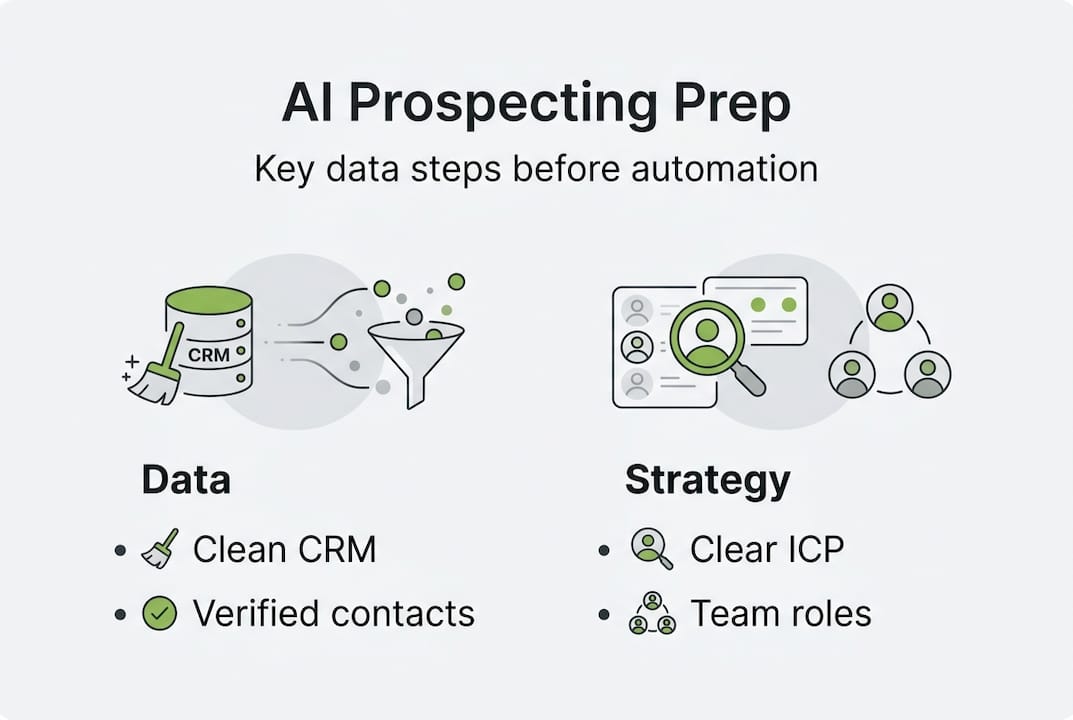
Define a tight Ideal Customer Profile (ICP). Your ICP is not just “mid-market SaaS companies.” It should include industry, company size, tech stack, growth signals, and even the specific pain points your solution addresses. The tighter your ICP, the more relevant your AI outputs will be. Vague targeting leads to wasted outreach and burned sender reputation.
Assign clear team roles. Someone needs to own the AI layer, and someone else needs to own the human review layer. These are different skill sets. Your ops or RevOps person can manage the tooling, while a senior sales rep reviews flagged leads and approves high-value outreach before it goes out.
Here is a quick overview of the tools you will need at each stage:
| Stage | Tool category | Example platforms |
|---|---|---|
| Data enrichment | Enrichment and verification | Clay, Apollo, Clearbit |
| Lead scoring | AI scoring models | HubSpot AI, Salesforce Einstein |
| Outreach drafting | AI writing assistants | GPT-based tools, Lavender |
| Delivery and tracking | Email infrastructure | Instantly, Smartlead |
For most teams, the biggest leverage comes from using AI for sales at the top of the funnel, specifically enrichment, scoring, and first-draft messaging. As AI sales intelligence research confirms, mid-sized B2B teams should prioritize AI for top-of-funnel tasks to free reps for closing. Knowing the pitfalls of agentic prospecting before you start also helps you design guardrails from day one.
Pro Tip: Map out your handoff process before you launch. When AI qualifies a lead, who gets notified, and what information do they receive? A clear handoff protocol between AI and human reps consistently boosts ROI by reducing the time leads sit idle after showing interest.
You should also think about AI market research for outreach as a foundational input, not an afterthought. Understanding the market signals your AI will use to prioritize accounts is what separates a smart workflow from a spray-and-pray machine.
Step-by-step: Building your AI prospecting workflow
With the foundational prep in place, here is how to actually build a workflow that harnesses AI without sacrificing authenticity.
Step 1: Enrich your target list. Pull accounts that match your ICP from your CRM or a prospecting database. Run them through an enrichment tool to add missing fields like LinkedIn URL, tech stack, recent funding, and verified email addresses.
Step 2: Score and prioritize leads. Use an AI scoring model to rank accounts by fit and intent. High-fit, high-intent accounts go into your priority queue. Lower scores go into a nurture sequence or get deprioritized.
Step 3: Generate first-draft outreach. Use AI to write personalized first-draft emails based on enriched data points. The AI pulls in company news, role-specific pain points, and relevant triggers to create a message that does not read like a template.
Step 4: Human review loop. Before anything goes out to high-value accounts, a human rep reviews and edits the draft. This is not optional. It is the step that protects your brand and improves reply rates.
Step 5: Send, track, and follow up. Deploy the campaign through a warmed-up email infrastructure. Track open rates, reply rates, and bounce rates daily. Set automated follow-up sequences for non-responders.
Here is how the manual and AI-augmented approaches compare:
| Task | Manual workflow | AI-augmented workflow |
|---|---|---|
| List building | 3 to 5 hours per week | 20 to 30 minutes |
| Personalization | 1 email per 15 minutes | 50 to 100 drafts per hour |
| Follow-up sequencing | Easy to forget | Fully automated |
| Quality control | Inconsistent | Structured review process |
The agentic prospecting debate is real: AI scales personalization and automates repetitive work, but without oversight it increases noise and delivers low ROI. The teams that win are the ones who use AI to scale the right activities, not all activities. For a deeper look at execution, the step-by-step AI prospecting guide covers each phase in more detail. You can also explore how to automate B2B prospecting without losing the human element that drives conversions.

Pro Tip: Use AI for first-draft outreach across your full list, then manually personalize the top 10 to 15 priority accounts. This gives you scale without sacrificing quality where it matters most.
AI sales intelligence insights consistently show that teams combining AI efficiency with human judgment outperform fully automated approaches by a significant margin.
Avoiding common AI prospecting mistakes
After setting up the workflow, it is critical to know what can go wrong, and how to get it right.
The most damaging mistake is over-automation. Teams get excited by the volume AI can produce and start blasting thousands of emails without reviewing a single one. This tanks deliverability, burns your domain reputation, and trains prospects to ignore you permanently.
Here are the most common pitfalls to avoid:
- Skipping human review: AI-generated emails without a human pass often contain factual errors, awkward phrasing, or irrelevant references that destroy credibility.
- Using a single domain for all outreach: Sending high volumes from one domain accelerates blacklisting. Use dedicated sending domains with proper warm-up periods.
- Ignoring unsubscribe and bounce signals: High bounce rates and spam complaints will kill your deliverability fast. Monitor these daily.
- Generic messaging at scale: AI can personalize, but only if you give it good inputs. Weak ICP data produces weak emails, regardless of how sophisticated the tool is.
- No feedback loop: If your sales reps are not reporting back on lead quality, your AI has no way to improve its targeting over time.
“88% of prospects ignore emails they suspect were written by AI.” This is not a reason to abandon AI outreach. It is a reason to make your AI-assisted emails indistinguishable from thoughtful, human-written ones.
The fix is not less AI. It is smarter AI with tighter guardrails. Review the AI sales tips for B2B that consistently separate high-performing teams from those adding noise. And if you want your outreach to actually land, the AI personalized outreach guide explains how to use enrichment data to write emails that feel genuinely relevant.
The risks of AI prospecting are real, but they are manageable when you treat AI as a force multiplier for your team, not a replacement for judgment.
Measuring and optimizing your AI prospecting efforts
Once live, ongoing optimization is the real secret to converting AI efficiency into sales results.
Most teams set up their AI workflow and then wait for results. That is a mistake. The data your campaigns generate in the first two to four weeks is the most valuable feedback you will ever get. Use it.
Here are the key metrics to track:
| Metric | What it measures | Target benchmark |
|---|---|---|
| Reply rate | Prospect engagement | 3% to 8% for cold outreach |
| Positive reply rate | Genuine interest signals | 1% to 3% |
| Bounce rate | List and domain health | Under 2% |
| AI vs. manual conversion | Workflow effectiveness | Compare monthly |
| Pipeline influenced | Revenue impact | Track per campaign |
Low ROI without oversight is one of the most documented risks of AI prospecting. The teams that avoid this track results obsessively and adjust fast.
Practical optimization actions you should run every two weeks:
- A/B test subject lines and opening sentences. Small copy changes can double reply rates.
- Refine your ICP based on which accounts actually reply. If a certain segment is consistently unresponsive, remove it.
- Run human QA rounds on outgoing emails. Pull a random sample of 20 emails per week and grade them for relevance and tone.
- Adjust sending volume based on deliverability signals. If open rates drop, slow down and investigate before scaling back up.
- Review AI scoring accuracy monthly. Are the accounts your AI ranks highest actually converting? If not, retrain the model.
For actionable prospecting tips for sales teams that connect measurement to execution, the process is straightforward once you build the habit. Agencies and growth teams can also find specific agency AI prospecting tips for managing multiple client campaigns simultaneously.
Our perspective: How real B2B teams actually win with AI prospecting
Having walked through the actionable steps, here is a candid look at what separates the teams who win with AI from those who just add more noise.
The uncomfortable truth is that most teams adopt AI prospecting tools hoping to eliminate the hard work of sales. They want a machine that fills the calendar while the team focuses on closing. That mindset leads to failure almost every time.
The teams that consistently win treat AI as a way to create more time for meaningful conversations, not to avoid them. AI handles the research, the list building, the first draft, and the follow-up sequencing. But the rep still shows up to the call with context, empathy, and a genuine understanding of the prospect’s situation.
Human review is not a bottleneck. It is a conversion multiplier. When a rep edits an AI draft and adds one specific detail about the prospect’s recent product launch or hiring trend, reply rates climb noticeably. That one human touch is what makes the difference between a deleted email and a booked meeting.
If you want to stay current on what is actually working in AI-driven outreach, the Lickfold Digital blog covers real patterns from active campaigns across industries.
Take the next step with Lickfold Digital’s AI expertise
Ready to move from ideas to execution? Lickfold Digital helps B2B sales teams build AI-powered prospecting systems that actually deliver qualified pipeline, not just volume.
Our approach combines dedicated AI agents for market research and outreach with human qualification of every reply before it reaches your sales team. We handle the infrastructure, the warm-up accounts, the reputation management, and the personalization layer. You get a predictable flow of high-quality leads without the guesswork. Whether you are starting from scratch or optimizing an existing workflow, Lickfold Digital is built to accelerate your results. Contact our experts to see what a fully managed AI prospecting system looks like in practice.
Frequently asked questions
What is the most common mistake in AI-powered prospecting?
Teams often over-automate, sending generic emails without human review, which lowers response rates. Since 88% ignore suspected AI emails, skipping the human review step is the fastest way to destroy a campaign.
How should mid-sized B2B teams start with AI prospecting?
Begin with clean data, a focused ICP, and use AI for enrichment and scoring while keeping humans in the loop. As AI sales intelligence research shows, prioritizing AI for top-of-funnel tasks frees reps to focus on closing.
How can I tell if my AI prospecting delivers good ROI?
Track reply rates, positive reply rates, and closed-won pipeline influenced by AI campaigns, then compare against manual outreach results. Low ROI without oversight is well-documented, so consistent measurement is non-negotiable.
What AI tools work best for B2B sales outreach?
The best tools handle enrichment, scoring, and first-draft outreach, but require careful human oversight to perform well. Platforms like Clay for enrichment and GPT-based tools for drafting work well when paired with AI intelligence scoring models.