
What Is an Agency Ideal Client? A Strategic Guide
What Is an Agency Ideal Client? A Strategic Guide
TL;DR:
- An agency’s ideal client profile is a data-driven, multi-attribute description of companies most profitable and easiest to serve. Building and regularly updating this profile enhances sales efficiency, retention, and referral potential by focusing on best-fit accounts. Treating the ICP as a living system, not a static document, ensures sustainable growth through targeted outreach and operational alignment.
An agency ideal client is a detailed, account-level description of the companies your agency can serve most profitably and retain most effectively, defined by firmographic, behavioral, and technographic data rather than gut instinct. This profile, formally called an Ideal Customer Profile (ICP), goes far beyond basic demographics. It captures industry, company size, revenue range, technology stack, buying behavior, and situational readiness. Agencies that build their ICP on real client data, not wishful thinking, consistently outperform those that chase any available contract. The following guide breaks down what makes a client truly ideal and how to operationalize that knowledge.
What is an agency ideal client profile?
An agency ideal client profile is a multi-attribute account description that identifies the hypothetical perfect customer using firmographic, behavioral, and technographic data. It answers one question with precision: which companies are most likely to convert, pay well, stay long, and refer others?

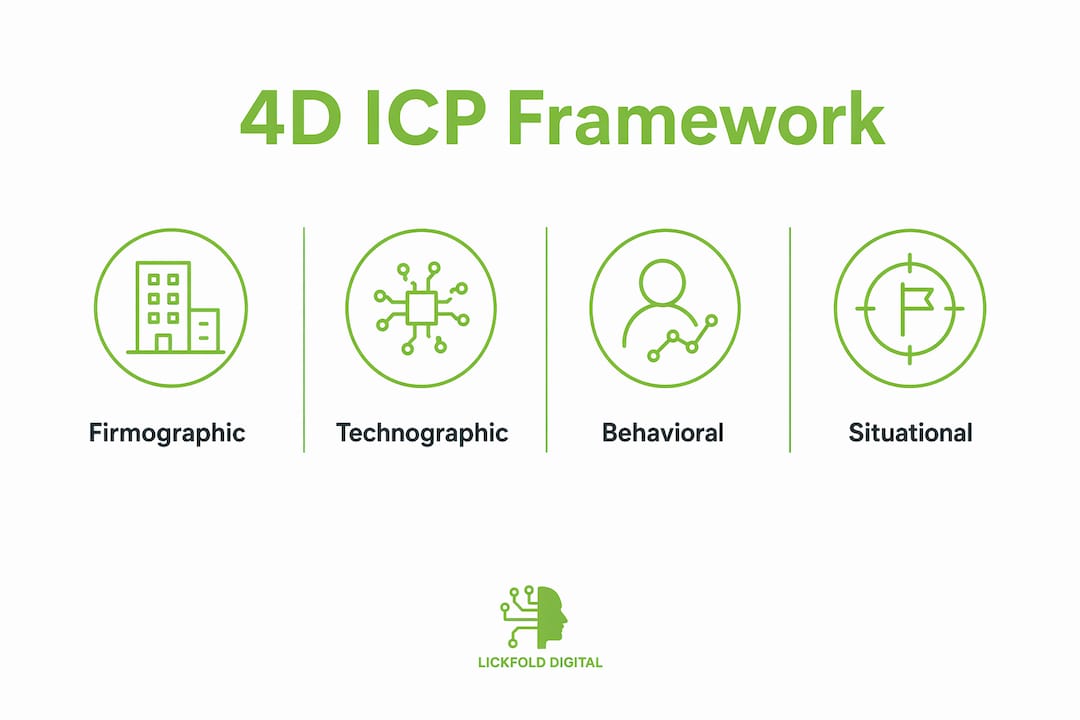
The ICP sits at the intersection of four data categories. Firmographics describe the structural facts of a company: industry vertical, headcount, annual revenue, and geography. A B2B content agency might define its firmographic sweet spot as SaaS companies with 50 to 200 employees generating between $5M and $30M in annual recurring revenue, headquartered in North America.
Technographics capture the tools a prospect already uses. A company running HubSpot, Salesforce, and Slack signals marketing maturity and budget allocation. One running spreadsheets for CRM signals the opposite. This data predicts whether a prospect can actually use and appreciate your services.
Behavioral and situational factors explain when a company is ready to buy. A company that just closed a Series B funding round, hired a new VP of Marketing, or missed its pipeline targets two quarters in a row is in a buying window. Firmographics alone are insufficient because buying behavior and timing explain most of the variance in conversion rates.
| Attribute category | What it captures | Why it matters |
|---|---|---|
| Firmographic | Industry, size, revenue, geography | Defines structural fit |
| Technographic | Current tools and platforms | Predicts service compatibility |
| Behavioral | Past buying patterns, engagement signals | Identifies purchase intent |
| Situational | Triggers like funding, leadership changes | Reveals buying window timing |
The four categories together form what Erik R. Miller calls the 4D ICP framework, a model that predicts which accounts can buy now rather than which accounts look good on paper.
Why defining your ICP is critical for agency growth
A well-defined ICP improves every stage of the client acquisition process. Sales teams spend less time on unqualified prospects. Marketing budgets concentrate on channels where ideal clients actually spend time. Messaging sharpens because you know exactly what problems your best clients share.
HubSpot recommends building ICPs from interviews with current and past clients, combined with input from your sales and delivery teams. This process surfaces patterns that no demographic spreadsheet reveals: the specific frustrations that drove clients to hire you, the internal dynamics that made the engagement smooth, and the outcomes they valued most.
The downstream effects on retention and referrals are significant. Ideal clients stay longer because your services fit their actual needs. They refer peers who share similar profiles, compressing your cost of acquisition over time. Agencies that focus on niches with the highest “Return on Understanding” scale more effectively because their expertise compounds with every new engagement in that niche.
The benefits of a sharp ICP include:
- Reduced wasted outreach on companies that will never convert or will churn quickly
- Higher close rates because messaging addresses real, known pain points
- Shorter sales cycles because prospects self-qualify against your positioning
- Better delivery outcomes because your team has practiced solving the same class of problems
- Stronger case studies and social proof that resonate with lookalike prospects
Pro Tip: Review your ICP every quarter. Funding climates, technology adoption curves, and market conditions shift. An ICP built in 2024 may no longer reflect which companies can actually buy in 2026.
Common misconceptions about defining ideal clients
The most damaging error agencies make is treating the ICP as a wish list. One key misconception is describing ideal clients as a fantasy demographic rather than an evidence-based fit portrait. The result is a profile that describes a “unicorn client” that rarely exists in the real market, which means the ICP never gets used because no real prospect matches it.
“A firmographic-only approach misses behavioral dimensions and buying readiness, leading to ineffective targeting.” — Erik R. Miller, ICP Development: The Complete Guide
A second critical confusion is conflating the ICP with a buyer persona. These are distinct tools. An ICP defines target accounts, meaning the companies you pursue. A buyer persona describes the individual decision-maker inside those accounts, such as a VP of Marketing at a Series B SaaS company. Mixing these up produces go-to-market strategies that target the right person at the wrong company, or the right company with messaging built for the wrong person.
A third pitfall is building the ICP from opinion rather than data. Agency founders often describe their ideal client based on who they want to work with, not who has actually generated the most revenue, caused the least friction, and stayed the longest. The fix is straightforward: pull your top 20 clients by lifetime value, score them across revenue, profitability, relationship ease, and cross-sell potential, and look for the patterns that emerge. Those patterns are your ICP.
Validating the ICP requires iteration. Run it against your current pipeline and check whether the highest-scoring prospects are actually closing. If they are not, the profile needs refinement. Static ICPs built once and filed away are a common reason agencies plateau.
How to create and operationalize your agency’s ICP
Building a functional ICP follows a structured sequence. Skipping steps, particularly the data-gathering phase, produces profiles that sound authoritative but fail in practice.
-
Audit your existing client base. Pull revenue, margin, contract length, and referral data for every client from the past two to three years. Identify your top 20% by combined value.
-
Score top clients across four dimensions. Apply the client scoring model that rates each client on revenue contribution, profitability, relationship ease, and cross-sell or upsell potential. Assign numerical scores to remove subjective bias.
-
Conduct structured interviews. Talk to five to ten of your highest-scoring clients. Ask what triggered their decision to hire an agency, what alternatives they considered, and what outcome they valued most. In-depth interviews and historical data produce positioning insights that no survey can replicate.
-
Map the 4D attributes. For each top client, document their firmographic profile, technology stack, behavioral signals that preceded the sale, and the situational trigger that opened the buying window. Look for patterns across all four dimensions.
-
Build a scoring rubric for new prospects. Translate the patterns into a scorecard. Assign point values to each attribute so your sales team can rate any inbound or outbound prospect against the ICP in under five minutes.
-
Embed the ICP into your CRM and lead scoring. Tag contacts and accounts in tools like HubSpot CRM or Salesforce with ICP match scores. Use those scores to prioritize outreach sequences and segment B2B audiences for marketing campaigns.
-
Review and refine quarterly. Schedule a 90-day ICP review. Compare the profiles of clients who closed in the last quarter against your current ICP definition. Update the scoring rubric when new patterns emerge.
Pro Tip: The niche with the highest Return on Understanding is the one where your agency has already solved the same problem multiple times. Every new engagement in that niche makes your delivery faster, your case studies stronger, and your positioning sharper. Resist the urge to broaden the ICP prematurely.
Operationalizing the ICP means it influences every workflow, not just prospecting. It shapes which speaking engagements you pursue, which content you publish, which partnerships you form, and which inbound leads you prioritize. When the ICP is embedded in your targeted prospecting process, it becomes a filter that compounds in value over time.
Key takeaways
A well-built ICP is the single most effective tool for reducing wasted outreach and increasing close rates, because it concentrates every agency resource on accounts that can actually buy and stay.
| Point | Details |
|---|---|
| ICP is multi-dimensional | Effective profiles combine firmographic, technographic, behavioral, and situational data. |
| Data beats opinion | Build your ICP from scored client history and structured interviews, not assumptions. |
| ICP differs from buyer persona | ICPs target companies; personas describe individuals inside those companies. |
| Operationalize it fully | Embed ICP scores in your CRM, outreach sequences, and marketing segmentation. |
| Review it quarterly | Market conditions and buying triggers shift; a static ICP becomes inaccurate fast. |
Why most agencies get this wrong before they get it right
I have reviewed dozens of agency ICPs over the years, and the pattern is consistent. The first version is always aspirational. It describes a client with unlimited budget, a decisive single stakeholder, a clear brief, and zero internal politics. That client exists, but rarely in the volume agencies need to build a business around.
The agencies that grow predictably are the ones that treat the ICP as a living decision system rather than a one-time exercise. They score every client after the first 90 days of engagement. They track which ICP attributes correlate with renewals and which correlate with scope creep and late payments. Over time, their profile becomes sharper and more predictive because it is grounded in operational reality, not marketing theory.
The uncomfortable truth is that most agencies avoid this work because it forces them to say no to revenue that does not fit the profile. That discipline is exactly what separates agencies with 40% margins from those grinding at 15%. A narrow, evidence-based ICP is not a constraint on growth. It is the mechanism that makes growth sustainable.
Treat your ICP as the most important strategic document your agency owns. Revisit it more often than your pitch deck.
— Duarte
How Lickfold helps agencies target the right clients
Lickfold builds AI-powered outbound systems that put your ICP to work at scale. Once your ideal client profile is defined, Lickfold deploys dedicated AI agents to identify matching decision-makers, verify their contact data, and execute personalized multi-touch outreach campaigns that maintain high delivery rates and avoid generic templates. Every reply is human-qualified before it reaches your sales team, so you receive warm, vetted opportunities rather than raw leads. For agencies ready to move from a defined ICP to a predictable pipeline, reach out to Lickfold to see how the system performs against your specific client profile.
FAQ
What is an agency ideal client in simple terms?
An agency ideal client is a detailed profile of the companies most likely to generate strong revenue, stay long-term, and be easy to serve well. It is built from real client data across firmographic, behavioral, and technographic dimensions.
How is an ICP different from a buyer persona?
An ICP defines the target company, while a buyer persona describes the individual decision-maker inside that company. Confusing these two concepts is a common go-to-market error that reduces sales efficiency.
How do you find your ideal client as an agency?
Score your top clients by revenue, profitability, relationship ease, and cross-sell potential, then conduct structured interviews to identify shared attributes. Use those patterns to build a targeted outreach campaign focused on lookalike accounts.
How often should an agency update its ICP?
Quarterly reviews are the standard. Buying triggers, technology adoption, and market conditions shift often enough that an ICP built more than six months ago may no longer reflect which companies are actively in a buying window.
Can a small agency benefit from building an ICP?
Small agencies benefit most from a defined ICP because they have fewer resources to waste on poor-fit prospects. A narrow, evidence-based profile concentrates limited time and budget on the accounts most likely to close and stay.