
What Is Targeted Prospecting for Sales Teams
What Is Targeted Prospecting for Sales Teams
TL;DR:
- Most sales teams focus on pipeline volume, but relevance and precise targeting drive better results and faster deals.
- Combining ICP and buyer personas ensures tailored messaging that resonates with high-fit prospects at optimal moments.
Most sales teams are solving the wrong problem. They obsess over pipeline volume, adding more names to lists, sending more emails, making more calls. But volume without relevance is just organized noise. What is targeted prospecting, really? It’s the practice of identifying and engaging a precisely defined set of high-fit prospects rather than blasting outreach at anyone who loosely matches your category. Get this right and your close rates climb, your sales cycles shorten, and your reps spend time on deals that actually close.
Table of Contents
- Key takeaways
- What targeted prospecting actually means
- How ICP and buyer personas power your targeting
- The real benefits of targeted prospecting
- How to do targeted prospecting effectively
- AI’s role in scaling targeted prospecting
- My honest take on why teams get this wrong
- How Lickfold can help you scale targeted outreach
- FAQ
Key takeaways
| Point | Details |
|---|---|
| Quality beats quantity | A smaller, well-qualified list consistently outperforms a large generic one in contact rate and conversion. |
| ICP and personas work together | Company-level fit (ICP) combined with individual-level detail (persona) sharpens every message you send. |
| Timing is part of the strategy | Reaching the right prospect at the wrong moment wastes effort. Buying signals make outreach land harder. |
| AI scales the approach | AI tools automate research, scoring, and follow-up so reps focus on conversations, not data entry. |
| Measure and refine constantly | Targeted prospecting is a living strategy that improves when you track results and adjust your criteria. |
What targeted prospecting actually means
The phrase “targeted prospecting” has become common in sales circles, but the industry term for the underlying discipline is account-based outbound sales. Both describe the same core idea: an end-to-end sales strategy that defines who you pursue, how you engage them, and when to reach out, with each decision grounded in fit rather than volume.
Contrast that with general prospecting, sometimes called “spray-and-pray.” In that model, you build the largest list possible, push everyone through the same sequence, and accept low response rates as the cost of doing business. Targeted prospecting rejects that trade-off entirely. It treats every touchpoint as an investment, so it demands that each prospect on your list is worth the effort before the first message goes out.
The strategy has three core components:
- Fit: The prospect’s company matches your Ideal Customer Profile across firmographics, industry, size, tech stack, and growth stage.
- Personalization: Messaging is built around the prospect’s specific situation, not a generic template with a first-name swap.
- Timing: Outreach is triggered or timed around signals that indicate buying readiness, such as a funding round, a new hire, or a product launch.
None of these components works well in isolation. A well-timed email to the wrong company is still a waste. A perfectly matched account receiving a generic blast is a missed opportunity. Targeted sales prospecting only delivers results when all three elements align.
How ICP and buyer personas power your targeting
Many teams think “targeting” means picking the right job titles. It doesn’t. A true Ideal Customer Profile defines the companies most likely to convert and stay loyal by incorporating firmographic, behavioral, and environmental characteristics. That means industry, revenue range, employee count, geographic market, tech stack in use, growth trajectory, and even regulatory environment.

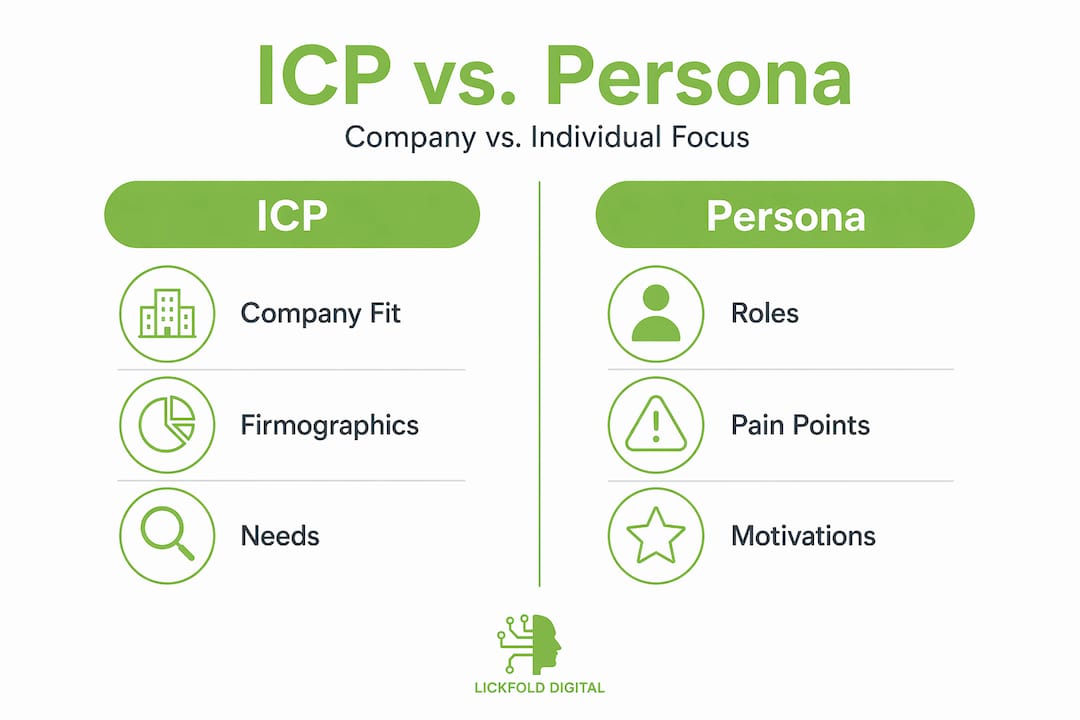
Buyer personas operate one level below the ICP. Where the ICP describes the company, the persona describes the individual you’re trying to reach inside that company. Their role, their goals, the metrics they’re judged by, the objections they typically raise, and the kind of evidence they find persuasive.
Here’s how the two compare:
| Dimension | Ideal Customer Profile (ICP) | Buyer Persona |
|---|---|---|
| Level | Company | Individual |
| Key data | Revenue, industry, size, tech stack | Role, goals, pain points, buying behavior |
| Primary use | Prioritizing accounts | Crafting messages and CTAs |
| Updated by | Market and win/loss data | Sales call notes, customer interviews |
When you combine a sharp ICP with detailed personas, your messaging stops sounding like it could have gone to anyone. A VP of Sales at a 200-person SaaS company faces completely different pressures than the same title at a 2,000-person manufacturing firm. Combining ICP with personas forces you to acknowledge that difference and write to it.
The most common mistake here is casting too wide a net at the ICP stage, which dilutes relevance before you even get to messaging. Specificity at the account level sets everything else up for success.
Pro Tip: Review your closed-won deals quarterly and extract three to five firmographic patterns they share. Those patterns are your ICP sharpening themselves in real time.
The real benefits of targeted prospecting
The case for focused outbound isn’t theoretical. With a list of 10,000 generic prospects, you might reach 100 people. With 250 carefully targeted prospects, you could reach 125. More contacts, from a list 40 times smaller. That’s not a marginal improvement; it’s a structural advantage.
Here’s what changes when your team shifts to a precision-first model:
- Higher response rates: Relevant messaging from a recognizable context gets opened and replied to. Generic outreach gets archived.
- Shorter sales cycles: Prospects who already fit your ICP require less education and qualification time once they’re engaged.
- Better retention post-close: Customers acquired through targeted outreach are more likely to be a genuine fit, which means lower churn and stronger expansion revenue.
- Smarter use of rep time: When reps work from a prioritized list, they’re not deciding who to call. They’re calling.
- Stronger prospect experience: Personalized outreach built on fit treats the buyer as a known quantity, not a cold target.
The last point matters more than most sales leaders acknowledge. Buyers remember how they were approached. A thoughtful, relevant first message creates a favorable impression even when the timing isn’t right. That same buyer may re-engage months later because the first interaction respected their intelligence.
The waste reduction alone justifies the shift. Spray-and-pray methods burn rep time, damage sender reputation, and generate lists of unqualified meetings that consume even more resources downstream.
How to do targeted prospecting effectively
You don’t need a complete technology overhaul to start. You need a clear process and the discipline to follow it. Here’s a framework that works:
-
Define your ICP with specificity. Document the firmographic and behavioral traits of your best-fit customers. Use closed-won data, not guesses. If your best customers share three or four distinct characteristics, those are your targeting criteria.
-
Build small, qualified lists. Resist the temptation to add volume. A list built on fit data will outperform a large generic list every time. Use sales intelligence tools to verify data and enrich records with company news, technology use, and hiring signals.
-
Map the right persona to each account. Identify the actual buyer, the influencer, and the blocker at each target account. Knowing all three shapes your sequencing and your messaging hierarchy.
-
Trigger outreach on buying signals. A funding announcement, a leadership change, a new product launch, a job posting for a role your product supports. Sales intelligence combined with behavioral signals gives you context that makes your first message land harder than any generic opener ever could.
-
Use multiple channels with a single narrative. Email, LinkedIn, phone, and warm introductions should reinforce one message, not feel like separate campaigns. Account-based outreach with warm introductions consistently outperforms any single-channel approach for high-value accounts.
-
Segment for prioritized attention. Not every ICP-fit account deserves the same level of effort right now. Score and tier your list so your best reps focus on your highest-opportunity accounts first.
-
Measure and refine. Track reply rate, meeting rate, and pipeline contribution by list segment. Use that data to adjust your ICP criteria and messaging quarterly. Prospecting that doesn’t feed back into itself stagnates.
Pro Tip: Before writing your next outreach sequence, ask whether a stranger could identify who you’re writing to from the message alone. If the answer is no, it isn’t targeted enough.
AI’s role in scaling targeted prospecting
Even the best targeting framework runs into a capacity problem. Researching accounts, personalizing messages, tracking follow-ups, and booking meetings are time-intensive at any scale. This is where AI changes the equation.
AI-powered prospecting tools use machine learning and predictive analytics to automate lead qualification, personalized outreach, and meeting scheduling. Reps who used to spend hours in research and data entry can redirect that time to actual conversations.
The specific capabilities worth understanding:
- Lead scoring: AI models trained on your historical conversion data rank incoming prospects by likelihood to close, so reps always know where to focus.
- Automated follow-up sequences: Multi-touch campaigns run on schedule without manual intervention, eliminating the common problem of leads going cold because no one had time to follow up.
- Meeting booking: AI sales agents can engage leads 24/7, answer initial questions, handle objections, and book meetings directly to rep calendars based on CRM context.
- Dynamic message personalization: Rather than applying a template, advanced AI agents can adapt outreach messages using deal-stage and buyer-behavior data to make each touchpoint feel contextual.
“AI adoption in sales prospecting reduces manual workload in research and messaging, letting reps focus on relationship-building and closing deals.” — Salesforce
The caution here is real. Automation amplifies what you put in. An AI agent running on a poorly defined ICP or generic messaging will scale your mistakes just as efficiently as it scales your successes. The targeting strategy still has to be right. AI is the accelerant, not the foundation.
For a deeper look at deploying AI for B2B pipeline growth, the AI prospecting guide from Lickfold covers the infrastructure, sequencing, and measurement frameworks in detail.
My honest take on why teams get this wrong
I’ve seen sales organizations invest heavily in targeted prospecting tools, build detailed ICPs, and then still produce mediocre results. The problem is almost never the targeting criteria. It’s that teams treat the ICP as a list-filtering tool rather than a messaging foundation.
They narrow the list correctly, and then send the same templated sequence to everyone on it. The “targeting” stops at the account level and never reaches the actual message. Operationalizing targeted prospecting means building workflows where fit data actively shapes what you say, not just who you say it to.
The other mistake I see constantly is treating the ICP as permanent. Markets shift. Buyer behavior shifts. The companies that were your best customers eighteen months ago may not reflect your best opportunity today. Targeting is a dynamic strategy that should be reviewed and updated like any other strategic asset. If your ICP hasn’t changed in two years, it probably needs to.
My advice to sales leaders: start with your last twenty closed-won deals and pull out every shared characteristic you can find. Build from evidence. Then commit to measuring whether your outreach is actually reaching those profiles, not just the ones you thought you were targeting. The gap between intended and actual targeting is usually where the lost pipeline is hiding.
— Duarte
How Lickfold can help you scale targeted outreach
If you’ve worked through this article and you recognize the gap between where your prospecting is and where it needs to be, Lickfold has built the infrastructure to close that gap faster than building it in-house.
Lickfold Digital deploys dedicated AI agents that identify decision-makers within your ICP, research accounts for buying signals, and execute personalized multi-touch outreach campaigns at scale. The system includes warm-up email infrastructure, sender reputation management, and human qualification of replies before opportunities reach your sales team. The result is a predictable pipeline of high-fit leads without adding headcount. If you want to see what that looks like for your specific market, the team at Lickfold can walk you through a tailored approach.
FAQ
What is targeted prospecting in sales?
Targeted prospecting is an outbound sales strategy that focuses on identifying and engaging a defined set of high-fit prospects based on your Ideal Customer Profile rather than pursuing large, generic lists. It covers who you contact, how you message them, and when to reach out.
How does targeted prospecting differ from general prospecting?
General prospecting prioritizes volume, sending broad outreach to large lists with low relevance. Targeted prospecting prioritizes fit and personalization, working from smaller, highly qualified lists that generate higher contact rates and better conversion outcomes.
What is an Ideal Customer Profile and why does it matter?
An Ideal Customer Profile defines the firmographic, behavioral, and environmental characteristics of the companies most likely to buy and stay. It’s the foundation of effective targeted sales prospecting because it determines which accounts deserve your attention before any outreach begins.
How does AI improve targeted prospecting?
AI tools automate lead scoring, personalized outreach, and meeting scheduling, freeing reps from manual research tasks. Platforms with AI sales agents can engage prospects around the clock and adapt messaging based on deal stage and buyer behavior.
How do you measure whether targeted prospecting is working?
Track reply rate, meeting booking rate, and pipeline contribution by list segment. If fit-qualified segments consistently outperform broader ones, your targeting criteria are working. Adjust ICP definitions and messaging quarterly based on what the data shows.