
Why prospecting efficiency matters for B2B lead generation
Why prospecting efficiency matters for B2B lead generation
TL;DR:
- Responding to a new lead within one minute increases conversion rates by 391%, but only 12% of companies respond this quickly.
- AI-driven automation enhances prospecting efficiency by reducing research time, personalizing outreach, and automating follow-ups, leading to significant pipeline growth.
Responding to a new lead within one minute boosts conversion by 391%, yet only 12% of companies manage to respond within five minutes. That single statistic should reframe how you think about prospecting. Most sales managers focus on sending more emails, sourcing more contacts, and filling more pipeline stages. But the data points to a different priority entirely: speed, precision, and systematic follow-through beat raw volume almost every time. This article walks through the business case for prospecting efficiency, the key bottlenecks that slow teams down, and the practical AI-driven strategies that solve them.
Table of Contents
- Why prospecting efficiency is crucial for B2B sales
- Key drivers and bottlenecks in prospecting
- How AI-driven automation transforms prospecting efficiency
- Applying prospecting efficiency: From workflow to revenue impact
- The uncomfortable truth: Efficiency isn’t just speed, it’s strategic quality
- Connect with AI-driven prospecting experts
- Frequently asked questions
Key Takeaways
| Point | Details |
|---|---|
| Faster prospecting drives results | Quick outreach and follow-up can nearly quadruple conversion rates. |
| AI delivers measurable efficiency | AI automation increases leads, reduces costs, and improves sales team productivity. |
| Integrated workflows win | Blending AI with CRM and automation unlocks more pipeline and revenue impact. |
| Balance speed and relevance | Efficiency succeeds when combined with quality targeting and personalized engagement. |
Why prospecting efficiency is crucial for B2B sales
Prospecting is not just a top-of-funnel activity. It sets the tone for everything that follows. A slow, scattered prospecting process produces low-quality leads, unpredictable pipeline, and frustrated sales reps who spend more time on admin than on selling. The cost compounds quickly.
When your team wastes time on unqualified leads, they have less time for prospects who actually match your ideal customer profile (ICP). That means lower win rates, longer sales cycles, and quota misses that hurt the entire organization. Efficiency, in this context, is not a nice-to-have. It is a direct revenue lever.
The numbers are hard to ignore. Sales reps save 2+ hours daily with AI automation, and HubSpot customers using AI-assisted workflows report 129% more leads and 36% more closed deals. That is not marginal improvement. That is a structural shift in what your sales team can accomplish in the same working day.
Here is what efficient prospecting actually delivers:
- More selling time. Reps spend less time on research and data entry and more time in actual sales conversations.
- Faster pipeline velocity. Leads move through stages faster when follow-up is timely and relevant.
- Better forecasting accuracy. Consistent, automated outreach creates more predictable pipeline data.
- Lower cost per acquisition. Fewer wasted touchpoints mean less spend per converted lead.
“The question is no longer whether AI can improve prospecting. It is how quickly your team adopts it before your competitors do.” This sentiment reflects AI’s proven impact on sales productivity and why B2B sales leaders are accelerating adoption across the board.
The case for AI for B2B prospecting is now backed by enough real-world data that skepticism has largely given way to urgency. The question is not whether to act, but where to start.
Key drivers and bottlenecks in prospecting
Understanding where your prospecting process breaks down is the first step toward fixing it. Most B2B sales teams experience the same set of recurring friction points, and they tend to cluster around three core problems: slow response times, manual research, and inconsistent follow-up.
Slow lead response is the most damaging bottleneck. A 391% boost in conversion is available to the team that responds in one minute, yet the majority of companies take hours or even days. By then, buyers have moved on or are already in conversation with a faster competitor. The window for capturing a warm lead is narrower than most managers assume.
Manual research is the second major drag. Reps routinely spend 30 to 60 minutes researching a single prospect before writing a personalized email. When you multiply that across a hundred contacts per week, you are talking about 50 to 100 hours of labor that produces one initial email per prospect. That ratio is unsustainable.
Inconsistent follow-up compounds both problems. Studies show that most conversions happen between the fifth and eighth touchpoint, but the majority of reps give up after two or three attempts. Without automated sequences, follow-up depends entirely on individual discipline, and that varies wildly across teams.
Here is a side-by-side look at where traditional and AI-assisted prospecting diverge:
| Prospecting task | Traditional approach | AI-assisted approach |
|---|---|---|
| Lead research | 30-60 min per prospect | 2-5 min with AI enrichment |
| Lead scoring | Manual review, often inconsistent | Automated predictive scoring |
| Outreach personalization | Template-based, low relevance | Dynamic, context-aware messaging |
| Follow-up cadence | Rep-dependent, often missed | Automated multi-touch sequences |
| Response time | Hours to days | Minutes with AI triggers |
| Data entry into CRM | Manual, prone to error | Auto-logged with enrichment |
The pattern is clear. Every bottleneck in the left column has a direct AI-powered solution in the right. The gap in output between a team running traditional workflows and one using modern automation is not a small performance difference. It is the difference between hitting quota and missing it consistently.
Pro Tip: Audit your team’s current lead response time before implementing any new tool. If your average is over 30 minutes, response automation should be your first priority, not outreach volume.
Fixing these bottlenecks starts with understanding them at the workflow level. AI prospecting tips that work in practice always begin with an honest map of where time is actually going in your current process.
How AI-driven automation transforms prospecting efficiency
Once you know where the bottlenecks are, AI tools provide a systematic way to remove them. The transformation is not about replacing your sales team. It is about removing the low-value, high-volume tasks that prevent them from doing what they do best.
McKinsey reports that AI-assisted sales tools yield up to 50% pipeline growth, 40 to 60% outreach cost reductions, and 10 to 15% efficiency gains in tasks like research and outreach drafting. These are not projections. These are results from organizations that have already deployed AI-driven sales workflows at scale.

Here is how the efficiency gains actually break down across the prospecting workflow:
| Area | Impact of AI automation |
|---|---|
| Lead research and enrichment | 70-80% reduction in manual research time |
| Outreach personalization | Relevance scores improve 2-3x vs. generic templates |
| Follow-up sequencing | 5-8x more consistent multi-touch cadence |
| Pipeline volume | Up to 50% more qualified opportunities per rep |
| Outreach cost per lead | 40-60% reduction through automated workflows |
The way AI sales efficiency works in practice comes down to five core capabilities:
- Automated lead research and enrichment. AI agents scrape, verify, and compile prospect data from multiple sources, including company news, job postings, LinkedIn signals, and CRM history, before a rep ever touches the record.
- Predictive lead scoring. Rather than scoring leads based on static criteria, AI models evaluate behavioral signals and firmographic data to rank prospects by actual likelihood to convert.
- Generative outreach personalization. Instead of mail-merge templates, AI generates contextually relevant first lines and value propositions tailored to each prospect’s role, company stage, and recent activity.
- Automated multi-touch sequences. AI triggers follow-up emails and tasks based on engagement signals, ensuring every prospect receives the right number of touchpoints without rep intervention.
- CRM integration and data hygiene. Every interaction is auto-logged, enriched, and synced, giving managers clean pipeline data they can actually forecast from.
AI workflow automation examples in B2B sales consistently show that the biggest wins come not from any single feature but from connecting these capabilities into a continuous workflow. When research feeds scoring, which feeds personalization, which feeds sequencing, the entire prospecting engine runs without manual intervention at each handoff.
Pro Tip: Start with one automated workflow before building an entire stack. A single AI-triggered follow-up sequence for inbound leads, for example, can produce measurable results within weeks and build organizational buy-in for broader adoption.
Applying prospecting efficiency: From workflow to revenue impact
Knowing that AI works is not the same as knowing how to implement it. Here is a practical framework for moving from concept to execution without derailing your existing sales process.
Step 1: Define your ICP with precision. Most teams have a general sense of who their ideal customer is. AI tools need specificity. Map out firmographic criteria such as company size, industry, tech stack, and revenue range. Add behavioral signals like hiring patterns, recent funding, or product launches. The more precise your ICP definition, the better AI can surface the right prospects and filter out noise.
Step 2: Build your lead scoring model. Work with your AI platform to configure predictive scoring based on historical win data. If you have closed 200 deals in the past two years, that data can train a model to identify which new prospects look most like your best existing customers. This step alone can dramatically cut the volume of low-quality leads entering your pipeline.
Step 3: Set up automated personalization at scale. Use generative AI to create outreach that references specific triggers: a recent funding round, a new executive hire, a product launch, or a relevant industry trend. This is not about making emails sound human. It is about making them relevant. Relevance is what earns replies.
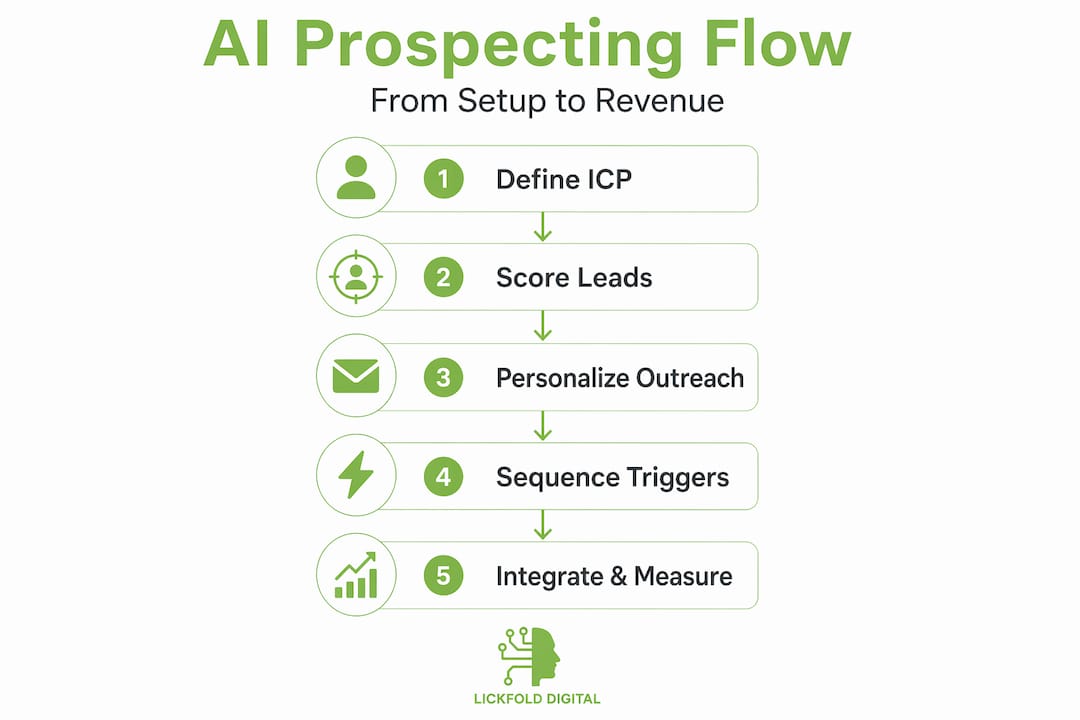
Step 4: Deploy multi-touch sequences with smart triggers. Configure sequences that escalate or adjust based on engagement. If a prospect opens your email three times but does not reply, that is a signal worth acting on. An AI-triggered follow-up or a LinkedIn touchpoint at that moment converts far better than a random day-seven email.
Step 5: Integrate with your CRM and review cadence. None of this works if your data stays siloed. Gartner notes that AI automates prospecting and outreach, boosting productivity, conversion rates, and forecasting accuracy, but only when the underlying data infrastructure supports it. Set up bidirectional CRM sync from day one.
Step 6: Measure, iterate, and expand. Track response rates, meeting booked rates, and pipeline contribution by cohort. Identify which ICP segments respond best, which messaging angles drive the most replies, and where prospects are dropping off. Use those insights to refine scoring, personalization, and sequencing continuously.
For agencies and consultancies managing prospecting across multiple client segments, the layered approach in agency prospecting tips adds another layer of precision, particularly around account segmentation and AI workflow automation tools that scale across verticals.
The uncomfortable truth: Efficiency isn’t just speed, it’s strategic quality
Here is something that rarely gets said plainly: you can automate yourself into irrelevance. We have seen it happen. Teams buy into the idea that more touchpoints, sent faster, will produce more pipeline. They set up automated sequences, fire off hundreds of emails per week, and wonder why reply rates crater.
Speed matters. But speed without relevance is just noise at scale. The prospects you are targeting are bombarded with outreach every single day. Generic automation does not stand out. It gets deleted, filtered, or reported as spam, which damages your sender reputation and kills deliverability for all future campaigns.
Current AI capabilities do deliver real gains of 10 to 50% in productivity, but the full potential, including projected 80% time savings, remains a future-state goal. Right now, the biggest wins from AI are in administrative tasks, not core selling. And those wins require clean data and proper training to materialize.
What this means in practice is that your AI system is only as good as your data hygiene and your messaging strategy. Garbage in, garbage out is not just a cliche here. It is a precise description of what happens when you deploy powerful automation on top of a flawed ICP definition or stale contact data.
The B2B AI sales tips that produce lasting results always combine automation with strategic intent. The best-performing teams we work with treat AI as a force multiplier for their best sales thinking, not as a replacement for it. They invest in data quality. They test messaging with genuine curiosity. They review sequence performance weekly. They treat prospecting as a discipline, not a volume game.
True efficiency means your reps are spending their time on conversations that have a realistic chance of converting, backed by AI that has already done the research, scored the lead, and sent the right message at the right time. That is a very different outcome than faster bulk email.
Connect with AI-driven prospecting experts
If this article has sharpened your thinking on where your prospecting process could be working harder, the next step is figuring out what that looks like for your specific sales motion, industry, and ICP.
At Lickfold Digital, we build fully managed AI-driven prospecting systems for B2B sales teams that need qualified pipeline without adding headcount. Our AI agents handle lead research, decision-maker identification, personalized multi-touch outreach, and human-qualified lead handoffs, so your reps stay focused on closing. Explore our AI prospecting solutions or contact our experts to talk through what a more efficient prospecting system could look like for your team.
Frequently asked questions
What are the main benefits of improving prospecting efficiency?
Improving prospecting efficiency boosts lead generation, increases conversion rates, and allows sales teams to spend more time closing deals rather than on manual tasks. Sales reps using AI automation save over two hours daily and generate significantly more leads and closed deals.
How does AI specifically enhance prospecting efficiency?
AI streamlines lead research, automates outreach, and personalizes interactions, resulting in faster response times and better-qualified leads. According to McKinsey’s GenAI research, AI-assisted sales tools can yield up to 50% pipeline growth and reduce outreach costs by 40 to 60%.
How fast should you respond to a new lead for best results?
Responding within one minute maximizes conversions, but very few teams achieve this without automation. Response within one minute boosts conversion by 391%, yet only 12% of companies respond within five minutes.
Are there downsides to focusing only on efficiency?
Yes, over-prioritizing speed can sacrifice personalization, and true efficiency balances automation with high-quality, relevant engagement. Current AI limitations mean that data quality and strategic messaging remain essential inputs, and automation without them produces diminishing returns.