
Sales Acquisition Cost Explained: Guide for B2B Leaders
Sales Acquisition Cost Explained: Guide for B2B Leaders
TL;DR:
- Fully-loaded CAC includes salaries, overhead, tools, and ads, giving an accurate cost of acquiring a customer.
- Tracking CAC by channel helps optimize investments and improves sales efficiency and profitability.
- A healthy LTV to CAC ratio for B2B is at least 3:1, with higher ratios indicating sustainable growth.
Most B2B service leaders believe they know their sales acquisition cost. They pull a number from their CRM, divide it by new customers, and move on. But that figure almost always understates the real cost by 30 to 60 percent because it ignores salaries, overhead, and tool subscriptions that quietly drain budget every month. Getting this number wrong means your pricing, hiring, and channel decisions are built on a flawed foundation. This guide walks you through exactly what sales acquisition cost (CAC) means in a B2B service context, how to calculate it accurately, how to track it by channel, and how to use it to make smarter growth decisions.
Table of Contents
- What is sales acquisition cost?
- Breaking down the B2B sales acquisition cost formula
- How to track, analyze, and optimize outbound sales CAC
- Applying CAC: LTV ratios, red flags, and maximizing ROI
- The uncomfortable truth about sales acquisition cost in B2B
- Get expert help optimizing your sales acquisition cost
- Frequently asked questions
Key Takeaways
| Point | Details |
|---|---|
| All-in CAC matters | B2B leaders must use fully-loaded CAC to reveal true acquisition costs and make better strategic decisions. |
| Track by channel | Separate CAC tracking for paid, outbound, and blended campaigns enables actionable optimization. |
| Benchmark for sustainability | Maintain a minimum 3:1 LTV:CAC ratio to avoid unsustainable growth and ensure healthy ROI. |
| Use technology wisely | Leverage AI sales tools and workflow automation to track and reduce CAC with greater efficiency. |
What is sales acquisition cost?
Sales acquisition cost, commonly called CAC, is the total amount your company spends to win one new customer. Simple in theory. Complicated in practice, especially for B2B service companies where sales cycles are long, teams are large, and the line between marketing spend and operational overhead blurs fast.
For B2B services, CAC must account for every dollar that touches the acquisition process. That means:
- Sales team salaries and commissions (including managers and SDRs)
- Marketing salaries and agency fees
- Paid advertising spend (LinkedIn, Google, sponsored content)
- Sales and marketing tools (CRM, outreach platforms, data enrichment)
- Event and content costs tied to demand generation
- Overhead allocation for the portion of operations supporting sales
What you leave out matters just as much. Post-sale costs like customer success, support, and R&D are excluded. The fully-loaded CAC model, which includes salaries, commissions, tools, ads, agencies, and overhead, is the recommended standard for B2B companies. Anything less gives you a number that looks better than reality.
Why does this matter so much? Because CAC is not just a finance metric. It is a strategic signal. If your CAC is rising quarter over quarter and you do not know why, you cannot fix it. If your CAC is artificially low because you are only counting ad spend, you will overhire, underprice, and misallocate budget across channels.
For service companies running account-based marketing programs or investing in decision maker targeting, knowing your true CAC is what separates a scalable outbound program from an expensive experiment. And as lead generation automation becomes more sophisticated, the cost inputs are changing fast. Tracking them accurately is now a competitive advantage, not just a bookkeeping task.
Key insight: CAC is not what you spend on ads. It is everything you spend to close a customer, divided by how many you close.
Breaking down the B2B sales acquisition cost formula
The formula itself is straightforward:
CAC = Total Sales and Marketing Expenses / Number of New Customers Acquired
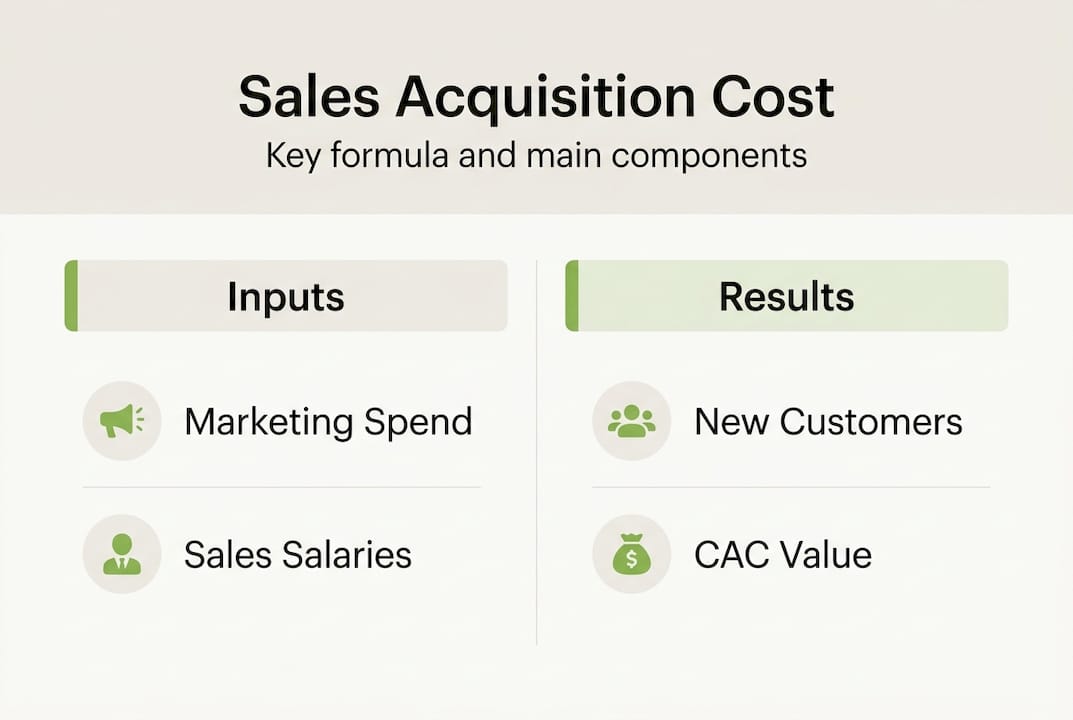
But the inputs are where most teams get it wrong. Here is a side-by-side comparison of what a direct (paid-only) CAC calculation looks like versus a fully-loaded one:
| Cost Component | Direct CAC | Fully-Loaded CAC |
|---|---|---|
| Paid ad spend | Included | Included |
| Agency fees | Sometimes | Always |
| Sales team salaries | Excluded | Included |
| Marketing salaries | Excluded | Included |
| CRM and tools | Excluded | Included |
| Overhead allocation | Excluded | Included |
| Support and R&D | Excluded | Excluded |
For context, 2026 CAC benchmarks for B2B SaaS startups sit in the $200 to $700 range, while Professional Services companies typically see fully-loaded CAC between $1,500 and $5,000. If your number falls outside these ranges, it is worth auditing your inputs before assuming something is broken.
Here is how to calculate your CAC step by step:
- Set your time window. Use a consistent period, typically one quarter or one fiscal year.
- Sum all sales expenses. Include salaries, commissions, travel, and tools used by your sales team.
- Sum all marketing expenses. Include ad spend, agency retainers, content costs, and marketing salaries.
- Add overhead allocation. Estimate the percentage of shared costs (office, software licenses, management time) attributable to sales and marketing.
- Count new customers only. Do not include expansions or renewals. Only net-new logos.
- Divide total spend by new customers. That is your fully-loaded CAC.
Pro Tip: Run this calculation separately for each major channel. Your outbound workflow will have a very different CAC than your inbound content program, and blending them hides which channel is actually performing. Solid B2B market research can also help you identify which segments yield lower CAC before you scale spend.
How to track, analyze, and optimize outbound sales CAC
Tracking CAC is not a one-time exercise. It is an ongoing discipline that requires separating your acquisition costs by channel type so you can make smart decisions about where to invest next.
There are three CAC variants worth tracking:
- Blended CAC: Total spend across all channels divided by all new customers. Useful for board-level reporting and unit economics.
- Paid CAC: Spend on paid channels only (ads, sponsored content) divided by customers from those channels. Best for evaluating paid channel efficiency.
- Outbound CAC: Costs tied to outbound sales activity (SDR salaries, outreach tools, data costs) divided by customers sourced from outbound. Essential for evaluating your sales team’s ROI.
Tracking blended, paid, and outbound CAC separately gives you the granularity to optimize each channel without distorting your overall picture. Use paid CAC to assess channel effectiveness, and fully-loaded CAC for unit economics decisions.
Here is what channel-specific CAC tracking looks like in practice:
| Channel | Monthly Spend | New Customers | CAC |
|---|---|---|---|
| Outbound (AI-driven) | $8,000 | 6 | $1,333 |
| Paid LinkedIn Ads | $5,000 | 3 | $1,667 |
| Inbound Content | $3,000 | 4 | $750 |
| Referral Program | $1,000 | 2 | $500 |
This kind of breakdown immediately shows where you are getting the best return. In the example above, referrals are cheapest, but outbound delivers more volume. That insight drives resource allocation decisions that a blended number would never surface.

Pro Tip: If you are using AI sales tools for outbound, make sure the platform cost is included in your outbound CAC calculation. Many teams forget to factor in tool subscriptions, which understates the true cost and makes outbound look more efficient than it is. Pairing this with AI-driven sales campaigns and workflow automation tools can reduce your outbound CAC significantly over time by improving conversion rates at each stage.
Applying CAC: LTV ratios, red flags, and maximizing ROI
Knowing your CAC is only half the job. The real strategic value comes from comparing it to your customer lifetime value (LTV). The LTV:CAC ratio tells you whether your growth model is sustainable or whether you are spending more to acquire customers than those customers will ever return.
“A healthy LTV:CAC ratio for B2B companies is a minimum of 3:1. Anything below that signals unsustainable growth and requires immediate attention.”
For B2B services, a 5:1 ratio is the target. At 3:1, you are viable but thin. Below 3:1, you are effectively paying to lose money over time.
Here are the red flags to watch for in your CAC data:
- Rising CAC quarter over quarter without a corresponding increase in deal size or LTV
- LTV:CAC below 3:1 for more than two consecutive quarters
- CAC payback period exceeding 18 months, which ties up cash and limits reinvestment capacity
- Blended CAC masking a broken channel, where one high-performing channel hides another that is burning budget
- Ignoring churn when calculating LTV, which inflates the ratio and makes the business look healthier than it is
To improve your ROI through smarter CAC management, focus on these levers:
- Shorten your sales cycle. Every week a deal sits in your pipeline adds to your CAC through salary and tool costs.
- Improve lead quality at the top of the funnel. Better targeting means fewer wasted outreach hours.
- Increase average contract value. Higher ACV improves LTV without changing your CAC.
- Automate repetitive outbound tasks. Reducing manual SDR time per deal directly lowers your outbound CAC.
For teams looking to boost sales efficiency, the fastest path to a healthier LTV:CAC ratio is usually improving conversion rates at the middle of the funnel, not just cutting spend at the top.
The uncomfortable truth about sales acquisition cost in B2B
Here is what years of working with B2B service companies reveals: most leaders are not tracking CAC wrong because they lack data. They are tracking it wrong because the real number is uncomfortable.
When you include fully-loaded costs, CAC almost always looks higher than expected. And when it looks high, the instinct is to cut spend rather than improve conversion. That is the wrong move. Cutting outbound investment or delaying tool adoption because your CAC appears elevated is a short-term reaction to a long-term metric.
The companies that grow predictably are the ones that accept a higher fully-loaded CAC and then work systematically to improve LTV and conversion rates. They use market research for lead quality to target better-fit accounts, which lowers CAC over time without slashing budgets.
Superficial CAC tracking does not protect your margins. It just delays the moment you discover how much acquisition actually costs. The earlier you face that number honestly, the faster you can build a model that scales.
Get expert help optimizing your sales acquisition cost
Understanding your true sales acquisition cost is one thing. Systematically reducing it while maintaining pipeline volume is another challenge entirely.
At Lickfold Digital, we help B2B service companies build AI-powered outbound systems that lower CAC by improving targeting precision, personalizing outreach at scale, and qualifying leads before they ever reach your sales team. Our approach means your team spends time on opportunities that are already warm, not cold lists. If you are ready to see what AI-powered CAC optimization looks like in practice, or want to discuss your current acquisition model, reach out to our team and we will map out a strategy built around your numbers.
Frequently asked questions
What expenses are included in sales acquisition cost for B2B services?
Salaries, commissions, tools, ads, agency fees, and overhead are all included in a fully-loaded CAC calculation; post-sale costs like support and R&D are excluded.
What is a sustainable LTV:CAC ratio for B2B companies?
A minimum 3:1 ratio is the baseline for sustainability in B2B; anything below that signals your growth model is costing more than it returns.
How do outbound sales techniques impact acquisition cost?
Outbound often carries a higher upfront CAC than inbound, but it targets higher-value accounts, which is why tracking outbound CAC separately from paid and blended figures is essential for accurate optimization.
What are typical CAC benchmarks for B2B SaaS and Professional Services in 2026?
B2B SaaS startups typically see CAC between $200 and $700, while Professional Services companies range from $1,500 to $5,000 on a fully-loaded basis.
Why is it important to distinguish between paid and fully-loaded CAC?
Paid CAC tells you how efficient a specific channel is, while fully-loaded CAC reveals your true unit economics and whether your overall acquisition model is profitable at scale.