
What is prospect engagement and why it drives B2B sales
What is prospect engagement and why it drives B2B sales
TL;DR:
- Most B2B sales teams mistake activity volume for prospect engagement, which requires meaningful, two-way interactions. AI-driven systems automate and personalize multichannel outreach, leading to higher relevance and genuine buyer responses. Building a system-level approach that leverages data and triggers enhances engagement and outperforms volume-based strategies over time.
Most B2B sales teams think they have a prospect engagement problem when they actually have an activity problem. They send more emails, make more calls, add more touchpoints, and then wonder why pipeline numbers stay flat. The two things are not the same. Prospect engagement is the process of initiating and managing meaningful, two-way interactions with potential buyers, not simply generating outreach volume. This article breaks down exactly what that distinction means, how AI-powered systems change the equation, and what practical steps you can take to build an engagement model that converts.
Table of Contents
- Prospect engagement defined: More than just outreach
- How AI transforms prospect engagement systems
- Practical steps: Designing your prospect engagement system
- Common mistakes and expert tips for maximizing engagement
- Why the real difference is system-level thinking
- Enhance your prospect engagement with AI-driven automation
- Frequently asked questions
Key Takeaways
| Point | Details |
|---|---|
| Engagement is interaction | Prospect engagement means ongoing, two-way connections, not just sending messages. |
| Automation elevates outcomes | AI streamlines and personalizes every step of the engagement process for higher ROI. |
| Optimize for KPIs that matter | Measure interactions and meetings, not just activity volume, to guide continuous improvement. |
| System thinking wins | Treat engagement as a coordinated system, not a one-off task, for long-term success. |
Prospect engagement defined: More than just outreach
Here is the mistake most sales leaders make early in their career: they measure success by the number of messages sent. Emails out, LinkedIn connection requests accepted, calls logged. The dashboard looks impressive. The pipeline stays quiet. The problem is that activity is not engagement.
“Prospect engagement is the bridge between lead generation and conversion, moving beyond passive reception to active participation and relationship building.” — The Ultimate Guide to Prospect Engagement
Real engagement means a prospect has responded, reacted, clicked with intent, asked a clarifying question, or agreed to the next step. It is directional and two-way. You cannot measure it purely by outputs; you measure it by genuine buyer interactions. That is why lead engagement and lead generation are fundamentally different disciplines that require different KPIs, different workflows, and different success benchmarks.
Lead generation in B2B sales is the front door. Prospect engagement is everything that happens after a qualified buyer walks through it. Confusing the two causes teams to pour budget into top-of-funnel activities while the middle of the funnel leaks.
What actually counts as authentic engagement versus noise? Here is a practical breakdown:
- Authentic engagement: A reply to an outreach email, a LinkedIn message response, a link click followed by a return visit, a meeting booked, a question asked about pricing or fit, a referral sent
- Noise: An email opened but not responded to, a LinkedIn invitation accepted with no follow-up conversation, a contact added to a sequence with no interaction recorded
- Borderline signals: Webinar attendance, content downloads, ad clicks (these require follow-up to convert signals into true engagement)
The nuance matters because it determines where you focus your optimization energy. If your team celebrates email opens as engagement wins, you are reinforcing the wrong behavior at every level of your sales process.
Pro Tip: Audit your current engagement metrics for a single month. Strip out every metric that does not involve a buyer taking a deliberate action. What is left is your real engagement rate, and it will likely be lower than you expect. That gap is your opportunity.
How AI transforms prospect engagement systems
Understanding what engagement means is only half the battle. The other half is building a system that generates it at scale. This is where AI changes everything.
Traditional outreach relied on reps doing manual research, writing individual emails, and tracking follow-ups in spreadsheets or CRMs with variable discipline. It worked at small scales. At 50 or 100 prospects a week, it collapsed. AI-driven systems remove the bottleneck without removing the personalization that makes engagement possible.

The AI-driven engagement loop typically follows this sequence: prospect research, personalized outreach, multichannel cadence orchestration, reply handling and triage, scheduling and qualification, and finally measurement feeding back into optimization. Each stage is automated, but each stage is also configured to produce genuine interaction rather than broadcast-style messaging.
Here is how that system maps across a typical engagement workflow:
| Stage | Traditional approach | AI-driven automation | Engagement outcome |
|---|---|---|---|
| Prospect research | Manual list building | AI identifies ICP-matched decision-makers | Higher relevance, better reply rates |
| Outreach personalization | Generic templates | AI generates context-specific messaging | Lower spam risk, higher open and reply rates |
| Multichannel cadence | Email only or inconsistent | Coordinated email, LinkedIn, and follow-ups | More touchpoints, fewer missed opportunities |
| Reply handling | Rep reviews and responds | AI triages, qualifies, flags warm replies | Faster response, less rep burnout |
| Meeting scheduling | Manual back-and-forth | Automated calendar booking | Shorter sales cycle entry |
| Optimization | Gut feel and manager reviews | Data-driven iteration on timing, message, channel | Compounding improvement over time |
Here is where AI improves outcomes at each stage, step by step:
- Research: AI agents scan company databases, news feeds, and LinkedIn activity to surface prospects who match your ideal customer profile with a level of specificity no manual process can match at volume.
- Personalization: Instead of filling in a name and company name in a template, AI generates unique context, such as referencing a prospect’s recent funding round, leadership change, or published content, which signals genuine relevance.
- Cadence orchestration: The system manages timing, channel selection, and message sequencing across email and LinkedIn without a rep having to remember where each prospect sits in the funnel.
- Reply handling: AI reads incoming responses, categorizes them by intent (interested, not now, wrong person, objection), and routes them appropriately. Warm replies go to human qualification immediately.
- Scheduling: Qualified prospects move directly to calendar booking, removing friction between interest and meeting.
- Feedback loops: Engagement data from every touchpoint feeds back into the system to refine what works. Over time, the system learns which message types, send times, and subject lines produce the most genuine interaction.
Exploring AI automation in prospecting gives you a clearer picture of how these components fit together at the infrastructure level. If you want the tactical mechanics, a detailed AI prospecting step-by-step breakdown walks through exactly how each component is configured and sequenced.
An AI-powered lead gen guide shows how data quality at the research stage directly determines the quality of engagement downstream. Garbage in, garbage out applies here more than anywhere else in the process.
Pro Tip: Measure your engagement rates by channel and by message type, not just by campaign. You will often find that one message variation on LinkedIn outperforms email by 40% for a specific persona, or that a specific follow-up timing produces dramatically better replies. AI gives you the data to find these patterns.
Practical steps: Designing your prospect engagement system
Knowing the framework is useful. Building your own version of it requires a structured process. Here are the concrete steps to design or redesign your engagement system.
- Audit your current engagement process. Map every touchpoint from first contact to meeting booked. For each touchpoint, identify whether it produces buyer-initiated action or just records rep-initiated activity. Mark the gaps.
- Select the right automation tools. Not every tool that automates outreach is built for engagement. Look for platforms that support personalization at scale, multichannel orchestration, reply detection, and reporting on engagement rates, not just send volumes. Business automation for scalable growth covers the criteria worth evaluating.
- Orchestrate multichannel touchpoints. A single-channel approach (email only) leaves significant engagement on the table. Build sequences that touch prospects across at least two channels with message types that are contextually appropriate for each channel. LinkedIn works better for relationship-building openers; email works better for detailed value propositions and follow-ups.
- Define engagement KPIs before you launch. Confusing engagement with activity leads to wrong KPI focus. Decide in advance that your primary metrics will be reply rate, positive reply rate, meeting booking rate, and engagement per channel. Volume metrics (emails sent, connections requested) are secondary.
- Optimize iteratively using data. Run your system for four to six weeks, collect engagement data by segment, channel, and message type, and adjust. Use a step-by-step AI prospecting guide to benchmark your setup against proven frameworks.
The table below shows how traditional and AI-driven engagement compare across the metrics that actually matter:
| Attribute | Traditional engagement | AI-driven engagement |
|---|---|---|
| Research quality | Manual, inconsistent | Systematic, ICP-matched |
| Personalization depth | Template-based | Context-specific |
| Channel coverage | Usually email only | Email, LinkedIn, multi-touch |
| Follow-up consistency | Dependent on rep discipline | Automated, scheduled |
| KPI focus | Activity volume | Interaction rates and outcomes |
| Optimization speed | Quarterly reviews | Continuous, data-driven |
| Scalability | Limited by headcount | Scales without proportional cost |
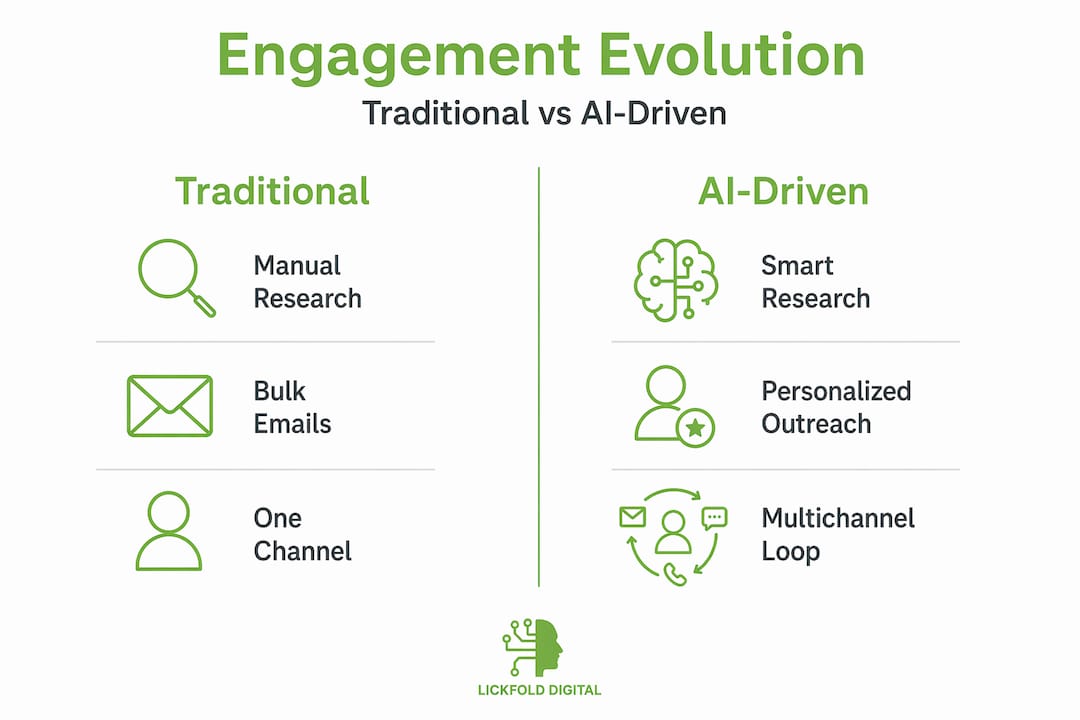
The shift from traditional to AI-driven is not just a technology upgrade. It is a philosophy change. Personalized engagement with AI at scale means you stop choosing between quality and volume.
Common mistakes and expert tips for maximizing engagement
Even teams with good systems make predictable errors. These mistakes are costly because they compound over time, training both reps and buyers to expect lower-quality interactions.
The three most damaging pitfalls are:
- Confusing activity with engagement: Sending 500 emails a week and measuring success by open rates. This inflates effort metrics while obscuring the fact that virtually no real buyer interaction is occurring.
- Ignoring multi-touch orchestration: Relying on a single outreach channel or stopping after one or two touches. Research consistently shows that most B2B responses come after three to five touchpoints, often across different channels.
- Failing to act on engagement signals: A prospect clicks a link twice, revisits your pricing page, and opens three emails in a row. Without a system tracking these behavioral signals and triggering timely, relevant follow-up, the signal fades and the opportunity closes quietly.
Consider this scenario: a sales team runs a campaign to 200 prospects. They send two emails and move on when they get no replies. The actual engaged subset of that list (who clicked, opened multiple times, or visited the website) is around 30 people. By failing to follow up on those behavioral signals with timely, personalized messages, they leave roughly 15% of their addressable pipeline completely untouched. Multiply that across a quarter and the revenue impact is significant.
The engagement system across touchpoints must account for these signals because buyers rarely convert on first contact. The system should detect intent and respond to it, not just broadcast on a predetermined schedule regardless of buyer behavior.
AI-driven email automation enables exactly this kind of behavioral triggering, allowing your outreach to respond to what a prospect actually does rather than what your calendar says.
For specific guidance on improving your outbound approach, AI-driven prospecting tips and a look at AI prospecting agents in action will give you both strategic and tactical direction.
Pro Tip: Set up behavioral triggers in your engagement system. Any prospect who takes two or more significant actions (link click, page visit, email open combined with a LinkedIn view) should enter a priority follow-up sequence within 24 hours. Speed to follow-up on warm signals is one of the clearest separators between average and top-performing outbound teams.
Why the real difference is system-level thinking
Here is the uncomfortable truth about B2B engagement that most thought leadership glosses over: the teams winning on outbound are not winning because they have better tools. They are winning because they think at the system level, and their competitors do not.
Most sales organizations still treat engagement as a numbers game. Hire more reps. Send more emails. Add more sequences. Buy more lists. This approach works until it stops working, usually around the point where deliverability drops, prospect fatigue sets in, and pipeline quality collapses. We have seen this pattern play out repeatedly.
The compounding value of system-level thinking is difficult to quantify in a single quarter but impossible to ignore over a year. When every touchpoint is tracked, when every engagement signal feeds back into your process, and when your messaging improves based on actual buyer behavior rather than assumptions, the system gets smarter every week. A team running a feedback-driven engagement system for twelve months will outperform a larger team relying on volume-based outreach, because boosting engagement efficiency with AI is ultimately about compounding marginal gains, not single dramatic improvements.
The costly lesson we have seen play out in teams without system-level KPIs is a plateau followed by burnout. Reps send more and more, see diminishing returns, and eventually disengage themselves. The fix is almost never more activity. It is better measurement, tighter feedback loops, and honest accounting for what is actually producing buyer interaction versus what is simply filling a CRM with logged tasks.
Top performers differentiate through systematization. They define their engagement KPIs before a campaign launches, not after it fails. They build multichannel sequences with explicit behavioral triggers. They review engagement data weekly and adjust message types, timing, and targeting accordingly. Tool choice matters, but it is secondary to the discipline of treating engagement as a system you build and improve, not a task you complete.
Enhance your prospect engagement with AI-driven automation
The difference between a B2B team that struggles with pipeline predictability and one that hits targets consistently often comes down to how systematically they approach prospect engagement. Understanding the framework is the first step. Implementing it with the right infrastructure is what actually moves the needle.
At Lickfold Digital, we deploy AI agents that handle every stage of the engagement loop, from ICP-matched research to personalized multichannel outreach, reply qualification, and meeting booking, so your team receives warm, pre-qualified opportunities rather than raw contacts. If you are ready to build an engagement system that compounds over time rather than burning through lists, connect with our team and we will walk you through exactly what that looks like for your specific market and buyer profile.
Frequently asked questions
What is the main difference between lead generation and prospect engagement?
Lead generation focuses on finding and capturing prospects, while prospect engagement is about initiating and maintaining two-way interactions that guide a lead toward a meeting or purchase decision.
How does AI improve prospect engagement in B2B sales?
AI agents orchestrate cadences across email and LinkedIn, handle reply triage, qualify prospect intent, and book meetings automatically, making engagement faster, more scalable, and more data-driven.
What KPIs should I track to measure prospect engagement?
Track reply rates, positive reply rates, meeting booking rates, and engagement per channel. Confusing engagement with activity leads to measuring the wrong outputs and optimizing for volume instead of genuine buyer interaction.
Can automation lead to impersonal or spammy outreach?
Only if it is configured carelessly. AI agents that personalize context, orchestrate thoughtful multichannel cadences, and qualify replies before any human handoff produce outreach that feels relevant and timely, not automated or generic.