
What Is a Sales Development Function in B2B Sales?
What Is a Sales Development Function in B2B Sales?
TL;DR:
- A sales development function is a team that qualifies prospects before passing them to account executives. It improves pipeline predictability and speeds up response times by focusing on early-stage lead qualification. Effective practices include aligned definitions, multi-channel outreach, and prioritizing quality over quantity.
A sales development function is a specialized team focused on identifying, qualifying, and nurturing prospects before handing them off to account executives for closing. This front-end role sits between marketing and the closing team, handling the early stages of the sales cycle so that Account Executives (AEs) spend their time on deals that are actually ready to move. Sales Development Representatives (SDRs) and Business Development Representatives (BDRs) are the two primary roles within this function. Together, they generate sales-qualified leads (SQLs) and book meetings that feed a predictable pipeline. For any B2B company serious about growth, understanding what a sales development function does is the first step toward building one that works.
What is a sales development function and what does it do?
A sales development function is the organizational unit responsible for all front-end sales activities, from first contact to qualified handoff. SDRs act as the bridge between marketing-generated interest and the closing conversations that AEs handle. Without this function, AEs waste time chasing unqualified leads, and marketing-generated demand goes cold before anyone follows up.

The function operates in two directions. Inbound sales development handles leads that marketing has already attracted, qualifying them quickly before interest fades. Outbound sales development targets cold accounts that match the ideal customer profile, building pipeline from scratch through research and multi-channel outreach.
Both directions share the same goal: deliver a qualified, well-documented opportunity to an AE who can close it. The function does not close deals. It creates the conditions for deals to be closed.
What are the primary responsibilities of the sales development function?
The sales development role covers a defined set of activities that move a prospect from first awareness to sales-ready status.
Core responsibilities include:
- Prospecting: Identifying target accounts and decision-makers through research, intent data, and CRM records
- Outreach: Executing multi-channel sequences across email, phone, and LinkedIn to initiate contact
- Lead qualification: Applying frameworks like BANT (Budget, Authority, Need, Timeline) or MEDDIC to assess fit and intent
- Lead nurturing: Maintaining contact with prospects who are not yet ready to buy, keeping them warm until timing improves
- Handoff preparation: Documenting fit, intent, and agreed next steps before transferring the opportunity to an AE
Qualification frameworks matter because they create a shared language between sales development and closing teams. BANT asks whether a prospect has the budget, decision-making authority, a clear need, and a defined timeline. MEDDIC goes deeper, adding economic buyer identification and competitive analysis. The choice of framework depends on deal complexity and average contract value.
Pro Tip: Never hand off a meeting without a documented “next step” that both the prospect and the AE have agreed to. A meeting without a confirmed agenda and stakeholder commitment is just a calendar event, not a sales opportunity.
Effective sales development also depends on close alignment with marketing teams and CRM tools for tracking engagement. When marketing and sales development share the same lead scoring criteria, qualification becomes faster and more consistent.
How does the sales development function improve pipeline predictability?
Pipeline predictability is the single biggest operational benefit of a dedicated sales development function. A consistent flow of qualified opportunities reduces end-of-quarter scrambles and gives revenue leaders accurate data for forecasting. When AEs are the ones doing their own prospecting, pipeline volume fluctuates with their capacity and mood. A dedicated team removes that variability.
Dedicated sales development teams also improve speed-to-lead, responding to inbound inquiries faster than closing teams who are managing active deals. Speed matters because the first vendor to engage a qualified prospect wins the meeting at a disproportionate rate.
The function is measured by a specific set of metrics that track quality, not just volume:
| Metric | What it measures |
|---|---|
| Connect rate | Percentage of outreach attempts that reach a live prospect |
| Meetings booked | Number of qualified meetings scheduled per rep per month |
| Meeting show rate | Percentage of booked meetings that actually occur |
| Meeting-to-opportunity rate | Percentage of meetings that convert to active pipeline |
| Pipeline per rep | Total dollar value of opportunities generated per SDR |
Sales development effectiveness is measured by conversion quality, not activity volume. A rep booking 30 meetings a month that never convert is less valuable than one booking 12 that consistently become pipeline. That distinction separates well-run sales development functions from busy ones.
Pro Tip: Track meeting-to-opportunity rate by SDR, not just by team. Individual variation in this metric reveals coaching opportunities and shows which reps are qualifying well versus just filling calendars.
Separating SDR and BDR teams from AEs enhances efficiency by letting specialists focus on distinct parts of the sales cycle. AEs close faster when they are not also responsible for cold outreach. SDRs qualify better when they are not distracted by deal management.
What is the difference between SDRs and BDRs?
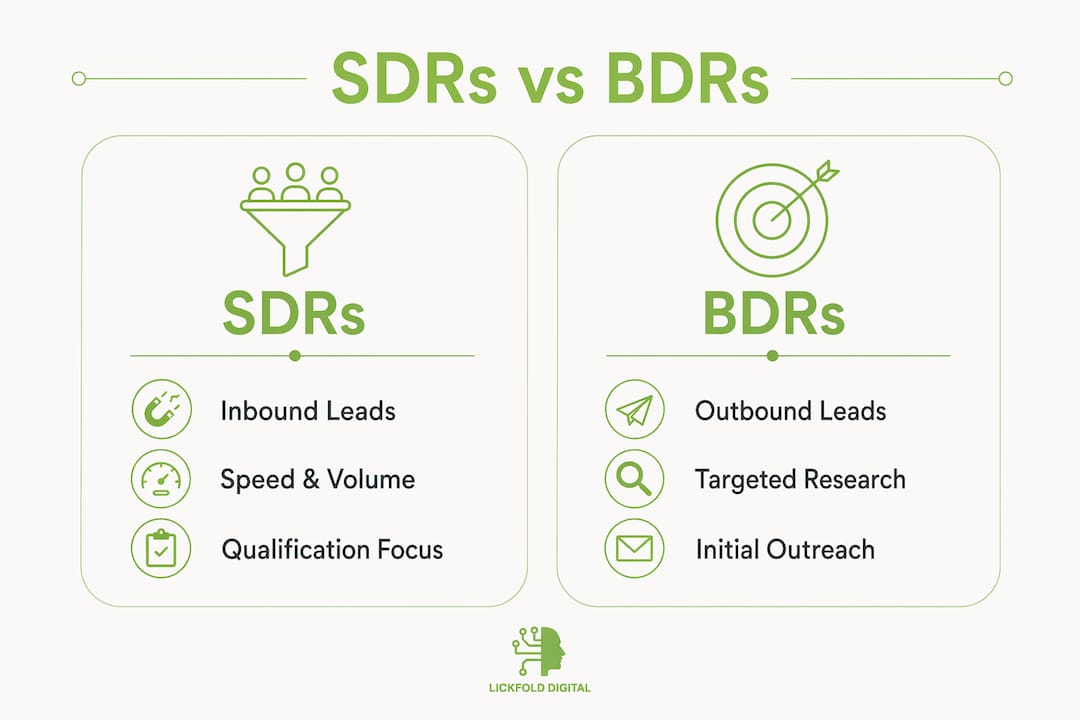
The SDR vs. BDR distinction is one of the most misunderstood topics in B2B sales. The distinction lies primarily in lead source: SDRs qualify inbound leads that marketing has generated, while BDRs focus on outbound prospecting into cold accounts.
The operational difference is significant. SDRs work with speed and volume. An inbound lead has already shown interest, so the SDR’s job is to qualify quickly and book a meeting before that interest fades. BDRs work with research and relationship. A cold account has no existing interest, so the BDR must identify the right contact, build relevance, and create a reason to engage.
| Dimension | SDR | BDR |
|---|---|---|
| Lead source | Inbound (marketing-generated) | Outbound (cold accounts) |
| Primary skill | Fast qualification and conversion | Research, targeting, and relationship building |
| Volume vs. depth | Higher volume, shorter cycles | Lower volume, longer cycles |
| Key metric | Speed-to-lead and meeting show rate | Meetings booked from cold outreach |
| Shared objective | Handoff quality to AE | Handoff quality to AE |
Title variations exist across companies, but consistent qualification criteria and handoff quality matter more than what the role is called. Some companies use “SDR” for both inbound and outbound work. Others use “BDR” exclusively for enterprise outbound. The label is less important than the process behind it.
The qualification package handed to AEs, covering fit, intent, and a defined next step, matters more than the number of meetings booked. This is true for both SDRs and BDRs. A clean handoff with complete context gives the AE a real shot at closing. A bare meeting invite without context wastes everyone’s time.
What are best practices for effective sales development in B2B?
Effective sales development in B2B requires more than hiring reps and giving them a list of contacts. The function needs structure, technology, and tight coordination with both marketing and sales.
Practices that consistently produce results:
- Align on lead definitions. Marketing and sales development must agree on what constitutes a marketing-qualified lead (MQL) and a sales-qualified lead (SQL). Without shared definitions, leads fall through the cracks or get passed too early.
- Build multi-channel cadences. Single-channel outreach underperforms. Effective cadences combine email, phone, and LinkedIn touches over a defined number of days. The sequence should vary message angle, not just repeat the same ask.
- Use CRM data to prioritize. Not all prospects deserve equal attention. CRM engagement data, intent signals, and firmographic fit should determine which accounts SDRs and BDRs contact first.
- Coach on handoff quality. Regular review of handoff notes and AE feedback on meeting quality closes the loop between sales development and closing. This is where most teams leave improvement on the table.
- Invest in training. SDRs require strong communication and prospecting skills, and employers prioritize those skills over formal education. Ongoing coaching on objection handling, qualification, and messaging quality compounds over time.
The best sales development strategy balances inbound lead qualification with proactive outbound prospecting. Companies that rely only on inbound are vulnerable to marketing budget cuts. Companies that rely only on outbound miss warm demand already in their pipeline. The most resilient functions run both.
Modern SDRs increasingly rely on AI-driven prospecting tools for list building, multi-channel outreach automation, and prioritizing high-value prospects. These tools do not replace human judgment on qualification. They remove the manual work that slows reps down and lets them focus on conversations that matter.
Understanding step-by-step lead qualification gives sales development teams a repeatable process that scales without sacrificing quality. Consistency in qualification is what turns a sales development function into a reliable pipeline engine.
Pro Tip: Review your sales pipeline health monthly with both your SDR lead and your AE lead in the same room. Disagreements about lead quality surface faster when both sides are accountable to the same pipeline number.
The importance of networking in B2B marketing also reinforces sales development efforts. Warm introductions and referral networks shorten qualification cycles because trust is already partially established before the first outreach.
Key Takeaways
A dedicated sales development function is the most direct way to build a predictable B2B pipeline by separating prospecting from closing and measuring quality at every handoff.
| Point | Details |
|---|---|
| Core purpose | Sales development qualifies prospects and books meetings so AEs can focus on closing. |
| SDR vs. BDR distinction | SDRs handle inbound leads; BDRs prospect cold accounts. Both share handoff quality as the key goal. |
| Pipeline predictability | Dedicated teams reduce end-of-quarter scrambles by maintaining a consistent flow of qualified opportunities. |
| Metrics that matter | Track meeting-to-opportunity rate and pipeline per rep, not just meetings booked. |
| Best practice foundation | Align marketing and sales on lead definitions, run multi-channel cadences, and coach reps on handoff quality. |
Why most B2B teams underestimate the sales development function
The most common mistake I see B2B leaders make is treating sales development as a temporary fix rather than a permanent function. They hire one or two SDRs, skip the process work, and then wonder why pipeline quality does not improve. The function fails not because the concept is flawed, but because it was never given the structure it requires.
The second mistake is measuring the wrong things. Activity metrics like calls made and emails sent feel productive but tell you nothing about pipeline health. The teams that get this right obsess over meeting-to-opportunity rate and pipeline per rep. Those two numbers reveal whether the function is actually working.
AI-assisted prospecting is changing what sales development teams can accomplish. Tools that automate list building and outreach sequencing free reps to spend more time on qualification conversations, which is where the real value is created. Lickfold builds exactly this kind of system for B2B companies, running AI-powered outbound workflows that feed qualified opportunities directly to closing teams.
The balance between inbound and outbound is also worth getting right early. Inbound-only functions are fragile. Outbound-only functions are expensive. The best-performing sales development teams I have observed run both, with clear criteria for when each approach applies.
One more thing: do not underestimate the handoff. The qualification package an SDR or BDR delivers to an AE is the product of the entire function. If that package is thin, the AE starts the sales conversation at a disadvantage. Invest in handoff quality as seriously as you invest in outreach volume.
— Duarte
How Lickfold helps B2B teams build a sales development engine
Building a sales development function from scratch takes time, process design, and the right technology. Lickfold gives B2B companies a faster path by deploying AI-driven outbound workflows that identify decision-makers, execute personalized multi-touch outreach, and qualify replies before passing opportunities to your sales team.
The system handles infrastructure setup, email warm-up, and reputation management so your team focuses on conversations, not configuration. Every qualified opportunity arrives with context, fit data, and a confirmed next step. If you want a predictable client growth strategy without building a full SDR team from the ground up, reach out to Lickfold to see how the system works for your market.
FAQ
What is a sales development function in simple terms?
A sales development function is a specialized team that identifies and qualifies prospects before passing them to account executives for closing. Its primary output is sales-qualified leads and booked meetings.
What does an SDR do on a daily basis?
SDRs prospect target accounts, execute multi-channel outreach sequences, qualify inbound leads using frameworks like BANT or MEDDIC, and prepare handoff documentation for account executives.
How is sales development different from sales?
Sales development handles the front end of the sales cycle, focusing on prospecting and qualification. Sales, specifically account executives, handles demos, negotiations, and closing once a qualified opportunity exists.
What metrics should I use to measure sales development performance?
The most important metrics are meeting-to-opportunity rate and pipeline per rep. Connect rate and meeting show rate are useful secondary indicators of outreach quality.
Do SDRs need a college degree?
Employers prioritize communication and prospecting skills over formal education for SDR roles. A college degree is not required to perform effectively in sales development.