
What are decision-maker databases? Unlock B2B outreach
What are decision-maker databases? Unlock B2B outreach
TL;DR:
- Decision-maker databases provide verified, in-depth contact information of key organizational influencers. Using these combined with intent signals significantly improves outreach effectiveness and pipeline growth. Regular data refreshes and compliance are essential for maintaining accuracy and legal adherence.
Most B2B sales teams believe a spreadsheet of company emails is enough to drive pipeline. It isn’t. Generic contact lists rarely connect you with the people who actually control budgets and sign contracts. Decision-maker databases are purpose-built to solve exactly that problem, giving you verified access to the executives, directors, and influencers who move deals forward. Lusha users saw up to 3x more outbound leads and 40-50% better decision-maker reach using verified databases compared to standard lists. This guide breaks down what decision-maker databases are, how they are built, how they compare to intent data, and how to measure their real impact on your pipeline.
Table of Contents
- What are decision-maker databases and why do they matter?
- How decision-maker databases are built: Data sources, verification, and AI
- Decision-maker databases vs intent databases: What’s the difference?
- Key performance benchmarks, pitfalls, and ROI: What to measure and avoid
- The overlooked reality: Why you need more than just lists
- Discover smarter B2B outreach with AI-driven decision-maker databases
- Frequently asked questions
Key Takeaways
| Point | Details |
|---|---|
| Strategic accuracy | Decision-maker databases connect you with verified buyers for better B2B outreach. |
| AI-powered workflows | Modern databases use AI for enrichment, scoring, and real-time updates, improving targeting results. |
| Benchmarks matter | Compare accuracy, refresh rates, and ROI when choosing the right provider. |
| Intent vs contact | Combine intent data with contact data for full-funnel success. |
| Continuous evolution | Regularly refresh your data and process to avoid decay and maintain high outreach performance. |
What are decision-maker databases and why do they matter?
A decision-maker database is not a simple contact list. It is a structured, continuously verified repository of professionals who hold purchasing authority inside their organizations. Think C-suite executives, VPs, directors, procurement leads, and department heads. These are the people who can say yes or no to your solution, and decision-maker databases contain verified information on exactly those executives, C-suite leaders, VPs, directors, and other key influencers.
Standard B2B lists typically include names, job titles, and maybe a company email scraped from a website. Decision-maker databases go much further. They layer in firmographic data (company size, industry, revenue), technographic data (what software a company uses), direct phone numbers, LinkedIn profiles, and in many cases, behavioral intent signals. The difference in depth is enormous.
Why does that depth matter for your team? Because identifying decision makers in a target account without verified data is like cold-calling a switchboard and hoping to reach the CFO. You waste time, burn goodwill, and miss your number.
Here is what a strong decision-maker database typically includes:
- Verified direct email addresses with deliverability confirmation
- Mobile and direct-dial phone numbers for high-value contacts
- Job function and seniority level mapped to buying authority
- Firmographic filters including industry, headcount, and revenue range
- Technographic signals showing current software stack
- Intent signals indicating active research or buying behavior
Understanding the types of decision makers in any given account is equally important. A VP of Sales and a Chief Technology Officer have very different priorities, pain points, and preferred communication styles. A quality database lets you filter by both role and seniority so you reach the right person with the right message.
“The fastest way to kill an outbound campaign is to send it to people who have no authority to act on it. Decision-maker databases exist to eliminate that waste entirely.”
Leading intent data providers have recognized this gap and are increasingly merging contact accuracy with behavioral signals, which we will cover shortly. The strategic advantage is simple: when you reach the right person at the right time, response rates climb and sales cycles shorten.
How decision-maker databases are built: Data sources, verification, and AI
Building a reliable decision-maker database is not a one-time project. It is an ongoing engineering challenge that combines multiple data streams, layered verification, and increasingly, machine learning.
Here is how the process typically works, step by step:
- Data collection from professional networks, public web sources, job boards, press releases, and third-party data partnerships
- Format validation to check that emails follow correct syntax and domain structures
- SMTP verification to confirm that email addresses actually exist on the mail server
- Human review for high-value records where algorithmic confidence is low
- Enrichment with firmographic, technographic, and intent layers from additional sources
- Continuous re-verification triggered by signals like job change alerts or bounce rates
The mechanics involve data collection from professional networks, public sources, and partners, combined with multi-step verification using both algorithms and human review. That human layer matters more than most vendors admit. Algorithms are fast but imperfect, especially when someone changes roles or a company rebrands.

AI plays a transformative role at every stage. Machine learning models predict which contacts are most likely to match your ideal customer profile (ICP), flag records showing signs of data decay, and score contacts by likely engagement. For AI targeting in B2B, this means your outreach list is not just accurate, it is prioritized.
A B2B data provider comparison across seven leading platforms shows that top databases now contain between 280 million and 700 million records globally. Scale alone does not guarantee quality, though. The best platforms balance breadth with rigorous re-verification cycles.
Pro Tip: Before committing to any database vendor, ask specifically about their re-verification frequency and what triggers a record update. Monthly or real-time re-verification is the gold standard. Quarterly is acceptable. Anything less means you are paying for stale data.
For AI-driven prospecting tips that go beyond raw database access, the key is combining verified contacts with AI-powered sequencing so your outreach adapts based on engagement signals rather than firing the same message to everyone.
Decision-maker databases vs intent databases: What’s the difference?
Once you understand how databases are built, the next question is which type of database you actually need. The answer is usually both, but for different reasons.
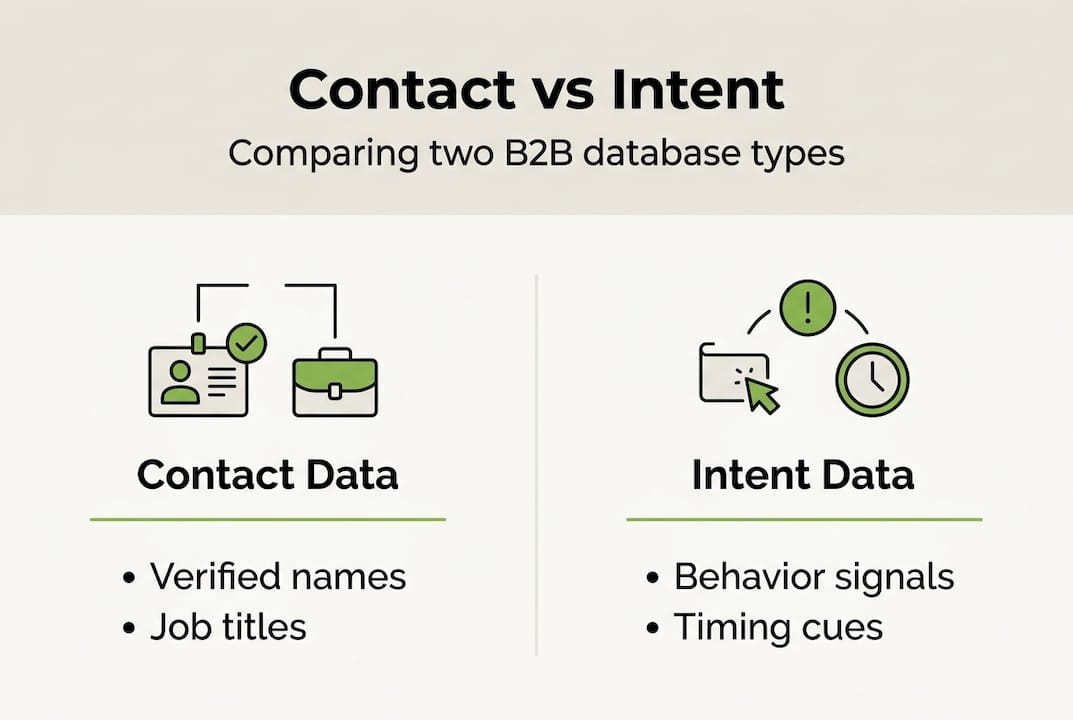
Contact databases and intent databases serve distinct purposes, and confusing them leads to misaligned campaigns. Here is a clear side-by-side comparison:
| Feature | Contact database | Intent database |
|---|---|---|
| Primary focus | Verified contact details | Behavioral buying signals |
| Data type | Static (name, email, title) | Dynamic (content consumption, searches) |
| Best use case | Cold outreach, prospecting | ABM prioritization, timing |
| Accuracy | 88-98% email accuracy | Varies by signal source |
| Update frequency | Quarterly to real-time | Near real-time |
| Decision-maker reach | 40-50% improvement | Lower but better timed |
Pure contact databases excel in verified reach but lack behavioral signals. Intent providers add timing and priority but may have lower contact accuracy. Neither alone gives you the full picture.
The winning approach is a hybrid. You use a verified contact database to build your target list with confidence, then layer intent signals on top to prioritize who to contact first. Someone who matches your ICP and is actively researching solutions like yours is worth three times the outreach effort of someone who simply fits the firmographic profile.
For decision-maker targeting steps that integrate both data types, the workflow looks like this: build your universe from a contact database, filter by intent signals, then sequence outreach starting with the highest-intent accounts.
Key stat: Teams using hybrid databases report 40-50% better decision-maker reach compared to intent-only approaches, which tend to surface timely but less verified contacts.
For account-based marketing (ABM) specifically, the ABM targeting checklist approach works best when you combine contact accuracy with intent prioritization. You want to know who to target and when they are ready to hear from you. Using intent marketing tools alongside a verified contact database gives your team both signals simultaneously.
Key performance benchmarks, pitfalls, and ROI: What to measure and avoid
Knowing which database to use is only half the battle. You also need to know how to measure whether it is working and what can go wrong.
Accuracy benchmarks across leading platforms:
| Provider | Email accuracy | Phone accuracy |
|---|---|---|
| Lusha | 98% | 86% |
| RangeLead | 94% | 41% |
| Industry average | 88% | 60% |
Empirical benchmarks show Lusha at 98% email and 86% phone accuracy, with RangeLead at 94% email accuracy. Teams using verified databases report 3x more outbound leads, 25% more closed deals, and 40-50% better decision-maker reach.
Those numbers sound compelling, but there are real pitfalls to watch for:
- Data decay: 22% annual job changes mean roughly one in five contacts becomes inaccurate every year. Quarterly refreshes are not optional.
- GDPR and CCPA compliance: Storing and using personal contact data without proper legal basis exposes your company to significant fines. Always verify your vendor’s compliance posture.
- Scale vs. accuracy tradeoffs: Larger databases are not always better. A smaller, highly verified list outperforms a massive unverified one every time.
- ICP drift: Your ideal customer profile evolves. A database that matched your ICP 18 months ago may now be pulling the wrong accounts.
Pro Tip: Run a quarterly audit of your database against your last 20 closed-won deals. If the firmographic profile of your wins has shifted, update your ICP filters before your next campaign.
ROI from verified databases compounds over time. Personalized B2B outreach built on accurate data reduces research time per rep, increases connect rates, and makes ABM campaigns scalable without proportionally increasing headcount. For a full breakdown of how to operationalize this, the AI prospecting guide walks through the exact workflow. Lusha’s prospecting tool is one practical starting point for teams evaluating their first verified database.
The overlooked reality: Why you need more than just lists
Here is the uncomfortable truth most database vendors will not tell you: the list is the least important part of your outbound strategy. We see B2B teams spend weeks evaluating data providers, negotiating contracts, and building massive contact exports, then send a generic sequence and wonder why nothing converts.
Static lists decay the moment you export them. Buyers change roles, companies restructure, and priorities shift. Winning teams do not treat a database purchase as a one-time fix. They build workflows that continuously refresh data, layer in intent signals, and evolve their ICP every quarter based on what is actually closing.
Another thing most teams miss: they target a single decision-maker per account. Real buying decisions involve an average of six to ten stakeholders. AI decision-maker strategies that map full buying groups, not just a single contact, consistently outperform single-threaded outreach. The database is your starting point. The workflow, the personalization, and the human judgment layered on top are what actually drive results.
Discover smarter B2B outreach with AI-driven decision-maker databases
Verified data is only powerful when it feeds a system designed to act on it intelligently. If your team is still manually researching contacts, sending templated sequences, or refreshing spreadsheets once a year, you are leaving significant pipeline on the table.
At Lickfold Digital, we combine AI-driven decision-maker databases with fully automated, personalized outreach workflows that identify your best-fit accounts, locate the right contacts, and engage them with messaging that actually resonates. Our system handles infrastructure, warm-up, reputation management, and human qualification of replies before anything reaches your sales team. If you want to see what a fully operational AI-powered outbound pipeline looks like for your specific market, reach out to our team and we will walk you through it.
Frequently asked questions
What types of contacts are included in decision-maker databases?
These databases contain verified profiles for C-suite executives, VPs, directors, and other key influencers with buying authority inside their organizations.
How accurate are AI-driven decision-maker databases?
Leading providers report 88-98% email and 41-86% phone accuracy with routine re-verification cycles built into their platforms.
How often should B2B teams refresh their decision-maker data?
Quarterly refreshes are recommended because 22% annual job changes cause significant data decay that erodes deliverability and accuracy over time.
What’s the difference between a contact database and an intent database?
Contact databases provide verified static information on who to reach, while intent databases track behavioral signals like buying readiness to tell you when to reach them.
What compliance issues should B2B teams consider?
Teams must ensure GDPR and CCPA compliance when storing and using personal contact information, including verifying that their data vendor maintains proper legal basis for processing.