
Human qualification in lead gen: frameworks and best practices
Human qualification in lead gen: frameworks and best practices
TL;DR:
- Human qualification adds essential judgment and nuance to AI-filtered leads, ensuring only valuable prospects reach sales. Combining AI-driven filtering with structured human review improves conversion rates, efficiency, and pipeline quality in B2B sales. Regularly refining qualification criteria and feedback loops is crucial for sustaining high performance and alignment with actual revenue outcomes.
More leads in your pipeline does not automatically mean more revenue. Most B2B marketing managers and sales directors discover this the hard way, watching their teams chase hundreds of prospects each month only to close a fraction of them. The real bottleneck is not volume. It’s the ability to separate genuine sales opportunities from noise, quickly and consistently. Human qualification fills that gap, adding judgment, context, and nuance to what AI-powered systems surface. This article breaks down exactly what human qualification means, which frameworks make it work, and how the best teams blend it with AI to build pipelines that actually convert.
Table of Contents
- Why human qualification matters in modern lead generation
- Core criteria: What defines a “qualified” lead?
- The AI and human hybrid approach: Maximizing conversion and efficiency
- Key performance indicators for human qualification success
- Why most companies get human qualification wrong (and what actually works)
- Take your lead qualification to the next level with Lickfold Digital
- Frequently asked questions
Key Takeaways
| Point | Details |
|---|---|
| Human qualification is essential | AI accelerates, but only human insight ensures true sales readiness. |
| Hybrid approaches outperform | Combining AI and human review boosts conversion rates and lead quality. |
| Clear criteria drive results | Defining and updating strict qualification standards prevents wasted effort. |
| KPI tracking enables optimization | Regularly monitor conversion and disqualification rates to identify improvement opportunities. |
Why human qualification matters in modern lead generation
The appeal of automation in lead generation is obvious. AI can scan thousands of companies, identify decision-makers, and trigger personalized outreach at a scale no human team can match. But speed and volume, on their own, can bury your sales team under a pile of leads that go nowhere.
The numbers are telling. Top-performing teams achieve a 28% marketing-qualified lead to sales-qualified lead (MQL-to-SQL) conversion rate using an AI-plus-human hybrid approach, along with a 52% sales-accepted rate after AI-assisted screening. Teams relying on manual qualification alone are capped at roughly 20 to 30 leads per rep per day, which limits throughput significantly. And here is the signal that most leaders overlook: if your team is disqualifying fewer than 30% of inbound leads, your qualification criteria are almost certainly too soft.
“Volume without rigor is just organized waste. The companies winning at outbound aren’t those sending the most emails. They’re the ones who know exactly when to say no.”
Human qualification is not about slowing the process down. It’s about making sure that when a lead reaches your sales team, it’s worth their time. AI-powered prospecting tips can help scale the top of the funnel effectively, but the middle of the funnel still requires human eyes. AI is excellent at pattern matching and scoring based on firmographic or behavioral data. What it struggles with is reading the subtle signals that a conversation is actually going somewhere: the tone of a reply, the urgency behind a question, or the organizational dynamics that make a deal viable.
Here is what a strong hybrid qualification model covers:
- AI filters for target industry, company size, job title, and engagement signals
- Human reviewers assess intent, buying authority, timing, and fit at a deeper level
- Sales reps receive only pre-screened, sales-ready opportunities
- Disqualified leads feed back into the AI model to sharpen future filtering
- Regular audits ensure criteria stay aligned with actual closed-won characteristics
That last point matters more than most teams realize, but we will come back to it.
Core criteria: What defines a “qualified” lead?
Knowing that human qualification matters is only half the equation. The other half is knowing what your reviewers are actually looking for. Without clear, objective criteria, qualification becomes a gut-feel exercise that varies rep by rep and produces inconsistent outcomes.
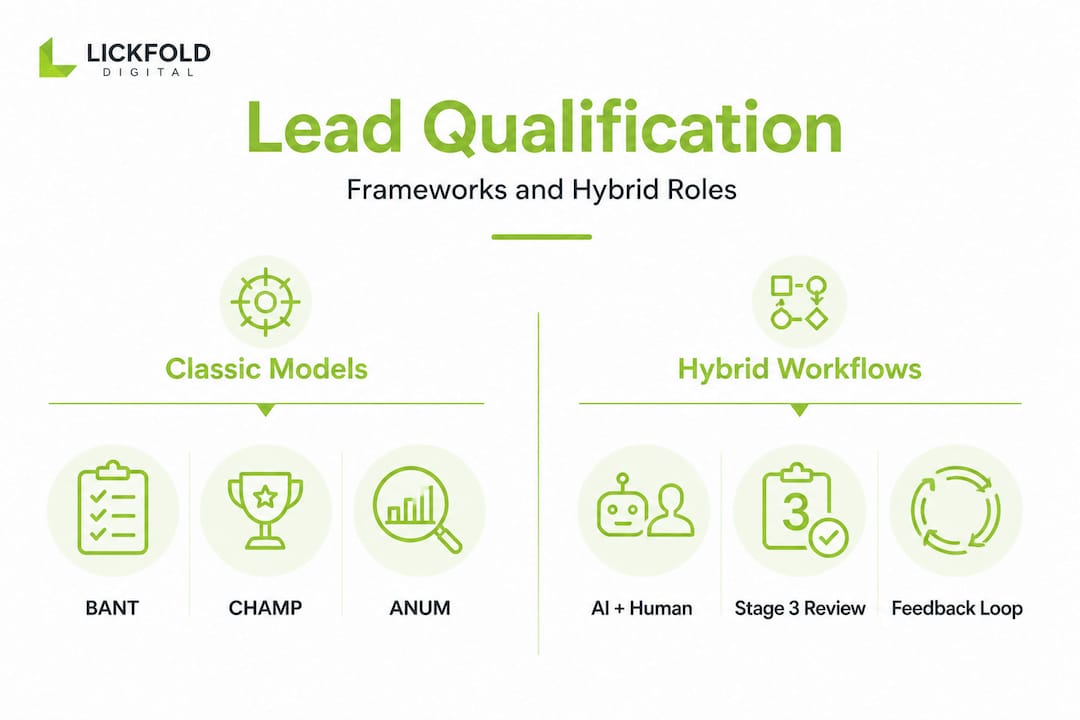
The most widely used frameworks in high-performing B2B organizations are BANT and CHAMP:
| Framework | Core criteria | Best fit |
|---|---|---|
| BANT | Budget, Authority, Need, Timeline | Complex enterprise sales, longer cycles |
| CHAMP | Challenges, Authority, Money, Prioritization | Solution-oriented, consultative selling |
| Behavioral scoring | Engagement data, response patterns, content consumption | Mid-market, inbound-led motions |
BANT (Budget, Authority, Need, Timeline) is the classic framework, originally developed by IBM. It asks whether the prospect has the money, the decision-making power, a real problem to solve, and a concrete timeline to act. CHAMP flips the emphasis, leading with the challenge the buyer is facing rather than budget, which tends to create more authentic early-stage conversations. Behavioral scoring adds a third dimension, drawing on how a prospect actually engages with your outreach and content to infer intent.

The real problem for most teams is not which framework they choose. It’s that their criteria are too vague to apply consistently. Disqualification rates under 30% are a reliable indicator that the team is operating with soft, poorly defined standards. When everyone is a “possible fit,” no one gets prioritized effectively.
Here is a numbered approach to sharpening your qualification criteria:
- Pull your last 12 months of closed-won deals and identify the common attributes across company size, role, industry, and pain point.
- Compare those attributes against your current ideal customer profile (ICP) definition to find gaps or outdated assumptions.
- Translate those attributes into clear, objective yes-or-no qualification questions that any human reviewer can apply consistently.
- Define explicit disqualification triggers, such as companies below a revenue threshold, titles without purchasing authority, or industries outside your service scope.
- Set a benchmark disqualification rate and review it monthly to ensure criteria are working as intended.
Well-structured lead qualification frameworks make this process systematic rather than subjective, and pairing them with precise decision-maker targeting ensures you are evaluating the right people in the first place.
Pro Tip: Calibrate your qualification criteria against the actual buyers who closed, not the ones who showed early interest. Lots of prospects look promising at the top of the funnel and go cold for predictable, preventable reasons. Your criteria should reflect what genuinely correlates with revenue, not what feels like a good lead in week one.
The AI and human hybrid approach: Maximizing conversion and efficiency
Understanding the criteria is one thing. Building a workflow that applies them efficiently, at scale, is where teams separate themselves. The hybrid approach is not just about adding a human review step on top of an AI-generated list. It is a structured, feedback-driven process where each component sharpens the other.
Here is how conversion rates compare across models:
| Qualification model | MQL-to-SQL rate | Sales-accepted lead rate | Leads processed per day |
|---|---|---|---|
| Manual only | 12 to 16% | 30 to 35% | 20 to 30 per rep |
| AI only | 18 to 22% | 38 to 44% | Unlimited volume |
| AI + human hybrid | Up to 28% | Up to 52% | Scalable with rep review |
Hybrid teams consistently hit a 28% MQL-to-SQL rate and a 52% sales-accepted rate, figures that neither approach reaches on its own. The reason is straightforward: AI removes the noise efficiently, and humans catch what AI cannot. Together, they cover more ground with higher accuracy.
A practical hybrid qualification workflow looks like this:
- Stage 1, AI prospecting: The system identifies companies and decision-makers matching your ICP based on firmographic data, technology stack, hiring signals, and engagement behavior.
- Stage 2, automated outreach: Personalized, multi-touch sequences are deployed across email and LinkedIn, and AI tracks open rates, click behavior, and reply sentiment.
- Stage 3, human triage of replies: A trained human reviewer reads every response, assessing tone, stated intent, buying signals, and whether the conversation warrants a sales call.
- Stage 4, qualification confirmation: The reviewer applies your defined criteria (BANT, CHAMP, or a custom version) and either advances the lead or logs the disqualification reason.
- Stage 5, handoff to sales: Only leads that pass human review reach the sales rep, complete with a summary note on why they qualified and what the next step should be.
The point where humans add the most unique value is Stage 3. An AI can flag a reply as “positive” based on word sentiment. A human can recognize that the reply actually signals budget fatigue, org restructuring, or a competitor evaluation underway, all of which change the strategy for the next interaction entirely. The AI transformation research in adjacent sectors like executive search confirms this: AI dramatically improves efficiency, but human judgment remains the deciding factor for high-stakes assessments.
Explore hybrid qualification methods and AI-powered lead automation to see how these workflows are implemented in practice across different B2B verticals.
Pro Tip: Feed every disqualification reason back into your AI model as a labeled data point. Over time, this teaches the system which early signals actually predict disqualification, so it filters them out before human review is even needed. Teams that do this consistently see human review volume drop while lead quality improves quarter over quarter.
Key performance indicators for human qualification success
Building a hybrid process is only useful if you can measure whether it is working. Too many teams track activity metrics, like number of outreach sequences sent or number of replies received, while ignoring the outcome metrics that reveal whether qualification is actually filtering for value.
The metrics that matter most are:
- MQL-to-SQL conversion rate: The percentage of marketing-qualified leads that become sales-qualified after human review. Top-performing teams hit 28% with a hybrid model.
- Sales-accepted lead (SAL) rate: The percentage of SQL-labeled leads that sales reps accept as genuinely worth pursuing. A 52% SAL rate is the benchmark for high-performing hybrid teams.
- Disqualification rate: The percentage of leads reviewed by humans that are removed from the pipeline. This is a leading indicator, not a lagging one. Disqualification below 30% reliably signals that criteria are too soft and that marginal leads are slipping through.
- Time to qualification: How long it takes from initial contact to a qualified or disqualified decision. Long cycle times suggest bottlenecks in the review process.
- Disqualification reason distribution: A breakdown of why leads are being removed. If 60% of disqualifications share a single root cause, that root cause should be filtered by AI before it ever reaches human review.
Tracking both positive and negative outcomes is essential. Most CRM setups record conversions religiously but log disqualifications inconsistently. That asymmetry hides critical intelligence. Every “no” is a data point that, when aggregated, reveals patterns in where your ICP definition or outreach targeting is off.
A strong opportunity qualification practice includes a structured feedback loop: human reviewers flag disqualification reasons, those reasons are reviewed weekly by the marketing or demand generation team, and AI filtering rules are updated monthly based on patterns. The AI governance research that applies to broader AI programs in business is relevant here, because qualification AI requires ongoing oversight to stay aligned with real-world sales outcomes rather than drifting toward optimizing for volume.
Why most companies get human qualification wrong (and what actually works)
Here is the uncomfortable truth most articles on lead qualification avoid: the majority of B2B teams treat qualification as a checkpoint, not a filter for value. A lead hits a score threshold, someone on the team glances at the company name, and it gets passed to sales because nobody wants to be the person who said no to a potential deal.
That behavior is understandable. Marketing teams are measured on MQL volume. Sales teams complain about lead quality but rarely document why leads fail. The result is a feedback void where no one is systematically learning from what did not convert.
What the highest-performing organizations do differently is treat every disqualification as training data, not a failure to hide. When a lead is removed, they record the specific reason. When a deal is lost, they trace back to the qualification stage to understand whether the signals were there early and ignored. They audit their criteria quarterly, not annually, because markets shift and so do ICP profiles.
The real differentiator is not choosing AI over human review or vice versa. It is the feedback loop between the two. AI gets smarter when human disqualification decisions are fed back as labeled examples. Humans get more consistent when AI surfaces objective signals they might otherwise overlook. Companies that treat these two functions as separate departments or sequential handoffs miss most of the value.
We also see teams invest heavily in qualification tooling while neglecting the most basic requirement: clear criteria everyone agrees on. No amount of AI sophistication fixes ambiguous standards. Before adding another tool to your stack, audit your qualification criteria and ask whether two different reviewers looking at the same lead would reach the same decision. If the answer is no, the criteria need work first. AI-driven prospecting tips can accelerate volume, but alignment on what “qualified” actually means is the foundation everything else depends on.
Take your lead qualification to the next level with Lickfold Digital
If this article has clarified what human qualification should look like in your pipeline, the next step is building the infrastructure to make it work at scale. That means more than adopting a framework. It means deploying AI prospecting, structured human review, and continuous feedback loops as an integrated system.
Lickfold Digital combines AI-powered prospecting with dedicated human qualification to deliver sales-ready opportunities directly to your team, without the overhead of managing the process in-house. The platform handles ICP targeting, personalized multi-touch outreach, inbox management, and human review of every reply before anything reaches your sales rep. If you want to see what a fully integrated qualification system looks like in practice, get started with Lickfold Digital today and put your pipeline on a foundation that scales.
Frequently asked questions
What is the difference between marketing-qualified leads and sales-qualified leads in human qualification?
Marketing-qualified leads meet initial interest or firmographic criteria set by the marketing team, while sales-qualified leads have been further reviewed, usually by human judgment, to confirm genuine purchase intent and sales readiness.
How does a low disqualification rate indicate weak human qualification?
When disqualification rates fall below 30%, it typically signals that qualification criteria are too broad or inconsistently applied, allowing marginal leads to pass through and dilute pipeline quality.
Can AI replace the need for human qualification entirely?
No. While AI accelerates prospecting and scales initial filtering, manual-only approaches cap out at 20 to 30 leads per rep per day and miss the contextual signals, tone, and organizational nuance that determine whether a lead is genuinely worth pursuing.
What KPIs should we track for effective human qualification?
Track MQL-to-SQL conversion rate, sales-accepted lead rate, and disqualification percentage together. Top hybrid teams achieve 28% MQL-to-SQL conversion and 52% sales-accepted rates, giving you clear benchmarks to measure against.
Are there proven frameworks for human qualification in B2B sales?
Yes. Leading B2B teams use BANT (Budget, Authority, Need, Timeline) and CHAMP (Challenges, Authority, Money, Prioritization) as structural frameworks, often layered with behavioral scoring to account for engagement signals alongside firmographic fit.