
Automated appointment setting: Boost your sales pipeline
Automated appointment setting: Boost your sales pipeline
TL;DR:
- Automated appointment setting streamlines scheduling but can lead to low quality meetings if qualification is overlooked.
- Effective automation requires a strong qualification framework, clear lead criteria, and continuous feedback between SDRs and AEs.
Booking more meetings sounds like a win. But here’s the paradox many B2B marketing managers discover the hard way: automate your appointment setting, watch your calendar fill up, and then watch your close rate quietly drop. The meetings are there. The deals aren’t. Automated appointment setting is one of the most powerful tools in a modern B2B sales stack, but it’s also one of the most misunderstood. This guide cuts through the noise, explains where automation genuinely accelerates results, and shows you exactly how to avoid the traps that turn a full calendar into a graveyard of wasted sales hours.
Table of Contents
- What is automated appointment setting?
- Lead qualification: The linchpin of successful scheduling automation
- Integrating automated scheduling into your sales workflow
- When automation falls short: Edge cases and pitfalls
- Our take: Why quality beats quantity in appointment automation
- Next steps: Streamline your appointment setting with expert guidance
- Frequently asked questions
Key Takeaways
| Point | Details |
|---|---|
| Automation accelerates booking | Automated appointment setting slashes scheduling time compared to manual processes. |
| Qualification is vital | Successful automation depends on strong lead qualification and role alignment. |
| Track conversion, not just bookings | Measuring only the number of meetings booked masks the real impact; conversions should be tracked. |
| Edge cases can undermine results | Poor qualification or misalignment can create more activity with less business value. |
| Human input improves automation | Integrating feedback and ongoing optimization helps automation deliver consistent ROI. |
What is automated appointment setting?
Automated appointment setting replaces manual, back-and-forth scheduling with technology that handles the logistics of booking meetings between prospects and sales reps. Instead of an SDR (sales development representative) sending five emails to find a time that works, a bot, scheduling app, or workflow automation tool does it instantly, at scale, and without human error.
At its core, the technology works by connecting outreach sequences, availability calendars, and CRM systems into a single, seamless flow. A prospect clicks a link, picks a time, and a meeting appears in both parties’ calendars. Simple. But that simplicity is exactly where the danger hides. Understanding the automation fundamentals behind scheduling tools helps you make smarter choices about where to deploy them.
Key benefits of automated appointment setting include:
- Drastically reduced admin time for SDRs
- Faster response to inbound interest (response speed matters enormously in B2B)
- Elimination of scheduling errors and double-bookings
- Scalable outreach without proportional headcount increases
- Consistent follow-up sequences that keep prospects engaged
Here’s how manual and automated appointment setting compare across the dimensions that matter most to a growing B2B sales team:
| Dimension | Manual appointment setting | Automated appointment setting |
|---|---|---|
| Speed | Slow, multiple exchanges required | Near-instant, single click |
| Error rate | Higher (human oversight, calendar conflicts) | Lower (system-managed) |
| Scalability | Limited by headcount | Scales with volume |
| Conversion potential | Can be high if qualified well | High if qualification is intact |
| Admin burden | Heavy on SDRs | Minimal |
| Cost per booking | Higher | Lower at scale |
As you can see, automation wins on nearly every operational metric. But notice the asterisk on “conversion potential.” That’s the number that actually drives revenue, and it’s the one most teams forget to monitor. Following business automation steps correctly means keeping conversion at the center of every decision.
Here’s the deeper issue: SDR-AE misalignment and lack of SLAs/feedback loops can structurally guarantee leakage, meaning booked meetings may not convert regardless of how slick your scheduling tool is. Technology streamlines logistics. It doesn’t fix broken process.
Lead qualification: The linchpin of successful scheduling automation
Understanding the technology is only half the battle. The real pitfall lies in assuming automation can fix everything. Lead qualification bridges the gap between a full calendar and a healthy pipeline.

When you automate appointment setting without a solid qualification layer, you’re essentially installing a faster tap on a leaky pipe. Volume goes up. Useful output doesn’t. Your AEs (account executives) find themselves sitting through meetings with prospects who were never going to buy, your SDRs get rewarded for booking volume rather than booking quality, and the whole machine runs faster toward the wrong destination.
Common signs your team needs better qualification before automating:
- AEs frequently report that meetings are “unqualified” or “not a fit”
- Pipeline stages show high drop-off immediately after the initial meeting
- SDRs are spending time prepping for calls that go nowhere
- No agreed-upon definition of a “qualified” lead exists across the team
- Feedback from AEs never makes it back to the SDRs who set the meetings
The research backs this up. Structural leakage from SDR-AE misalignment is not a performance problem you can automate away. It’s a process problem that automation will only magnify.
“SDR-AE misalignment and lack of SLAs/feedback loops can structurally guarantee leakage, meaning booked meetings may not convert.”
Before you touch your scheduling tools, build a tight qualification framework. A step by step lead qualification process gives your team a shared definition of what a good lead looks like before the meeting ever gets booked. Pair that with human qualification frameworks to ensure that AI-assisted outreach doesn’t skip the judgment layer that separates a promising prospect from a time-waster.
Pro Tip: Write an SLA (service-level agreement) between your SDR and AE teams that defines exactly what a qualified meeting looks like. Include criteria like company size, decision-maker seniority, budget signals, and timing. Review it monthly. When AEs and SDRs are aligned on quality standards, automation becomes a genuine accelerant rather than a noise amplifier.
Following automation best practices in your outbound workflow means treating qualification as infrastructure, not an afterthought. Teams that invest here first consistently outperform those that bolt it on later. A solid qualification layer also transforms how you approach prospecting with AI, because your AI-driven outreach reaches the right people rather than just more people.
Integrating automated scheduling into your sales workflow
With qualification in place, the next step is implementing automation into your workflow. Done right, it’s a game-changer. Here’s how to do it without breaking what’s already working.
Step-by-step integration process:
- Audit your current workflow. Map out every touchpoint between first contact and booked meeting. Identify where delays and manual effort currently live.
- Select your scheduling tool. Choose a platform that integrates natively with your CRM and email system. Clunky integrations create data gaps that haunt you later.
- Define your lead routing rules. Not every lead should go to the same rep or the same meeting type. Set up routing logic based on company size, industry, or product interest.
- Build your qualification checkpoint. Before the automated scheduler fires, ensure a qualification step exists. This can be a short form, a human review step, or a scored lead threshold.
- Connect your CRM bidirectionally. Meeting data, prospect responses, and no-show rates should all flow back into your CRM automatically.
- Set up feedback loops. Create a mechanism for AEs to flag unqualified meetings immediately after they occur. This data feeds back to refine SDR targeting.
- Test with a small segment first. Run your automated flow on a defined lead segment before scaling. Use this phase to catch integration errors and calibrate your qualification thresholds.
Measuring whether all of this is working requires the right metrics. Don’t just track booked meetings. Track these:
| Metric | What it tells you | Target benchmark |
|---|---|---|
| Booking rate | % of outreach that results in a booked meeting | Varies by industry; compare to baseline |
| Show rate | % of booked meetings where prospect attends | Above 75% is healthy |
| Conversion rate (meeting to opportunity) | % of meetings that advance in pipeline | Benchmark against pre-automation rate |
| Leak rate | % of meetings that result in no follow-up or advance | Should decrease over time |
| Average time to appointment | Days between first contact and meeting | Lower is better; track trends |
| Cost per qualified meeting | Total spend divided by meetings that convert | Declining trend indicates efficiency |
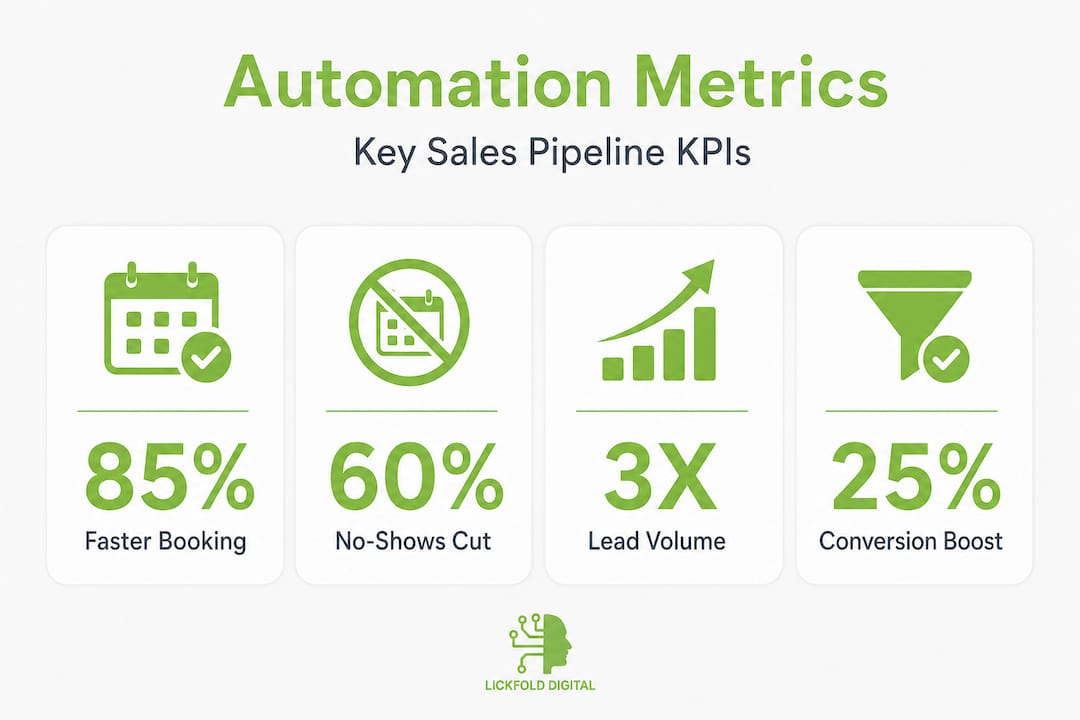
Good management tools for scheduling will surface most of these metrics natively, but you may need to combine CRM data with your scheduling platform reports to get the full picture.
Pro Tip: Never celebrate a high booking rate in isolation. If your conversion rate drops as your booking rate rises, you have a qualification problem, not a success story. Review conversion data weekly during the first 90 days after any automation change.
Teams that handle this integration thoughtfully often find it opens up entirely new growth channels. Automated market entry becomes viable when your scheduling and qualification system can operate at scale without breaking down. Keeping up with sales automation trends also helps you anticipate where the technology is heading so your workflow doesn’t become obsolete.
When automation falls short: Edge cases and pitfalls
Automation is not a panacea. Here’s where even the best systems can trip up, and what to look for before these issues cost you real pipeline.
The most common failure mode is this: a team implements scheduling automation, sees a 40% increase in booked meetings, and celebrates. Three months later, they notice their close rate has fallen and their AEs are demoralized. What happened? The automation was booking everyone who responded, not just the right responders.
Common pitfalls that undermine automated appointment setting:
- Unclear lead criteria. If SDRs don’t know exactly who qualifies, they’ll set any meeting the automation can fill.
- No AE feedback mechanism. When AEs can’t flag bad meetings quickly, the same errors repeat indefinitely.
- Overloaded SDRs. Automation can generate so much activity that SDRs lose the ability to apply judgment to individual cases.
- Poor CRM integration. Disconnected systems mean prospect history doesn’t reach the AE before the meeting, making every call feel cold.
- Template-heavy messaging. Generic outreach sequences get meetings with the wrong people, while personalized approaches attract genuine buyers.
- Ignoring no-show patterns. High no-show rates are a leading indicator that something in your targeting or qualification is off.
The conversion drop-off in teams with structural SDR-AE misalignment is not a small variance. It can represent the difference between a profitable outbound function and one that burns through budget without producing revenue.
Consider a real-world scenario: a SaaS company automates its inbound scheduling, removing a human qualifier from the process to save time. Booking volume rises 60% in the first month. But two months later, they find that 55% of those new meetings are with users in job roles that have no purchasing authority. Their AEs are frustrated, their pipeline is inflated with low-quality opportunities, and their actual close rate has cratered. The fix isn’t more automation. It’s re-inserting a qualification gate and using their case study on booking automation as a reference point for what the system should and shouldn’t handle.
Understanding the mechanics behind online booking systems also helps you see where human judgment genuinely adds value versus where it’s just friction.
Our take: Why quality beats quantity in appointment automation
The B2B sales industry has developed an unhealthy fixation with volume metrics. More outreach, more bookings, more meetings. The assumption is that if you optimize the top of the funnel enough, the revenue will follow. That’s not how it works.
We’ve seen teams across industries deploy sophisticated scheduling automation and end up worse off than before because they treated technology as a substitute for process. It isn’t. Technology is an amplifier. If your underlying process is weak, scaling it faster just creates louder noise.
The teams that get the most from automated appointment setting share a common trait: they are obsessive about quality at every stage, and they are humble enough to let feedback change their behavior. That means AEs who flag bad meetings the same day they happen. It means SDRs who take those flags seriously and adjust their targeting. It means managers who look at conversion rates, not just booking rates, when evaluating performance.
There’s also a counterintuitive lesson here. Slowing down your automation to insert a human review step often increases your overall output. Fewer meetings, but more of them convert. Your AEs are energized rather than exhausted. Your pipeline is tighter and more predictable. That’s what good human-centric lead qualification actually looks like in practice.
The contrarian truth is that the best use of AI in appointment setting is not to replace human judgment but to give human judgment more leverage. Let AI handle targeting research, outreach sequencing, and scheduling logistics. Reserve human attention for the moments where context, nuance, and relationship intelligence actually matter. That combination, AI speed plus human precision, is where the real competitive edge lives.
Next steps: Streamline your appointment setting with expert guidance
If the lesson here resonates, you’re probably already thinking about where your current process has gaps. Maybe your AEs are seeing too many unqualified meetings. Maybe your automation is running without a real qualification layer underneath it. Maybe you’re tracking bookings but not conversions.
Lickfold Digital works with B2B teams to design and deploy outbound systems that combine AI-powered prospecting with human qualification, so the meetings your team shows up to are actually worth their time. From infrastructure setup to outreach sequencing to AI automation solutions that run continuously across your target market, the approach is built around pipeline quality, not pipeline volume. You can book your free session to walk through your current setup and identify exactly where automation can add genuine value, or schedule a consultation to go deeper on your specific industry and ICP. The goal isn’t a fuller calendar. It’s a better one.
Frequently asked questions
Can automated appointment setting replace human qualification?
No. Automation handles logistics efficiently, but structural leakage from SDR-AE misalignment proves that without human judgment in the qualification process, booked meetings simply won’t convert at rates that justify the effort.
How do I measure the success of automated appointment setting?
Focus on conversion rate, show rate, and leak rate rather than raw booking volume, because meetings that don’t advance the pipeline represent wasted sales capacity regardless of how efficiently they were scheduled.
What are common pitfalls when automating appointment setting?
The most damaging pitfalls are unclear lead criteria and absent feedback loops between SDRs and AEs, because without both, automation reliably scales the wrong behavior.
What technology is essential for effective scheduling automation?
At minimum, you need a scheduling bot, a CRM integration that flows data bidirectionally, an email automation platform, and a qualification mechanism, whether that’s a lead scoring threshold, a short intake form, or a human review step before the meeting is confirmed.