
What Is Prospect Fit Analysis? A B2B Guide
What Is Prospect Fit Analysis? A B2B Guide
TL;DR:
- Prospect fit analysis scores accounts against the ideal customer profile to determine their suitability before outreach. It helps prioritize high-fit accounts for faster conversions and longer retention, improving pipeline efficiency. The process should be regularly reviewed and integrated with routing rules for effective ABM and outbound campaigns.
Prospect fit analysis is the process of scoring accounts and contacts against your ideal customer profile (ICP) to determine whether they belong in your pipeline at all, before you spend a dollar of SDR time on them. It answers one question: is this the right kind of company for us? ICP-fit accounts convert faster and retain longer than low-fit accounts, which means every hour your team spends chasing poor-fit prospects is a direct tax on pipeline efficiency.
TL;DR:
- Fit analysis sets eligibility — who gets worked, who gets nurtured, who gets suppressed
- Fit scores drive tiering — A/B/C bands that map to ABM motions and SDR coverage
- Fit scores enable routing — immediate AE alerts, SDR sequences, or automated nurture
Lickfold Digital and the Pedowitz Group both treat fit-first tiering as the foundation of any AI-driven outbound or ABM program, and this guide walks through exactly how to build and operationalize it.
Table of Contents
- How does prospect fit analysis differ from intent scoring?
- What signals and data sources go into a fit model?
- How do you build a prospect fit model step by step?
- How do you use fit scores in ABM and outbound workflows?
- What metrics should you track, and what pitfalls should you avoid?
- Worked example: scoring a sample B2B prospect
- Key Takeaways
- Why most teams get fit scoring wrong before they even start
- Lickfold Digital can build and run this for you
- Useful sources and further reading
How does prospect fit analysis differ from intent scoring?
These two signals answer completely different questions, and conflating them is one of the most common mistakes in B2B go-to-market execution.
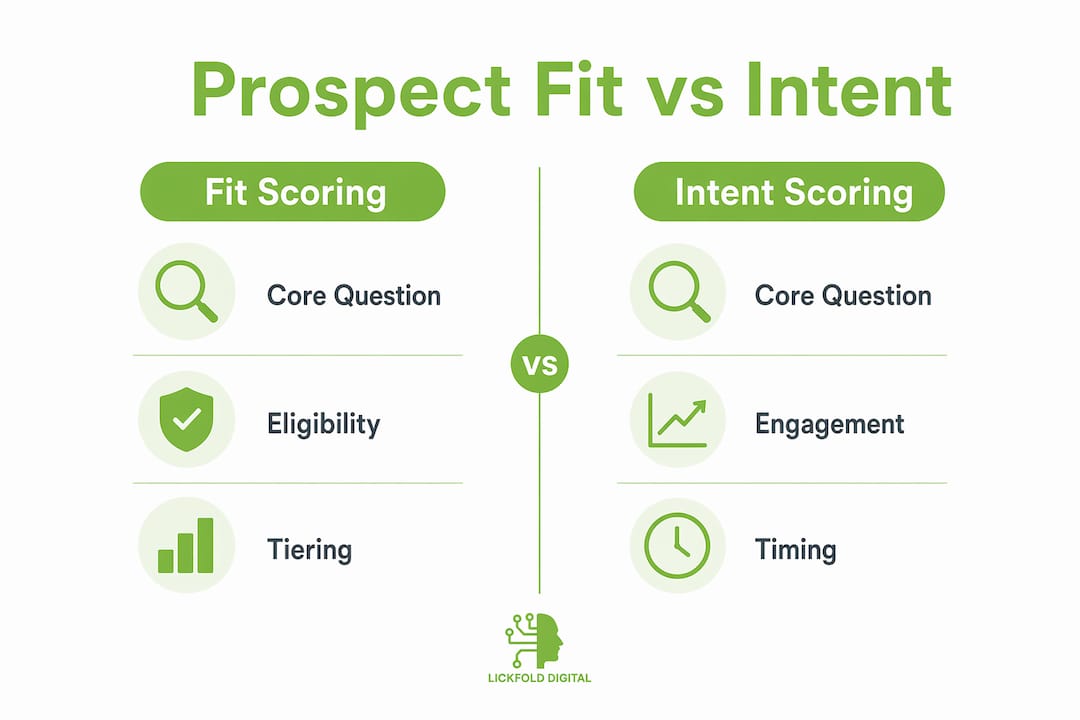
Fit scoring answers “Is this the right kind of account for us?” Intent scoring answers “Are they showing buying interest right now?” Use fit to define eligibility and tiering; use intent for timing and urgency in outreach. — Pedowitz Group
| Dimension | Fit scoring | Intent scoring |
|---|---|---|
| Core question | Is this account a match for our ICP? | Is this account actively researching a solution? |
| Primary use | Eligibility, tiering, territory coverage | Outreach timing, urgency, surge response |
| Data inputs | Firmographics, technographics, persona | Content consumption, search topics, ad engagement |
| Update cadence | Weekly to monthly | Daily to weekly |
| ABM motion | Sets the tier (A/B/C) | Triggers the play within that tier |
The practical rule: run fit first to build your addressable universe, then layer intent on top to decide who to call this week. A high-intent, low-fit account is a distraction. A high-fit, low-intent account is a future pipeline asset worth nurturing.
When to lead with fit: ABM programs, territory planning, new market entry, and any motion where coverage and precision matter more than speed.
When intent takes the wheel: Surge campaigns, competitive displacement plays, and time-sensitive trigger events like funding rounds or executive hires.
What signals and data sources go into a fit model?
A well-structured fit scoring pipeline combines firmographic, technographic, persona, and enrichment inputs. Here is how to think about each layer.
Firmographic signals (the foundation):
- Industry vertical and sub-vertical (SIC/NAICS codes)
- Employee headcount band (e.g., 50–500)
- Annual revenue or ARR range
- Geography and market segment
- Funding stage (seed, Series A–C, PE-backed, public)
Technographic signals (compatibility check):
- CRM platform (Salesforce, HubSpot) — confirms your integration works
- Complementary tools in the stack (e.g., a marketing automation platform your product connects to)
- Incompatible or competitive tools that signal a no-go
Buyer and persona signals:
- Job title seniority and function
- Decision-making authority (economic buyer vs. champion vs. blocker)
- Buying committee size — larger committees often mean longer cycles
Enrichment and behavioral signals (used to inform fit, not replace it):
- Recent job changes that shift authority
- Hiring patterns that signal growth or a new initiative
- Technology spend indicators from enrichment APIs
Where to source this data: CRM first-party data, enrichment APIs (such as Clearbit or Apollo), job posting scrapers, and intent providers for technographic overlays. For data hygiene and enrichment workflows, trigger enrichment before scoring runs, not after.
Pro Tip: Prioritize first-party CRM data and one high-quality enrichment API over stacking three noisy third-party feeds. Signal overlap creates false confidence; a clean, narrow dataset scores more accurately than a bloated one with 40% field coverage.
How do you build a prospect fit model step by step?
A practical scoring rubric uses 5–7 criteria. Using too few criteria misses predictive signal; using too many slows evaluation without meaningful accuracy gains.
-
Define your ICP from closed-won data. Pull a sample of recent closed-won deals. Identify the firmographic, technographic, and persona attributes that appear most consistently. Add strategic goals (new verticals, upmarket move) as secondary inputs.
-
Select 5–7 signals and map them to features. Use the signal categories above. Assign each a maximum point value based on predictive importance. ICP fit and decision-making authority should carry the heaviest weights.
-
Choose a scoring approach. For most teams starting out, a simple point system works well. Assign raw points per signal, sum them, and normalize to a 0–100 scale. More mature teams can move to logistic regression or gradient-boosted trees once they have 500+ closed outcomes to train on.
Sample scoring formula:
Fit Score = Σ(signal_weight × signal_value) / max_possible_points × 100 -
Normalize inputs and run data hygiene. Deduplicate records, resolve company name variants, and enrich missing fields before the score calculates. A missing “employee count” field that defaults to zero will tank an otherwise strong account.
-
Validate against historical outcomes. Score your closed-won and closed-lost datasets. If A-fit accounts are not clustering in closed-won, your weights are off. For predictive models, check ROC/AUC. Recalibrate weights quarterly.
Implementation timeline and cost drivers: Expect several weeks for an initial point-based model, covering ICP definition, signal selection, CRM build, enrichment setup, and validation. Primary cost drivers are enrichment API subscriptions, intent feed licenses, and RevOps or engineering time for CRM configuration.
Pro Tip: Overfitting happens when you tune weights to a small closed-won sample. Keep your model to 5–7 signals and validate on a holdout set of at least 30 accounts before deploying to live routing.
How do you use fit scores in ABM and outbound workflows?
Operational routing maps fit bands to coverage models and SLAs. Here is the standard tiering logic:
- A-fit (score 80–100): High-touch ABM motion. Immediate AE alert within 4 hours. Personalized 1:1 outreach with custom research, executive-level messaging, and multi-channel sequencing.
- B-fit (score 55–79): SDR-led outbound. Enroll in a structured 8–12 touch sequence. Personalize at the persona level (role, industry pain point). SLA: first touch within 24 hours.
- C-fit (score 30–54): Automated nurture. Marketing-owned cadence. No SDR time until fit score improves or intent signal spikes.
- D-fit (score below 30): Suppression. Do not contact. Flag for periodic re-evaluation if the account’s firmographics change.
The routing rule that most teams skip: connect fit bands to SLA enforcement in your CRM. A score without a routing rule is just a number. — Pedowitz Group
For CRM integration, store fit scores as governed properties in Salesforce or HubSpot. Set up automation to re-trigger enrichment when key fields change, recalculate scores on a weekly schedule, and update the routing tier automatically. Your ABM playbook execution depends on these tiers being current.
Pro Tip: Build a closed-loop feedback pipeline: when a deal closes or churns, write the outcome back to the account record. This feeds your quarterly recalibration and catches weight drift before it corrupts routing.

What metrics should you track, and what pitfalls should you avoid?
KPIs to track by fit band:
- Conversion rate (MQL to SQL, SQL to closed-won) per band
- Pipeline velocity (days from first touch to close) per band
- Average contract value (ACV) per band
- Customer acquisition cost (CAC) per band
- Routing accuracy (% of records routed to the correct tier)
- Enrichment coverage rate (% of records with all scored fields populated)
Common pitfalls:
- Over-broad ICP: if more than 30% of your total addressable market scores as A-fit, your criteria are too loose
- Stale enrichment: scores calculated on 6-month-old firmographic data will misroute accounts that have grown or pivoted
- Mixing fit and intent into one score: a single blended score hides which signal is driving the number, making recalibration guesswork
- Ignoring closed-lost patterns: negative disqualification flags for no-go conditions (wrong industry, too small, incompatible tech) are as predictive as positive signals
Recalibration cadence: Review scoring weights quarterly against closed-won and closed-lost outcomes. For predictive models, run ROC/AUC checks when your closed-outcome sample grows by 100+ records.
Pro Tip: Track routing accuracy separately from conversion rate. If a significant portion of A-fit accounts are being manually re-routed by AEs, your thresholds may be incorrect — not your ICP.
Worked example: scoring a sample B2B prospect
Here is a points-based fit score for a hypothetical SaaS prospect.
| Signal | Max points | Raw score | Notes |
|---|---|---|---|
| Industry (target vertical) | 25 | 25 | Exact ICP vertical match |
| Employee headcount (100–500) | 20 | 20 | — |
| Decision-maker seniority (VP+) | 20 | 15 | Director-level contact, not VP |
| CRM stack (Salesforce) | 15 | 15 | Confirmed via technographic API |
| Funding stage (Series B) | 10 | 10 | Recent Series B announced |
| Geography (US, target region) | 10 | 10 | HQ in target metro |
| Total | 100 | 95 |
Step-by-step calculation:
- Sum raw scores: 25 + 20 + 15 + 15 + 10 + 10 = 95
- Normalize: 95 / 100 × 100 = 95 (Fit Score)
- Apply band: score 80–100 = A-fit
- Routing action: AE alert triggered within 4 hours; enroll in 1:1 ABM sequence
If the contact seniority field had been missing before scoring, the score would have defaulted to 0 for that signal, dropping the total to 80 and still landing in A-fit — but just barely. Enriching missing fields before the calculation runs prevents false negatives on accounts that would otherwise qualify. Shifting the seniority weight from 20 to 25 points (and reducing geography to 5) would push a VP-level contact to a 100 and make the model more sensitive to authority, which is worth testing if authority is a strong predictor in your closed-won data.
Key Takeaways
Prospect fit analysis is the eligibility layer every B2B outbound and ABM program needs before intent data or personalization can work at full precision.
| Point | Details |
|---|---|
| Fit vs. intent are separate signals | Use fit for eligibility and tiering; use intent for outreach timing — never blend them into one score. |
| 5–7 signals is the right rubric size | Fewer misses predictive signal; more than eight slows qualification without meaningful accuracy gains. |
| Routing rules complete the model | A fit score without a CRM routing rule and SLA enforcement is just a number — connect them. |
| Recalibrate quarterly | Review weights against closed-won and closed-lost data every quarter to prevent score drift. |
| Lickfold applies fit-first tiering | Lickfold’s AI agents enrich and score accounts before outreach, routing only qualified prospects to human review. |
Why most teams get fit scoring wrong before they even start
The conventional wisdom says to build your ICP first, then score. That order is right, but the mistake is treating ICP definition as a one-time workshop exercise. Most teams define their ICP from intuition and a handful of marquee logos, then bake those assumptions into a scoring model that never gets challenged. The model runs, routes records, and quietly drifts away from reality while the team assumes the system is working because it is producing output.
The fix is not a better scoring formula. It is a governance habit: a quarterly closed-loop review where you pull the last 90 days of closed-won and closed-lost outcomes, check whether A-fit accounts are actually converting at a higher rate, and adjust weights when they are not. That feedback loop is what separates a fit model that compounds in value from one that calculates a number nobody trusts after six months.
AI makes this faster, not automatic. Enrichment APIs fill missing fields before scoring runs. Machine learning models surface non-obvious predictors. But the judgment call about which signals matter for your specific product and market still requires a human with access to your closed-won data. The teams that get the most out of AI-driven prospecting are the ones who treat the model as a living asset, not a one-time setup.
Lickfold Digital can build and run this for you
Fit-first prospecting delivers results when the data infrastructure, enrichment, and routing are set up correctly from day one. Lickfold handles the entire stack: AI agents for account research and decision-maker mapping, enrichment before scoring, personalized multi-touch outreach, and human qualification of every reply before it reaches your sales team. The result is a pipeline where your AEs only see accounts that already passed a fit threshold.
A 90-day pilot covers infrastructure setup, ICP definition, fit model build, campaign launch, and a calibration review at day 60. Expected deliverables include a scored account universe, tiered routing rules in your CRM, and a live outbound sequence targeting A-fit and B-fit accounts. Reach out to Lickfold to scope your pilot and get a qualified pipeline running within the quarter.
Useful sources and further reading
- Prospect Fit Analysis: Prioritize High-Value Leads — Upcell
- What Is Fit-Based Account Scoring — Pedowitz Group
- B2B Sales Prospect Evaluation Criteria — Sendspark
- ICP Fit: Definition, Scoring & How to Prioritize Leads — Bullseye
- B2B Lead Qualification Framework — Sendspark
- AI-Powered Prospecting Guide — Lickfold Digital
- AI Prospecting Step-by-Step Guide for B2B Sales — Lickfold Digital
- Step-by-Step Lead Qualification for B2B Sales — Lickfold Digital