
The Role of Data in Agency Prospecting: 2026 Guide
The Role of Data in Agency Prospecting: 2026 Guide
TL;DR:
- Data-driven prospecting relies on signals like firmographics, behavioral, and intent data to target prospects precisely. Agencies using this method achieve higher conversion rates, faster research, and more predictable pipelines compared to cold outreach. Automating data collection and AI-powered workflows further enhance efficiency and early engagement, giving agencies a competitive advantage.
Data-driven prospecting is defined as the practice of using firmographic, behavioral, and intent signals to identify and engage prospects with precision, replacing random outreach with targeted, timed campaigns. The role of data in agency prospecting has shifted from a supporting function to the primary engine of client acquisition. Companies using data effectively are 23 times more likely to acquire customers and 19 times more likely to be profitable, according to McKinsey research. That gap explains why agencies still relying on gut instinct and cold lists are losing ground to those running signal-led pipelines.
What is the role of data in agency prospecting?
Agency prospecting is the process of identifying, qualifying, and engaging potential clients before a formal sales conversation begins. Data’s role in that process is to replace guesswork with evidence. Instead of calling a list of companies that match a rough industry description, data-driven agencies target accounts showing active buying signals, such as recent funding rounds, leadership changes, or hiring spikes in relevant departments.

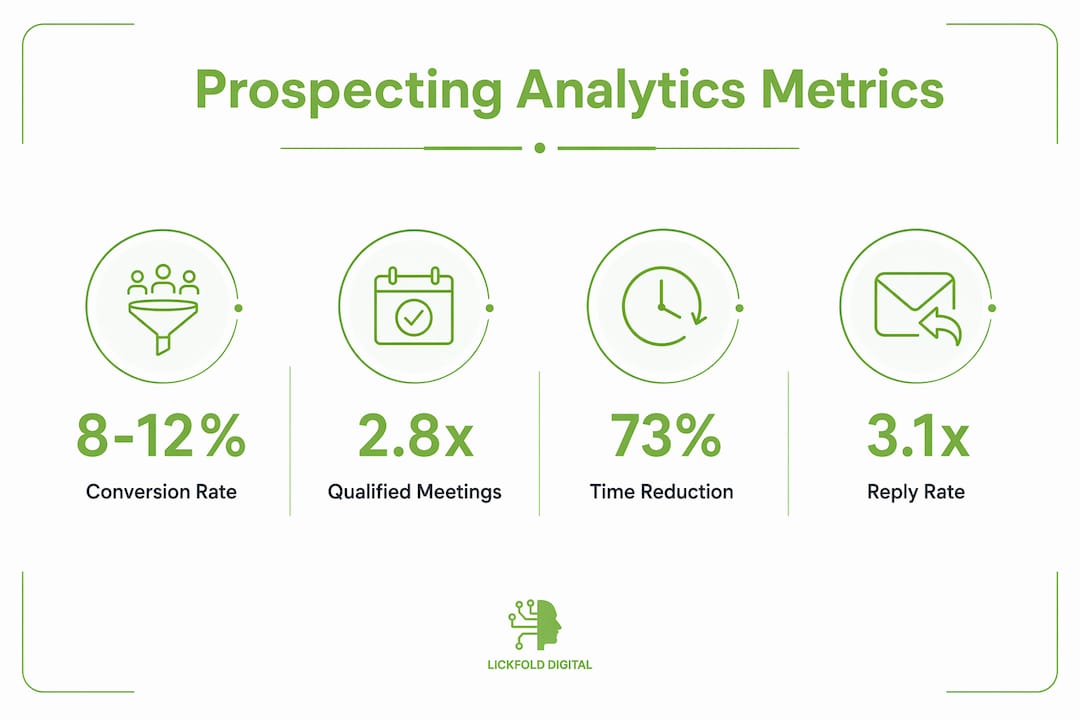
The industry benchmark makes the case clearly. Signal-led prospecting delivers 2.8x more qualified meetings and conversion rates of 8–12%, compared to a 2.3% industry average for cold calling. That is not a marginal improvement. It is the difference between a prospecting motion that funds growth and one that drains business development budgets.
The standard industry term for this approach is data-driven prospecting, sometimes called intelligence-led outreach. Both phrases describe the same discipline: using structured data inputs to guide every decision in the sales process, from which accounts to target to what message to send and when to send it. Agencies that master this discipline build predictable pipelines rather than chasing reactive leads.
What types of data drive successful agency prospecting?
Four data categories form the foundation of any serious prospecting program.
- Firmographic data covers company size, industry, revenue range, headcount, and geography. This is the baseline filter that defines your ideal client profile (ICP).
- Behavioral signals include hiring activity, job postings in marketing or growth roles, leadership changes, and press releases about expansion. These signals indicate a company is in motion and likely open to outside help.
- Intent data comes from third-party platforms that track which companies are actively researching topics related to your services. A company reading multiple articles about paid media strategy is a warmer prospect than one that has not shown that behavior.
- AI-enhanced signals layer machine learning on top of the above categories to surface patterns a human analyst would miss, such as correlations between funding stage and agency spend timing.
- CRM intelligence treats your own historical data as a prospecting asset. Lost deal notes, email response patterns, and past client profiles reveal which account types convert and which waste your team’s time.
Data enrichment connects these layers. When a behavioral signal fires, enrichment tools append firmographic context automatically, so your team sees the full picture before writing a single word of outreach. The result is personalization that feels specific because it is specific, not because a template was filled in with a company name.
Pro Tip: Treat your CRM as a dynamic intelligence source, not a contact database. Analyze lost deal notes and email engagement patterns to sharpen your ICP definition every quarter.
How does data analytics improve prospecting precision and outcomes?
Analytics transforms raw data into ranked priorities. The most effective agencies assign a Strategy-Fit Score to each account, combining firmographic match, behavioral signals, and intent data into a single number that tells business development reps where to spend their time first.
Predictive lead scoring takes this further by applying historical win data to new accounts. If your agency has closed 15 SaaS companies between 50 and 200 employees after they posted a VP of Marketing role, that pattern becomes a scoring rule. Every new account matching that profile rises to the top of the queue automatically.
The analytics metrics that matter most in agency prospecting are reply rates, meeting rates, and win rates. Tracking all three reveals where the pipeline breaks. A high reply rate with a low meeting rate signals a messaging problem. A high meeting rate with a low win rate points to a qualification or positioning issue. Data makes the diagnosis specific.
| Metric | Benchmark | Signal-led result |
|---|---|---|
| Cold call conversion rate | 2.3% | 8–12% |
| Reply rate (templated email) | 4% | 11% |
| Prospect research time | 22 minutes | 4 minutes |
| Sales cycle length | 11 weeks | 8 weeks |
Automated workflows cut research time from 22 minutes to 4 minutes per account and lift reply rates from 4% to 11%. That efficiency gain compounds across hundreds of accounts per month.
Pro Tip: Automate your data enrichment and scoring workflows before you scale outreach volume. Reps who spend time on manual research instead of conversations pay an “admin tax” that kills outbound cadence after week three.
How do AI and automation power data-driven prospecting workflows?
AI changes the economics of data-driven prospecting by doing in seconds what previously took hours. The most impactful application is early engagement. Agencies using AI-powered intent platforms engage prospects an average of 47 days before an RFP is issued. By the time a competitor receives the RFP, the AI-enabled agency has already built a relationship and shaped the prospect’s thinking.
Here is how a fully automated prospecting workflow operates in practice:
- Signal detection. An AI agent monitors job boards, funding databases, news feeds, and intent platforms continuously. When a target account triggers a buying signal, the system flags it immediately.
- Account enrichment. The flagged account is automatically enriched with firmographic data, contact details for relevant decision-makers, and recent company news.
- Outreach drafting. The AI drafts a personalized message referencing the specific signal, the prospect’s business context, and a relevant agency capability. No generic templates.
- Multi-touch sequencing. The system schedules follow-up touches across email and LinkedIn, adjusting timing based on engagement behavior.
- Human handoff. When a prospect replies with interest, a human team member reviews the conversation, qualifies the opportunity, and books the meeting.
Predictive lead scoring reduces time wasted on low-quality prospects by 73%, freeing business development capacity for accounts that actually convert. That is not a workflow improvement. It is a fundamental shift in how agencies allocate their most expensive resource: experienced people.
AI personalization achieves 3.1x better reply rates compared to templated cold email. The reason is simple. Prospects respond to messages that reference their actual situation, not messages that could have been sent to anyone. You can read more about how AI agents accelerate sales across B2B environments to understand the full scope of what these workflows can do.
The common pitfall in AI adoption is treating automation as a replacement for judgment. AI surfaces the signal and drafts the message. A human decides whether the account is a genuine fit and whether the message reflects the agency’s voice. Agencies that skip the human review step produce volume without quality.
Pro Tip: Start AI automation with signal detection and enrichment before automating outreach writing. Getting the targeting right first means your personalized messages land on accounts that are actually ready to buy.
What are the best practices for applying data in agency prospecting?
Applying data well requires more than buying a tool. It requires aligning your data inputs with your agency’s actual delivery edge. If your strongest service is B2B content strategy for fintech companies, your ICP should reflect that specificity, and your data filters should target fintech companies showing content-related buying signals, not every company in financial services.
The agencies that build predictable pipelines share three practices:
- ICP discipline. They define their ideal client profile with enough specificity that a data filter can find matching accounts. “Mid-market SaaS companies with a marketing team of 5 or more” is a filter. “B2B companies” is not.
- Signal timing. Signal-based outreach timing converts 4–5x better than random cold outreach. Agencies that send messages within 48 hours of a trigger event capture attention when it is most available.
- Multi-threading. Engaging both senior buyers and operational champions raises deal win rates by 34%. Data helps identify both contacts within an account, so outreach reaches the economic decision-maker and the day-to-day champion simultaneously.
The shift from reactive to predictable growth also requires focusing data on high-profit services. Identifying high-profit service lines through data analysis lets agencies stop pursuing work that consumes capacity without generating margin. When your prospecting data is aligned with your most profitable delivery capabilities, every meeting you book has a higher chance of becoming a retainer worth keeping.
Understanding how AI benefits agencies in terms of productivity and ROI gives additional context for why data orchestration is becoming the defining capability for agencies that grow consistently.
Key Takeaways
Agencies that treat data as a prospecting system, not a contact list, consistently outperform those relying on cold outreach and intuition.
| Point | Details |
|---|---|
| Signal-led outreach converts far better | Signal-led prospecting delivers 8–12% conversion rates versus 2.3% for cold calling. |
| AI enables early engagement | AI-powered platforms engage prospects 47 days before RFP issuance, ahead of competitors. |
| Automation cuts research time sharply | Automated workflows reduce account research from 22 minutes to 4 minutes per account. |
| Multi-threading raises win rates | Engaging both senior buyers and operational champions improves deal win rates by 34%. |
| ICP alignment drives pipeline quality | Matching data filters to your strongest service lines produces meetings that convert to retainers. |
Data as a competitive moat, not just a tool
I have worked with agency teams that had access to the same intent data platforms, the same enrichment tools, and the same CRM systems as their fastest-growing competitors. The difference was never the data. It was the discipline around using it.
The agencies that win on data do not just collect signals. They build scoring systems that force prioritization. They review lost deal notes every month to refine their ICP. They automate the research tasks that used to eat three hours of a rep’s morning, and they redirect that time toward conversations that require actual judgment.
The insight that changed how I think about this: raw data is a commodity. Every agency can buy the same lists and subscribe to the same intent platforms. The competitive moat comes from transforming that data into proprietary intelligence through consistent scoring, signal interpretation, and AI-assisted analysis. That is what separates agencies building predictable pipelines from those still running spray-and-pray outreach.
The admin tax is real and it is underestimated. When reps spend 22 minutes researching each account manually, they burn out by week three of any outbound push. Automation does not replace the rep. It removes the friction that causes reps to stop prospecting. That is a human performance problem with a data solution.
My prediction for the next two years: agencies that invest in data orchestration now will find it nearly impossible for competitors to replicate their pipeline velocity. The gap between data-enabled and data-absent agencies will widen faster than most agency leaders expect.
— Duarte
How Lickfold helps agencies build data-powered pipelines
Agencies ready to move from manual prospecting to a signal-led system have a clear path forward with Lickfold. Lickfold deploys dedicated AI agents that monitor buying signals, enrich target accounts, and execute personalized multi-touch outreach campaigns continuously, without the admin overhead that stalls most outbound programs.
The system covers the full prospecting workflow: signal detection, contact identification, outreach personalization, follow-up sequencing, and human qualification of replies before they reach your sales team. Agencies using Lickfold reduce research time, increase reply rates, and build predictable client growth without scaling headcount. If your agency is ready to run a data-driven outbound program at scale, reach out to Lickfold to see how the system works in practice.
FAQ
What is data-driven prospecting for agencies?
Data-driven prospecting uses firmographic, behavioral, and intent signals to identify and engage prospects at the right time with relevant messaging. It replaces random cold outreach with a targeted, signal-led process that consistently produces higher conversion rates.
How much better does signal-led outreach perform?
Signal-led prospecting delivers conversion rates of 8–12% and 2.8x more qualified meetings compared to the 2.3% industry average for cold calling. Outreach timed to buying signals also converts 4–5x better than untimed cold outreach.
What is a Strategy-Fit Score?
A Strategy-Fit Score combines firmographic match, behavioral signals, and intent data into a single ranking that tells business development teams which accounts to prioritize. It replaces subjective gut-feel prioritization with a repeatable, data-based system.
How does AI reduce prospecting time?
AI automates signal detection, account enrichment, and outreach drafting, cutting per-account research time from 22 minutes to 4 minutes. That efficiency lets agencies run consistent outbound programs without burning out their business development teams.
Why does multi-threading improve agency win rates?
Multi-threading engages both the senior economic buyer and the operational champion within the same account simultaneously. Agencies that apply this approach raise deal win rates by 34%, because no single contact departure can stall a deal in progress.