
What Is Agency Prospecting Automation? 2026 Guide
What Is Agency Prospecting Automation? 2026 Guide
TL;DR:
- Agency prospecting automation uses AI to identify, qualify, and engage potential clients automatically. It helps sales teams recover time and increase pipeline speed by replacing manual research and outreach tasks. Successful implementation relies on clean data, signal-based triggers, and ongoing workflow optimization.
Agency prospecting automation is the use of artificial intelligence and software to automatically identify, qualify, and engage potential clients in agency sales workflows. The industry term for this discipline is outbound sales automation, and it covers everything from AI-driven lead discovery to personalized multi-channel outreach at scale. Tools like HubSpot Prospecting Agent and Salesforce AI features now handle tasks that once required a full team of sales development representatives. The result is a faster pipeline, better-qualified leads, and sales reps who spend their time closing rather than researching. This guide explains exactly how the technology works, what separates it from traditional automation, and how to implement it without common pitfalls.
What is agency prospecting automation and how is it defined?
Agency prospecting automation is defined as the deployment of AI agents and automated software to replace manual steps in the client acquisition process. Those steps include lead research, data enrichment, lead scoring, outreach sequencing, and follow-up. The goal is not to remove humans from sales. The goal is to remove humans from the parts of sales that do not require human judgment.

The distinction matters because sales reps spend only 28–30% of their time actually selling. The rest goes to research, data entry, and administrative tasks. Automation reclaims that time by handling lead discovery, enrichment, and initial engagement automatically. When a rep finally speaks to a prospect, the groundwork is already done.
Modern agency lead generation tools go further than simple email sequences. Platforms like HubSpot Prospecting Agent use AI to research accounts, draft personalized messages, and adapt outreach based on prospect behavior. Salesforce AI features integrate directly into CRM workflows to score leads and trigger follow-up actions without manual input. The practical effect is an outbound team that operates continuously, across time zones, without fatigue.
How does agency prospecting automation work?
The operational workflow behind prospecting automation follows a clear sequence. Understanding each step helps you identify where automation adds the most value in your agency’s pipeline.
-
Data unification. The system pulls contact and account data from your CRM, website analytics, LinkedIn, and third-party data providers into a single source of truth. Without this step, every downstream action is built on incomplete information.
-
Signal-based lead discovery. Instead of working through a static list on a fixed schedule, the system monitors buying signals. A prospect visiting your pricing page, downloading a case study, or changing job titles triggers an immediate response. High-performing agencies favor signal-based prospecting over calendar-based cadences because timing is the single biggest variable in outreach effectiveness.
-
Data enrichment. Once a lead is identified, the system appends missing information: company size, tech stack, revenue range, decision-maker contacts. The best implementations use a waterfall enrichment approach, querying multiple data providers in sequence until the record is complete.
-
Lead scoring and routing. AI models score each lead based on fit and intent signals, then route high-priority prospects to the right rep or trigger an automated outreach sequence for lower-priority contacts.
-
Multi-channel outreach. The system executes personalized outreach across email, LinkedIn, phone, and video simultaneously. Messaging is tailored to the prospect’s industry, role, and the specific signal that triggered the sequence.
-
Autonomous AI engagement. Inbound prospects who respond receive immediate, context-aware replies from AI agents. These agents handle qualification questions, schedule meetings, and escalate complex conversations to human reps.
Pro Tip: Start with data quality before you build any automation. Without clean, enriched data, automation amplifies targeting errors at scale. Run a deduplication and enrichment audit on your CRM before activating any outreach sequences.
How does prospecting automation differ from traditional sales automation?
The difference between agency prospecting automation and traditional sales automation is the difference between a rule and a decision.
| Automation type | How it works | Best for |
|---|---|---|
| Rule-based automation | Executes fixed workflows triggered by preset conditions | Email drip sequences, CRM field updates |
| Autonomous AI agents | Reasons, adapts, and executes complex tasks without manual input | Lead research, personalized outreach, meeting scheduling |
| Marketing automation | Broadcasts messages to large segments | Brand awareness, nurture campaigns |
| Prospecting automation | Manages individual lead lifecycle with 1-on-1 personalization | Client acquisition, pipeline generation |
Rule-based automation follows a script. If a contact opens an email, send a follow-up in three days. If they click a link, add them to a list. These workflows are predictable and easy to build, but they cannot adapt when a prospect’s behavior falls outside the script.
Autonomous AI agents operate differently. They reason about context, evaluate available information, and choose the next best action. A 2026 shift in the industry has moved leading agencies from rules-based to autonomous AI agents capable of handling complex, multi-step sales tasks without human intervention at each step.
Prospecting automation focuses on individual lead lifecycle management, unlike marketing automation, which targets broad audience segments. Marketing automation sends the same nurture email to 10,000 contacts. Prospecting automation researches a specific decision-maker, writes a message referencing their recent company news, and follows up based on their actual response behavior. The two tools solve different problems and should not be confused.
What are the measurable benefits of prospecting automation for agencies?
The business case for automating client outreach is built on three categories of impact: quota attainment, time recovery, and pipeline speed.
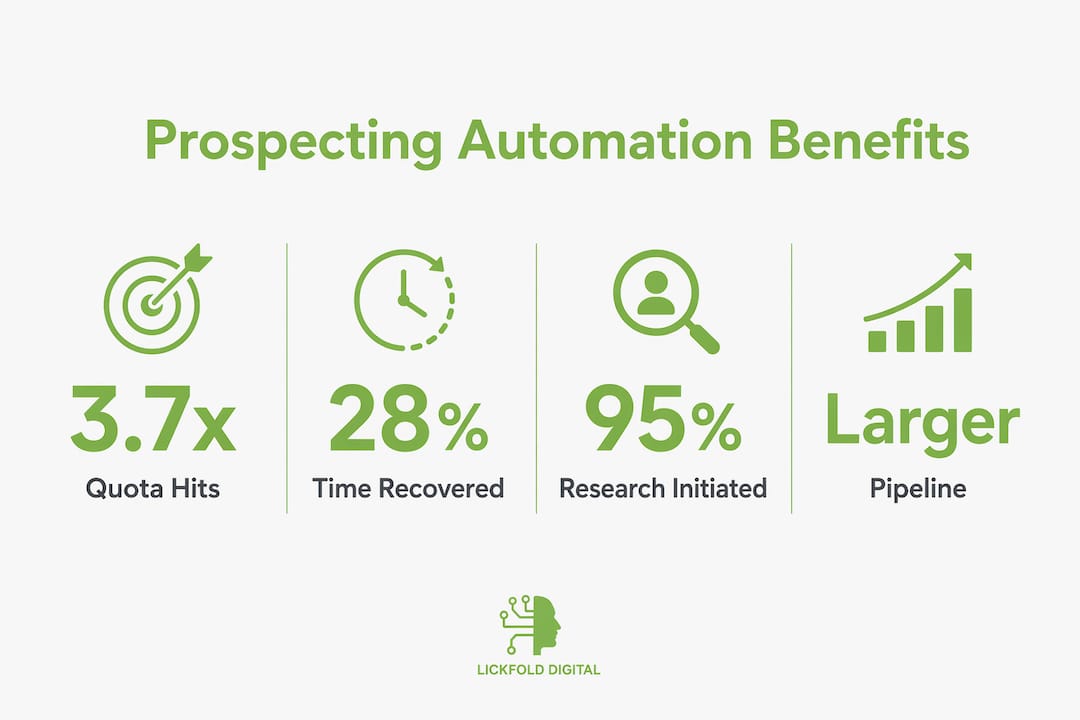
Teams using AI-driven prospecting are 3.7x more likely to hit sales quotas compared to teams relying on manual prospecting. That gap reflects the compounding advantage of consistent, high-volume, well-timed outreach that human teams cannot sustain manually.
Time recovery is the second major benefit. When automation handles lead research, data entry, and initial outreach, reps redirect their attention to discovery calls and contract negotiations. The productivity gain is not marginal. It fundamentally changes what a sales team can accomplish with the same headcount.
Pipeline speed matters because buyer behavior has changed. By 2027, 95% of B2B sales research workflows will initiate with AI, and buyers finalize their vendor shortlist on day one 95% of the time. If your agency is not in the conversation early, you are not in the conversation at all. Automated prospecting software closes that gap by responding to buying signals within minutes rather than days.
The combined effect is a pipeline that is larger, faster, and more predictable. Agencies that automate B2B prospecting report lower cost per qualified lead and higher conversion rates at every stage of the funnel.
How to implement agency prospecting automation effectively in 2026
Effective implementation starts with a narrow focus, not a broad rollout. Agencies that try to automate everything at once typically automate nothing well.
- Start with high-intent triggers. Website pricing page visits, proposal follow-ups, and referral inquiries are the highest-value moments in your pipeline. Automating high-intent responses first delivers faster ROI than broad cold outreach and carries far less risk to your sender reputation.
- Keep humans in the loop for complex deals. AI handles routine research and outreach while humans focus on trust-building and closing. Define clear escalation rules so AI agents hand off conversations before they reach their limits.
- Invest in prompt engineering and workflow optimization. High-performing agencies allocate 20–30% of their time to refining AI behavior, adjusting prompts, and improving workflow logic. Automation is not a one-time setup. It requires ongoing calibration to stay effective.
- Audit your data before you scale. Poor data quality is the most common reason prospecting automation underperforms. Run enrichment and deduplication before activating any sequence.
- Measure what matters. Track reply rates, meeting booking rates, and pipeline value generated per sequence. Vanity metrics like emails sent tell you nothing about whether your automation is working.
Pro Tip: The fastest path to ROI in agency client acquisition automation is not cold outreach. Focus your first automated sequences on prospects who have already shown intent: website visitors, webinar attendees, and lapsed clients. These contacts convert at significantly higher rates than cold lists.
What are the top agency lead generation tools for prospecting automation?
The market for automated prospecting software has matured quickly. Several platforms now offer AI-native features built specifically for agency sales workflows.
HubSpot Prospecting Agent integrates directly with HubSpot CRM to research accounts, draft personalized outreach, and manage follow-up sequences. It is best suited for agencies already operating within the HubSpot ecosystem.
Salesforce AI features, including Einstein AI and Agentforce, bring autonomous prospecting capabilities to Salesforce CRM users. The platform excels at lead scoring and opportunity routing for larger sales teams.
LeadAdvisor AI specializes in high-ticket outbound for agencies, combining AI-driven lead research with multi-channel outreach orchestration. Its signal-based triggering system is particularly effective for agencies targeting enterprise accounts.
Rep’s autonomous agents handle the full prospecting workflow from lead discovery through meeting scheduling, operating as a virtual SDR team. The platform is designed for agencies that want to scale B2B leads without proportionally increasing headcount.
When evaluating any tool, apply these four criteria:
- Data capabilities. Does the platform support waterfall enrichment and integrate with your existing data sources?
- AI autonomy level. Can the system reason and adapt, or does it only execute fixed rules?
- CRM integration. Does it sync bidirectionally with your existing CRM without manual exports?
- Ease of calibration. How much technical expertise does it take to adjust AI behavior and refine workflows?
Key takeaways
Agency prospecting automation delivers measurable pipeline growth when built on clean data, signal-based triggers, and human oversight for complex deals.
| Point | Details |
|---|---|
| Core definition | Agency prospecting automation uses AI to handle lead discovery, enrichment, scoring, and outreach automatically. |
| Signal-based triggers | Replace calendar-based cadences with event-driven outreach to reach prospects at the right moment. |
| Quota impact | Teams using AI-driven prospecting are 3.7x more likely to hit sales quotas than manual teams. |
| Data quality first | Waterfall enrichment and deduplication must precede any automation rollout to avoid amplified targeting errors. |
| Human oversight | AI handles routine tasks; humans manage complex negotiations and relationship-building to close deals. |
The shift I’ve seen that most agencies are still missing
Most agencies I talk to frame prospecting automation as a volume play. Send more emails, book more meetings, fill the pipeline faster. That framing is wrong, and it leads to burned sender domains and annoyed prospects.
The real value of autonomous AI agents is not volume. It is precision at scale. An AI agent that researches a prospect’s recent funding round, identifies the decision-maker who owns the budget, and sends a message that references a specific business challenge they have publicly discussed is not doing cold outreach. It is doing warm outreach at the speed of cold outreach. That distinction changes conversion rates entirely.
What I have also seen is that agencies underestimate the ongoing work. The agencies getting the best results from prospecting automation are not the ones who set up a sequence and walked away. They are the ones treating their AI workflows the way a good editor treats a manuscript: reading the output, identifying what is not working, and rewriting until it is. That takes discipline. Most agencies do not build that discipline into their process, and their results plateau within 90 days.
The future belongs to agencies that treat AI as a team member that needs direction, feedback, and continuous improvement. Not a vending machine you load once and collect from indefinitely.
— Duarte
How Lickfold can help you build a prospecting engine that actually works
Lickfold deploys dedicated AI agents that identify decision-makers matching your ideal client profile, execute personalized multi-touch outreach, and hand off qualified opportunities directly to your sales team. Every campaign includes infrastructure setup, sender reputation management, and human qualification of replies before they reach you. If you are ready to move from manual prospecting to a system that runs continuously and delivers predictable pipeline, reach out to Lickfold to discuss a setup built around your agency’s specific market and growth targets.
FAQ
What is agency prospecting automation in simple terms?
Agency prospecting automation is software that uses AI to find, qualify, and contact potential clients on your behalf. It replaces manual lead research and outreach tasks so your sales team focuses on closing deals.
How does prospecting automation differ from marketing automation?
Prospecting automation manages individual lead lifecycles with personalized 1-on-1 outreach, while marketing automation broadcasts messages to large audience segments. They solve different problems and work best when used together.
What results can agencies expect from prospecting automation?
Teams using AI-driven prospecting are 3.7x more likely to hit sales quotas compared to manual prospecting teams. Results improve further when automation is built on clean data and signal-based triggers.
What is the biggest mistake agencies make when automating prospecting?
The most common mistake is treating automation as a set-and-forget system. Effective prospecting automation requires ongoing prompt engineering, workflow refinement, and data quality maintenance to sustain performance.
Which agency lead generation tools are best for prospecting automation?
HubSpot Prospecting Agent, Salesforce Agentforce, LeadAdvisor AI, and Rep’s autonomous agents are among the leading platforms. The right choice depends on your CRM, data infrastructure, and the level of AI autonomy your team can manage.