
What Is an Agency Prospect List? Build One That Converts
What Is an Agency Prospect List? Build One That Converts
TL;DR:
- A curated agency prospect list contains verified decision-makers matching the ideal customer profile and relevant contextual data. It outperforms unqualified lead lists by enabling personalized outreach, resulting in higher reply and conversion rates. Maintaining and updating the list regularly and using signal-based targeting significantly enhances outreach success.
An agency prospect list is a curated, pre-qualified database of decision-makers who match your agency’s ideal customer profile (ICP), built specifically for targeted outreach and client acquisition. Unlike a raw contact export or purchased lead database, a true prospect list filters for fit, verifies contact details, and adds contextual data that makes personalized outreach possible. Tools like Apollo, LinkedIn Sales Navigator, and ZoomInfo are the standard infrastructure for building these lists. Research confirms that 200 targeted prospects outperform a generic list of 5,000 contacts. That single fact defines the entire philosophy behind effective list building.
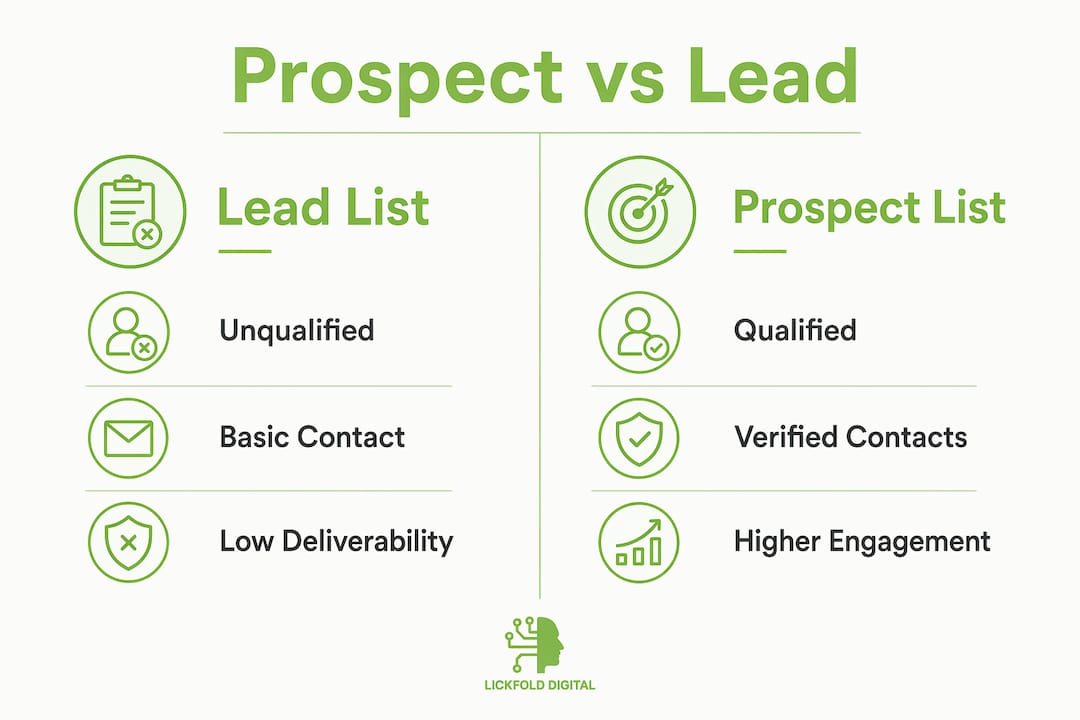
How does an agency prospect list differ from a lead list?
A lead list is unqualified. It is a raw collection of company names and contact emails pulled from a directory, purchased from a data vendor, or scraped from the web. No one has checked whether those companies need your service, can afford it, or have a decision-maker reachable at that address.

A prospect list is what you get after applying your ICP as a filter. You remove companies below a revenue threshold, exclude industries where you have no track record, and verify that the contact is actually the right title. You also add a context layer, such as a recent trigger event or a known pain point, that makes your first message relevant rather than generic.
The difference shows up in results. Agencies that skip qualification end up burning sender reputation, wasting sales hours, and generating noise instead of pipeline.
Prospect list vs. lead list: key differences
| Factor | Lead List | Prospect List |
|---|---|---|
| Qualification | None | ICP-filtered and verified |
| Contact accuracy | Unverified | Confirmed email and title |
| Context data | Absent | Trigger events, pain points |
| Outreach relevance | Generic | Personalized |
| Conversion potential | Low | High |
The table above is not just academic. Every column represents a real cost. Unverified emails hurt deliverability. Missing context forces you into generic templates. Generic templates get ignored.
What are the best techniques for building an agency prospect list?
Signal-based targeting is the single most effective method for building a high-quality list. A signal is a recent event that indicates a company may need your service right now. Funding rounds, leadership hires, product launches, and technology stack changes are all signals. Targeting based on timely signals improves reply rates by 5–10 times compared to static demographic filters. That gap exists because signals create relevance, and relevance is what gets replies.
Here is a structured process for building a list that actually converts:
- Define your ICP. Specify industry, company size, revenue range, geography, and technology stack. Be narrow. A vague ICP produces a vague list.
- Source initial contacts. Use Apollo, LinkedIn Sales Navigator, or ZoomInfo to pull companies and decision-makers that match your ICP criteria.
- Layer in signal data. Filter for companies that recently raised funding, hired a new CMO, or launched a new product. These are your highest-priority targets.
- Enrich contact records. Add verified email addresses using Hunter.io or Apollo’s built-in verification. Add LinkedIn URLs and direct phone numbers where available.
- Apply disqualification criteria. Defining negative personas removes companies below your revenue floor, industries where you have no case studies, and contacts who are not actual decision-makers. This step prevents wasted effort.
- Segment and score. Group prospects by signal strength, company size, or service fit. Prioritize the top tier for immediate outreach.
- Set a refresh cadence. Plan to revisit and update the list monthly. Contacts change jobs. Companies pivot. A static list decays fast.
Pro Tip: Move prospects who are not ready to buy into a CRM nurture bucket rather than deleting them. Tag them with a follow-up date 60–90 days out and assign a piece of relevant content to send at that point. Non-ready prospects today are often ready buyers in one quarter.
For agencies exploring AI-driven list building, the process above can be partially automated, which cuts research time significantly without sacrificing quality.
Which data points belong in a quality prospect list?
A prospect record is only as useful as the data it contains. Minimum fields are non-negotiable. Additional fields separate a good list from a great one.
Minimum required fields:
- Full name and job title
- Company name, industry, and employee count
- Verified business email address
- Company revenue range
- LinkedIn profile URL
High-value additional fields:
- Direct phone number
- Recent trigger event (funding, hire, product launch)
- Technology stack (e.g., HubSpot CRM, Shopify, Salesforce)
- Known pain point or website issue
- Engagement history if the contact has interacted with your content before
The context layer is what separates agencies that get replies from agencies that get ignored. Knowing that a prospect just hired a VP of Marketing tells you exactly what to say in your first sentence. That specificity is what makes personalized outreach possible at scale.
Must-have vs. nice-to-have fields
| Field | Priority |
|---|---|
| Verified email | Must-have |
| Job title | Must-have |
| Company size and revenue | Must-have |
| LinkedIn URL | Must-have |
| Trigger event | Nice-to-have (but high impact) |
| Direct phone | Nice-to-have |
| Tech stack | Nice-to-have |
| Pain point or site issue | Nice-to-have (but high impact) |
Scoring your list by field completeness is a practical way to prioritize outreach. A record with a verified email, a trigger event, and a known pain point scores higher than one with just a name and email. Send to your highest-scoring records first.
How do you maintain and refresh a prospect list over time?
A prospect list is not a static document. It is a living database that requires regular maintenance to stay conversion-ready. Contacts change jobs every 18–24 months on average. Companies get acquired, pivot their model, or fall outside your ICP as they grow or shrink.
Best practices for list maintenance include:
- Monthly refresh cycles. Pull new signal data from Apollo or LinkedIn Sales Navigator every 30 days. Add new companies that match your ICP and remove contacts who have left their roles.
- Requalification reviews. Every 90 days, review your full list against your current ICP. Your ICP may evolve as your agency wins new verticals or drops underperforming service lines.
- Nurture bucket management. Non-ready prospects should move into a CRM nurture stage with re-engagement scheduled every 60–90 days. Share a relevant case study or industry insight at each touchpoint.
- Metric tracking. Monitor reply rates, meeting booking rates, and conversion rates by list segment. Low reply rates on a specific segment signal a targeting or messaging problem, not just a volume problem.
Pro Tip: Combine an automated email verification tool like NeverBounce or ZeroBounce with a quarterly manual review of your top 50 prospects. Automation catches hard bounces. Manual review catches subtle mismatches, like a contact who is now at a competitor or a company that no longer fits your service capacity.
Tracking outbound reply rates over time gives you a direct signal on whether your list quality is improving or degrading. Treat that metric as a leading indicator of pipeline health.
What multi-channel outreach strategies work best with a curated list?
A well-built prospect list is the foundation. Multi-channel outreach is how you activate it. Combining email, LinkedIn, and phone in a 14–28 day cadence converts 5%–12% of a well-built list into qualified meetings. That rate is 2–3 times higher than email-only approaches. The channel mix matters because different buyers respond to different touchpoints.
A practical sequence looks like this:
- Day 1: Send a personalized cold email referencing a specific trigger event or pain point.
- Day 3: Connect on LinkedIn with a short, non-pitchy note.
- Day 7: Follow up by email with a relevant case study or insight.
- Day 14: Call or send a LinkedIn voice message.
- Day 21: Final email with a clear, low-friction call to action.
Pattern interrupts are the most underused tactic in this sequence. Opening an email with a reference to a prospect’s recent product launch or a specific line from their LinkedIn post signals that you did actual research. That signal alone separates your message from the 40 other pitches in their inbox that week.
Automation tools can handle sequencing and follow-up timing, but personalization must stay human. Generic merge-tag personalization (“Hi [First Name], I noticed your company is growing…”) no longer works. Specificity is the differentiator. For a deeper look at multi-channel outreach workflows, the mechanics of sequencing and timing are worth studying before you launch your first campaign.
Key takeaways
A well-built agency prospect list, grounded in ICP alignment, signal-based targeting, and verified contact data, is the single most reliable driver of predictable agency revenue growth.
| Point | Details |
|---|---|
| Quality beats quantity | 200 targeted prospects consistently outperform 5,000 unqualified contacts. |
| Signals drive replies | Trigger-based targeting improves reply rates by 5–10 times over static filters. |
| Context layer is non-negotiable | Verified pain points and trigger events enable personalization that gets responses. |
| Lists require active maintenance | Monthly refreshes and 60–90 day nurture cycles keep pipeline health strong. |
| Multi-channel outreach multiplies results | A 14–28 day cadence across email, LinkedIn, and phone converts 5%–12% of a curated list. |
Why most agencies are building prospect lists wrong
Most agencies I have worked with treat prospecting as something they do when the pipeline runs dry. That reactive posture is expensive. Sporadic prospecting causes agencies to under-monetize their book of business by 30%–60%. That is not a small inefficiency. That is a structural revenue problem.
The agencies that grow predictably treat prospecting as a weekly discipline with defined metrics. They know their ICP cold. They track reply rates by segment. They move non-ready prospects into nurture stages instead of deleting them. They refresh their lists monthly instead of rebuilding from scratch every six months.
The shift from volume-based to signal-based list building is where I see the biggest performance jump. Agencies that chase volume send 500 emails a week and book two meetings. Agencies that chase signals send 80 emails a week and book six. The math is not complicated. The discipline to stay narrow is what most teams struggle with.
If you are building an agency client list right now, start with your best three current clients. Define exactly what made them a good fit. Then build your ICP from that evidence, not from a wish list. That foundation produces a prospect list that actually reflects where your agency wins, which is the only list worth building.
— Duarte
How Lickfold builds curated prospect lists with AI
Lickfold applies AI-driven workflows to every stage of the prospect list process, from ICP definition and signal-based sourcing to contact verification and personalized multi-touch outreach. The platform deploys dedicated AI agents that identify decision-makers, enrich records with trigger event data, and execute sequenced campaigns across email and LinkedIn without relying on generic templates. Human qualification sits at the end of the pipeline, so your sales team only receives warm, vetted opportunities. If building and maintaining a high-quality agency prospect list is taking more time than your team has, Lickfold removes that bottleneck. Reach out to the team to see how the system fits your agency’s growth targets.
FAQ
What is an agency prospect list?
An agency prospect list is a curated, pre-qualified database of decision-makers who match the agency’s ideal customer profile, enriched with verified contact data and contextual information for personalized outreach. It differs from a raw lead list by prioritizing quality, fit, and relevance over volume.
How many prospects should be on an agency prospect list?
Size depends on ICP specificity, but research shows that 200 highly targeted prospects outperform generic lists of 5,000 contacts. A smaller, well-qualified list produces better reply rates and more efficient use of sales time.
How often should you refresh a prospect list?
Monthly refreshes are the standard practice for keeping a prospect list accurate and conversion-ready. Non-ready prospects should move into CRM nurture buckets with re-engagement scheduled every 60–90 days.
What tools are used to build a prospect list?
Apollo, LinkedIn Sales Navigator, ZoomInfo, and Hunter.io are the most widely used tools for sourcing, enriching, and verifying prospect records. CRM platforms like HubSpot or Salesforce handle segmentation, nurturing, and outreach tracking.
Why does signal-based targeting improve outreach results?
Signal-based targeting focuses outreach on companies experiencing trigger events, such as funding rounds or leadership changes, that indicate an immediate need for your service. This approach improves reply rates by 5–10 times compared to static demographic filters.