
Analytics in outbound prospecting: 3.43% reply rate fix
Analytics in outbound prospecting: 3.43% reply rate fix
TL;DR:
- Analytics reveals where prospects disengage and which channels perform best across segments.
- Focusing on key metrics like reply rate and meeting conversion improves outbound success.
- Combining AI tools with human oversight optimizes prospecting process and prevents data drift.
Most B2B sales teams operate on gut feel, legacy habits, and sheer persistence, yet the data tells a sobering story. The average cold email reply rate sits at just 3.43%, with only elite performers pushing past 10.7%. That gap isn’t closed by sending more emails. It’s closed by understanding exactly where your process breaks down and rebuilding it around hard evidence. Analytics is the mechanism that turns scattered outbound activity into a repeatable, scalable system. In this article, we’ll walk through the metrics that matter, the tools worth your attention, and the mistakes that quietly drain your pipeline.
Table of Contents
- Why analytics matters in modern outbound prospecting
- Key outbound prospecting metrics and what they reveal
- Turning analytics insights into action: AI-driven solutions
- Analytics pitfalls and practical fixes in outbound prospecting
- What most B2B teams still get wrong about outbound analytics
- Boost your prospecting with expert analytics and AI solutions
- Frequently asked questions
Key Takeaways
| Point | Details |
|---|---|
| Analytics drives results | Teams using outbound analytics see significant gains in reply and meeting rates over intuition-based methods. |
| Benchmarks reveal gaps | Knowing metrics like reply and hit rates helps pinpoint where to improve outreach tactics. |
| AI boosts efficiency | AI-powered tools automate data-driven tweaks, making prospecting more targeted for B2B teams. |
| Avoid common pitfalls | Sales managers should regularly review metrics and blend tech with human insights for sustainable success. |
Why analytics matters in modern outbound prospecting
Outbound prospecting has always been a numbers game, but most teams are playing with the wrong numbers. They count calls made and emails sent while ignoring the metrics that actually predict revenue. Analytics shifts the focus from activity volume to conversion quality, and that shift changes everything.
Think about what typically separates a high-performing outbound team from an average one. It’s rarely effort. Both teams work hard. The difference is that the top team knows which message variant converts best on Tuesday mornings, which vertical responds to phone calls over email, and at which touchpoint their pipeline typically stalls. That’s intelligence the average team simply doesn’t have.
“Persistence alone is not a strategy. The teams winning in outbound prospecting today are the ones measuring the right signals and acting on them fast.”
Here’s what analytics specifically reveals that raw intuition never will:
- Where prospects disengage: Is it after email one, email three, or on the demo call itself?
- Which channels perform by segment: Some industries reply to LinkedIn. Others respond only to cold calls.
- Time-of-day patterns: Open and reply rates fluctuate dramatically by hour and day of the week.
- Message fatigue thresholds: At what point does continued outreach hurt your domain reputation?
Data from analytics and human review of live campaigns shows that teams tracking email, call, and meeting data consistently outperform those that don’t, often by a factor of two or more in meeting conversion rates. The gap isn’t theoretical. It’s measurable and it compounds over time.
One of the most persistent misconceptions in outbound is that more touches automatically mean more meetings. In reality, booking a first meeting requires an average of 8 touchpoints, but those touchpoints must be distributed intelligently across channels and timed thoughtfully. Spamming a prospect seven times in five days doesn’t replicate a well-sequenced 8-touch campaign. It just burns the lead.
The practical implication: analytics tells you not just how many touches to make, but which combination of channels, timing, and messaging generates a response. That’s the competitive edge that data-driven teams exploit while their intuition-reliant competitors keep wondering why reply rates are falling.
Key outbound prospecting metrics and what they reveal
Having established the analytical advantage, here’s how to put it into practice by focusing on the right numbers. Not all metrics are created equal. Some are vanity, some are leading indicators, and some are the precise levers you need to pull.
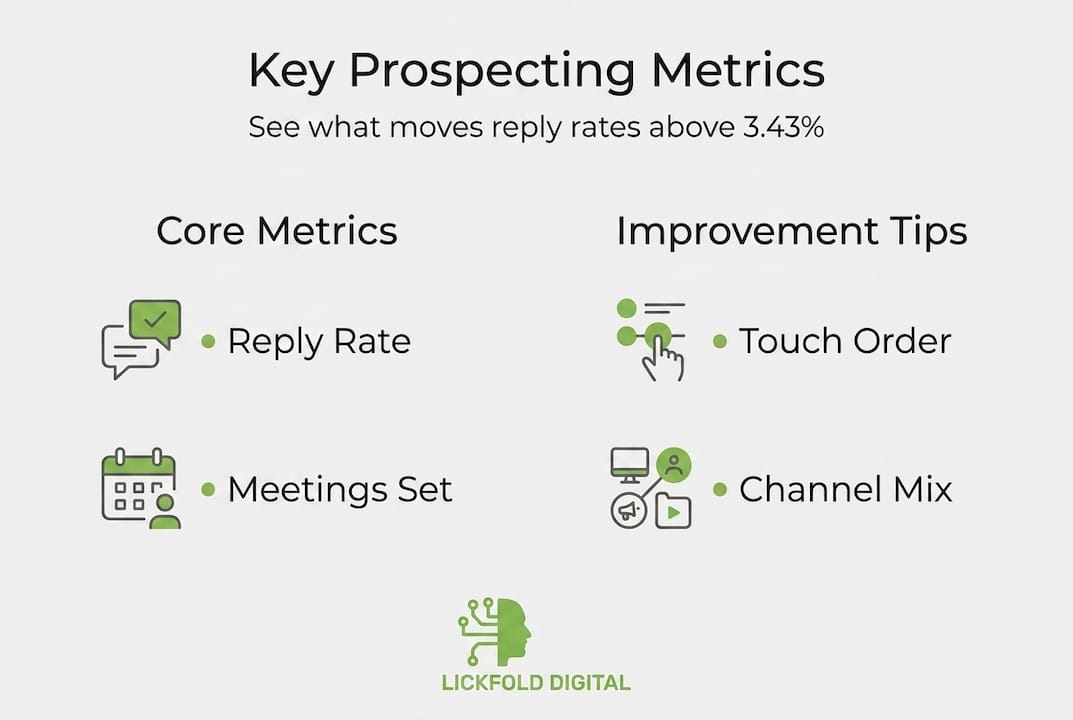
Here’s a benchmark table based on industry research averages for outbound B2B campaigns:
| Metric | Typical average | Top performer benchmark | What a low value signals |
|---|---|---|---|
| Email reply rate | 3.43% | 10.7% | Weak subject line or poor targeting |
| Call connection rate | 6-8% | 15%+ | Wrong time, wrong list, or bad data |
| Meeting booking rate | 0.5-1% | 2-3% | Poor qualification or weak pitch |
| Avg. touchpoints to meeting | 8 | 5-6 | Messaging not landing early enough |
Each number tells a specific story. A low email reply rate often points to targeting issues before it points to messaging issues. If you’re reaching the wrong people, even a great email will get ignored. A low meeting booking rate despite decent reply rates suggests your qualification criteria or pitch clarity needs work.
Here’s what to watch closely beyond the table:
- Reply rate by sequence step: Does step three outperform step one? That tells you your warm-up copy is too weak.
- Meeting show rate: Scheduling a meeting and having the prospect actually show are two very different outcomes.
- Response time to your reply: Fast responders are hot leads. Slow ones need nurture, not volume.
Explore AI prospecting tips for more ideas on optimizing each stage of your sequence.
Pro Tip: Adjust the order of your touchpoints before changing the content. Teams often rewrite emails when the real fix is simply moving a LinkedIn touch earlier in the sequence.
Ignoring even one metric can throw off your entire analysis. If you’re only watching reply rates but not meeting show rates, you might scale a campaign that books meetings no one attends. Every metric is a check on the others.
Turning analytics insights into action: AI-driven solutions
With the metrics in hand, the question becomes: how do you act on this new intelligence at scale? For mid-sized B2B teams without enterprise headcount, the answer increasingly involves AI-driven tools that turn data into decisions automatically, while keeping humans in the loop for quality control.
Here’s a practical comparison of tool tiers worth considering:
| Solution type | Examples | Best for | Limitations |
|---|---|---|---|
| SMB AI tools | Apollo, Instantly, Lemlist | Budget-conscious teams | Less customization |
| Mid-market platforms | Outreach, Salesloft | Growing teams with ops support | Higher cost and complexity |
| Enterprise systems | Salesforce Einstein | Large org integrations | Often overkill for mid-sized teams |
For most mid-sized companies, SMB analytics tools offer strong value without the complexity or cost overhead of enterprise platforms. The key is pairing the right tool with a clear process.
Here’s a step-by-step framework for implementing analytics-driven prospecting:
- Gather clean data first: Dirty CRM data corrupts every downstream insight. Audit your contact lists before connecting any AI tool.
- Select tools matched to your team’s size: Smaller teams need simplicity and speed, not feature bloat.
- Run A/B tests on messaging: Change one variable at a time. Subject line, first sentence, or call-to-action, but never all three simultaneously.
- Apply human oversight to AI outputs: Following AI sales trends, the most effective teams treat AI as a junior analyst, not a final decision-maker.
- Recalibrate monthly: What worked in January may underperform by March. Markets shift and so do response patterns.
AI cost savings in lead generation are real, but only when the underlying process is sound. Automating a broken workflow just breaks it faster.
Pro Tip: Set a calendar reminder every 30 days to check for data drift. If your AI model’s predictions are diverging from actual results, small/mid-size teams need affordable tools with human oversight built in to course-correct before the gap grows.
Multi-threaded outreach, contacting multiple stakeholders at the same account simultaneously, also amplifies your analytics advantage. If one contact goes cold, your data still reveals which message angle resonated so you can adjust for the next touch.

Analytics pitfalls and practical fixes in outbound prospecting
While analytics opens new doors, it’s easy to stumble into common traps. The good news: each one has a practical fix if you catch it early.
Here are the most common analytics pitfalls for B2B outbound teams:
- Equating activity with productivity: High call volume means nothing if connection rates are flat. Track outcomes, not just inputs.
- Setting and forgetting AI automation: AI sequences feel like autopilot, but without oversight, they drift. Complex ML models can fail when data patterns shift, requiring ongoing adjustment and human oversight.
- Ignoring data drift: Your ideal customer profile evolves. So do the market conditions your models were trained on. If you haven’t updated your targeting criteria in six months, your data is likely outdated.
- Over-investing in enterprise tools: A mid-sized team paying for a Fortune 500 analytics platform often gets overwhelmed by features they don’t need and data they can’t act on.
- Cherry-picking metrics: Reporting only the numbers that look good while ignoring lagging indicators creates blind spots that eventually kill campaigns.
“No AI tool, regardless of sophistication, replaces the judgment of a sales professional who understands their market. Use data to inform decisions, not to make them automatically.”
For each pitfall, here’s a practical fix: Review your core metrics every week with your sales team, not just a dashboard. Calibrate your AI tool’s outputs against real sales rep feedback at least once a month. Use a profile optimization guide to sharpen how your company presents itself digitally, which feeds better inbound signals into your outbound targeting. And before renewing any enterprise analytics contract, ask honestly whether your team is using more than 40% of its features.
The teams that avoid these traps use an AI automation guide to set clear rules for when AI decisions escalate to a human. That boundary is where most analytics implementations either succeed or quietly fail.
What most B2B teams still get wrong about outbound analytics
Here’s what years of working with outbound sales teams has made clear: most companies that invest in analytics tools still don’t see the results they expect. The reason is almost never the tool. It’s the process around it.
The real mistake is treating analytics as a reporting function rather than an experimentation engine. Teams pull weekly dashboards, nod at the numbers, and carry on doing roughly the same thing. The teams that actually win use the same data to run structured experiments, test a single hypothesis per sprint, and kill underperforming sequences fast.
The contrarian reality is this: better process discipline outperforms better technology, every single time. You can run outbound sales innovations through a mid-range stack and outperform a competitor using enterprise software if your team reviews, debates, and acts on the data weekly.
The best outbound teams blend AI-driven analysis with genuine sales intuition. Numbers tell you what happened. Your reps tell you why. Both inputs are essential. Ignoring either one leaves performance on the table.
Pro Tip: Start each quarter with a manual review session before touching your tech stack. Have reps share qualitative observations first, then overlay the data. The patterns that emerge are often more valuable than any automated report.
Boost your prospecting with expert analytics and AI solutions
Analytics transforms outbound prospecting from a volume game into a precision operation. When you know which metrics matter, which tools fit your team’s size, and which traps to avoid, your pipeline becomes far more predictable and efficient.
If you’re ready to move from tracking data to acting on it, the AI experts at Lickfold Digital build fully managed outbound systems that combine AI precision with human oversight, exactly the balance that mid-sized B2B teams need. From ICP targeting to personalized multi-touch campaigns and qualified lead delivery, every element is optimized around your numbers, not generic templates. Contact Lickfold Digital to explore how an analytics-driven outbound system can become your team’s competitive edge.
Frequently asked questions
What are the most important analytics for outbound prospecting success?
Key analytics include email reply rate, meeting conversion rate, call connection rate, and average touchpoints to meeting. Typical reply and meeting rates serve as baselines that reveal where your conversion funnel is leaking.
How often should sales teams review their prospecting analytics?
Review analytics weekly for agile campaign improvements and quarterly for strategic adjustments. Ongoing adjustment is critical for ML-based prospecting because data drift can silently degrade results over time.
Can mid-sized companies leverage AI analytics without paying enterprise prices?
Yes. There are strong AI-driven analytics platforms built specifically for smaller teams at accessible price points. SMBs require affordable and practical analytics solutions, not enterprise-scale complexity.
Why is human oversight important even with advanced AI analytics?
AI models can drift as market conditions change, producing recommendations that no longer match real-world outcomes. Complex ML still needs regular human review to stay accurate and actionable.