
What Is an Agency Sales Funnel? A Practical Guide
What Is an Agency Sales Funnel? A Practical Guide
TL;DR:
- An agency sales funnel is a structured process that guides prospects from initial awareness to signing a contract. It helps agencies track and improve their conversion rates while reducing reliance on founder relationships. Using clear stages, exit criteria, and automation improves scalability and predictability in sales growth.
An agency sales funnel is defined as the structured, stage-by-stage journey a prospective client takes from first becoming aware of your agency to signing a contract. The funnel shape is intentional: many prospects enter at the top, and progressively fewer reach the bottom as each stage filters out poor fits. Understanding this structure is the foundation of any effective agency sales process. The industry also uses the term “client acquisition funnel” interchangeably, but the underlying framework is the same. Agencies that map this journey explicitly convert leads more consistently and predict revenue more accurately.
What is an agency sales funnel and why does it matter?
An agency sales funnel is the visual model that shows how prospects move through defined stages until they become paying clients. Each stage has a specific goal, a set of activities, and clear criteria that determine when a prospect moves forward or gets disqualified. Without this structure, agencies rely on gut feel and founder relationships to close deals. That approach does not scale.
The funnel differs from a sales pipeline in one critical way. The funnel describes the buyer’s journey from the client’s perspective. The sales pipeline describes the same journey from the agency’s internal perspective, tracking deal status, activities, and probabilities inside a CRM. Both are necessary. Confusing the two leads to misaligned metrics and wasted effort.
Agencies that define their funnel clearly gain three immediate advantages. They can identify where leads drop off, they can assign the right resources to each stage, and they can forecast revenue with real data instead of optimism.
What are the typical stages of an agency sales funnel?
An effective agency sales process consists of six stages, each with clear exit criteria and target durations to prevent ambiguity and delays. That structure matters because vague stages create vague results.
| Stage | Goal | Key Activity | Target Duration |
|---|---|---|---|
| Intake | Capture and log the lead | Form submission, referral, or outbound reply | Under 24 hours |
| Qualification | Confirm fit before investing time | Screening call or questionnaire | 2–3 days |
| Discovery | Understand client needs deeply | 60-minute discovery call | 1–2 weeks |
| Proposal/Pitch | Present tailored solution | Live proposal presentation | 1 week |
| Negotiation | Align on scope and terms | Stakeholder review, mutual action plan | 1–2 weeks |
| Close | Secure signed contract | Contract sent and countersigned | 1 week |
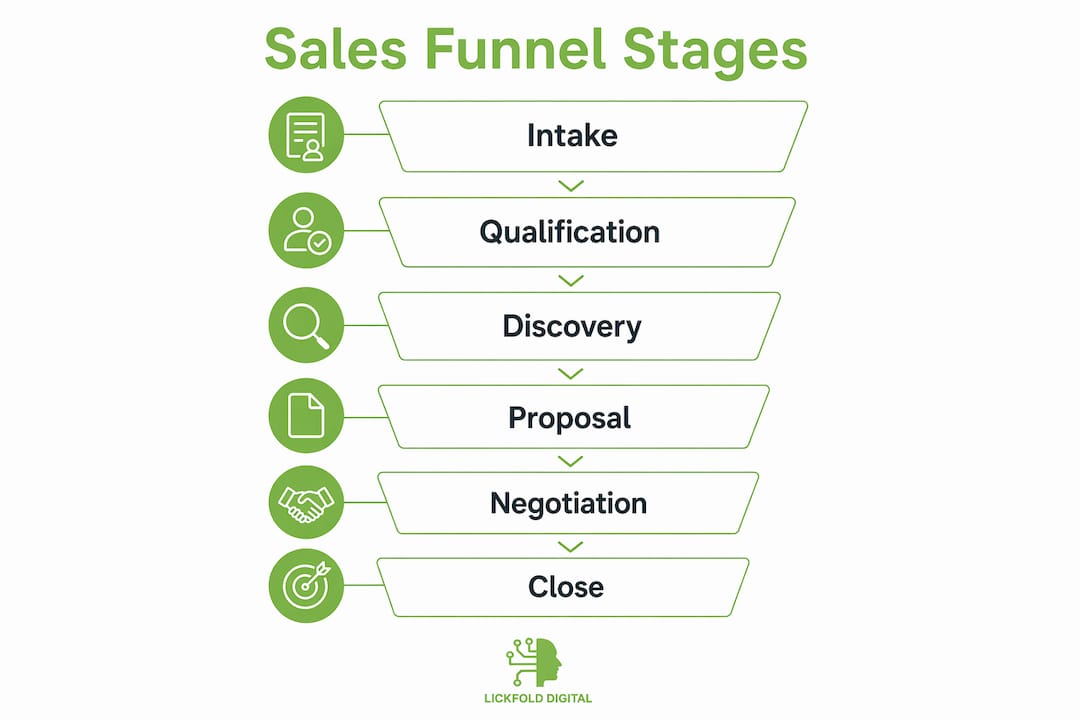
Awareness sits above the funnel itself. It is where content marketing, paid ads, referrals, and outbound prospecting generate the initial contact. Once a lead enters the funnel at Intake, the clock starts.
Qualification is where most agencies lose time by moving too slowly. A short screening call or a written questionnaire filters out prospects who lack budget, authority, or genuine need. Moving an unqualified lead to Discovery wastes senior time and distorts your metrics.
Discovery is the highest-value stage for relationship building. A structured 60-minute call uncovers the client’s real problems, decision process, and timeline. The output of Discovery is a clear brief that drives the Proposal.
Proposal and Negotiation are where deals stall most often. Sending proposals via email alone leads to lost deals. A live 20–30 minute presentation with all key stakeholders present, followed by a mutual action plan with agreed timelines, dramatically reduces stall risk.
Pro Tip: Set a firm stage duration target for every stage. Any deal that sits in Negotiation beyond two weeks without a logged update should trigger an automatic review call.
How does the sales funnel differ from the sales pipeline, and why both matter?
The sales funnel and the sales pipeline describe the same process from two different angles. Mixing them up is one of the most common mistakes agency owners make, and it leads directly to founder dependence and inefficient resource use.
The funnel is client-facing. It maps what the prospect experiences: awareness, evaluation, decision. It guides your marketing content, your nurturing sequences, and your messaging at each stage. The pipeline is internal. It lives in your CRM and tracks what your team is doing: calls logged, proposals sent, follow-ups scheduled, deal values recorded.
Here is why the distinction matters in practice:
- The funnel tells you where prospects drop off and why. If 80% of leads exit at Qualification, your top-of-funnel targeting is off.
- The pipeline tells you where your team is spending time. If most activity clusters in Negotiation, you may be under-investing in Intake and Qualification.
- CRM discipline is the connective tissue. Any communication not logged in the CRM is treated as if it never happened. That rule enables real diagnostics.
- Pipeline reviews should happen weekly. Funnel reviews should happen monthly, with a focus on conversion rates between stages.
- Deals that exceed their stage duration target signal either a qualification failure or a negotiation problem. Both require different fixes.
Pro Tip: Map each funnel stage to a corresponding pipeline stage in your CRM before you hire your first salesperson. Without that map, a new hire has no repeatable process to follow.
Best practices and common pitfalls in managing agency sales funnels
The single biggest pitfall in agency sales is founder dependence. When the agency principal is the only person who can close deals, the business cannot grow beyond that person’s capacity. Building a fast-fail sales process that screens poor-fit prospects early is the structural fix. It protects senior time and increases the long-term value of the agency.
Hiring salespeople without a documented process produces inconsistent results regardless of how talented those salespeople are. Top performers still need clear stage exit criteria and a repeatable funnel to follow. Without that, every deal becomes a custom negotiation, and you cannot learn from wins or losses.
The following practices separate agencies with predictable revenue from those that lurch between feast and famine:
- Document every stage with written exit criteria. “We like them” is not an exit criterion. “They have confirmed budget, authority, and a decision timeline” is.
- Set maximum stage durations and enforce them. A deal stuck in Discovery for three weeks is not progressing. It is decaying.
- Disqualify fast. A prospect who fails Qualification criteria costs you nothing to release. A prospect who fails at Proposal costs you hours of senior time.
- Log everything in your CRM. Every call, email, and follow-up gets recorded. CRM data discipline enables pipeline diagnostics and team accountability.
- Balance nurturing with closing. Agencies that focus only on closing neglect the top of the funnel and create future pipeline gaps.
- Review funnel metrics monthly. Track discovery call volume, proposal conversion rates, and average sales cycle length. Patterns reveal systemic problems.
- Present proposals live. Email-only proposals stall in inboxes. A live session with all stakeholders present aligns expectations and accelerates decisions.
Pro Tip: Run a “fast-fail” audit on your current pipeline. For every deal in Qualification or Discovery, ask: does this prospect meet all written exit criteria? Remove those that do not. Your pipeline will shrink, but your close rate will rise.
How to create and optimize an agency sales funnel for better conversions
Building an effective sales funnel starts with mapping the buyer’s journey before you define any internal stages. Talk to your last ten clients and ask them to describe how they evaluated and chose your agency. Their answers reveal the real decision stages, not the ones you assumed.

Once you have that map, define your funnel stages, write the exit criteria for each, and set duration targets. Then configure your CRM to mirror those stages exactly. A high-performing sales pipeline is built on this alignment between the funnel model and the CRM structure.
Track these key metrics from day one:
| KPI | What it measures | Healthy benchmark |
|---|---|---|
| Discovery calls per month | Top-of-funnel activity volume | 6–10 per month |
| Proposal conversion rate | Quality of Discovery and Qualification | Above 40% |
| Sales cycle length | Funnel efficiency | 30–60 days for mid-market |
| Win rate | Overall funnel effectiveness | Varies by market |
Mid-market sales cycles typically run 30–60 days, while enterprise cycles run 90–180 days. A cycle that is significantly shorter than the benchmark often signals a qualification problem. One that runs significantly longer signals a negotiation or prioritization issue.
AI-based prospecting tools can fill the top of the funnel consistently without relying on referrals or founder networking. Lickfold’s approach uses AI agents to identify decision-makers, execute personalized outreach, and pass qualified replies to your sales team. That keeps Intake and Qualification stages full without adding manual prospecting work. Pairing that with sales funnel automation reduces the time between first contact and Discovery call.
Pro Tip: Use step-by-step lead qualification criteria at the Qualification stage to score prospects before they reach Discovery. Scored leads give your team a consistent, objective basis for prioritization.
Key Takeaways
A documented, stage-specific agency sales funnel with clear exit criteria is the single most effective structure for converting leads consistently and reducing founder dependence.
| Point | Details |
|---|---|
| Define stages with exit criteria | Vague stages produce vague results; write specific criteria for every stage transition. |
| Separate funnel from pipeline | The funnel maps the buyer’s journey; the pipeline tracks your team’s internal activities in a CRM. |
| Disqualify early and often | Releasing poor-fit prospects at Qualification protects senior time and improves close rates. |
| Present proposals live | A 20–30 minute live presentation with all stakeholders reduces stall risk in Negotiation. |
| Track funnel KPIs monthly | Discovery call volume, proposal conversion rate, and sales cycle length reveal systemic problems early. |
Why most agency funnels fail before they start
Agencies almost always build their sales funnel backward. They hire a salesperson, hand that person a CRM login, and expect results. What they have actually done is expose their process gaps to a new employee who has no framework to follow.
I have seen this pattern repeatedly. The salesperson is talented. They work hard. But without documented exit criteria and stage durations, every deal becomes a judgment call. Some close. Many stall. The agency concludes that the salesperson was the wrong hire. The real problem was the missing process.
The agencies that scale past founder-led sales share one trait: they built the funnel before they needed it. They documented their stages, tested their exit criteria on real deals, and only then brought in additional sales capacity. That sequence matters more than the tools or the talent.
The fast-fail mindset is the other shift that changes everything. Most agency owners feel uncomfortable disqualifying prospects quickly. It feels like leaving money on the table. The opposite is true. Every hour spent on a poor-fit prospect is an hour not spent on a good one. A tight Qualification stage is not pessimism. It is resource management.
If your funnel currently depends on your personal relationships to close, that is not a sales process. It is a liability. The goal is a funnel that any trained person can run, with results that are predictable enough to plan hiring and capacity around.
— Duarte
How Lickfold helps agencies build funnels that fill themselves
Building a structured sales funnel is only half the challenge. Keeping the top of that funnel full without burning founder time on cold outreach is the other half.
Lickfold uses AI-driven prospecting to identify decision-makers who match your ideal client profile, execute personalized multi-touch outreach, and deliver qualified replies directly to your sales team. Your Intake and Qualification stages stay active without manual prospecting. If you are ready to build a funnel that generates consistent, qualified opportunities, reach out to Lickfold and start the conversation.
FAQ
What is an agency sales funnel in simple terms?
An agency sales funnel is the structured path a prospect follows from first contact to signed contract. It typically includes six stages: Intake, Qualification, Discovery, Proposal, Negotiation, and Close.
How is a sales funnel different from a sales pipeline?
The sales funnel maps the client’s decision journey from the buyer’s perspective. The sales pipeline tracks the agency’s internal activities and deal status inside a CRM.
How many discovery calls should an agency run per month?
A healthy agency pipeline typically includes 6–10 discovery calls per month. Fewer than that signals a top-of-funnel volume problem that requires attention.
Why do agency sales funnels fail?
Most agency funnels fail because they lack documented exit criteria and rely on founder relationships to close deals. Without a repeatable process, results are inconsistent and the agency cannot scale.
How long should an agency sales cycle be?
Mid-market sales cycles typically run 30–60 days from first contact to signed contract. Enterprise cycles run 90–180 days. Cycles significantly outside these ranges indicate qualification or prioritization issues.