
The Role of Localization in B2B Sales: A Growth Guide
The Role of Localization in B2B Sales: A Growth Guide
TL;DR:
- Localization enhances trust and reduces sales cycle length by making communications feel relevant to local buyers. Prioritizing localization of pricing, proposals, and sales assets yields the highest conversion and revenue growth. Organizing cross-team efforts with a dedicated champion and integrating localization into workflows drives successful market expansion.
Localization is defined as the process of adapting your sales communication, pricing, and product experience to match the language, culture, and business norms of a specific market. The role of localization in B2B sales goes far beyond swapping words into another language. It shapes whether a prospect trusts you enough to take a meeting, sign a contract, or renew. 70% of users prefer engaging with content in their native language, and companies that act on that preference see measurable revenue gains. For B2B sales teams expanding into new markets, localization is the difference between a pipeline that converts and one that stalls.
How localization improves buyer trust and shortens B2B sales cycles
Trust is the currency of B2B sales. Localization builds it faster than any other single tactic. 71% of buyers lose trust when they encounter poorly translated content. That number means a mistranslated proposal or a culturally tone-deaf email can kill a deal before your sales rep even gets on a call.
Well-executed localization does the opposite. It signals that you understand the buyer’s world. When a prospect in Germany reads a case study featuring German compliance standards, or a buyer in Japan sees pricing in yen with locally familiar payment terms, the message is clear: this vendor did their homework. That perception shortens the evaluation phase because buyers spend less time questioning fit.
Localization also drives direct revenue impact. Research shows localization drives 20–50% revenue increases depending on the segment and journey stage. The variance matters. Early-funnel content like landing pages and ads tends to see the higher end of that range because localization removes the first barrier to engagement. Late-funnel content like contracts and onboarding materials sees gains too, but they compound over time through retention.
Key areas where localization accelerates B2B sales cycles:
- Outbound messaging: Localized cold emails and LinkedIn messages use region-specific references that make outreach feel relevant, not generic.
- Sales decks and proposals: Adapting proof points to local industry examples increases credibility during the evaluation stage.
- CRM routing: Assigning leads to reps who speak the prospect’s language reduces friction at the handoff stage.
- Follow-up sequences: Localized nurture emails maintain the tone and context set during initial outreach.
Pro Tip: Map your sales funnel by region and identify the three highest-friction touchpoints. Localize those first. You will see faster cycle improvements than if you try to localize everything at once.
Connecting long-term B2B relationships to localization is not a stretch. Buyers who feel understood from the first touchpoint are more likely to renew, expand, and refer.
What are the strategic elements of B2B localization beyond language?
Localization that only addresses language leaves significant revenue on the table. Pricing, payment methods, and product framing are equally critical, and they are often the last things sales teams think to adapt.

Pricing and payment localization
Uniform global pricing is a common mistake. It causes companies to lose 30% revenue in markets where buyers have higher willingness to pay and where local anchoring would justify a premium. The inverse is also true: charging US-market prices in price-sensitive markets like Southeast Asia or Eastern Europe blocks deals that would otherwise close at a lower tier.
Payment localization has a direct and measurable effect on conversion. Adding local payment methods boosts checkout conversion from 4.3% to 6.5%, a 51% improvement. In B2B contexts, this translates to faster contract execution when invoicing, wire transfer preferences, and local procurement workflows are accommodated.
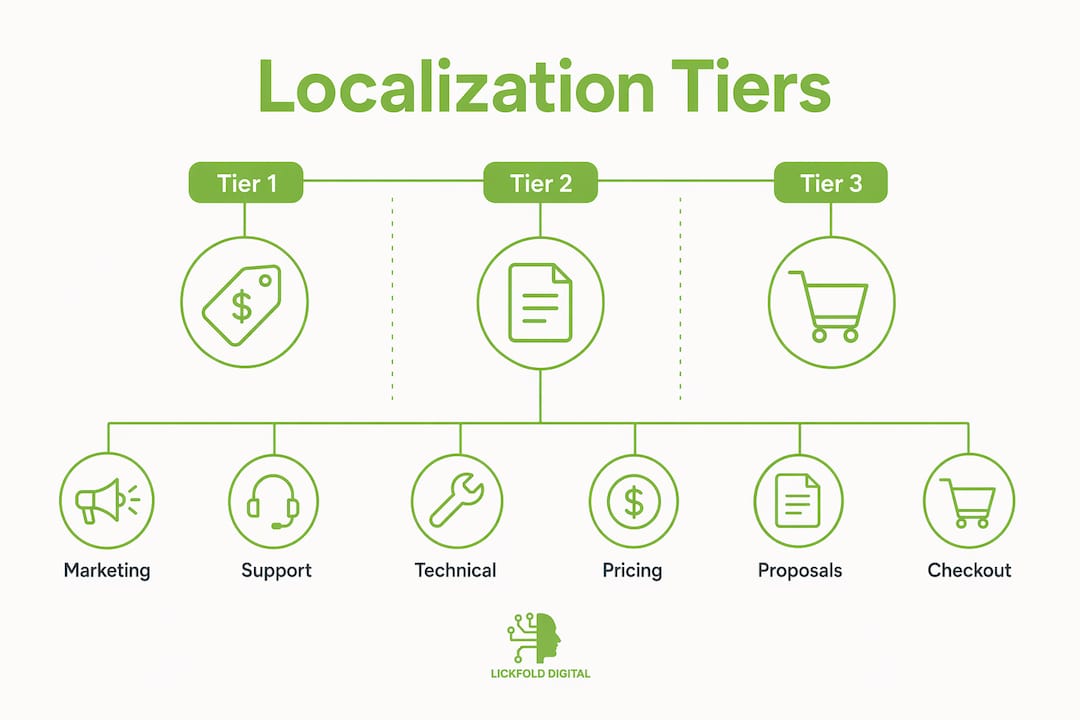
Tiered localization by impact
Not every asset deserves the same depth of localization. Localization depth is a dial, and the smartest teams prioritize conversion-critical surfaces first. Over-localizing low-impact assets wastes capital and slows sales cycles.
| Localization tier | Asset type | Primary impact |
|---|---|---|
| Tier 1 (highest priority) | Pricing pages, proposals, checkout flows | Direct conversion rate |
| Tier 2 | Sales decks, case studies, email sequences | Trust and deal velocity |
| Tier 3 | Blog content, social posts, help docs | SEO and long-term brand |
| Tier 4 (lowest priority) | Internal training materials | Operational efficiency |
This tiered model lets sales and marketing teams allocate localization budgets where they generate the fastest return. Start at Tier 1, measure conversion lift, then expand down the table as resources allow.
Product and messaging adaptation
The core value proposition should stay globally consistent. What changes is how you prove it locally. Proof points and objections require regional adaptation to resonate. A security software company selling into the EU needs GDPR-specific case studies. The same company selling into the US needs SOC 2 references. Same product, different proof.
How should B2B sales teams organize for localization success?
Organizational fragmentation kills localization programs before they produce results. Sales, marketing, and product teams each own a piece of the buyer experience, but they rarely coordinate on localization. The result is a localized website that feeds into English-only sales follow-ups, which erodes trust despite the investment made in the public-facing content.
The fix is structural. Appointing a localization champion aligns cross-team metrics and goals. This person owns the localization roadmap, sets prioritization criteria, and holds each function accountable for consistency. Without this role, localization stays a project. With it, localization becomes a system.
Localization also needs to enter the product and sales process early. Treating localization as market-entry infrastructure rather than a downstream translation task means building it into go-to-market planning from day one. Companies that delay this risk losing competitive advantage in key markets to first movers who establish word-of-mouth and brand loyalty early.
Best practices for organizing a B2B localization program:
- Appoint a localization champion with authority across sales, marketing, and product.
- Set region-specific revenue targets tied to localization milestones, not just translation completion.
- Build i18n infrastructure early. Technical localization infrastructure like number formatting and CI/CD integration must be built into platforms from the start to avoid costly retrofits later.
- Track localization ROI by region using pipeline velocity, conversion rate, and average deal size as primary metrics.
- Review quarterly. Markets shift, and localization that worked in year one may need updating as competitive dynamics change.
Pro Tip: Before entering a new market, run a localization audit of your three highest-traffic sales assets. If any of them confused or alienate a local buyer, fix those before spending on paid acquisition.
Understanding why B2B expansion fails early often comes down to exactly these organizational gaps. Teams that treat localization as a checkbox rather than a system consistently underperform in new markets.
How do you implement localization in B2B sales workflows?
Embedding localization into daily sales execution requires a sequenced approach. Starting with the highest-volume touchpoints produces the fastest measurable impact.
- Audit your current CRM data. Identify which regions generate the most leads and where conversion rates drop. These gaps often signal localization failures.
- Localize your top three email templates. Outbound sequences, follow-up emails, and proposal cover notes are the highest-frequency sales assets. Adapting these to local tone and context produces immediate lift.
- Route leads by language in your CRM. Assign Spanish-speaking prospects to Spanish-speaking reps. This single change reduces drop-off at the handoff stage.
- Adapt your objection-handling scripts. Common objections vary by region. A buyer in France may question vendor stability. A buyer in Brazil may focus on local support availability. Scripts that address local concerns close faster.
- Localize your website for organic reach. Website localization influences both buyer engagement and SEO performance. A localized page ranks for local-language queries and converts visitors who arrive with purchase intent.
- Test before scaling. Run a localized sequence in one region for 60 days. Measure open rates, reply rates, and meeting conversion before rolling out to additional markets.
Personalization in B2B outreach and localization work together. Localization sets the cultural context. Personalization targets the individual within it. Both are required for outreach that converts at scale.
The end-to-end localization approach includes sales follow-up workflows, CRM routing, and nurture sequences. Teams that localize only the website but leave the sales process in English create a jarring experience that buyers notice and distrust.
Key Takeaways
Localization in B2B sales drives measurable revenue growth when it covers pricing, payment methods, sales workflows, and cultural messaging, not just language translation.
| Point | Details |
|---|---|
| Trust drives conversion | 71% of buyers lose trust with poorly translated content, making accuracy non-negotiable. |
| Revenue impact is real | Localization delivers 20–50% revenue increases depending on segment and funnel stage. |
| Prioritize by tier | Localize pricing pages and proposals first; blog content and internal docs can wait. |
| Organize for it | Appoint a localization champion to align sales, marketing, and product around shared goals. |
| Embed it in workflows | Localize CRM routing, follow-up sequences, and objection scripts, not just your website. |
Why I think most B2B teams are localizing the wrong things first
Most sales teams I have seen treat localization as a website project. They translate the homepage, maybe the pricing page, and call it done. Then they wonder why their pipeline in that market stays flat.
The real problem is that the website is the easiest thing to localize and often the least important at the deal stage. By the time a prospect is evaluating your product seriously, they are reading your proposals, your follow-up emails, and your contracts. Those assets are almost always still in English, or worse, in machine-translated text that reads like it was written by someone who has never visited the country.
The importance of localization in sales is that first movers who get this right build word-of-mouth advantages that late entrants cannot buy their way out of. I have watched companies spend heavily on paid acquisition in a new market, only to lose deals to a smaller competitor who simply communicated better in the local language at every stage of the sales process.
The mindset shift that matters is treating each new region like a new product-market fit exercise. You would not launch a new product without validating the messaging. Do not launch into a new market without validating that your sales communication actually lands. That means testing localized sequences, talking to local buyers about what resonates, and measuring conversion at every stage.
Localization done right also supports premium pricing. Buyers who feel understood pay more and churn less. That is not a soft benefit. It shows up in net revenue retention numbers, and it compounds every year you stay in the market.
— Duarte
Lickfold’s approach to localized B2B sales outreach
B2B sales teams that want to expand into new markets need more than translated content. They need outreach that reaches the right decision-makers with messaging that fits the local context from the first touchpoint.
Lickfold builds AI-driven outbound systems that identify decision-makers, craft personalized multi-touch sequences, and execute outreach across markets without relying on generic templates. The platform handles infrastructure, warm-up, reputation management, and human qualification of replies before passing opportunities to your sales team. If your team is ready to build a localized pipeline that converts, reach out to Lickfold to discuss a market-specific outreach strategy built around your ideal customer profile.
FAQ
What is the role of localization in B2B sales?
Localization adapts your sales communication, pricing, and product experience to match the language, culture, and business norms of a specific market. It builds buyer trust and shortens sales cycles by making every touchpoint feel relevant to the local prospect.
How does localization impact B2B revenue?
Research shows localization drives 20–50% revenue increases depending on the segment and funnel stage. Companies that invest in localization early also report stronger retention and higher average deal sizes in localized markets.
What are the most important assets to localize first?
Pricing pages, proposals, and checkout flows produce the fastest conversion lift and should be localized before lower-impact assets like blog posts or internal training materials.
Why do B2B localization programs fail?
Most programs fail because of organizational fragmentation. Sales, marketing, and product teams each localize their own assets without coordination, creating inconsistent buyer experiences. Appointing a localization champion with cross-team authority is the most effective fix.
How does localization affect B2B customer engagement?
Localized content increases engagement because buyers respond to communication that reflects their cultural context and business norms. Localization effects on customer engagement are strongest when they extend beyond the website into sales follow-ups, CRM workflows, and nurture sequences.