
Human-qualified replies: the sales leader's guide
Human-qualified replies: the sales leader’s guide
TL;DR:
- Most sales leaders believe AI outbound replies require no further review, but human oversight remains crucial. Human-qualified replies are AI drafts or selections approved by humans to ensure accuracy, relevance, and appropriate tone before reaching prospects. Properly structured review tiers, timely handoffs, and continuous quality monitoring help avoid pitfalls, protect brand integrity, and maximize conversion rates.
Most sales leaders assume that once AI handles their outbound replies, the job is done. It isn’t. What is human-qualified replies, exactly, and why does getting this wrong cost you real pipeline? The short answer: human-qualified replies are AI-drafted or AI-selected responses that a trained human reviews and approves before they reach your prospect. That distinction matters enormously. In B2B outbound, a single off-topic reply can kill a warm conversation. This guide breaks down how the process works, where teams consistently get it wrong, and what it takes to build a system that actually converts.
Table of Contents
- Defining human-qualified replies in B2B outbound sales
- The role of human review tiers and quality criteria
- Critical handoff and orchestration: ensuring seamless AI-to-human reply qualification
- Avoiding common pitfalls in human-qualified reply workflows
- Implementing human-qualified replies: best practices for sales leaders
- Why human-qualified replies are your secret weapon against sales fatigue and missed opportunities
- Enhance your B2B sales with expert human-qualified reply implementation
- Frequently asked questions
Key Takeaways
| Point | Details |
|---|---|
| Definition | Human-qualified replies combine AI drafting with human review to ensure accuracy and compliance. |
| Tiered review | Different reply types require tiered human review from quick checks to deep evaluations. |
| Critical handoff | Seamless AI-to-human handoff preserves momentum and context for better sales outcomes. |
| Avoid pitfalls | Prevent relevance drift and bottlenecks by operationalizing review rules and iterative feedback. |
| Best practices | Implement clear workflows, train reviewers, leverage automation, and measure outcomes frequently. |
Defining human-qualified replies in B2B outbound sales
The definition of human-qualified replies is more operational than it sounds. As the concept is applied in practice, “human-qualified replies” means automation followed by explicit human validation before the system acts. In other words, the AI does the drafting; the human does the approving.
In B2B outbound sales, this matters for three reasons: accuracy, compliance, and prospect impact. Your AI might draft a reply that’s technically coherent but strategically wrong, referencing a competitor’s product feature, misreading the prospect’s objection, or using a tone that reads as dismissive to a CFO. Human oversight catches those errors before they damage the relationship.
What makes this different from simply proofreading? The scope. Human qualification in outbound sales isn’t about grammar. It’s about verifying that each reply:
- Accurately reflects your product’s current capabilities
- Matches the tone and seniority level of the prospect
- Directly addresses the prospect’s actual question or concern
- Advances the conversation toward a clear next step
- Stays within legal and compliance boundaries your team has established
Most replies clear quickly. A high-confidence AI draft responding to a standard scheduling request needs maybe 15 seconds of review. The real value of human qualification frameworks shows up when the stakes are higher: executive-level objections, pricing discussions, or any reply that could define whether a deal moves forward or dies quietly.
The role of human review tiers and quality criteria
Understanding what constitutes human-qualified replies leads us to how human review is structured and what quality factors matter most. Not all replies deserve the same level of scrutiny, and treating them equally is how review becomes a bottleneck instead of an asset.
Human review tiers range from quick 15-30 second scans to deep 3-5 minute evaluations for complex replies. A workable structure looks like this:
- Tier 1 (quick review): High-confidence AI drafts for routine replies, meeting confirmations, or simple follow-ups. Review time under 30 seconds. Reviewer checks tone and verifies no factual errors.
- Tier 2 (standard review): Moderate complexity replies involving product questions, objection handling, or competitor comparisons. Review time 1-2 minutes. Reviewer checks relevance, completeness, and accuracy.
- Tier 3 (deep review): Complex, sensitive, or high-value messages. Think C-suite objections, pricing responses, or replies to prospects in a regulated industry. Review time 3-5 minutes. Full quality check against all five criteria.
Those five quality criteria apply across every tier, just at different depths:
- Factual accuracy: Does the reply state correct product information, pricing ranges, and timelines?
- Completeness: Does it fully address what the prospect asked, or does it leave obvious gaps?
- Tone appropriateness: Does it match the communication style of the prospect’s seniority and industry?
- Relevance: Does it answer the actual question, not a similar but different one?
- Clarity without jargon: Can the prospect understand it without needing to decode internal terminology?
Relevance is the one that surprises most teams. An AI can confidently answer a question the prospect didn’t ask, and the reply will sound perfectly reasonable until the prospect feels ignored. Strong lead qualification steps always treat relevance as a primary filter, not an afterthought.
Pro Tip: Train reviewers on the same rubric every quarter. Reviewers who develop personal preferences create inconsistent quality. A shared scoring card takes ten minutes to build and eliminates most of that drift.

Critical handoff and orchestration: ensuring seamless AI-to-human reply qualification
With human review quality defined, next we examine how the AI-human integration and timing support effective outbound qualification. The handoff is where most workflows quietly break down.
The AI-to-human handoff is the most critical step to preserve momentum and context in lead qualification. Timing matters more than most teams realize. Transfer too early, before a buying signal is clear, and your rep walks into a cold conversation with no context. Transfer too late, after the prospect has already disengaged, and the conversation is already lost.
Proper orchestration involves four components working together:
- Routing rules: Which replies trigger human review, and which route directly to send after AI validation?
- Confidence thresholds: At what AI confidence score does a reply require human review versus auto-approval?
- State synchronization: Does the human reviewer see the full conversation thread, the prospect’s prior touchpoints, and any enrichment data the AI has pulled?
- Handoff alerts: Is the reviewer notified immediately, with full context, the moment a reply enters their queue?
Qualified routing uses explicit decision thresholds and lifecycle controls for accurate handoffs. Without those thresholds defined in advance, reviewers make judgment calls on routing every time, which slows everything down and creates inconsistency.
| Handoff element | Done poorly | Done well |
|---|---|---|
| Timing | After prospect disengages | At peak buying signal |
| Context transfer | Reviewer sees only the last message | Full thread and enrichment data visible |
| Routing | Manual, case-by-case decisions | Rules-based with confidence thresholds |
| Alert speed | Batched hourly or daily | Real-time notification |
| Outcome | Prospect drops off, rep starts cold | Warm handoff, rep closes faster |
AI-powered messaging in outreach works best when the handoff protocol is treated as a technical specification, not a vague process guideline. Build it like an engineer, not like a suggestion.
Avoiding common pitfalls in human-qualified reply workflows
Having covered handoff mechanics, we now address practical challenges teams face in scaling human-qualified replies effectively.
The first mistake is applying full human review to every AI draft. That’s not quality assurance. That’s distrust of your own system, and it destroys the efficiency benefit of using AI in the first place. Route exceptions to humans, not everything.
The second, and far more damaging mistake, is ignoring relevance. Relevance drift is the most common failure mode where AI replies answer the wrong question. A prospect asks about integration timelines. The AI replies about onboarding support. The reply sounds helpful. The prospect feels dismissed. That gap is invisible without a trained reviewer looking specifically for it.
Tactics for keeping these pitfalls from scaling:
- Categorize your most common reply types and assign specific review rules to each category
- Use confidence scoring to route only borderline replies to human review, not every draft
- Build a shared log of flagged replies so reviewers learn from each other’s catches
- Review rejection patterns weekly to identify where the AI model needs retraining
Define decision types with custom review requirements to avoid overwhelming human reviewers. When every reply looks the same to the routing system, reviewers can’t prioritize, and high-risk messages wait in queue behind routine ones. The fix is categorization done once, upfront.
For teams willing to commit to blending human and AI qualification, iterative quality improvement is what separates a functional workflow from a great one.
“Human review is not a bottleneck; it’s quality assurance that protects your brand and drives smarter conversations.”
Pro Tip: Run a weekly 20-minute review of flagged and rejected drafts with your team. Patterns emerge fast, and you’ll catch model drift before it affects conversion rates.
Implementing human-qualified replies: best practices for sales leaders
Finally, let’s translate these insights into concrete steps that sales leaders can adopt to implement human-qualified replies effectively.
Human-in-the-loop systems augment human judgment by letting AI handle routine tasks while humans focus on context-rich exceptions. That’s the operating model. Here’s how to build it:
- Establish clear action categories. Map your common reply types: scheduling, objection handling, pricing inquiries, technical questions, executive escalations. Assign a risk level and review tier to each before you write a single workflow rule.
- Implement tiered human review with a shared rubric. Build your five-point quality checklist and train every reviewer on it. Consistency matters more than perfection. A reviewer who scores 90% on relevance every time beats one who scores 100% some days and misses it entirely on others.
- Deploy AI-human orchestration tools for automated routing and context transfer. Your reviewers should never have to search for conversation history. The system delivers full context automatically. If they’re hunting for prior touchpoints, the orchestration layer isn’t doing its job.
- Measure reply quality weekly. Track acceptance rate by tier, time-to-review by category, and conversion rate by reply type. When acceptance rates drop, investigate the AI’s recent output. When conversion rates slip, investigate reviewer consistency.
Comparison: fully AI replies vs. human-qualified replies
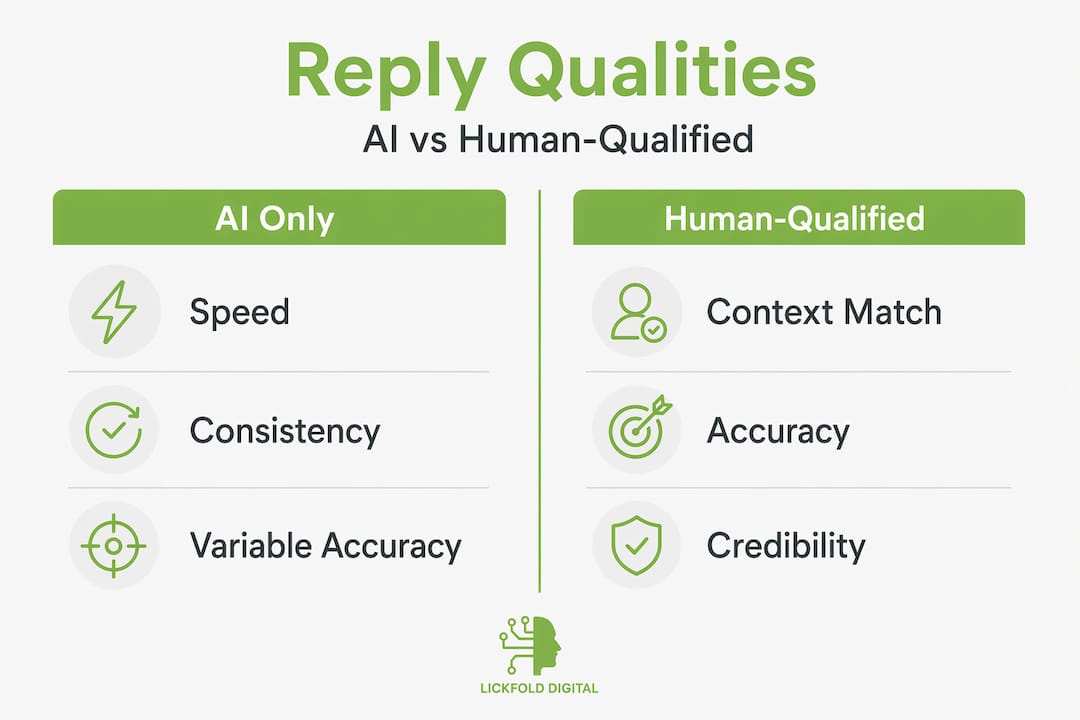
| Dimension | Fully AI replies | Human-qualified replies |
|---|---|---|
| Factual accuracy | Variable, model-dependent | Consistently verified |
| Tone match | Generalized | Prospect-specific |
| Relevance | Prone to drift | Reviewed before send |
| Conversion impact | Inconsistent | Measurably higher |
| Scalability | High but risky | High with control |
| Brand protection | Low | Strong |
Pair your implementation with scalable lead generation strategies from the start, and align your review metrics with pipeline KPIs. If your team is already using AI workflow automation examples, human-qualified replies slot in as the quality layer, not a separate process.
Pro Tip: Align your human-qualified reply goals directly to a KPI your sales leadership already tracks, such as reply-to-meeting rate. Adoption accelerates when reps see the connection between better replies and booked calls.
Why human-qualified replies are your secret weapon against sales fatigue and missed opportunities
Here’s the uncomfortable truth most sales automation vendors don’t talk about: AI confidence is not the same as sales intelligence. An AI system can be highly confident it has answered a question while a trained sales rep reading the same reply knows immediately it would frustrate the prospect. That gap is real, it’s common, and it compounds over hundreds of conversations per week.
The purpose of human-in-the-loop is to augment, not replace, human judgment by letting AI handle predictable tasks and humans handle exceptions. When companies implement this properly, something interesting happens. Reps stop feeling burned out by inbox management and start showing up to calls better prepared, because the only conversations they handle manually are the ones that genuinely need their expertise.
Companies that rely entirely on AI for outbound replies also tend to suffer from what I’d call invisible pipeline erosion. Prospects stop responding. Open rates hold steady. Reply rates fall. The AI keeps sending confident responses that are just slightly off-target, and nobody catches it because there’s no human in the loop checking. By the time the team notices the conversion rate decline, three months of warm prospects have gone cold.
Blending human and AI qualification protects against that erosion. The human reviewer is your early warning system, your brand guardian, and your quality gate, all in one role that takes 15 to 30 minutes per day when the system is set up correctly.
“The AI solves the routine, the human solves the nuanced — together they transform sales.”
Enhance your B2B sales with expert human-qualified reply implementation
Getting human-qualified replies right requires more than a good idea. It requires the right infrastructure, routing logic, reviewer training, and quality measurement built to fit your specific sales motion.
At Lickfold Digital, we’ve built this exact system for B2B sales teams, combining AI-driven prospecting with disciplined human review layers that protect your brand and accelerate pipeline. From setting up the right human qualification frameworks to fine-tuning handoff protocols, our team handles the implementation so your reps focus on closing. If you want to see how blending human and AI qualification works in practice for companies like yours, reach out to our team and let’s build it together.
Frequently asked questions
What does ‘human-qualified replies’ mean in sales outreach?
Human-qualified replies are responses drafted or selected by AI but reviewed and approved by a human before being sent, ensuring accuracy and relevance. As defined in human-in-the-loop frameworks, “human-qualified replies” means automation followed by explicit human validation before the system acts.
Why is the AI-to-human handoff critical in reply qualification?
Timely, well-contextualized handoffs maintain sales momentum and give reps the full picture they need to engage prospects effectively. The handoff moment is critical because when done well, the rep receives complete context and a warm prospect.
How can sales teams avoid AI relevance drift in replies?
Train human reviewers to specifically check whether each reply addresses the actual question asked, not a similar-sounding one. Relevance drift is a common failure mode where AI answers a different question than asked, and only a human reviewer consistently catches it.
What are best practices for scaling human review without slowing processes?
Define decision types with tailored review requirements and use confidence thresholds to route only exceptions for human approval. Workflows define categories with specific review needs and confidence levels to prevent review overload and keep response times fast.
How frequently should teams review and improve human-qualified reply workflows?
Weekly iteration is the right cadence. Iterate weekly, not quarterly, to improve human-qualified reply outcomes and catch model drift before it affects your pipeline metrics.