
How Agencies Land Enterprise Clients: A 2026 Playbook
How Agencies Land Enterprise Clients: A 2026 Playbook
TL;DR:
- Winning enterprise clients requires building relationships early, not just waiting for RFPs.
- Agencies must focus on targeted outreach, multi-stakeholder engagement, and long-term, disciplined sales cycles.
Marketing agencies that consistently win enterprise clients do one thing differently from everyone else: they stop waiting for RFPs and start building relationships before the budget is ever approved. The core formula is straightforward. Define a tight ideal client profile, build multi-stakeholder engagement across buying committees, prepare compliance documentation before anyone asks for it, and commit to a 3–9 month sales cycle with disciplined follow-through. Agencies that treat enterprise sales as a sprint lose. The ones that treat it as a long game, with the right infrastructure, win accounts that can anchor their revenue for years.
Here is what that looks like in practice:
- Define your ideal enterprise client by industry, company size, annual revenue, and budget authority before you prospect a single account
- Build a multi-stakeholder engagement strategy that addresses every member of a buying committee, not just the CMO
- Prepare trust signals in advance: SOC 2 documentation, GDPR compliance pages, and enterprise-grade case studies
- Adopt a disciplined sales cadence that sustains contact and value delivery across months, not weeks
- Run account-based marketing campaigns with personalized outreach targeted at specific named accounts
- Adjust internal operations so your team can actually service enterprise complexity once you win the deal
- Commit to long-term partnership thinking from the first discovery call, not just after the contract is signed
What makes enterprise clients fundamentally different from SMB clients
Enterprise clients are not just bigger SMB clients. They are a different species of buyer, and agencies that treat them as oversized small businesses consistently lose deals they should have won.
An enterprise organization typically operates with formal procurement departments, legal review cycles, security audits, and buying committees of five to ten stakeholders. A single contract can require sign-off from several executives including a CMO, CFO, procurement lead, IT security officer, and sometimes a regional VP. Contrast that with an SMB, where one founder or marketing manager can approve quickly and wire a deposit within days.
Enterprise buyers prioritize ROI evidence, risk mitigation, and vendor stability over price. They want to know your agency will still exist in three years, that your data handling meets their legal team’s standards, and that you have delivered measurable results for organizations at their scale. Generic case studies about a $50K project do not move the needle with a buyer managing a $5M marketing budget.
The sales cycle reflects all of this. Where an SMB deal might close in a few weeks, enterprise deals regularly run for several months, with multiple evaluation stages. Agencies that understand this going in budget their time and cash flow accordingly. Those that don’t often abandon promising deals at the three-month mark, right before the procurement team was about to issue a purchase order.
The practical differences agencies must internalize:
- Enterprise buyers evaluate vendors on financial stability, compliance posture, and reference quality, not just creative samples
- Buying committees include both champions (who want you to win) and blockers (who need to be convinced separately)
- Procurement processes involve vendor questionnaires, security reviews, and legal redlines that can each take two to four weeks
- Enterprise clients expect dedicated account management, not a shared project manager juggling ten accounts
- Decisions move slowly but contracts are large, long-term, and often renewable with expansion potential
How agencies land enterprise clients: the step-by-step sales process
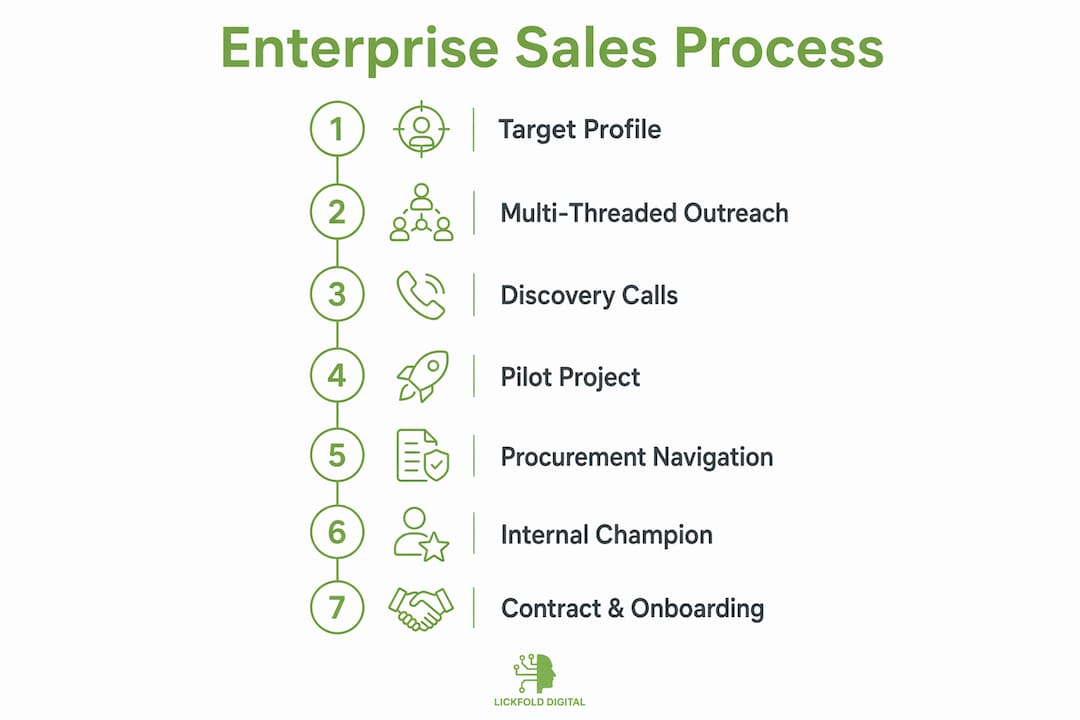
Winning a large account is not a single event. It is a sequence of deliberate moves, each one building the credibility and trust that eventually converts to a signed contract.
1. Build a targeted account list from a tight ideal client profile
Start by analyzing your three to five most profitable existing clients. What industry are they in? What triggered their decision to hire an agency? What was their annual marketing budget? Reverse-engineer those answers into firmographic criteria, then use tools like LinkedIn Sales Navigator to build a list of 25–50 accounts that match. Broader than that and you cannot personalize properly. Narrower and you run out of pipeline.
2. Run multi-threaded outreach to the full buying committee
Single-threaded outreach, where you email one contact and wait, fails in enterprise sales. Map five to seven stakeholders per account: the economic buyer, the day-to-day champion, the creative or marketing lead, procurement, and IT security if your work involves data. Reach each of them with messaging tailored to their specific concerns. The CMO cares about brand outcomes. Procurement cares about contract terms and vendor stability. IT cares about data handling.

3. Conduct discovery calls focused on business pain, not your capabilities
Your first call is not a pitch. It is a diagnostic conversation. Ask about their current agency relationships, what is working, what is not, and what a successful outcome looks like in twelve months. The agencies that win enterprise deals are the ones that make the prospect feel genuinely understood before they ever show a single slide.
4. Propose a low-risk pilot project
Enterprise buyers are risk-averse by design. A focused pilot, scoped to a specific campaign or deliverable with clear success metrics, gives them a way to evaluate your work without a full commitment. Structure the pilot so it solves a real problem and produces a measurable result. That result becomes your case study for the next stage of the conversation.
5. Navigate procurement, legal, and security proactively
Proactively sharing SOC 2 reports, GDPR documentation, and data processing agreements before procurement asks for them accelerates trust-building and reduces legal friction. Agencies that wait to be asked look unprepared. Agencies that send a compliance package with their proposal look like enterprise-grade partners.

6. Develop and support an internal champion
Every enterprise deal has at least one person inside the organization who wants you to win. Find them early, give them the materials they need to sell you internally, and keep them informed at every stage. A champion with a clear ROI summary and a risk-mitigation one-pager can unblock a stalled deal faster than any external follow-up call.
7. Close with a formal contract and a structured onboarding plan
Enterprise buyers expect professional contract management. Have your master service agreement, SLA terms, and data ownership clauses ready before negotiations start. When the deal closes, present a structured onboarding plan with named milestones, a dedicated Slack channel or communication protocol, and a kickoff timeline. The transition from “signed” to “started” is where agencies lose momentum, and enterprise clients notice.
What your agency needs to change internally to serve enterprise clients
Winning an enterprise client with your current team structure and then trying to service them the same way you handle SMB accounts is a reliable path to churn. The operational gap between what enterprise clients expect and what most agencies deliver is where relationships break down.
Internal shifts that separate agencies that retain enterprise clients from those that lose them:
- Dedicated enterprise sales roles: Sales reps who split time between SMB and enterprise accounts consistently underperform on both. Dedicated sales teams focused on enterprise accounts improve closing rates and retention compared to mixed-role functions. Assign at least one person whose only job is enterprise business development.
- Consultative selling training: Enterprise buyers respond to advisors, not order-takers. Train your sales team on discovery questioning, stakeholder mapping, and value-based positioning. The goal is to become a trusted advisor before the contract is signed.
- Account management workflows built for complexity: Enterprise clients need quarterly business reviews, proactive reporting, and a named account lead who knows their business. Build these into your service delivery model before you win the account, not after.
- Compliance documentation prepared in advance: A security questionnaire that takes your team two weeks to answer is a red flag to enterprise procurement. Prepare a standard compliance package covering data handling, security certifications, and insurance documentation that can be shared within 24 hours of a request.
- CRM infrastructure that supports long cycles: Enterprise deals involve dozens of touchpoints across months. A CRM like Salesforce or HubSpot, configured to track multi-stakeholder engagement and deal stage progression, is not optional. Without it, deals fall through the cracks.
- Cross-functional alignment: Your marketing, sales, and delivery teams need to operate from the same account intelligence. When the delivery team does not know what was promised during the sales process, enterprise clients feel the disconnect immediately.
- Ongoing value delivery post-contract: Enterprise clients expect to receive value between deliverables, not just at project milestones. Share relevant industry research, flag emerging trends in their sector, and bring new ideas to quarterly reviews. Agencies that do this retain accounts for years. Those that go quiet between invoices get replaced.
How account-based marketing and AI outbound accelerate enterprise wins
Account-based marketing is the single most effective shift an agency can make in its approach to enterprise client acquisition. Instead of broadcasting to a broad audience and hoping enterprise buyers find you, ABM concentrates your resources on a curated list of named accounts and runs coordinated, personalized campaigns across every relevant stakeholder simultaneously.
The results are measurable. Agencies using account-specific creative campaigns see 67% higher pipeline velocity compared to traditional inbound approaches. Agencies that allocate 15–25% of the potential annual contract value to their top-tier ABM accounts report 30% higher deal sizes and 50% shorter sales cycles. This reflects a fundamental truth about enterprise sales: precision beats volume every time.
A tiered ABM structure that works for most agencies:
- Tier 1 (5–10 accounts): Full 1:1 campaigns with custom creative assets, personalized direct mail, dedicated landing pages, and individual outreach to each buying committee member. Budget 15–25% of the potential annual contract value per account.
- Tier 2 (10–15 accounts): Cluster campaigns grouped by industry or shared challenge, with personalized email sequences and LinkedIn advertising targeting the specific companies.
- Tier 3 (15–20 accounts): Broad thought leadership content and targeted ads that build awareness across the full list without heavy per-account investment.
Multi-threaded personalization across buying committee members yields 66% workshop conversion rates in enterprise CPG accounts, according to StrategicABM research. The mechanism is straightforward: when a creative director receives a custom brand audit and a CMO receives a strategic positioning analysis, both tailored to their specific company, the agency stops looking like a vendor and starts looking like a partner who already understands the business.
AI tools amplify this at scale. AI-powered outbound systems can identify accurate decision-makers, craft personalized multi-channel outreach sequences, and maintain consistent follow-up across a 25–50 account list without the manual overhead that typically makes this level of personalization unsustainable. For agencies running targeted outreach campaigns, AI handles the research and sequencing so the sales team can focus on the conversations that actually move deals forward.
Pro Tip: Send a custom brand audit or a visual concept mockup to your Tier 1 target accounts before you ever request a meeting. A short, polished analysis of their current creative positioning demonstrates expertise without a pitch, and it gives the creative director a reason to forward your name to the CMO.
Building authority through selective targeting also matters here. Agencies that publish substantive, sector-specific thought leadership, such as a detailed analysis of how retail brands are rethinking creative strategy post-cookie, attract enterprise buyers who arrive pre-qualified and pre-convinced. Pair that content with a data-driven content strategy and your ABM outreach lands in a context where the prospect already recognizes your name.
Early transparency on security and compliance belongs in your ABM campaigns too, not just in procurement. Including a link to your security documentation in your initial outreach signals enterprise readiness from the first touchpoint, which is exactly what a risk-averse buying committee needs to see.
Key Takeaways
Agencies that win enterprise clients combine precise targeting, multi-stakeholder engagement, operational readiness, and disciplined long-cycle persistence into a single repeatable system.
| Point | Details |
|---|---|
| Define a tight ideal client profile | Target 25–50 named accounts by industry, budget, and decision structure before any outreach begins. |
| Prepare compliance documentation early | Sharing SOC 2 and GDPR materials proactively accelerates procurement and signals enterprise readiness. |
| Use tiered ABM campaigns | Allocating 15–25% of potential annual contract value to Tier 1 accounts drives 30% higher deal sizes. |
| Build dedicated enterprise sales roles | Dedicated sales teams focused on enterprise accounts outperform mixed-role functions on both closing rates and retention. |
| Lickfold accelerates pipeline building | Lickfold’s AI-driven outbound system identifies decision-makers and runs personalized multi-touch sequences across your target account list. |
The enterprise opportunity most agencies are still leaving on the table
The conventional wisdom in agency circles is that enterprise clients are too slow, too bureaucratic, and too risky to pursue unless you are already a large shop. That framing is wrong, and it is costing mid-sized agencies the accounts that would actually change their trajectory.
The real barrier to winning enterprise clients is not size. It is preparation. Most agencies lose enterprise deals not because they lack the talent, but because they show up to a procurement process without compliance documentation, pitch to a single contact instead of the full buying committee, and abandon the pursuit after two months of silence. Enterprise procurement silence is not rejection. It is process. The agencies that understand this stay in the game long enough to win.
There is also a misunderstanding about what enterprise clients actually buy. They are not buying creative work or media buying or SEO. They are buying risk reduction, strategic alignment, and a partner who will make them look good internally. Every pitch, every case study, every follow-up email should be framed around those three things. The agencies that frame their value in terms of outcomes and risk mitigation close deals. The ones that lead with their portfolio and their process rarely do.
The technology shift happening right now is also worth taking seriously. AI-powered outbound prospecting has made it possible for a 15-person agency to run a disciplined, personalized ABM program across 40 named accounts without hiring a full business development team. That changes the math on enterprise acquisition for agencies that previously thought the investment was out of reach. The agencies moving on this now are capturing disproportionate share before the approach becomes standard practice.
Lickfold builds the enterprise pipeline your sales team can actually close
Most agencies know they should be running personalized, multi-touch outreach to enterprise decision-makers. The gap is execution. Researching 40 named accounts, mapping five to seven stakeholders per account, crafting individualized sequences for each persona, and maintaining consistent follow-up across a six-month sales cycle is a full-time operation.
Lickfold deploys AI agents that handle exactly that work. The system identifies decision-makers matching your ideal client profile, builds personalized outreach sequences without generic templates, manages dedicated warm-up email accounts to protect deliverability, and passes human-qualified replies directly to your sales team. The result is a predictable pipeline of enterprise-ready conversations, without the overhead of a large outbound team. If you are ready to stop waiting for RFPs and start building relationships with the accounts that matter, reach out to Lickfold and see what a purpose-built enterprise prospecting system looks like in practice.