
Why Agencies Struggle with New Business in 2026
Why Agencies Struggle with New Business in 2026
TL;DR:
- Agency new business fails mainly due to staffing gaps, unclear positioning, and operational inefficiencies.
- Agencies that focus on specialization, disciplined pipelines, and AI adoption improve their chances of growth in 2026.
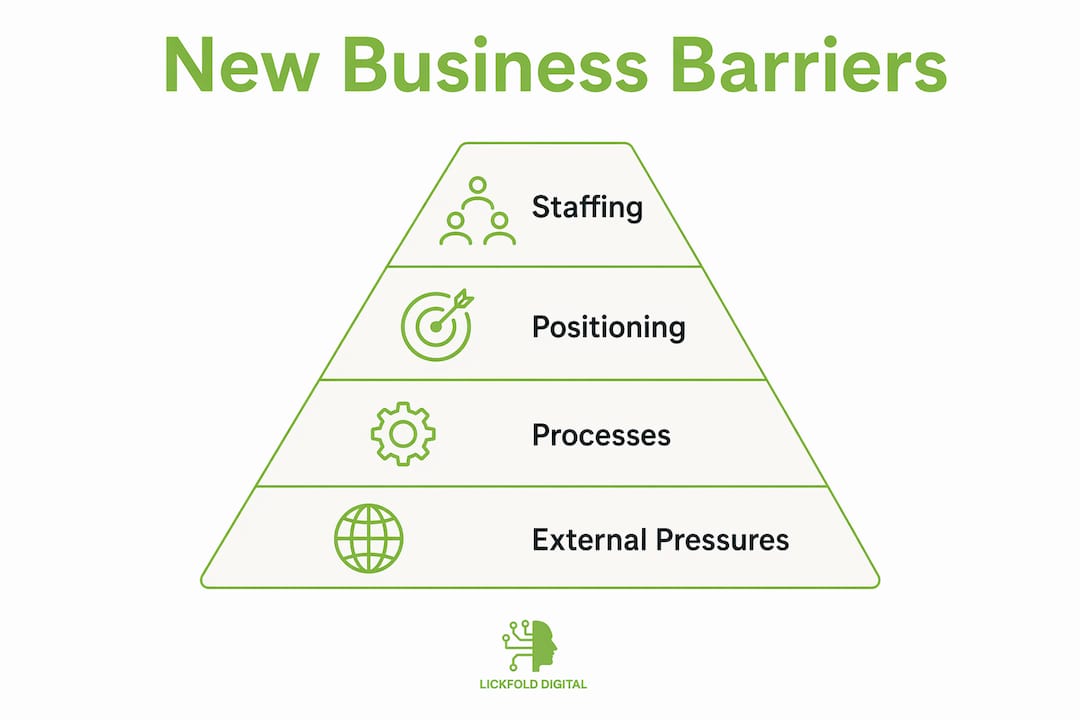
Agency new business failure is defined by three structural gaps: understaffed sales functions, unclear positioning, and broken operational workflows. These are not isolated problems. They compound each other, and the result is a pipeline that shrinks faster than leadership can react. Agency new business ranks as the top concern for agency leaders heading into 2026, with pipeline instability rising faster than any other challenge. Understanding why agencies struggle with new business starts with the data, and the data points to systemic dysfunction, not bad luck.
Why agencies struggle with new business: the staffing gap at the root
The most direct cause of new client acquisition failure is the absence of people whose job it is to find new clients. 79% of agencies lack dedicated marketing staff, and 70% have no full-time sales personnel. That means the majority of agencies rely on founders, account managers, or project leads to generate new business on top of their existing workloads.
This creates a predictable failure pattern. When client work gets busy, business development stops. When client work slows down, everyone scrambles to fill the pipeline at once. The result is a feast-or-famine cycle that no amount of motivation fixes without structural change.
The confusion between marketing and business development makes this worse. Marketing builds awareness and attracts inbound interest. Business development identifies target accounts, initiates outreach, and moves prospects through a pipeline. These are different disciplines requiring different skills and different time commitments. Agencies that assign both to the same person, or to no one in particular, get diluted results from both.
- Assign one person or team to own the pipeline, with a defined quota and weekly reporting cadence
- Separate inbound content marketing from outbound prospecting in your planning and budget
- Track pipeline volume, deal stage, and conversion rate as distinct metrics, not a single “leads” number
- Review the agency business development role to clarify who owns what before hiring
Pro Tip: If your agency cannot name one person responsible for new business this week, that is the first problem to solve. Shared responsibility means no responsibility.
Why does unclear positioning kill lead generation?
Agencies that cannot clearly state who they help and what result they deliver end up competing on price and availability. That is the race to the bottom that kills margins and attracts the wrong clients. Generic positioning forces prospects to compare agencies on cost alone, because there is no other meaningful differentiator.
Specialization is the most direct fix. An agency that serves mid-market SaaS companies with demand generation programs has a clear story. A prospect in that category immediately recognizes the fit. A generalist agency that “helps businesses grow” gives prospects no reason to choose them over anyone else.
Effective positioning answers three questions without ambiguity:
- Who do you serve? Name the industry, company size, or buyer role you specialize in. “B2B technology companies with 50–500 employees” is specific. “Businesses of all sizes” is not.
- What problem do you solve? Describe the business outcome, not the service. “We fill your sales pipeline with qualified demos” beats “We do paid media and SEO.”
- Why are you the best choice? Name the proof. Case studies, vertical expertise, proprietary methodology, or measurable results all work. Vague claims about passion and creativity do not.
Agencies resist specialization because they fear turning away business. That fear is understandable but counterproductive. Specializing by vertical or service is the most effective way to stop competing on price and become a premium choice in a defined market. The agencies that command the highest fees are almost always the ones with the narrowest, clearest focus.
Building authority within a niche accelerates lead generation. Publishing case studies, speaking at industry events, and running targeted outbound campaigns to a defined list of ideal clients all work better when the positioning is specific. A clear message also improves referral quality. Clients refer you to people who match their own profile, so the more precisely you define your ideal client, the more useful your referral network becomes.
Pro Tip: Write your positioning statement in one sentence and test it on a stranger outside your industry. If they cannot tell you who you help and what you do for them, rewrite it.
How do operational inefficiencies block agency growth?
Process failure is the second largest structural barrier to new business. 44.1% of agencies cite inefficient processes as a primary growth barrier, and 40.4% point to siloed systems that prevent teams from sharing information and coordinating outreach. These are not technology problems. They are workflow problems that technology cannot fix without a clear process underneath.
The table below shows the difference between ad-hoc and systematic business development across four key dimensions:
| Dimension | Ad-hoc approach | Systematic approach |
|---|---|---|
| Outreach cadence | Sporadic, driven by urgency | Fixed weekly schedule, protected from client work |
| Pipeline visibility | Informal, tracked in email or memory | Stage-defined CRM with deal age and conversion metrics |
| Lead qualification | Inconsistent, based on gut feel | Defined criteria applied at every stage |
| Follow-up | Forgotten or delayed | Automated reminders with human review at key touchpoints |
Ad-hoc business development produces bloated CRMs full of unqualified deals and pipelines that look full but convert poorly. The fix is not more activity. It is more structure applied to the right activity.
A functional pipeline requires three things:
- A fixed weekly block of time dedicated to business development, protected from client meetings and delivery work
- Clear stage definitions with entry and exit criteria so every deal in the CRM reflects real progress
- A review cadence where pipeline health is measured by conversion rate and deal velocity, not just deal count
Agencies that build these habits see more predictable revenue. The agency business development workflow matters as much as the quality of the outreach itself. A great pitch sent inconsistently loses to a good pitch sent on a reliable schedule.
What external pressures are reshaping new client acquisition?
Three forces outside agency control are making new business harder in 2026. 65.3% of agencies report clients moving work in-house, reducing the pool of available work for traditional agency models. Economic uncertainty is compressing client budgets and extending procurement timelines. AI is reshaping what clients expect agencies to deliver and at what price.

The AI challenge is particularly acute. 60.7% of agencies cite skills gaps as the primary barrier to AI adoption, and 51.8% report being too busy with daily client work to build AI capability. Only 16.1% have AI embedded across their teams with measurable outcomes. That gap creates a competitive disadvantage as clients increasingly expect AI-native workflows and faster turnaround times.
The agencies winning new business despite these pressures share a common approach. They have moved from generalist models to data-driven, specialized services that are harder to replicate in-house. They treat AI adoption as a parallel investment, not a future project. And they use outbound prospecting systems that do not depend on referrals or inbound traffic alone.
The productivity gains from AI for agencies are real and measurable, but they require deliberate investment in training and workflow redesign. Agencies that wait for a quiet period to build AI capability will keep waiting. The ones building it now, alongside client delivery, are the ones pulling ahead.
Pro Tip: Dedicate one hour per week per team lead to AI tool testing and documentation. Small, consistent investment compounds faster than a single training sprint.
Key Takeaways
Agency new business failure is structural, not situational. Fixing it requires dedicated staffing, specific positioning, and a disciplined pipeline process applied consistently.
| Point | Details |
|---|---|
| Staffing is the root cause | 79% of agencies lack dedicated marketing staff, making pipeline growth structurally impossible without role clarity. |
| Positioning drives lead quality | Specializing by vertical or service stops the race to the bottom and attracts clients who buy on fit, not price. |
| Process beats effort | A fixed weekly cadence and stage-defined CRM outperform sporadic high-volume outreach every time. |
| External pressure demands specialization | With 65.3% of clients moving work in-house, generalist agencies face shrinking demand and must narrow their focus. |
| AI adoption requires parallel investment | Building AI capability alongside client delivery is the only realistic path to staying competitive in 2026. |
The uncomfortable truth about agency business development
I have worked with enough agencies to know that the staffing and positioning problems are symptoms of a deeper issue: most agency leaders do not treat business development as a system. They treat it as a task they will get to when things slow down. Things never slow down.
The agencies I have seen break out of the feast-or-famine cycle all made the same decision. They stopped waiting for a good time to fix their pipeline and started protecting time for it every single week, regardless of how busy client work was. That discipline is harder than it sounds. Client urgency always feels more pressing than a prospecting call. But a pipeline that gets attention only when it is empty is already too late.
The positioning problem is equally self-inflicted. Agencies know they should specialize. They resist it because saying no to a prospect feels like leaving money on the table. The reality is the opposite. Saying yes to every prospect dilutes your message, attracts low-margin clients, and makes it impossible to build the case studies and referral networks that drive premium pricing. The agencies charging the most are the ones who turned away the most.
On AI: the skills gap is real, but it is not the main barrier. The main barrier is leadership that has not decided AI maturity is a business priority. When it becomes a priority with a budget and an owner, the skills gap closes fast. Using AI for sales prospecting is not a future capability. It is a current competitive advantage for the agencies willing to build it now.
The agencies that will win new business in 2026 are not the ones with the best creative or the lowest prices. They are the ones with the clearest positioning, the most disciplined pipelines, and the willingness to say no to work that does not fit.
— Duarte
How Lickfold helps agencies build a predictable pipeline
Agencies that have fixed their positioning and process still face one persistent problem: consistent outreach at scale. That is where Lickfold comes in.
Lickfold deploys AI-driven prospecting systems that identify decision-makers matching your ideal client profile, execute personalized multi-touch outreach campaigns, and pass only human-qualified replies to your sales team. The system runs continuously, which means your pipeline gets attention every week whether or not your team has bandwidth. For agencies serious about improving their new business results, Lickfold provides the outbound infrastructure that makes consistent lead generation possible without adding headcount.
FAQ
Why do most agencies fail at new business development?
Most agencies fail because they lack dedicated sales and marketing staff, with 79% having no dedicated marketing resources. Without a defined owner and a protected weekly cadence, business development gets deprioritized every time client work gets busy.
What is the biggest barrier to agency growth in 2026?
44.1% of agencies cite inefficient processes as their top growth barrier, followed closely by siloed systems at 40.4%. These operational failures prevent agencies from building the stable, predictable pipelines that new business requires.
How does poor positioning affect new client acquisition?
Agencies without clear positioning compete on price and availability rather than fit and expertise. Specializing by vertical or service is the most effective way to attract higher-quality leads and command premium pricing.
How is in-housing affecting agency new business?
65.3% of agencies report clients moving work in-house, which directly reduces the available market for generalist agency services. Agencies that specialize in outcomes clients cannot replicate internally are best positioned to retain and grow revenue.
Can AI help agencies win more new business?
AI can significantly improve outbound prospecting efficiency, but only 16.1% of agencies have AI embedded across their teams with measurable outcomes. Agencies that invest in AI-driven prospecting now gain a compounding advantage over those still relying on manual outreach and referrals alone.