
The One First-Line Fix That Actually Lifts Cold Email Replies
The One First-Line Fix That Actually Lifts Cold Email Replies
The single highest-leverage move is opening with a verifiable, recent signal about the prospect (a launch, a hire, a post they wrote) stated in a second-person line under 15 words. Teams that do this consistently see meaningfully higher reply rates than teams sending generic openers, with Lickfold Digital’s internal data putting the lift at over 14%. The tactical checklist for building that line is below.
TL;DR:
- Ensure signals are recent, verifiable, and specific within the last 30 to 60 days, such as a press release or LinkedIn post, to maximize relevance.
- Keep the first line under 15 words, use “you” or “your,” and make sure it reads naturally to avoid generic templates and boost reply rates by over 14%.
- Use AI-assisted personalization primarily for mid-tier or long-tail segments, and always verify data accuracy before human editing to prevent insincere or outdated lines.
- Prioritize signals from prospects’ control—such as recent posts, funding announcements, or job changes—and allocate no more than three to five minutes for manual research per lead.
- Avoid personalization errors such as referencing stale signals, overloading facts, using template phrases, quoting wrong data, or referencing sensitive issues, to prevent lower reply rates.
Table of Contents
- What makes first line personalization actually work
- AI personalization: when to use it and practical guardrails
- Where to find personalization signals fast
- Templates and formulas for personalized first lines
- How to scale personalization without losing authenticity
- Mistakes that quietly kill your reply rate
- Duarte’s perspective: what actually moves the needle
- Get verified, personalized outreach without building the process yourself
- Sources
What makes first line personalization actually work
First line personalization comes down to three things: a real signal, tight phrasing, and a “you” focused sentence instead of a “we” focused one. Get those right and the opener does the job a subject line can’t finish alone.
Keep the line under 15 words. Anything longer starts to read like a paragraph crammed into a sentence, and most inboxes truncate preview text well before word 20 anyway. Use “you” and “your” at least once. Sales reps who write “I noticed your Series A” outperform “We wanted to reach out because your company recently…” almost every time, because the second version buries the point under throat-clearing.
A good signal has to be verifiable and recent, ideally something that happened in the last 30 to 60 days. A press release, a job posting, a LinkedIn post, a podcast appearance, a product launch. Stale signals (“Congrats on your Series B” three years after the raise) do more damage than no personalization at all, because they signal you didn’t actually check.

Before: “I hope this email finds you well. I wanted to reach out because I think our solution could help your team.”
After: “Saw your post on switching to a usage-based pricing model. Curious how the sales team adjusted quota targets.”
The second version names something specific, uses “you,” and implies the sender read the actual post rather than skimmed a company page.
Pro Tip: Run every draft line through a 5-second test: could this sentence apply to 100 other companies unchanged? If yes, it’s not personalization, it’s a template with a name field.
Before you send, run this quick QA pass:
- Does the line name something specific and checkable, not a vague category?
- Is it under 15 words and does it use “you” or “your”?
- Would the prospect recognize the reference within two seconds of reading it?
- Does it match the tone of your subject line and preview text, since personalized subject lines see significantly higher open rates and the first line often IS the preview text in most inboxes?
AI personalization: when to use it and practical guardrails
AI-assisted personalization works well for high-volume, low-stakes segments where a solid line beats no line, and it works poorly when you skip the human check. Practitioner reports on cold email performance note that AI-written openers often sound insincere and actually reduce reply rates when nobody edits them before send, per Prospeo’s research on personalized first lines. The fix isn’t avoiding AI. It’s building a process around it.
Use this three-step sequence for any AI-assisted batch:
- Generate. Feed the model a specific, structured prompt: name, role, company, one verified data point (a recent post, a funding event, a job change), and instructions to write one sentence under 15 words in second person.
- Verify. Confirm the data point is accurate and current before the line ever reaches a send queue. AI models occasionally hallucinate details that sound plausible but don’t check out.
- Human edit. Have a person scan for tone, awkward phrasing, and anything that reads like it came from a template with the blanks filled in.
Manual research still wins for your highest-value accounts, where one closed deal justifies the extra ten minutes. Reserve AI for the mid-tier and long-tail prospects where volume matters more than perfection. Run A/B tests at the segment level, comparing AI-drafted-and-edited lines against fully manual ones on identical audiences, and track reply rate by variant for at least 200 sends before drawing conclusions.
Where to find personalization signals fast
The best signals come from places prospects control directly, because those reveal what they actually care about right now, not what a database scraped six months ago.
Prioritize these sources in order:
- Company or founder LinkedIn posts from the last 30 days. A recent post about hiring, a product launch, or an industry opinion is gold.
- Job listings on the company’s careers page. A sudden push to hire five account executives tells you something about growth plans a generic pitch never will.
- Press releases and funding announcements, especially anything in the last 60 days.
- Podcast appearances or webinar panels where the prospect speaks in their own words about a problem they’re solving.
- Recent company blog posts, which often reveal internal priorities before they show up anywhere else.
Cap manual research at 3 to 5 minutes per lead. Past that point, the marginal payoff drops fast and you’re better off moving to the next prospect. Cross-reference whatever you find against a second source before writing the line. A LinkedIn post that turns out to be a re-share of someone else’s news, not the prospect’s own update, will torpedo credibility fast.
Data hygiene matters as much as the research itself. Verified contact records and segmented lists, built from sign-up data, profile updates, and activity history, give you both accurate targets and the raw material for dynamic fields. Skip this step and you’re personalizing a line that bounces before anyone reads it.
Templates and formulas for personalized first lines
Four formula categories cover most cold outreach scenarios, and each one bends around a different type of signal.
1. Event-based: Reference something that happened recently.
- Weak: “I saw your company is doing well lately.”
- Strong: “Noticed [Company] closed its Series A last month. Congrats on the momentum.”
2. Role insight: Speak to a challenge specific to their job title.
- Weak: “As a VP of Sales, you probably deal with a lot of challenges.”
- Strong: “Managing quota resets across three regions probably ate your whole week in January.”
3. Micro-cohort: One line written for a tight segment, not an individual, but specific enough to feel personal.
- Weak: “Companies like yours often struggle with lead generation.”
- Strong: “Series B logistics startups usually hit a wall scaling outbound past 50 SDR-sourced meetings a month.”
4. Preview-text-aware: Written so the first line and subject line form one coherent snippet in the inbox preview.
- Weak: subject “Quick question” + first line “I wanted to reach out” (redundant, says nothing)
- Strong: subject “Your Q1 hiring push” + first line “Five open AE roles usually means a pipeline gap, not a headcount problem”
Adapting tone is simple once you have the formula: keep the sentence structure, swap the signal, and match your brand’s usual register. A blunt, data-driven brand should stay blunt in the opener. A warmer, consultative brand can soften the phrasing without losing specificity.
How to scale personalization without losing authenticity
Scaling personalization means writing for segments, not individuals, once your list passes a few hundred prospects. Micro-cohort segmentation, where you write one tailored line per tight segment rather than one per contact, is the approach most recommended for mid-market teams trying to balance throughput against authenticity.
Group prospects by a shared, specific trait: same funding stage, same recent hiring pattern, same industry pain point. Write one strong line per group instead of one generic line for the whole list or one bespoke line for every single name.
Use dynamic fields for structural elements, name, company, title, but never for the actual insight or observation. A line that says “Hi {{first_name}}, congrats on {{company}}'s growth” reads as a mail merge the second someone glances at it. The insight itself has to be written, not templated.
The workflow that holds up at volume looks like this:
- Verify contact and company data before anything else, since triggered and behavior-based emails outperform static sends significantly in open and click metrics, and that lift depends entirely on accurate targeting data.
- Generate first-line drafts by segment, using AI where volume demands it.
- Route drafts through a human edit pass before they enter any send sequence.
- Monitor reply rate, bounce rate, and open rate by segment weekly, not just in aggregate.
Watch bounce rate closely as you scale. Lists with high bounce rates can erase the entire benefit of a well-written opener, according to Prospeo’s analysis of first-line performance, because deliverability problems hit before the personalization ever gets read. Segmentation and dynamic content built on clean CRM data keep both problems in check at once. A lead generation playbook that pairs subject lines with personalized openers is worth a look if you’re building this system from scratch.
Mistakes that quietly kill your reply rate
Most personalization failures aren’t about laziness. They’re about a good idea executed sloppily, and the damage often shows up as a lower reply rate with no obvious cause.
- Stale signals. Referencing news that’s six months old signals you didn’t actually check anything recently.
- Over-personalizing. Cramming three separate facts into one opener reads as stalking, not research.
- Template leakage. Phrases like “I couldn’t help but notice” or “I hope this finds you well” tip off a reader that a script is running underneath.
- Wrong data. Referencing the wrong company, an outdated title, or a merger that already closed does more harm than sending no personalization.
- Sensitive triggers. Referencing layoffs, leadership departures, or legal trouble as an opener reads as opportunistic, not thoughtful.
Before any batch goes out, run a fast QA pass: fact-check every signal against a second source, scan for anything sensitive that could land wrong, and confirm bounce and complaint rates from the last send stayed low. Skip personalization entirely on any record you can’t verify. A blank but honest line beats a specific but wrong one every time.
Duarte’s perspective: what actually moves the needle
Most advice on this topic treats personalization as a copywriting problem. It’s mostly a data problem. The best opener in the world fails against a stale signal or a bad email address.
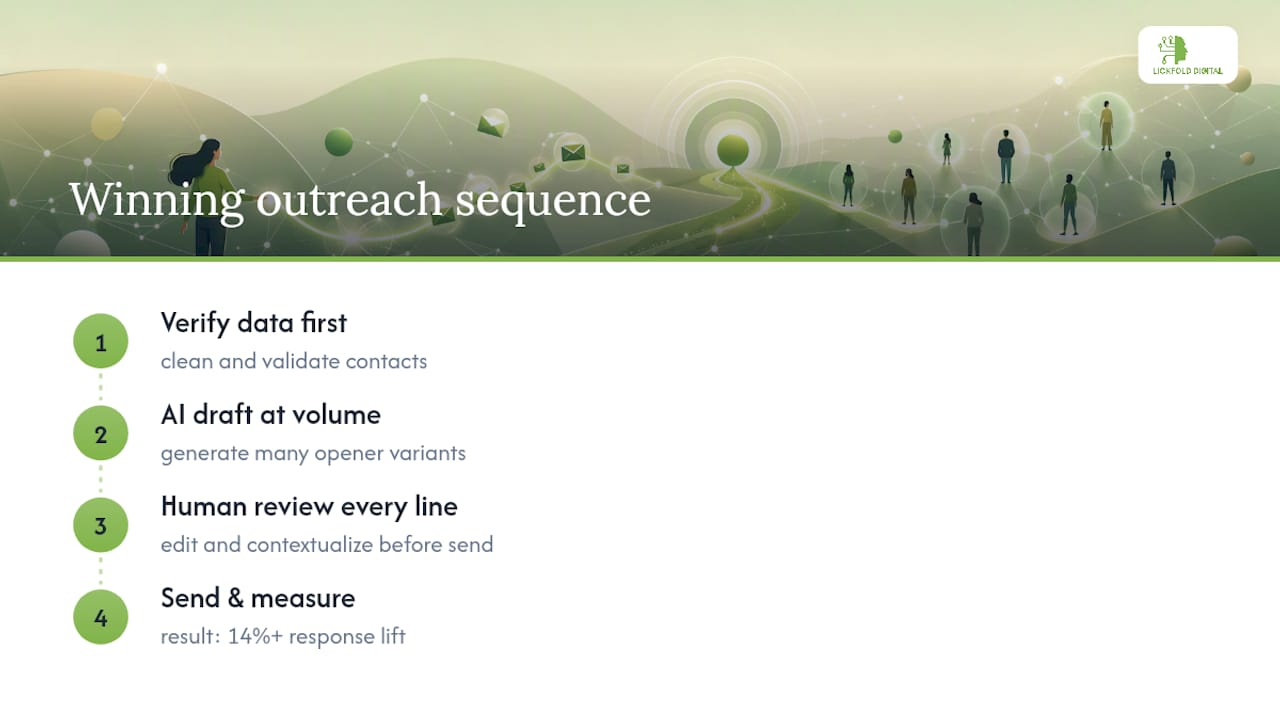
Lickfold Digital’s workflow reflects that: verify the data first, let AI draft at volume, then run every line through human review before it reaches a prospect’s inbox. That sequence, not any clever phrasing trick, is where our 14%+ response lift actually comes from.
If you take one thing from this: fix your data hygiene before you touch your copy. Better research beats better writing almost every time.
— Duarte
Get verified, personalized outreach without building the process yourself
Everything in this article, the research cadence, the AI-plus-human editing pass, the segmentation logic, is exactly what Lickfold Digital runs as a managed system instead of a manual habit your team has to maintain. Our AI agents handle the market research and decision-maker mapping, draft personalized multi-touch sequences against verified signals, and route every reply through human qualification before it hits your pipeline.
That combination is what produces a scalable pipeline of qualified opportunities instead of a spreadsheet of half-verified leads and inconsistent openers. Clients get the deliverability infrastructure (warm-up accounts, reputation management) built in, so personalization at scale doesn’t come at the cost of your sender reputation. If your team is stretched thin trying to research signals, draft lines, and QA every send manually, see how Lickfold Digital can take that workload off your plate and start building your outbound pipeline this quarter.
Sources
- Email Personalization | Salesforce
- Email Personalization: A Marketing Guide | Mailchimp
- An Expert Guide to Email Personalization 2024 | AMA