
Best Email Outreach Tools for B2B Teams in 2026
Best Email Outreach Tools for B2B Teams in 2026
TL;DR:
- Effective cold email in 2026 requires deliverability-first infrastructure and prospect-level AI personalization.
- Top tools like Lickfold Digital and Instantly focus on maximizing inbox placement and scale, respectively, while others excel in multichannel and creative outreach.
If you want cold email to actually work in 2026, the answer isn’t more volume. It’s deliverability-first infrastructure paired with prospect-level AI personalization. That combination consistently outperforms generic mass sends, and it’s the lens this shortlist is built around.
TL;DR top picks:
- Lickfold Digital — Best for teams that want a fully managed, hands-off outbound pilot with AI prospecting and human reply qualification
- Instantly — Best for high-volume sending with unlimited mailboxes and warmup networks
- Lemlist — Best for creative multichannel personalization (images, video, LinkedIn)
- Smartlead — Best for agencies needing dedicated infrastructure and white-labeled dashboards
- Reply.io — Best for AI SDR workflows and unified multichannel inbox
Jump to the comparison matrix below for a full feature breakdown, or read the per-tool details to evaluate trade-offs before your trial.
Table of Contents
- What are the best email outreach tools right now?
- Side-by-side comparison of top email outreach platforms {#side-by-side-comparison}
- Detailed breakdowns: what each tool actually does well
- How we tested and evaluated these tools
- How to pick the right email outreach tool for your team
- Why personalization beats volume in 2026
- Final recommendations by use case
- Key Takeaways
- The deliverability gap most teams ignore
- Lickfold Digital: the managed outbound alternative
- Sources and further reading
What are the best email outreach tools right now?
The market has split into four clear categories: unlimited-volume platforms (cost-effective for pure sending), AI-first personalization platforms (higher per-seat cost, better reply quality), database-led platforms (prospecting and outreach bundled), and deliverability-specialist platforms (dedicated IP and reputation controls). Knowing which category matches your team’s actual constraint is the fastest way to narrow the list.
Here are the top options, each labeled by the narrow use case where they genuinely lead:
-
Lickfold Digital — Managed AI-driven outbound service. Includes warmup infrastructure, AI prospecting agents, and human reply qualification. Best for organizations that want a deliverability-first outbound pilot without building internal tooling. No self-serve setup required.
-
Saleshandy — Low entry price with unlimited mailboxes on higher plans and basic AI sequence assistance. Starting around $25/month. Free trial available. Warmup: included. LinkedIn: no. AI personalization: basic.
Pro Tip: Entry-level plans from credible tools typically run within a moderate monthly price range in mid-2026. Anything below that range usually means per-seat costs explode at scale or warmup is not included.
Side-by-side comparison of top email outreach platforms {#side-by-side-comparison}
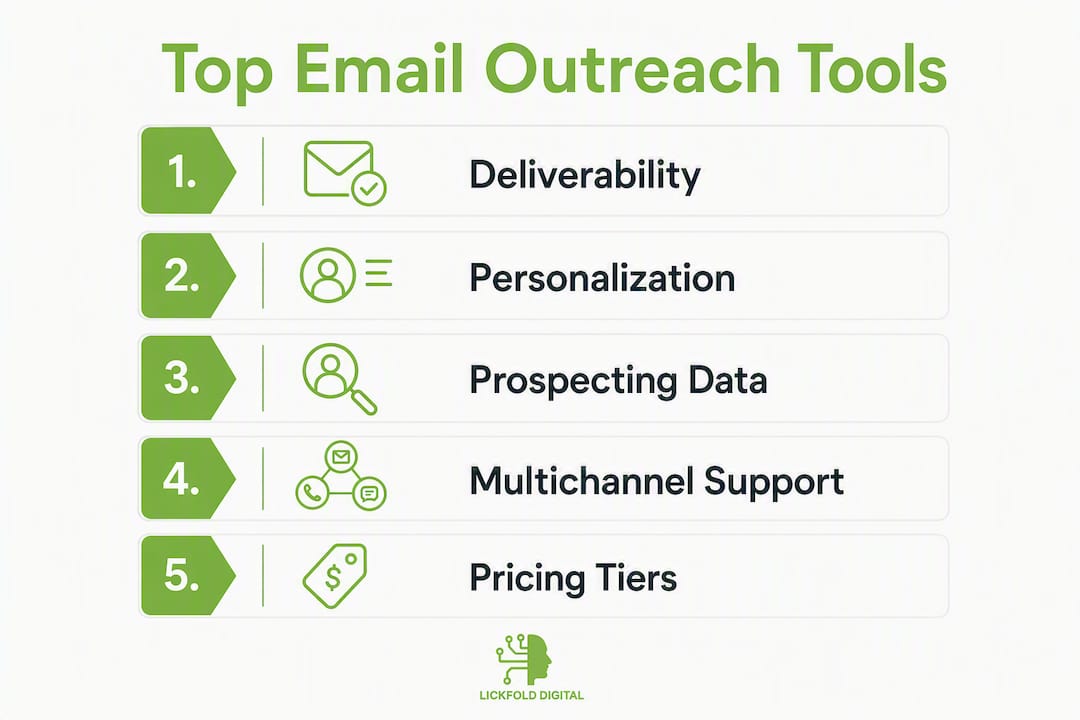
The table below covers the dimensions that actually drive buying decisions: deliverability infrastructure, AI personalization depth, prospecting data, multichannel support, and pricing shape.
| Tool | Best for | Warmup / Deliverability | AI Personalization | Prospecting data | Multichannel (LinkedIn/SMS) | Integrations | Pricing / Trial |
|---|---|---|---|---|---|---|---|
| Lickfold Digital | Hands-off managed outbound pilot | Managed warmup + reputation monitoring | AI agents, prospect-level research | AI-driven ICP targeting | Email + multi-touch | Custom | Custom / contact for pilot |
| Instantly | High-volume sending, inbox rotation | Unlimited mailboxes + large warmup network | Basic | No | Email only | Zapier, CRMs | From ~$37/mo / free trial |
| Lemlist | Creative personalization + multichannel | lemwarm built-in | Strong (images, video, AI copy) | No | Email + LinkedIn + calls | HubSpot, Salesforce, Zapier | From ~$59/mo / free trial |
| Apollo (Apollo.io) | Prospecting + outreach in one platform | Limited warmup | Moderate | Yes (large database) | Email + LinkedIn (partial) | Salesforce, HubSpot, Zapier | From ~$49/seat/mo / free tier |
| Smartlead | Agencies, multi-client, white-label | Dedicated-tenant infra + IP control | Moderate | No | Email only | Zapier, API | From ~$39/mo / free trial |
| Saleshandy | Budget-conscious teams | Warmup included | Basic AI assist | No | Email only | HubSpot, Zapier | From ~$25/mo / free trial |
| Reply.io | AI SDR workflows + unified inbox | Warmup included | Strong (AI SDR agents) | Partial | Email + LinkedIn + SMS + calls | Salesforce, HubSpot, Zapier | From ~$60/mo / free trial |
| Woodpecker | Simple, reliable cold-email flows | Warmup included | Minimal | No | Email only | Pipedrive, HubSpot, Zapier | From ~$39/mo / free trial |
| GMass | Gmail-native individual senders | Gmail reputation dependent | Minimal | No | Email only | Google Sheets, Gmail | From ~$25/mo / free trial |
| Mailshake | Simple sequences + phone steps | Basic warmup | Basic | No | Email + calls | Salesforce, HubSpot, Zapier | From ~$59/mo / free trial |
| Hunter | Email finding + verification | N/A (finder tool) | Minimal | Email finding only | Email only | HubSpot, Zapier | Free tier / from ~$39/mo |
| Snov.io | Integrated prospecting + drip | Warmup included | Basic | Yes (finder + verifier) | Email only | HubSpot, Pipedrive, Zapier | Free tier / from ~$30/mo |
| Klenty | CRM-native cadences | Basic warmup | Moderate | No | Email + calls + SMS | Salesforce, HubSpot, Pipedrive | From ~$50/seat/mo / free trial |
| QuickMail | Deliverability-focused small teams | Strong warmup focus | Basic | No | Email only | Zapier, API | From ~$49/mo / free trial |
| PlusVibe | Budget-conscious senders | Warmup included | Basic | No | Email only | Zapier | From ~$25/mo / free trial |
| Overloop | AI-assisted multichannel flows | Warmup included | Moderate AI assist | Partial | Email + LinkedIn | HubSpot, Salesforce, Zapier | From ~$49/mo / free trial |
** Best for deliverability:** Lickfold Digital (managed), Smartlead (self-serve agency) ** Best for scale:** Instantly ** Best for personalization:** Lemlist, Reply.io
Detailed breakdowns: what each tool actually does well
Lickfold Digital
Lickfold sits in a different category from every other tool on this list. It’s not software you configure yourself. It’s a managed outbound service where AI agents handle ICP research, decision-maker mapping, and personalized multi-touch sequences, while a human team qualifies replies before handing them to your sales reps.
Strengths:
- Dedicated warmup accounts and ongoing reputation management are built into the service, not add-ons
- AI prospecting agents research each prospect and write non-template copy
- Human reply qualification means your team only sees sales-ready conversations
- No internal deliverability expertise required from the client
Weaknesses:
- Not a self-serve tool; requires onboarding and a pilot commitment
- Pricing is custom, not publicly listed, so you can’t compare it on a per-seat basis
Verdict: The right fit for founders, sales directors, or marketing managers who want a predictable outbound pipeline without hiring an SDR team or managing deliverability infrastructure themselves.
Instantly
Instantly built its reputation on one thing: letting teams send at scale without hitting mailbox limits. Unlimited mailboxes on most plans, a large warmup network, and inbox rotation are the core value proposition.
Strengths:
- Unlimited mailboxes on paid plans means you can rotate senders freely
- Warmup network is large and included, not a paid add-on
- Clean UI with a relatively short learning curve
- Warmed mailboxes consistently outperform cold ones on inbox placement in independent tests
Weaknesses:
- AI personalization is shallow compared to Reply.io or Lemlist
- No native LinkedIn or multichannel support
- Analytics depth is limited for teams that need granular reporting
Pricing: From approximately $37/month. Free trial available.
Verdict: Best for SDR teams whose primary bottleneck is sending volume and inbox rotation, not personalization depth.

Lemlist
Lemlist is the tool that made image personalization mainstream in cold email. Drop a prospect’s name, company logo, or LinkedIn photo into a custom image template, and suddenly your email looks nothing like a mass send. Add native LinkedIn steps and video thumbnails, and you have a genuinely multichannel sequence in one platform.
Strengths:
- Image and video personalization that no other tool in this list matches natively
- lemwarm warmup is built in and well-regarded
- Native LinkedIn steps and call steps in the same sequence
- Strong template library for teams that need a starting point
Weaknesses:
- Higher price point than volume-first tools
- The creative setup takes time; not ideal for teams that want to launch in a day
- Prospecting data is not included; you bring your own list
Pricing: From approximately $59/month. Free trial available.
Verdict: Best for teams that compete on creative differentiation and need multichannel sequences. Multichannel campaigns combining email and LinkedIn show significantly higher reply rates than email-only in sample tests, which is the core argument for Lemlist’s approach.
Apollo (Apollo.io)
Apollo’s real advantage is the database. Over 275 million contacts with filters for industry, title, company size, technology stack, and funding stage. For teams that spend hours building prospect lists before they can even start a sequence, having that data inside the same platform as the outreach tool removes a painful handoff.
Strengths:
- Largest built-in contact database of any tool on this list
- Sequencing and prospecting in one workflow
- Free tier is genuinely useful for small teams testing the platform
- Strong CRM integrations
Weaknesses:
- Warmup support is limited compared to deliverability-specialist tools
- Per-seat pricing scales poorly for larger SDR teams
- Data accuracy varies by industry and geography
Pricing: From approximately $49/seat/month. Free tier available.
Verdict: Best for teams that need prospecting data and outreach in one place and are willing to manage deliverability separately.
Smartlead
Smartlead is built for agencies. Dedicated-tenant infrastructure means your clients’ sending reputations don’t bleed into each other, which is a real problem on shared-IP platforms. White-labeled dashboards let you present campaign reporting under your own brand.
Strengths:
- Dedicated infrastructure with IP control per client
- White-label dashboards for agency client reporting
- Warmup included and well-configured out of the box
- API access for custom integrations
Weaknesses:
- No native LinkedIn or multichannel support
- AI personalization is moderate, not a differentiator
- Less intuitive for non-technical users
Pricing: From approximately $39/month. Free trial available.
Verdict: The strongest self-serve option for agencies running multiple client campaigns where sender reputation isolation is non-negotiable.
Saleshandy
Saleshandy’s main argument is price. At around $25/month to start, it’s the lowest entry point among tools that still include warmup and basic automation. Unlimited mailboxes on higher plans make it a reasonable choice for cost-sensitive teams that need to scale sending without per-mailbox fees.
Strengths:
- Lowest starting price with warmup included
- Unlimited mailboxes on higher-tier plans
- Basic AI sequence assistance for copy suggestions
- Solid Zapier and HubSpot integrations
Weaknesses:
- AI personalization is shallow
- No multichannel support
- Reporting is basic compared to Smartlead or Reply.io
Pricing: From approximately $25/month. Free trial available.
Verdict: A practical choice for early-stage teams or solo SDRs who need warmup and automation without a large monthly commitment.
Reply.io
Reply.io has pushed hardest into AI SDR territory. Its AI agents can handle initial outreach, follow-ups, and even basic reply handling, which makes it closer to a lightweight managed service than a pure sequencing tool. The unified inbox pulls email, LinkedIn, and SMS replies into one view, which prevents the lost-reply problem that kills follow-up cadence at scale.
Strengths:
- AI SDR agents handle outreach and follow-up autonomously
- Unified inbox for email, LinkedIn, SMS, and calls
- Broad channel support in one platform
- Strong personalization depth
Weaknesses:
- Higher learning curve than simpler tools
- Per-seat pricing adds up for larger teams
- Some AI features require configuration to perform well
Pricing: From approximately $60/month. Free trial available.
Verdict: Best for teams that want AI-assisted SDR workflows and need all reply channels in one place. Unified reply management prevents missed follow-ups that degrade conversion at scale.
Woodpecker
Woodpecker doesn’t try to be everything. It’s a clean, condition-based cold-email platform that does what it promises: sends sequences, handles warmup, and stops when a prospect replies. No AI hype, no multichannel complexity. For teams that have been burned by over-engineered tools, that simplicity is the feature.
Strengths:
- Condition-based campaigns with clear logic
- Warmup included and reliable
- Very low learning curve
- Stable platform with a long track record
Weaknesses:
- No AI personalization to speak of
- No LinkedIn or multichannel support
- Limited prospecting or data features
Pricing: From approximately $39/month. Free trial available.
Verdict: Best for teams that want a dependable cold-email workflow without the overhead of AI configuration or multichannel setup.
GMass, Mailshake, Hunter, Snov.io, Klenty, QuickMail, PlusVibe, and Overloop
These tools each serve a specific niche rather than competing head-on with the full-featured platforms above.
- Overloop — offers AI-assisted multichannel flows with LinkedIn integration, sitting between Lemlist and Reply.io in feature depth.
Match these against your specific checklist rather than treating them as general-purpose alternatives.
How we tested and evaluated these tools
Every tool on this list was evaluated against the same framework, applied during free trials or published test data from independent sources.
Warmup behavior: We checked whether warmup was included natively or required a paid add-on, how large the warmup network was, and how quickly mailboxes reached stable sending volumes. Independent tests show warmed mailboxes hit 94% inbox placement versus 61% for cold ones, which makes warmup quality a primary evaluation criterion, not a secondary feature.
Inbox placement checks: Test domains were used to send matched sequences to Gmail, Outlook, and Yahoo seed inboxes. SPF, DKIM, and DMARC configuration was verified for each platform’s default setup. Tools that required manual DNS configuration without guidance were penalized.
AI personalization depth: We distinguished between merge-field personalization (inserting a first name or company name) and prospect-level AI personalization (researching each contact and generating unique copy). Prospect-level AI personalization can lift reply rates by 2–3x compared to template-level approaches in measured tests.
A/B sequence testing: Where platforms supported it, we ran matched A/B sequences to compare subject line and body copy performance across sending conditions.
Reply capture and unified inbox: We evaluated whether the platform captured replies from all active channels in one view, and whether follow-up sequences paused correctly when a reply arrived.
Multichannel simulation: For tools claiming LinkedIn support, we tested whether LinkedIn steps were native or required a third-party integration, and whether reply capture worked across channels.
Deliverability infrastructure: IP type (shared, dedicated, or tenant-isolated), reputation monitoring features, and bounce handling were assessed. Deliverability depends more on infrastructure setup than feature checklist alone, which is why tools with dedicated or tenant-isolated IPs scored higher on this dimension.
Limitations: Results vary by industry, sending history, and list quality. A tool that performs well with a clean, verified list may underperform with a purchased or unverified one. Pricing snapshots reflect mid-2026 published rates and may change.
How to pick the right email outreach tool for your team
The right tool depends on three things: your team’s deliverability maturity, your personalization ambition, and your budget model. Work through this checklist before committing to a trial.
-
Ask whether warmup is included or an add-on. Platforms that bundle high-quality warmup networks simplify deliverability for teams without a dedicated deliverability specialist. If warmup costs extra, factor that into the total monthly cost before comparing prices.
-
Clarify the IP model. Shared IP pools are fine for low-volume senders with clean lists. Dedicated IPs give more control but require configuration knowledge. Tenant-isolated infrastructure (Smartlead’s model) is the right choice for agencies where client reputation isolation matters.
-
Check the AI personalization depth. Ask whether the platform generates unique copy per prospect or just inserts merge fields. If the answer is merge fields, you’re paying for automation, not personalization.
-
Verify prospecting data accuracy. If the tool includes a contact database, ask about data freshness and bounce rates on exported lists. A database with 20% bounce rates will damage your sender reputation faster than any warmup network can repair.
-
Test the unified inbox. If you’re running multichannel sequences, confirm that replies from LinkedIn and email land in one view and that follow-up sequences pause correctly when a reply arrives.
-
Map the pricing model to your team size. Per-seat pricing at $49/user/month versus flat or unlimited-mailbox plans creates dramatically different annual costs for teams of five or more. Run the math for your actual team size before signing up.
-
Check CRM integration depth. A native two-way sync with your CRM (Salesforce, HubSpot, Pipedrive) is worth more than a Zapier workaround if your team lives in the CRM.
Red flags to watch for:
- “Unlimited volume” promises with no mention of warmup or sender reputation management
- Per-user pricing that isn’t disclosed clearly until checkout
- No SPF/DKIM/DMARC setup guidance during onboarding
- Unified inbox that only captures email replies, not LinkedIn or SMS
- AI personalization that turns out to be spintax (rotating synonyms) rather than prospect-level research
Decision flow by team profile:
- Solo SDR or early-stage team: Saleshandy or QuickMail. Low cost, warmup included, simple setup.
- Growth-stage team needing multichannel: Lemlist or Reply.io. Native LinkedIn steps and strong personalization.
- Agency managing multiple clients: Smartlead. Dedicated infrastructure, white-label dashboards.
- Team that needs prospecting data bundled: Apollo. Database plus sequencing in one platform.
- Team that wants a fully managed pilot: Lickfold Digital. No internal tooling required.
For teams combining outreach with inbound demand generation, pairing your outreach tool with a strategy for targeting decision makers with SEO can significantly shorten sales cycles.
Why personalization beats volume in 2026
The single biggest mistake in modern outreach is treating it as a numbers game. Inbox providers have gotten better at identifying generic mass sends, and the consequences are severe: spam folder placement, domain blacklisting, and reply rates that don’t justify the infrastructure cost.

The higher-return motion is AI-assisted alignment to a prospect’s immediate, measurable problem. That means researching each contact, identifying a time-sensitive trigger (a funding round, a new hire, a product launch, a public pain point), and writing copy that speaks to that specific moment. Not a template with a first name dropped in.
A structured AI workflow makes this scalable. One documented approach uses data enrichment, bucketed templates, and an AI rewrite layer to produce 48 personalized emails across 12 prospects in a single session, with consistent quality throughout. The key is that the AI is doing prospect-level research, not just filling merge fields.
The volume-versus-personalization tradeoff is a false choice when you have the right infrastructure. A well-warmed sending domain with a conservative daily limit and prospect-level AI copy will outperform a high-volume blast on a cold domain every time. The math works because inbox placement is the multiplier. An email that lands in spam has a 0% reply rate regardless of how good the copy is.
The practical implication: prioritize warmup and sender reputation first, then layer in AI personalization. Getting both right is what separates a low reply rate from a much higher one.
Pro Tip: Start with a personalized email outreach approach that limits daily sends to 30–50 per mailbox during the first month. Use that period to validate inbox placement before scaling volume. Scaling too fast on a new domain is the most common reason warmup fails.
Final recommendations by use case
You’re an agency managing multiple client campaigns. Smartlead is the self-serve answer. Dedicated-tenant infrastructure keeps client reputations isolated, and white-label dashboards let you present reporting under your own brand. If you want the infrastructure managed for you, Lickfold’s managed service removes the configuration burden entirely. For agency-specific AI prospecting tactics, the agency prospecting guide covers multi-client workflow setup in detail.
You’re a small SDR team focused on volume. Instantly. Unlimited mailboxes, large warmup network, and a price point that doesn’t punish you for adding senders. Accept that AI personalization will be shallow and plan your copy strategy accordingly.
You need multichannel sequences with creative personalization. Lemlist. The image and video personalization capabilities are genuinely differentiated, and native LinkedIn steps mean you’re not stitching together three tools to run one campaign. Pricing starts at around $59/month.
You want prospecting data and outreach in one platform. Apollo. The database is the reason to choose it. Just manage deliverability carefully, because Apollo’s warmup support is limited compared to deliverability-specialist tools. Pricing starts at around $49/seat/month.
You want AI SDR workflows and a unified inbox. Reply.io. The AI SDR agents handle outreach and follow-up autonomously, and the unified inbox captures replies across email, LinkedIn, SMS, and calls in one view. Pricing starts at around $60/month.
You want a fully managed, hands-off outbound pilot. Lickfold Digital. AI agents handle ICP research, decision-maker mapping, and personalized outreach. Human reply qualification means your team only sees conversations that are worth having. No deliverability expertise required internally. The AI outreach benefits guide covers the ROI case for managed outbound in more detail.
What to test during a free trial: Run a 30-day warmup on a fresh subdomain, send a matched A/B sequence to 50–100 verified contacts, and measure inbox placement (not just open rate). A tool that delivers 90%+ inbox placement on a warmed domain is doing its job. Below 70%, investigate the IP model and warmup configuration before scaling.
Success metrics to watch: Inbox placement rate, reply rate (not open rate), booked meetings per 100 contacts contacted, and bounce rate. If bounce rate exceeds 5%, your list quality is the problem, not the tool.
Key Takeaways
Deliverability-first infrastructure paired with prospect-level AI personalization is the most reliable path to cold-email ROI in 2026, and the tool you choose should be evaluated on those two dimensions before anything else.
| Point | Details |
|---|---|
| Warmup is non-negotiable | Warmed mailboxes hit 94% inbox placement versus 61% for cold ones; always confirm warmup is included, not an add-on. |
| Personalization beats volume | Prospect-level AI personalization lifts reply rates by 2–3x compared to merge-field templates in measured tests. |
| Multichannel multiplies results | Email plus LinkedIn campaigns show reply rates of 12%–18% versus 3%–5% for email-only in sample tests. |
| Pricing model matters at scale | Per-seat pricing versus flat or unlimited-mailbox plans creates noticeably different costs for larger teams. |
| Lickfold Digital | The managed alternative for teams that want deliverability infrastructure, AI prospecting, and human reply qualification without internal tooling. |
The deliverability gap most teams ignore
Most articles about email outreach tools spend their word count on feature comparisons. What they underweight is the infrastructure gap between tools that look similar on a feature checklist but perform very differently in the inbox.
The warmup question is the clearest example. Two platforms can both advertise “warmup included,” but one runs a network of a few hundred mailboxes while another runs tens of thousands. The size and quality of that network determines how quickly your sending domain builds a positive reputation with Gmail and Outlook’s filtering systems. That difference doesn’t show up in a feature table. It shows up in your inbox placement rate three weeks into a campaign.
The second thing most buyers underestimate is the cost of managing deliverability themselves. Monitoring sender reputation, adjusting daily send limits, rotating mailboxes when a domain starts showing spam signals, and re-warming after a bounce spike are real operational tasks. For teams without a dedicated deliverability specialist, those tasks either don’t get done or they get done badly. That’s the operational case for a managed service like Lickfold, not just a convenience argument.
The tools that win in 2026 are the ones that treat deliverability as a continuous process, not a one-time setup. The ones that treat it as a checkbox will cost you pipeline.
Lickfold Digital: the managed outbound alternative
Most of the tools above require your team to configure warmup, manage sender reputation, write AI-personalized copy, and qualify replies. Lickfold removes all of that from your plate.
Lickfold’s AI agents identify decision-makers inside your ICP, research each prospect, and write non-template outreach copy tied to a specific, verifiable trigger. Dedicated warmup accounts and ongoing reputation management are part of the service from day one. When a prospect replies, a human team qualifies the conversation before it reaches your sales rep, so your team only handles opportunities worth their time.
What’s included in a Lickfold pilot:
- AI-driven ICP research and decision-maker mapping
- Personalized multi-touch outreach sequences (no generic templates)
- Dedicated warmup accounts and reputation monitoring
- Human reply qualification and lead handoff
- Campaign reporting and onboarding support
If you’ve evaluated the self-serve tools above and want a deliverability-first outbound pilot without building the infrastructure yourself, reach out to the Lickfold team to discuss a pilot that fits your ICP and growth targets.
Sources and further reading
These are the primary sources used to evaluate tools, validate deliverability claims, and build the comparison framework in this article. Use them to run your own checks during trials.
-
7 Best Email Outreach Tools (2026) – Tried & Tested — EmailToolTester: Deliverability-focused evaluation covering IP types, warmup quality, and SPF/DKIM/DMARC handling. Useful for understanding the infrastructure dimensions that don’t appear in feature tables.
-
The 8 best cold email software options in 2026 — Zapier: Pricing model analysis, including the per-seat versus flat-pricing comparison for scaling SDR teams.
-
9 Best AI Email Outreach Tools (2026): Tested & Compared — Overloop: — Comparative review covering AI-assisted multichannel tools including Overloop’s own positioning and competitor analysis.
-
Gartner Sales Technology Insights: Analyst coverage of sales technology trends, useful for validating market segmentation and buyer priorities in outreach tooling.
-
The End of Solution Sales — Harvard Business Review: The foundational argument for insight-led outreach over generic solution pitching, which underpins the personalization-over-volume framework used throughout this article.