
Cold Outreach Optimization Guide for B2B Teams
Cold Outreach Optimization Guide for B2B Teams
TL;DR:
- Effective B2B cold outreach depends on strong infrastructure, accurate ICP targeting, and varied, personalized sequences. Reply rates improve significantly when teams focus on data quality, appropriate timing, and meaningful engagement metrics like replies and clicks. Building a 90-day system with continuous optimization and AI support ensures sustainable success beyond initial volumes.
Most B2B sales teams run cold outreach campaigns that quietly underperform for months before anyone questions why. The reply rates sit below 2%, the sequences feel generic, and the pipeline reflects it. This cold outreach optimization guide is built for the teams who want to fix that. You will find specific, tested approaches covering infrastructure setup, list quality, message construction, AI tool use, and metrics that actually matter. No abstract theory. Just the system changes that separate teams averaging 1% replies from those consistently hitting 5% and above.
Table of Contents
- Key Takeaways
- Cold outreach optimization guide: building the foundation right
- Writing messages that get real responses
- Using AI tools without burning your reputation
- Measuring what actually moves the needle
- My honest take on building a cold outreach system
- How Lickfold can take your outreach further
- FAQ
Key Takeaways
| Point | Details |
|---|---|
| Fix infrastructure first | SPF, DKIM, and DMARC records must be configured correctly before sending a single outreach email. |
| ICP precision beats volume | Defining a tight Ideal Customer Profile with intent signals drives better replies than sending to larger, unfocused lists. |
| Open rates are unreliable | Apple Mail Privacy Protection inflates opens to near 100%, so reply rates and clicks are the only trustworthy engagement signals. |
| Sequences need varied angles | A 4 to 6 message sequence with different value hooks outperforms a single email or repeated reminders. |
| AI enhances relevance, not just scale | AI tools are most effective when used to improve targeting precision and message personalization, not just sending volume. |
Cold outreach optimization guide: building the foundation right
Before you write a single word of copy, your technical infrastructure needs to be correct. Most teams skip this step and wonder why their emails land in spam. Four key levers determine cold email performance: deliverability, data quality, targeting and timing, and copy. Most businesses get at least two of those wrong, which keeps reply rates stuck between 1% and 5%.
Setting up your technical records
Your domain needs three authentication records configured properly before any outreach begins. SPF (Sender Policy Framework) tells receiving servers which IP addresses are authorized to send from your domain. DKIM (DomainKeys Identified Mail) adds a cryptographic signature to each email to verify it has not been tampered with. DMARC (Domain-based Message Authentication, Reporting, and Conformance) ties the two together and tells receiving servers what to do when emails fail authentication.
Since February 2024, Google and Yahoo require DMARC for any sender exceeding 5,000 messages per day. But even if you are sending fewer, a missing DMARC record signals to inbox providers that your domain is unverified and unmanaged. Getting flagged early is extremely difficult to recover from.
Use a separate domain dedicated to cold outreach rather than your primary business domain. If your reputation takes a hit from aggressive sending or a bad list, it will not affect your main website emails, product notifications, or transactional messages.
Pro Tip: Warm up a new sending domain for at least 3 to 4 weeks using a warm-up tool before sending any real campaigns. Start with 20 to 30 emails per day and increase gradually. Inbox providers watch sending velocity closely, and a sudden spike from a new domain is a near-certain spam trigger.
Data quality and ICP definition
A clean, verified prospect list matters more than the volume of names on it. Outdated contacts, incorrect job titles, and companies outside your target segment waste time and hurt your sender score when emails bounce. Verify every email address before it enters a sequence.
Your Ideal Customer Profile should include more than just industry and company size. The most effective ICPs incorporate specific variables:
- Job title and seniority level (not just “marketing” but “Head of Demand Generation at a 50 to 500 person SaaS company”)
- Technology stack indicators, especially if your product integrates with or replaces specific tools
- Business trigger signals such as recent funding rounds, leadership hires, product launches, or geographic expansion
- Revenue range and growth rate where accessible
- Geographic focus and any market-specific regulations that make your offer more relevant
Intent signals are particularly valuable for timing. A company that just raised a Series B and hired a new VP of Sales is in a completely different buying mindset than one that has been stable for three years. Reaching them at the right moment changes everything.
Pro Tip: Focus 80% of your research effort on defining your ICP and identifying intent signals. Reserve only 20% for writing the actual email. Most teams do this backwards and wonder why even well-written emails get ignored.
| ICP variable | Why it matters |
|---|---|
| Job title + seniority | Targets decision-makers instead of influencers who cannot buy |
| Company size (employees/revenue) | Aligns offer complexity and pricing to the buyer’s reality |
| Business trigger signal | Identifies active need and receptive buying window |
| Technology stack | Enables context-specific relevance in messaging |
Writing messages that get real responses
Now that your foundation is in place, the message itself has to earn attention. The average decision-maker receives dozens of cold emails weekly. Your email needs to feel like it was written specifically for that one person, not broadcast to thousands.

Keep emails under 100 words wherever possible. Short messages are read. Long ones are skimmed or deleted. The opening line should reference something specific to that prospect: a recent company announcement, a public comment they made, a challenge that is well-documented in their industry, or a relevant competitor move. Generic openers like “I help companies like yours…” are immediately recognizable as templates and signal that you have not done any research.
Here is a practical structure that works well for first-touch cold emails:
- Opening hook: One sentence referencing something specific to the prospect or their company. This shows you actually looked them up.
- Problem acknowledgment: One sentence naming a real challenge they are likely facing based on their role and situation.
- Credibility bridge: One concise statement connecting your offer to a result you have achieved for a similar company.
- CTA: A single, low-friction request. A Calendly link, a yes/no question, or an offer to send a short case study. Never ask for a 30-minute discovery call in a first email to someone who has never heard of you.
Short, personalized emails with a clear CTA consistently outperform longer templated messages. Mobile reading is a major factor. Your email should be completely readable on a phone screen without scrolling.
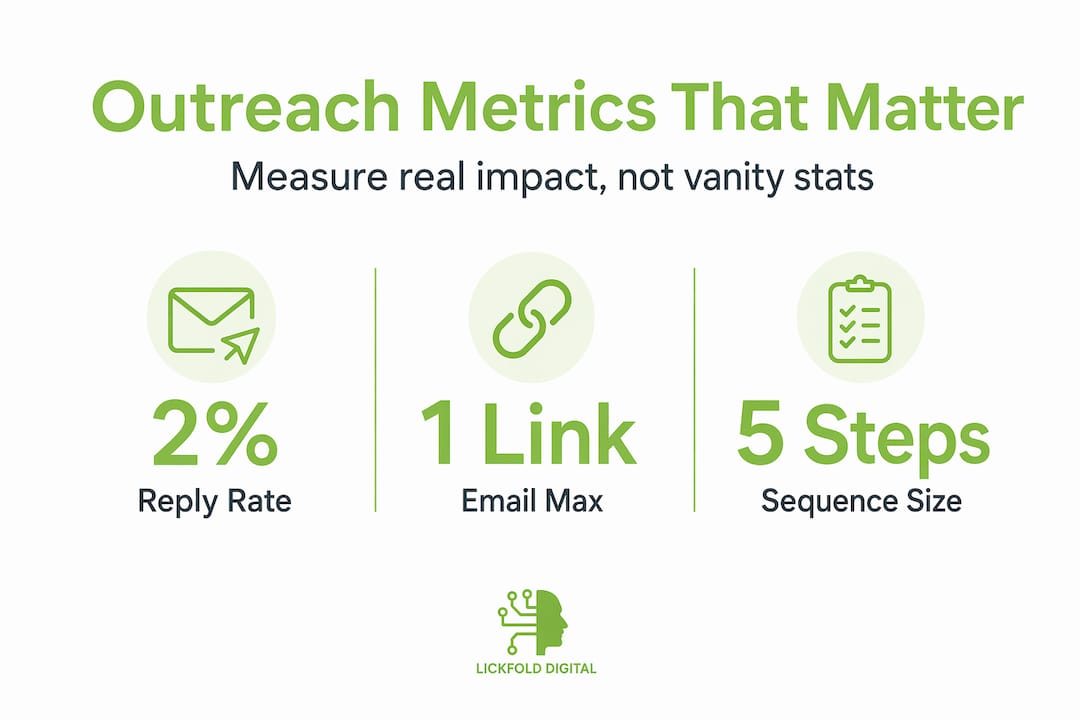
Avoid spam trigger phrases and keep images and links to a minimum in the first message. One link at most, ideally your CTA link only. Multiple links and embedded images immediately increase the likelihood of being filtered before your email reaches the inbox.
Designing a sequence that earns replies over time
A single email rarely converts. 58% of cold email replies come from the first message, but 42% come from follow-ups. That is nearly half of your pipeline sitting in the sequence, not the opener.
The key is that each follow-up must add something. A different angle, a new piece of evidence, a relevant case study, a link to a useful resource. Sending “just checking in” emails is not a strategy. It is noise.
A practical structure for a 5-touch sequence would look like this:
- Email 1: Personalized hook plus specific problem plus CTA
- Email 2 (Day 4): Different angle, perhaps a short social proof or a statistic relevant to their situation
- Email 3 (Day 8): Resource share, such as a relevant article or short video, with no hard pitch
- Email 4 (Day 14): Direct ask again, reframed around their specific context
- Email 5 (Day 20): Low-pressure close, offering an easy out while leaving the door open
Space these out thoughtfully. Daily follow-ups damage both your relationship with the prospect and your sender reputation.
Using AI tools without burning your reputation
AI can genuinely accelerate outreach, but only when it is applied to improve precision, not just volume. The teams that misuse AI by blasting thousands of generic, templated messages with AI-generated text are the ones that see their domains blacklisted within weeks.
Used correctly, AI-assisted outbound delivers the right message to the right person at the right moment. Here is how the best teams actually use AI tools in their outreach workflow:
- Data enrichment: AI tools can pull funding data, hiring signals, tech stack information, and news mentions to populate ICP scoring and trigger identification automatically
- Personalization at scale: Rather than writing unique emails by hand for every prospect, AI can generate personalized first lines based on enriched data, which a human then reviews before sending
- Reply classification: Automated sorting of responses into categories like “interested,” “not now,” “wrong person,” and “unsubscribe” keeps your team focused on warm conversations only
- A/B test acceleration: AI can analyze response patterns across subject lines, CTAs, and message lengths faster than manual tracking
The risk is real. Over-automating without human review creates messages that sound robotic and irrelevant, which prospects notice immediately. Lickfold’s approach to personalized outreach at scale specifically addresses how to combine AI enrichment with human review to keep quality high while scaling throughput.
| Approach | Risk level | Reply rate impact |
|---|---|---|
| Manual outreach, no AI | Low risk | Limited scale |
| AI-enriched, human-reviewed | Low risk | High positive impact |
| Fully automated, no review | High risk | Short-term gains, long-term damage |
| High volume, low personalization | Very high risk | Accelerated domain blacklisting |
Measuring what actually moves the needle
Measuring your cold outreach correctly is as important as running it correctly. Most teams default to tracking open rates, which are now one of the least reliable metrics available.
Apple Mail Privacy Protection inflates open rates to near 100% on Apple devices by pre-fetching email content. A prospect whose email client shows as “opened” may have never actually seen your message. When you base your engagement segmentation on opens, you are suppressing the wrong people and continuing to send to people who have genuinely ignored you.
The metrics that matter are replies, clicks, and meeting bookings. Engaged prospects should be defined as anyone who clicked or replied within the last 30 to 60 days. Anyone outside that window should be moved into a re-engagement sequence or removed entirely.
Pro Tip: Audit your existing ESP automations. Many were built on open-rate triggers that become counterproductive after Apple MPP. Rebuild them around click and reply signals to avoid sending to disengaged contacts and damaging your sender score.
| Metric | Reliability post-MPP | What it actually tells you |
|---|---|---|
| Open rate | Very low | Misleading on Apple devices |
| Click-through rate | High | Genuine content interest |
| Reply rate | Very high | Direct engagement and intent |
| Meeting booked | Very high | Pipeline-ready prospect |
| Unsubscribe rate | High | List quality and relevance signal |
Use this data to iterate actively. If reply rates drop below 2%, check your list quality and ICP fit before changing the copy. If clicks are high but replies are low, your CTA is likely the friction point. If meetings are booking but not converting to opportunities, the problem shifts to qualification.
My honest take on building a cold outreach system
I have seen a lot of B2B teams approach cold outreach like it is a sprint. They set up a sequence, send it to a large list, and expect meaningful pipeline within two weeks. When it does not materialize, they conclude that cold email is dead. It is not. The system was just never built properly.
What I have found is that committing at least 90 days before judging campaign performance is not just patience. It is math. Infrastructure takes time to warm up. Messaging takes iterations to sharpen. And prospects often reply to email number four in a sequence, not email number one.
The teams that outperform larger competitors in cold outreach are not sending more. They are sending smarter. A 50-person company with a tightly defined ICP, verified data, and a five-touch sequence that actually varies the angle will consistently out-reply a 500-person team blasting a mediocre template to anyone who fits a loose industry filter.
The uncomfortable truth is that most cold outreach failures are infrastructure and targeting failures, not copy failures. Teams obsess over subject line optimization when their DMARC record is misconfigured and half their emails are going to spam anyway. Fix the foundation, then earn the right to optimize the words.
— Duarte
How Lickfold can take your outreach further
If this article gave you a clear picture of what an effective cold outreach system requires, you also now know how much goes into building one correctly. From technical deliverability setup to ICP definition, personalization at scale, and engagement tracking, each layer needs to work together.
Lickfold specializes in doing exactly that for B2B teams. The platform deploys dedicated AI agents that identify decision-makers matching your ICP, enrich prospect data with intent signals, execute multi-touch personalized sequences, and hand off only human-qualified warm leads to your sales team. Infrastructure setup, domain warm-up, and reputation management are included. You focus on closing conversations that are already warm. Explore how Lickfold’s AI-powered outreach works and see what a fully managed outbound pipeline looks like for your team.
FAQ
What is cold outreach in B2B sales?
Cold outreach is the practice of contacting prospects who have had no prior relationship with your company, typically via email, LinkedIn, or phone, to generate interest in your product or service.
What is a realistic cold email reply rate?
Most B2B cold email campaigns generate reply rates between 1% and 5%. Teams that nail all four levers of deliverability, data quality, targeting, and copy can push above that range consistently.
Why are open rates no longer reliable for cold outreach?
Apple Mail Privacy Protection pre-fetches emails on Apple devices, causing phantom opens that inflate open rates to near 100%. Reply rates and click-through rates are now the standard for measuring real engagement.
How many follow-up emails should you send in a cold sequence?
A sequence of 4 to 6 messages spaced over 2 to 3 weeks performs best. Each follow-up should introduce a new angle or piece of value rather than simply repeating the original ask.
When should you stop sending to a cold prospect?
Move prospects to a re-engagement or suppression list if they have not clicked or replied within 30 to 60 days. Continuing to send to disengaged contacts hurts your sender reputation and reduces overall deliverability.