
Anchor Text Strategy: A Practitioner's Audit-to-Playbook Guide
Anchor Text Strategy: A Practitioner’s Audit-to-Playbook Guide
A sound anchor text strategy prioritizes branded and natural anchors as the majority of your profile, uses partial-match and LSI anchors to send topical signals, and keeps exact-match anchors rare enough that no single phrase dominates. Before reading further, run this three-step check:
- Audit first. Pull your anchor distribution from Ahrefs or Semrush, pivot by referring domain (not raw backlink count), and flag any anchor phrase above 15% of your total.
- Cap exact-match. If your target commercial keyword appears as anchor text on more than 1–3% of referring domains in a competitive niche, you are already in the risk zone.
- Add branded offset links. For every exact-match link you acquire, plan two to three branded or natural anchors to dilute the ratio and keep the profile looking editorial.
That is the core of it. Everything below explains why it works, how to measure it, and how to fix it when it breaks.
Key Takeaways
A sound anchor text strategy requires auditing your existing profile before acquiring a single new link, because the distribution you already have determines how much room you have to maneuver.
| Point | Details |
|---|---|
| Audit by referring domain | Compute anchor share over referring domains, not raw backlinks, to avoid distortion from sitewide links. |
| Cap exact-match anchors | Keep exact-match anchor share below 1–3% of referring domains in competitive niches to avoid algorithmic suppression. |
| Govern with a playbook | Set anchor-type allocations at the campaign level and enforce editorial style rules in your CMS publishing workflow. |
| Monitor velocity, not just ratios | A spike of 20+ identical anchors in 30 days is a risk signal even when the overall percentage looks safe. |
| Lickfold for managed execution | Lickfold automates anchor audits, sets campaign-level anchor allocations, and scales outreach with built-in anchor diversity controls. |
Table of Contents
- What is anchor text, and how does it differ from a hyperlink?
- What are the anchor text types, and when should you use each one?
- Why does anchor text matter for SEO and user experience?
- How should you write anchor text for internal links?
- What are the best practices for anchor text in backlinks and outreach?
- How do you run a step-by-step anchor-text audit?
- How do you fix problematic anchors and remediate risk?
- How do you govern anchor text at scale with a playbook?
- What KPIs and alerts should you track after changing anchors?
- What does anchor-text remediation actually look like in practice?
- Lickfold Digital handles anchor audits and scaled outreach for you
- Sources
What is anchor text, and how does it differ from a hyperlink?
Anchor text is the visible, clickable text a reader sees in a hyperlink. The hyperlink itself is the underlying HTML element, the <a href="..."> tag, which carries the destination URL. The two are related but distinct, and conflating them causes real confusion in audits.
Here is the minimal code form:
<a href="https://example.com/seo-guide">SEO best practices</a>
In that snippet, https://example.com/seo-guide is the hyperlink. “SEO best practices” is the anchor text. In a published article, a reader sees only the underlined phrase; the URL is invisible unless they hover.
Anchor text tells both users and search engines what to expect on the other side of a link. A well-chosen phrase sets accurate expectations and reinforces the destination page’s topical relevance.
Why does the wording matter beyond usability? Search engines parse anchor text as a relevance signal for the linked page. A link pointing to your pricing page with the anchor “B2B lead generation pricing” carries a different semantic weight than one using “click here.” The former tells a crawler something specific about the destination; the latter tells it almost nothing. That gap in signal quality is the entire reason anchor text strategy exists as a discipline.
Key distinctions to keep in mind:
- The anchor text lives inside the
<a>tag, between the opening and closing elements. - Image links have no visible text; the image’s
altattribute serves as the functional anchor text for crawlers. - Title attributes on links are parsed by some engines but carry far less weight than the visible anchor.
What are the anchor text types, and when should you use each one?
The SEO industry recognizes several canonical anchor types. Knowing which to deploy in which context is the foundation of any effective anchor text strategy.
- Branded: The brand name itself (“Lickfold,” “Nike,” “Ahrefs”). Best for homepage links, press mentions, and any context where the brand is the subject. Branded anchors are the safest in bulk and the most natural to acquire at scale.
- Naked URL: The raw URL as text (“https://example.com/guide”). Common in citations, forum posts, and resource lists. Adds diversity without keyword signal.
- Generic: Non-descriptive phrases (“click here,” “read more,” “this page”). Carry almost no topical signal and should be rare in any profile you control.
- Partial-match: Contains the target keyword alongside other words (“B2B outreach automation tips,” “guide to anchor text distribution”). Delivers topical relevance with lower over-optimization risk than exact-match.
- Exact-match: The precise commercial keyword phrase (“anchor text strategy,” “buy running shoes”). Powerful signal, but the most scrutinized by spam filters. Use sparingly.
- Long-tail descriptive / LSI: Naturally phrased, semantically related anchors (“how to audit your backlink anchor profile,” “what makes a high-quality backlink”). These are the workhorses of a healthy profile.
- Image alt text: When a linked image carries an
altattribute, that text functions as anchor text for crawlers. Include image-linked anchors in every audit and in any remediation plan, since they are easy to overlook. - Compound / title attribute: Anchors that combine visible text with a
titleattribute. Parsed inconsistently across engines; treat as supplementary, not primary.
Pro Tip: When you want topical signal without the risk of exact-match, reach for a partial-match or long-tail descriptive anchor. “Guide to B2B anchor text audits” signals the same topic as “anchor text audit” but reads as editorial rather than optimized, which is exactly the distinction modern spam filters are trained to make.
Why does anchor text matter for SEO and user experience?
Anchor text communicates topical relevance. When a high-authority domain links to your page with a descriptive phrase, that phrase becomes part of the evidence a search engine uses to decide what your page is about and how authoritative it is on that topic. Semrush’s anchor text guidance frames this clearly: anchor text helps search engines understand the linked page and should be used deliberately in internal linking to reinforce relevancy.
The historical lesson here is Penguin. Google’s Penguin algorithm, first launched in 2012 and later integrated into the core ranking system, specifically targeted sites with over-optimized anchor profiles. Sites that had acquired dozens of links all using the same commercial keyword phrase as anchor text saw dramatic ranking drops overnight. The lesson was not subtle.
Over-optimized anchor profiles, where a single exact-match phrase dominates the referring-domain distribution, remain one of the clearest signals of manipulative link building. Modern spam filters evaluate velocity, ratio, and surrounding context, not just the anchor phrase in isolation.
Search Engine Land’s anchor text guide reinforces this: repeated exact-match anchors can look manipulative, and a healthy profile requires ongoing monitoring. The risk is not theoretical.
From a user experience standpoint, descriptive anchors set accurate expectations. A reader who clicks “how to run a B2B outreach campaign” knows what they will find. A reader who clicks “here” does not. That clarity reduces bounce rates on linked pages and increases the probability that the link earns engagement signals that reinforce its value.
How should you write anchor text for internal links?
The governing rule for internal anchors is simple: make the anchor text descriptive, concise, and aligned to the destination page’s primary topic and title tag. Internal links are the one part of your anchor profile you control completely, so there is no excuse for generic or mismatched anchors.
Practical checklist for internal anchor hygiene:
- Match the destination’s intent. If the target page is about building authority in B2B services, the anchor should reflect that topic, not a tangential phrase.
- Vary anchors across pages. If ten articles all link to your pricing page with the identical phrase, that concentration looks unnatural even internally. Rotate phrasing while keeping the semantic theme consistent.
- Prioritize high-authority pages linking to priority URLs. Your highest-traffic, most-linked pages carry the most internal PageRank. Use those link slots deliberately.
- Avoid menu and footer anchor concentration. Sitewide links in navigation repeat the same anchor on every page. Crawlers discount them heavily; do not rely on them for topical signal.
- Never use “click here” or “read more” as internal anchors. These waste the signal entirely.
Do / don’t examples:
| Context | Don’t | Do |
|---|---|---|
| Linking to a pricing page | “See our plans here” | “AI-driven lead generation pricing” |
| Linking to a blog post | “Read more” | “B2B outreach campaign guide” |
| Linking to a category page | “Click here for services” | “Outbound sales automation services” |
Pro Tip: Build an anchor text style guide into your CMS publishing workflow. In WordPress, plugins like Link Whisper can suggest internal links during drafting, but the anchor text it proposes still needs editorial review. Set a house rule: every internal anchor must contain at least one word from the destination page’s H1 or title tag.
What are the best practices for anchor text in backlinks and outreach?
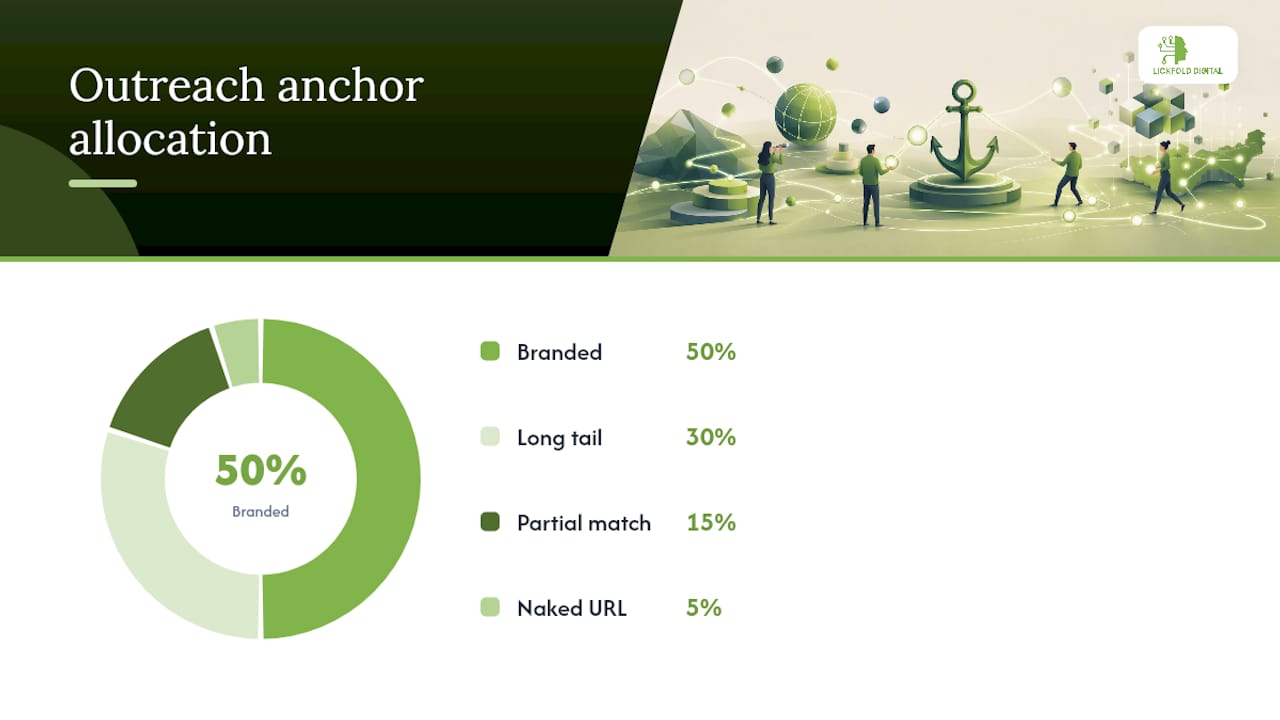
External anchor text is harder to control than internal, but you can shape it through outreach framing, briefing, and negotiation. Ahrefs notes that high-quality backlinks typically carry natural, non-keyword-stuffed anchor text, and that anchor distribution is a risk factor for link spam filters. That means your outreach strategy needs to treat anchor allocation as a campaign-level constraint, not an afterthought.
Outreach anchor briefing: step by step
- Before launching any link-building campaign, set an anchor allocation for the batch. Example: 50% branded, 30% long-tail descriptive, 15% partial-match, 5% naked URL. Zero exact-match for that campaign if your current profile is already at risk.
- In your outreach email or guest post brief, suggest anchor text explicitly but frame it as a recommendation, not a demand. Partners who feel directed tend to push back; partners who feel helped tend to comply.
- For guest posts, write the anchor into the draft itself. The editor rarely changes it if it reads naturally in context.
- For broken-link outreach, suggest a descriptive anchor that matches the content you are replacing. “B2B prospecting guide” replaces a dead link about the same topic without raising flags.
- For PR pitches, provide a brand mention with a natural URL. Journalists will use your brand name as anchor text by default, which is exactly what you want.
Do / don’t for external anchor requests:
- Do: “Feel free to link using our brand name or a phrase like ‘AI-driven B2B outreach guide’ — whatever fits your editorial style.”
- Don’t: “Please use the anchor text ‘best B2B lead generation software’ when linking to us.”
- Do: Accept whatever natural anchor a high-authority editorial site chooses. A branded or naked URL anchor from a domain with real traffic is worth more than a forced exact-match from a low-authority site.
- Don’t: Reject a link offer because the partner won’t use your target keyword as anchor text.
When a partner insists on a specific anchor you consider risky, offer an alternative framing. Suggest a partial-match variant that still contains the keyword but reads more naturally. Most partners are flexible when you explain that the editorial phrasing you are proposing will also pass their own editorial review more easily.
How do you run a step-by-step anchor-text audit?
The audit starts with a pivot: group anchors by referring domain, not by raw backlink count. A single domain linking to you 200 times with the same footer anchor inflates that phrase’s apparent share dramatically. Anchor distribution computed over referring domains gives you the real picture.
Tools and what each one contributes:
- Google Search Console: Provides a top-level list of inbound links and some anchor data. Best used as a sanity check and for identifying manual actions.
- Semrush: Detailed anchor distribution reports, referring-domain breakdowns, and historical anchor trend data. Strong for competitive benchmarking.
- Ahrefs: Deep anchor analysis with referring-domain filtering, anchor type classification, and lost/gained link tracking. The most granular option for large profiles.
- Majestic: Trust Flow and Citation Flow metrics alongside anchor data. Useful for evaluating the authority weighting of anchors, not just their frequency.
- Screaming Frog: Crawls your own site to extract internal anchor text across every page. Essential for internal anchor audits; the other tools do not cover this.
Audit data table structure (build this in a spreadsheet):
Step-by-step audit execution:
- Export the full anchor report from Ahrefs or Semrush, filtered to referring domains.
- Classify each anchor phrase by type (branded, exact-match, partial, generic, naked, image alt).
- Calculate each type’s share of total referring domains.
- Flag any single anchor phrase above 15% of referring domains for review.
- Cross-reference flagged anchors against domain quality (Majestic Trust Flow, Ahrefs Domain Rating).
- Run Screaming Frog on your site to export internal anchor text; repeat the classification and flagging process for internal links.
- Compare your distribution against SERP-specific medians for your niche. Universal ratio tables are misleading; pull the top 10 ranking competitors in your niche and average their distributions as your benchmark.
Pro Tip: *Set up a recurring monthly export from Ahrefs or Semrush and drop it into the same spreadsheet. Trend lines matter more than snapshots.
How do you fix problematic anchors and remediate risk?
Remediation follows a decision tree, not a single action. The priority order matters because the effort and risk of each step differ significantly.
Prioritization checklist:
- High-risk exact-match anchors from low-quality domains (low Trust Flow, thin content, irrelevant niche): address first.
- High-visibility pages losing rank where the anchor profile shows over-concentration: treat as urgent.
- Any anchor phrase above 15% of referring domains: schedule for dilution within 30 days.
- Anchors from otherwise strong domains that happen to use exact-match: lower priority; dilute through new acquisition rather than outreach.
Decision tree:
- Edit the anchor yourself (internal links only). For internal anchors, update the link text directly in your CMS. This is instant and carries no risk.
- Outreach to request a change. For external links from real editorial sites, email the webmaster. Keep the request brief and provide the suggested replacement anchor.
- Add nofollow, UGC, or sponsored attributes. If a link is from a site you control or a partner who will cooperate, adding
rel="nofollow"orrel="ugc"removes the link’s PageRank signal without removing the link. - Disavow as a last resort. Google’s Disavow Tool should be used only for links from clearly spammy or manipulative domains that you cannot remove or nofollow. Disavowing good links by mistake causes ranking drops.
Outreach email template for anchor change requests:
Subject: Quick update request for your [article title] link
Hi [Name], I noticed you linked to [our page] using the anchor “[current anchor]” — thank you for the mention. We are updating our internal style guide and would love it if you could update the anchor to “[suggested anchor]” when you next edit the post. Happy to return the favor if there is anything we can help with on your end.
Velocity considerations apply to remediation too. Do not disavow 50 links in a single submission or request 30 anchor changes in a week. Spread remediation over 60–90 days. Case studies in anchor rebalancing suggest measurable ranking improvement within that window once the dilution registers in crawl cycles, though results vary by domain age, niche competitiveness, and the severity of the original over-optimization.
How do you govern anchor text at scale with a playbook?
A playbook converts audit findings into standing rules the whole team follows without needing to re-litigate every link decision. The goal is to make the right anchor choice the default, not the exception.
Editorial anchor style rules:
- Default to branded anchors for homepage mentions and brand introductions.
- Use partial-match or long-tail descriptive anchors for category and resource pages.
- Reserve exact-match anchors for no more than one or two links per campaign, and only from high-authority domains.
- Never use generic anchors (“click here,” “this page,” “here”) in any editorial content.
- Treat image alt text as anchor text: every linked image needs a descriptive, relevant alt attribute.
Ready-to-copy anchor templates for common link types:
- Homepage mention: “Lickfold Digital” or “Lickfold’s AI-driven outreach platform”
- Category / service page: “B2B outbound sales automation” or “AI prospecting for B2B teams”
- Resource / blog citation: “guide to [topic]” or “how [topic] works”
- CTA in guest post: “learn how [brand] approaches [topic]” or “[brand]'s [topic] playbook”
For new domains, conservative anchor profiles with a high branded share and very low exact-match reduce algorithmic risk while trust signals accumulate. Allow higher exact-match tolerances only after the domain has established real authority, measured by referring-domain growth, organic traffic, and Trust Flow trends.
CMS and automation approaches:
- Link Whisper (WordPress) suggests internal links during drafting and flags orphan pages.
- Yoast SEO’s internal linking tool highlights anchor text patterns across posts.
- For large sites, a custom script that exports all internal anchor text from a Screaming Frog crawl and flags generic or duplicate anchors can run as part of a weekly publishing QA check.
- Brief every outreach campaign with an explicit anchor-type allocation before the first email goes out. Treat it as a campaign-level constraint, the same way you would set a budget. A SERP-benchmarked audit playbook can help you set those allocations against real competitor data rather than guesswork.
What KPIs and alerts should you track after changing anchors?
Changes to anchor distribution take time to register. Crawl cycles, index updates, and the lag between link acquisition and ranking movement mean you need a monitoring cadence, not a one-time check.
Primary KPIs:
- Organic rankings for target keywords on pages where anchors were changed or diluted.
- Referring-domain-weighted anchor distribution (recalculate monthly from Ahrefs or Semrush exports).
- Percentage of referring domains using exact-match anchors (track as a trend, not a snapshot).
- Referral traffic to targeted pages (a proxy for link quality independent of rankings).
- Manual actions in Google Search Console (check the Manual Actions report monthly; a clean report is a baseline, not a guarantee).
Alert thresholds worth setting:
- Exact-match anchor share increases by 3 or more percentage points within 30 days: investigate new link acquisition immediately.
- Twenty or more referring domains with identical anchor text appear within 30 days: velocity spike, likely from a link scheme or a viral mention that needs classification.
- A target page drops more than five positions in rankings within two weeks of anchor changes: check whether a disavow or nofollow inadvertently removed a strong link.
Reporting cadence:
Monthly anchor distribution reports are the minimum. For active link-building campaigns, run a weekly export and track anchor type share as a running percentage. A simple dashboard in Google Sheets, fed by Ahrefs or Semrush API exports, is sufficient for most teams. Quarterly, benchmark your distribution against the current SERP medians for your niche, since those medians shift as competitors build links.
Velocity signals matter as much as ratios: rapid accumulation of identical anchors is a trigger even when the absolute percentage looks safe. Spread acquisition over months and mix anchor types to keep the profile looking organic.
What does anchor-text remediation actually look like in practice?
Most anchor-text problems follow a predictable pattern. Rankings plateau or drop. A GSC check shows no manual action, which means the suppression is algorithmic.

The pragmatic fix is not dramatic. Pull the full anchor export, classify every phrase, and identify the top three to five over-represented anchors. That number becomes the acquisition target for the next 60–90 days. Simultaneously, run outreach to the ten to fifteen lowest-quality domains using the over-represented anchor and request either a change or a nofollow. Do not touch the high-authority domains; the risk of losing those links outweighs the benefit of changing their anchor text.
Editorial resistance is real. Content teams often push back on anchor style rules because they feel like arbitrary constraints. The fix is to frame the playbook as a user experience standard, not an SEO rule. “Descriptive anchors help readers know where they are going” lands better than “we need to avoid over-optimization.” Both are true; one gets buy-in.
Disavow returns are slow. If you submit a disavow file, expect 60–90 days before any measurable ranking movement, and even then the signal is noisy. Dilution through new acquisition is faster and safer in most cases.
Lickfold’s link-building and outreach infrastructure is built to execute this kind of phased remediation at scale, with anchor allocations set at the campaign level and monitored continuously via the SEO Link Building Platform | Build Quality Backlinks at Scale.
Lickfold Digital handles anchor audits and scaled outreach for you
Running a full anchor-text audit, building a remediation plan, and executing outreach at the pace required to move rankings is a significant operational lift. Lickfold’s AI-driven platform handles the heavy work: automated anchor distribution analysis, campaign-level anchor allocation built into every outreach brief, and a proprietary link-building network that delivers backlinks with pre-vetted anchor diversity. Every campaign ships with a clear anchor-type split, so exact-match share stays controlled from day one rather than being cleaned up after the fact. The platform also runs daily technical audits and publishes SEO content that generates natural branded mentions, the fastest way to offset an over-optimized profile. If you want a managed anchor-text remediation or a scaled outreach campaign with safe anchor allocations built in, book a strategy call with Lickfold and get a custom audit of your current profile within 48 hours.
Sources
The following resources are the most useful starting points for running audits and implementing the playbook described above.
- Anchor text - Moz
- Anchor Text - Search Engine Land
- What Is Anchor Text? An Overview + Best Practices - Semrush
- What makes a high-quality backlink? | Help Center - Ahrefs