
Building Authority in B2B Services: A Phased Guide
Building Authority in B2B Services: A Phased Guide
TL;DR:
- Building authority in B2B services relies on a layered trust stack that removes buyer objections through claim, evidence, process, outcome, and comfort. It takes 18 to 36 months of consistent effort to establish credible reputation signals that influence buyer research and shorten sales cycles. Investing in executive presence, specific content, and continuous thought leadership creates a competitive advantage that boosts credibility and profits.
Building authority in B2B services is defined as the consistent, deliberate demonstration of trusted expertise that compels multi-stakeholder alignment and accelerates client acquisition. B2B buyers complete about 90% of vendor research online before speaking to a salesperson. That means your authority signals are doing the selling long before your team picks up the phone. The industry term for this discipline is “B2B thought leadership development,” and it covers everything from verified reviews to executive visibility to earned media. Getting it right compresses sales cycles and protects your pricing power.
What are the core components of building authority in B2B services?
Authority in B2B services is not a single asset. It is a layered structure, and the industry term for this structure is the “trust stack.” A trust stack builds credibility by sequencing proof in a logical order: claim, evidence, process, outcome, and comfort. Each layer removes a specific objection a buyer holds before they are willing to move forward.
Here is what each layer looks like in practice:
- Claim: A clear, specific statement of what you do and who you serve. “We reduce SaaS churn for mid-market companies” outperforms “We help businesses grow.”
- Evidence: Verified third-party reviews, G2 ratings, or Clutch profiles. 91% of B2B buyers trust online reviews more than vendor-produced content. That gap is significant.
- Process: A visible, documented methodology. Buyers want to know how you deliver results, not just that you do.
- Outcome: Detailed case studies with measurable results. Revenue lifted by 34%. Churn reduced from 18% to 6%. Specificity is what makes outcomes credible.
- Comfort: Clear next steps, guarantees, and low-friction entry points. Trust stacks that include visible reviews, process clarity, and clear next steps consistently outperform disconnected proof points.
The order matters. Buyers who see a strong claim but no evidence disengage immediately. Buyers who see evidence but no process clarity stall at the proposal stage. Layering these elements in sequence removes friction at each decision point.
Pro Tip: Map your trust stack to your actual sales funnel. Identify which layer is weakest by asking your sales team where deals most often stall. That is the layer to fix first.

How to implement a phased roadmap to build authority over time
B2B sales authority takes 18–36 months of consistent, specific expertise demonstration to establish. That timeline surprises most decision-makers. The good news is that the effort compounds. Authority built in month six pays dividends in month twenty-four.
A phased approach prevents the common mistake of trying to do everything at once. Here is a proven sequence:
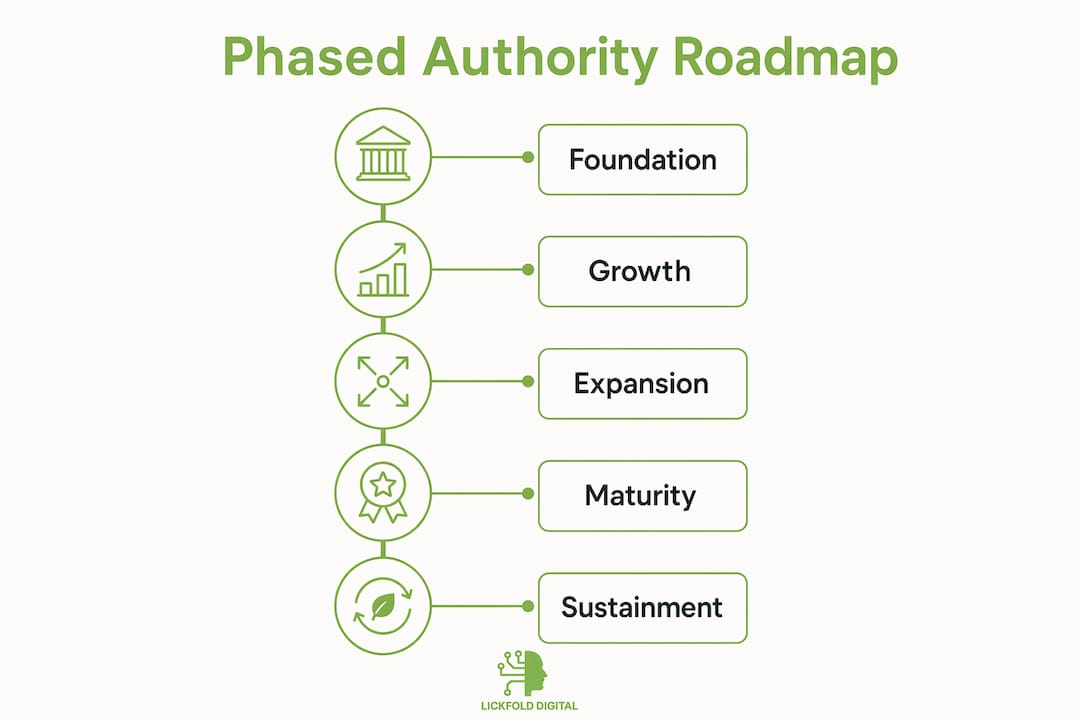
- Months 0–6: Verified reviews and data-backed case studies. Collect reviews on third-party platforms. Build two or three detailed case studies with real metrics. These are the foundation every subsequent layer rests on.
- Months 6–12: Earned media and structured content. Pitch guest articles to industry publications. Build a hub-and-spoke content architecture around your core expertise. Add schema markup to signal technical authority to AI search systems.
- Months 12–18: Social influence, leadership presence, and industry recognition. Submit for relevant awards. Develop executive thought leadership content mapped to buyer journey stages. Grow your LinkedIn presence with specific, insight-driven posts rather than promotional updates.
This multi-stage authority roadmap is validated by research into how AI search environments and human buyers evaluate vendor credibility. The sequence is not arbitrary. Reviews and case studies are the fastest trust signals to produce and the most heavily weighted by buyers in early research.
| Phase | Timeline | Primary focus |
|---|---|---|
| Foundation | Months 0–6 | Verified reviews, specific case studies |
| Amplification | Months 6–12 | Earned media, hub-and-spoke content |
| Influence | Months 12–18 | Executive presence, awards, social proof |
Pro Tip: Content must help buyers reduce career risk, not just gather information. Frame case studies around the internal consensus your client achieved, not just the result you delivered. That framing enables decision confidence for every stakeholder in the room.
What role does executive presence play in B2B authority?
Buyers trust people before they trust brands. Executive presence humanizes expertise and builds trust earlier in the buying process than any corporate asset can. A well-known founder or practice leader creates a shortcut in the buyer’s mind. The logic is simple: if I trust this person’s judgment, I trust their firm.
The methods that surface executive presence most effectively include:
- LinkedIn thought leadership: Specific, opinion-driven posts that address real buyer problems. Frequency matters less than specificity. One post that names a counterintuitive insight outperforms ten posts that restate industry consensus.
- Speaking engagements: Conference talks, webinar appearances, and podcast interviews position leaders as subject-matter authorities. Buyers who hear a leader speak before a sales call arrive warmer and close faster.
- Published points of view: Short-form articles, op-eds, or research-backed commentary published under the executive’s name. These create a searchable record of expertise that AI systems and human buyers both evaluate.
- Consistent engagement with buyer questions: Responding to LinkedIn comments, Quora threads, or industry forum discussions signals accessibility and depth of knowledge.
Complex B2B purchases involve 6–10 stakeholders, and 94% of marketers name trust as the primary success factor. Executive visibility gives each of those stakeholders a human anchor for their trust. That is a structural advantage no logo or tagline can replicate.
The fastest-growing B2B service firms treat their senior leaders as media assets. They invest in professional photography, writing support, and content calendars for executives the same way they invest in product marketing. The return on that investment shows up in shorter sales cycles and higher close rates.
What are common pitfalls in maintaining B2B service authority?
The most common mistake in B2B service trust building is confusing badges with authority. Award logos, generic certifications, and “as seen in” press mentions carry almost no weight with sophisticated buyers unless they are backed by specific, verifiable proof.
The second most common mistake is breadth over depth. Specificity outperforms breadth in B2B authority building. A detailed case study in a niche sector builds more credibility than twenty generic blog posts. Buyers in that sector recognize the specificity and trust it. Buyers outside that sector are not your audience anyway.
Sustainable authority requires avoiding these specific traps:
- Inconsistency: Publishing a burst of content and then going silent destroys the perception of stability. Buyers notice gaps. Consistency signals operational health.
- Generic social proof: “We work with Fortune 500 companies” without naming the company, the problem, and the result is noise. Specificity is the signal.
- Ignoring existing clients as authority sources: Your current clients are your best proof. Regular check-ins, documented results, and long-term client relationships generate the kind of testimonials and referrals that no content campaign can manufacture.
- Treating authority as a marketing project: Authority is a commercial asset. Trust reduces sales cycle time and defends pricing. It belongs on the revenue agenda, not just the marketing calendar.
Pro Tip: Audit your trust stack every six months. Ask three recent prospects what convinced them to move forward and what almost stopped them. Their answers will tell you exactly which layer of your authority needs work.
Key takeaways
Building authority in B2B services requires a layered trust stack, a phased 18–36 month roadmap, and consistent executive visibility to compress sales cycles and protect pricing power.
| Point | Details |
|---|---|
| Trust stack structure | Layer claim, evidence, process, outcome, and comfort in sequence to remove buyer friction at each stage. |
| Phased roadmap | Start with verified reviews and case studies, then add earned media, then scale executive presence and awards. |
| Executive visibility | Position senior leaders as media assets to build human trust before the first sales conversation. |
| Specificity over breadth | One detailed niche case study outperforms twenty generic posts for establishing credibility with target buyers. |
| Authority as a revenue asset | Trust compresses sales cycles and defends pricing. Treat authority building as a commercial priority, not a marketing task. |
Why most B2B firms underinvest in authority until it’s too late
I have watched firms with genuinely superior services lose deals to competitors who simply looked more credible online. That is a painful and avoidable outcome. The firms that win consistently are not always the best at what they do. They are the best at demonstrating what they do, to the right people, at the right moment in the buying process.
What I find most firms get wrong is treating authority as a one-time project. They build a case study, collect a few reviews, and consider the job done. Authority is not a destination. It is a continuous signal that buyers and AI systems are evaluating every time they search your name. The firms that understand this invest in thought leadership as an ongoing discipline, not a quarterly campaign.
The other insight I keep returning to is the role of specificity. Generic content feels safe because it offends no one. But it also convinces no one. The B2B buyers I have seen move fastest are the ones who found a firm that spoke directly to their exact problem, in their exact sector, with proof from a company that looked just like theirs. That level of specificity requires courage and focus. Most firms are not willing to narrow their message that sharply. The ones who do win disproportionately.
Authority also has a compounding quality that most decision-makers underestimate. The reviews you collect in month three show up in AI search results in month eighteen. The case study you publish in month six gets cited in an industry newsletter in month twelve. The executive post that gets 200 views today gets referenced in a buyer’s internal memo next quarter. The investment is front-loaded. The returns are back-loaded. That mismatch is why so many firms quit too early.
— Duarte
How Lickfold supports your authority and outreach goals
Authority gets you to the table. Outreach gets you in the room. The two work together, and the gap between them is where most B2B service firms lose momentum.
Lickfold deploys AI-driven prospecting to identify and engage the decision-makers who are already evaluating firms like yours. The platform researches your ideal client profile, locates the right contacts, and runs personalized multi-touch outreach campaigns that reflect your authority signals rather than generic templates. Every reply is qualified by a human before it reaches your sales team. The result is a predictable pipeline of warm opportunities, built on the credibility you have already established. Reach out to Lickfold to see how the system fits your current authority-building stage.
FAQ
What does building authority in B2B services actually mean?
Building authority in B2B services means consistently demonstrating specific, verifiable expertise that earns the trust of multiple stakeholders across a buying committee. It is distinct from brand awareness because it requires proof, not just visibility.
How long does it take to establish credibility in B2B?
B2B sales authority takes 18–36 months of consistent, specific expertise demonstration. The timeline compresses when firms prioritize verified reviews and detailed case studies in the first six months.
Why do online reviews matter so much for B2B trust building?
91% of B2B buyers trust online reviews more than vendor-produced content. Reviews from third-party platforms carry independent credibility that no marketing asset can replicate.
How does executive presence accelerate B2B trust?
Buyers trust people more than brands, and executive thought leadership content mapped to buyer journey stages humanizes authority before the first sales conversation begins. Leaders who publish specific, insight-driven content create a searchable record that AI systems and human buyers both evaluate.
What is the biggest mistake B2B firms make with authority building?
The biggest mistake is prioritizing breadth over specificity. A single detailed case study in a niche sector builds more authority than dozens of generic posts, because specificity signals genuine expertise to both buyers and AI-driven search environments.