
What Is an Agency Sales Cadence? A Practical Guide
What Is an Agency Sales Cadence? A Practical Guide
TL;DR:
- An agency sales cadence is a structured sequence of outreach activities across email, phone, and social channels designed to guide prospects through the buying process. It typically involves 12 touches over 21 business days, with decision gates to qualify or disqualify prospects at each stage. Successful agencies document this process, separate team roles, and use signal-based triggers to improve closing rates.
An agency sales cadence is a structured, repeatable sequence of planned outreach activities across email, phone, and social channels, engineered to move prospects through the buying journey and convert them into clients. The term “sales cadence” is the recognized industry standard; “agency sales cadence” simply applies that framework to the specific context of agency business development. A high-performance cadence typically runs 12 touchpoints over 21 business days, because senior decision-makers require 6–9 interactions before they engage. Without a defined cadence, outreach becomes reactive, inconsistent, and nearly impossible to improve.
What is an agency sales cadence and how does it work?
An agency sales cadence is a documented sequence of touches, each with a defined channel, message type, and timing. The goal is not to flood a prospect’s inbox. The goal is to appear at the right moment, through the right channel, with a message that matches where they are in the buying process.
The anatomy of a standard cadence
A well-structured cadence runs 12 touchpoints over 21 business days using a mix of phone calls, emails, and LinkedIn messages. Cadences under 8 touches under-convert. Cadences over 18 contacts risk eroding trust. That range exists because it mirrors the number of interactions decision-makers typically need before they respond.
A typical 21-day sequence looks like this:
- Day 1: Personalized email introducing your agency and a specific insight relevant to their business.
- Day 3: LinkedIn connection request with a short, context-specific note.
- Day 5: Follow-up email referencing a case study or result.
- Day 7: Phone call with a voicemail if no answer.
- Day 10: LinkedIn message referencing the email thread.
- Day 12: Email with a direct ask for a 20-minute call.
- Day 15: Phone call, no voicemail.
- Day 17: Email with a new angle, such as a relevant industry trend.
- Day 19: LinkedIn engagement on their content, then a direct message.
- Day 21: Final “breakup” email that closes the loop and leaves the door open.
This structure is not arbitrary. Each touch builds on the last, and the channel mix prevents any single channel from feeling like spam.
Channel mix and sequencing
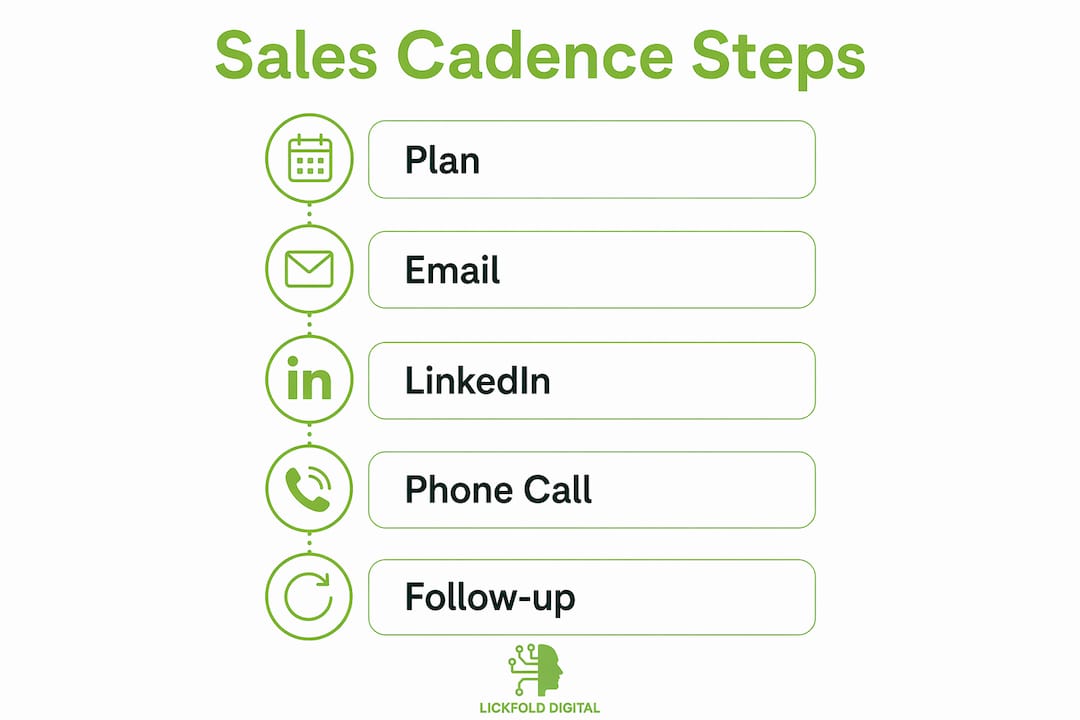
The most effective cadences alternate channels deliberately. Starting with email, moving to LinkedIn, then adding phone creates a multi-surface presence without feeling aggressive. Multi-channel outreach consistently outperforms single-channel sequences because different prospects respond to different mediums.

Pro Tip: Use sales engagement software, which typically costs $100–$200 per seat per month, to enforce touch sequencing and prevent reps from skipping stages. Discipline in execution is what separates a cadence from a to-do list.
How does an agency sales cadence differ from a simple follow-up list?
Most agencies already follow up with prospects. Very few run a true cadence. The difference is not cosmetic. It is structural.
A follow-up list is a passive reminder system. A sales cadence is a strategic, multi-channel, time-bound sequence with decision gates built in. Decision gates are checkpoints where you evaluate whether a prospect should advance, stay in the sequence, or be disqualified. That proactive qualification is what prevents deals from stalling indefinitely in your pipeline.
What decision gates actually do
Decision gates force a binary outcome at each stage. After touch 5, for example, you ask: has this prospect opened two or more emails, clicked a link, or responded in any way? If yes, they move to a higher-priority track. If no, they stay in the standard sequence or get deprioritized. This keeps your pipeline honest and your time focused on prospects who show real buying signals.
“A sales cadence is not a follow-up checklist. It is a strategic, time-bound, multi-channel process with decision gates for proactive pipeline progress.”
Signal-based triggers vs. schedule-based routines
Generic cadences run on a fixed schedule regardless of prospect behavior. Signal-based cadences fire when a prospect event occurs, such as a new hire, a funding round, or a website visit. Signal-based outreach improves reply rates from the generic 1–2% range to 6–10% with personalized touches. That improvement is not marginal. It is the difference between a cadence that generates pipeline and one that generates noise.
Key differences between a follow-up list and a true sales cadence:
- Structure: A cadence has defined stages, channels, and timing. A follow-up list has none.
- Decision gates: A cadence qualifies or disqualifies at each stage. A follow-up list never removes anyone.
- Channel mix: A cadence uses phone, email, and LinkedIn in sequence. A follow-up list usually means more emails.
- Predictability: A cadence produces measurable pipeline. A follow-up list produces unpredictable results.
- Personalization triggers: A cadence adapts to prospect signals. A follow-up list does not.
What roles and team structures support a successful cadence?
A sales cadence does not run itself. It requires people with distinct skills assigned to distinct funnel stages. Mixing those responsibilities into one role is one of the most common reasons agency sales efforts stall.
Separating the sales funnel into top, middle, and bottom stages with clear ownership per stage is the foundation of predictable agency pipeline. Each stage demands different skills, different KPIs, and different exit criteria.
| Funnel stage | Primary goal | Key skills needed |
|---|---|---|
| Top of funnel | Generate qualified leads | Prospecting, research, outreach copywriting |
| Middle of funnel | Qualify and advance prospects | Discovery, needs analysis, objection handling |
| Bottom of funnel | Close and onboard | Negotiation, proposal delivery, relationship management |
Protecting dedicated business development time
Protecting 6–10 hours weekly strictly for business development pipeline work is critical. Less than that leads to pipeline starvation. More than 15 hours per week impairs delivery quality. The right range treats BD as a non-negotiable weekly commitment, not something that happens when client work slows down.
Pro Tip: Block your BD hours on the calendar the same way you would block a client meeting. Treat a missed BD block as a missed client deliverable. That mental shift changes behavior faster than any process document.
Weekly pipeline hygiene also matters. Consistent cadence governance with KPI tracking prevents no-decision deals from clogging your pipeline and gives you the data to improve your sequence over time. A B2B business development workflow that includes weekly pipeline reviews catches stalled deals before they become dead deals.
How do you improve your cadence to close more deals?
Structure gets you into conversations. Tactics get you to a signed contract. The agencies that close at the highest rates combine a disciplined cadence with a small set of advanced practices that most competitors skip entirely.
Replace emailed proposals with live presentations
Live proposals are interactive 20–30 minute sessions with stakeholders where you walk through your recommendation and address objections in real time. They dramatically speed closing compared to a static PDF sent by email. When a prospect reads a proposal alone, every objection they have goes unanswered. When you present live, you handle objections the moment they surface.
Build a sales playbook before you hire
Documenting your sales stages, scripts, objection responses, and CRM-based exit criteria before hiring your first salesperson is the single most important thing you can do to scale. Agencies that skip this step hire salespeople who then build their own undocumented process. That creates inconsistency, makes performance impossible to diagnose, and means you lose institutional knowledge every time someone leaves.
Key elements of a sales playbook for agencies:
- Stage-by-stage exit criteria that define when a deal advances
- Email and call scripts for each touchpoint in the cadence
- A library of objection responses with tested language
- CRM fields that capture the data needed to measure cadence performance
- A mutual action plan (MAP) template for deals in the bottom of funnel
Pro Tip: A mutual action plan is a shared document between you and the prospect that lists every step needed to reach a decision, with owners and deadlines on both sides. It replaces vague “we’ll be in touch” conversations with a concrete timeline that both parties commit to.
Use step-by-step lead qualification frameworks to filter prospects before they enter your cadence. A well-qualified prospect list means every touch in your sequence goes to someone who can actually buy.
Key takeaways
An agency sales cadence is the difference between a predictable pipeline and a reactive one. The most effective cadences combine 12 structured touchpoints, signal-based personalization, and documented playbooks that any team member can execute consistently.
| Point | Details |
|---|---|
| Cadence length and structure | Run 12 touchpoints over 21 business days using email, phone, and LinkedIn in sequence. |
| Decision gates matter | Build qualification checkpoints into every cadence to remove dead deals and protect pipeline quality. |
| Signal-based personalization | Trigger outreach from prospect events to lift reply rates from 1–2% to 6–10%. |
| Team role separation | Assign distinct owners to top, middle, and bottom funnel stages for predictable performance. |
| Document before you hire | Build your sales playbook with scripts and CRM exit criteria before adding headcount. |
Why most agency cadences fail before they start
I have worked with enough agency sales teams to say this plainly: the cadence is rarely the problem. The problem is that most agencies treat their cadence as a living document that exists only in someone’s head. The moment that person leaves or gets busy with client work, the cadence disappears.
The agencies I have seen scale their BD consistently share one habit. They document everything before it feels necessary. They write down the scripts before they sound polished. They define CRM exit criteria before the pipeline is large enough to need them. They block BD time before they have enough prospects to fill it. That discipline looks excessive until the moment it saves you.
The other mistake I see constantly is treating all prospects the same. A prospect who just raised a Series B funding round is not the same as a prospect who has been in your CRM for 18 months with no activity. Running the same 21-day sequence on both is a waste of your best touchpoints. Signal-based triggers exist precisely to solve this. Use them.
The final lesson is about proposals. Sending a PDF and waiting is not a closing strategy. It is a hope strategy. Live proposals feel uncomfortable at first because you have to handle objections in real time. That discomfort is exactly why they work. The agencies that master live proposals close faster and lose fewer deals to silence.
— Duarte
How Lickfold supports your agency sales cadence
Building a disciplined sales cadence takes time, and executing it consistently takes infrastructure most agencies do not have in-house.
Lickfold builds AI-powered outbound systems that identify decision-makers matching your ideal client profile, execute personalized multi-touch outreach campaigns, and pass only human-qualified opportunities to your sales team. The result is a predictable pipeline that runs continuously without pulling your team away from delivery work. If you want to see how a structured outbound system fits your agency’s growth goals, reach out to Lickfold and start the conversation.
FAQ
What is an agency sales cadence?
An agency sales cadence is a structured, repeatable sequence of outreach touchpoints across email, phone, and LinkedIn, designed to engage prospects and guide them toward a buying decision. A standard high-performance cadence runs 12 touchpoints over 21 business days.
How many touches should an agency sales cadence include?
A cadence should include 12 touchpoints over 21 business days. Cadences under 8 touches under-convert, while sequences over 18 contacts risk damaging the relationship with the prospect.
How does a sales cadence differ from a follow-up list?
A sales cadence is a multi-channel, time-bound sequence with decision gates that qualify or disqualify prospects at each stage. A follow-up list is a passive reminder system with no structure, no channel mix, and no qualification logic.
What channels should an agency use in its sales cadence?
The most effective cadences combine email, phone calls, and LinkedIn messages in a deliberate sequence. Alternating channels prevents over-reliance on any single medium and increases the chance of reaching prospects where they are most active.
When should an agency build a sales playbook?
An agency should document its sales playbook, including scripts, objection responses, and CRM exit criteria, before hiring its first dedicated salesperson. Skipping this step creates inconsistency that is very difficult to fix after headcount grows.