
What Is an Agency Growth Model? Scale Outbound with AI
What Is an Agency Growth Model? Scale Outbound with AI
TL;DR:
- Agencies that replace referral dependence with a structured outbound system grow faster and more predictably.
- A repeatable growth model integrates unified revenue generation, productized offers, AI-driven prospecting, and performance measurement.
An agency growth model is a repeatable system that converts services into productized offers, pairs a unified revenue engine with predictable outbound, and uses AI to run that system at scale. The bottom line: agencies that replace referral dependence with a structured outbound system aimed at buyers who have budget and urgency grow faster and more predictably than those waiting on word-of-mouth. Lickfold Digital is built around exactly this model, targeting trigger events like funding rounds to generate qualified conversations in weeks rather than quarters.
B2B service firms and agencies between $500K and $10M in revenue benefit most from this approach. The sections below cover the core components, the four growth levers, productization, AI’s role, team structure, KPIs, a 90–180 day roadmap, and the most common mistakes that derail implementation.
Table of Contents
- What does an agency growth model look like?
- How do the four growth levers work together?
- How do you productize agency services?
- Where does AI fit in the agency growth model?
- What team and processes does the model require?
- Which KPIs actually measure growth model performance?
- What does a 90–180 day implementation look like?
- What mistakes kill agency growth models before they scale?
- How Lickfold Digital implements this model
- Key Takeaways
- The founder bottleneck nobody talks about honestly
- Lickfold Digital: AI-driven outbound without building it yourself
- Useful sources and further reading
What does an agency growth model look like?
The model has five connected modules. Each one feeds the next.
- Unified revenue generation (RevGen): Sales, marketing, and account management operate as one system, not three separate functions. Agencies that integrate these three functions achieve more predictable scale than those running them in silos.
- Productized offers: Fixed scope, fixed timeline, fixed price. Productization shortens sales cycles because buyers know exactly what they’re getting and what it costs.
- Outbound prospecting engine: Trigger-based lists (newly funded companies, leadership changes, hiring surges) feed a weekly outreach cadence. Passive referrals stay in the mix but can’t be the primary growth lever.
- Delivery engine: Documented SOPs and AI-assisted workflows that execute consistently without founder involvement on every account.
- Measurement layer: CAC, LTV, pipeline coverage, and net revenue retention (NRR) arbitrate every resource decision.
The interactions matter as much as the modules. Productization makes delivery repeatable, which lets AI automate the routine steps. Outbound supplies a steady flow of qualified conversations to those productized offers. Account management converts new clients into retained revenue, which compounds over time. Without the measurement layer, you can’t tell which module is the constraint.
How do the four growth levers work together?

The four-lever framework — Focus, Retention, Positioning, and Offer — is the most practical diagnostic tool available for agency operators. The problem is that most agencies optimize one lever in isolation and wonder why growth stalls.
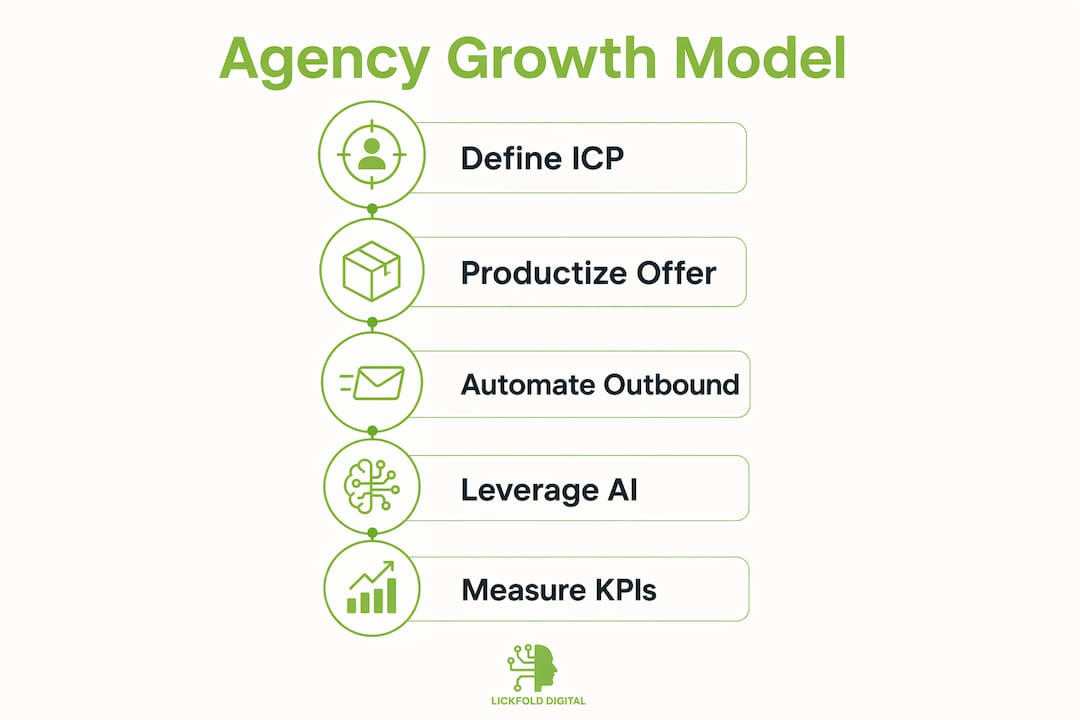
Focus means specialization: a defined ICP and a vertical or use case you own. Retention is NRR and churn; it’s the engine that compounds revenue. Positioning is situational and trigger-based — you show up when a buyer has a specific, urgent problem. Offer is your productized package: fixed scope, measurable outcome, clear price.
Misalignment is predictable. Sharp positioning with no productized offer produces long sales cycles because every deal becomes a custom negotiation. A productized offer with weak positioning yields low win rates because you’re not reaching buyers at the right moment. Excellent retention with no outbound caps growth at whatever referrals happen to arrive.
Quick diagnostic: If your sales cadence is inconsistent, Positioning or Offer is the constraint. If margins are eroding, review Offer pricing and scope. If the founder is still the primary qualifier, Focus and team structure are the problem. If NRR is declining, Retention needs immediate attention.
Pro Tip: Fix the weakest lever first. Trying to improve all four simultaneously spreads resources too thin and produces no measurable change in 90 days.
How do you productize agency services?
Productization is the critical bridge to scaling. Without it, AI automation has nothing consistent to run on.
- Audit existing engagements. Identify which client work repeats across accounts with similar inputs and outcomes.
- Define fixed scope, timeline, and deliverables. No open-ended statements of work. Every product has a start date, an end date, and a defined output.
- Price for value, not hours. Agency budgets often include hidden buffers for overruns; pricing by the hour exposes those buffers and invites negotiation. Price the outcome instead.
- Document SOPs. Every step that a team member executes should be written down before you automate it.
- Pilot with two clients. Run the productized version with two existing accounts before selling it to new buyers.
- Iterate, then lock scope. After the pilot, tighten the scope and resist adding variants for at least 90 days.
A valid productized offer passes this checklist: there’s a clear buyer trigger, a measurable outcome, fixed delivery inputs, defined handoff and QA rules, and a renewal or expansion path built in.
Pro Tip: Start with your highest-margin, easiest-to-repeat service. Limit variant options in the first 90 days so your automation templates stay effective and don’t fragment.
Where does AI fit in the agency growth model?
AI earns its keep in four specific places. Applying it everywhere at once is how agencies waste budget and damage deliverability.
- Trigger-list generation: AI agents scan for funding announcements, leadership changes, and hiring signals to build curated prospect lists. This is where outbound prospecting automation starts.
- Personalized multi-touch outreach: Email and LinkedIn cadences personalized to the trigger event, not generic templates. Email personalization at scale is what separates a 3% reply rate from a 0.3% one.
- Decision-maker research and mapping: AI agents identify the right contacts within target accounts, reducing manual research time.
- Deliverability and reputation management: Dedicated warm-up accounts and ongoing sender-reputation monitoring protect the outbound infrastructure. Skip this and your emails land in spam within weeks.
Infrastructure checklist before you run AI-driven outbound at scale: verified list source, dedicated warm-up email accounts, deliverability monitoring, CRM integration, rate-limited API governance, and a human-in-the-loop qualification step.
Pro Tip: Always pair AI agents with a single human reviewer for first-response qualification. It protects pipeline quality and generates the learning signals that improve agent performance over time.
What team and processes does the model require?
| Role | Primary Responsibility |
|---|---|
| Head of Growth / CRO | Owns the unified RevGen system and pipeline targets |
| Head of Delivery / COO | Owns SOPs, delivery quality, and AI workflow governance |
| Account Managers | Own NRR, upsell, and client retention |
| AI / Automation Engineer | Owns agents, flows, and infrastructure |
| SDR / Qualifier | Human qualification of outbound replies before CRM handoff |
Processes that must run on a fixed cadence:
- Weekly outbound rhythm: list refresh, sequence review, reply triage
- Quarterly business reviews for top-tier accounts
- Onboarding playbook for every new client
- Runbooks and training for AI tool adoption
- Escalation paths for deliverability issues and client complaints
Scaling past $5M–$10M requires the founder to shift from doing to leading and hire an ops executive to build repeatable systems. The hiring sequence that works: delivery capacity first, account management second, dedicated sales last. Hire for the current bottleneck, not the one you anticipate.
Which KPIs actually measure growth model performance?
| KPI | Definition | Why It Matters | Benchmark Range |
|---|---|---|---|
| Pipeline Coverage | Total pipeline value ÷ revenue target | Shows whether outbound is generating enough opportunities | ~3x revenue target |
| CAC | Total sales + marketing spend ÷ new clients acquired | Measures acquisition efficiency | Varies by ACV; track trend |
| LTV | Average contract value × average retention months | Determines how much you can spend to acquire | LTV:CAC ratio >3:1 |
| NRR | Revenue retained + expansion ÷ starting revenue | Measures account management effectiveness | — |
| Gross Margin per Account | Revenue minus direct delivery cost per client | Signals productization health | — |
| Qualified Conversations/Month | Outbound replies that meet ICP and intent criteria | Measures outbound engine output | Depends on ACV and team size |
Referred clients retain roughly 1.9x longer than clients from other channels, so NRR and referral rate belong in the same weekly review. Review pipeline coverage and qualified conversations weekly. Review CAC, LTV, and gross margin monthly. NRR is a quarterly metric but flag it immediately if it drops below 100%.
What does a 90–180 day implementation look like?
- Days 0–30: Diagnose the primary constraint using the four-lever framework. Productize one existing service. Set up a verified list source and warm-up email accounts.
- Days 30–90: Run a weekly outbound cadence to a trigger-based list. Pilot AI workflows for research and personalization. Hire or contract the first ops resource (delivery or qualification).
- Days 90–180: Scale the outbound cadence. Hire account managers. Formalize pricing, KPIs, and QBR cadence.
Spend first on list quality and deliverability infrastructure — these are the constraints that kill outbound before it starts. AI automation and SEO content come after the foundation is stable. U.S.-market tool costs vary, but budget for list sourcing, warm-up infrastructure, and an AI/automation platform subscription before adding headcount. The weekly outbound cadence paired with one packaged offer is the fastest path to predictable qualified conversations.
What mistakes kill agency growth models before they scale?
- Founder remains the primary qualifier. Pause and assign a dedicated SDR or qualifier immediately.
- Skipping email warm-up. Sending volume from cold domains destroys sender reputation fast. Switch to warmed accounts before scaling.
- Productization diluted by custom options. Lock scope. Every exception adds delivery complexity and breaks automation templates.
- No human-in-loop for qualification. AI agents miss context. A human reviewer on first responses protects pipeline quality.
- Ignoring deliverability monitoring. Check bounce rates, spam complaints, and open rates weekly, not monthly.
On change management: introduce the new cadence and runbooks to the team before automating end-to-end. Small experiments build trust faster than a full rollout.
How Lickfold Digital implements this model
Lickfold’s implementation follows the model directly. The process: productize the client’s core offer, build a trigger-based prospect list (newly funded firms, leadership changes), run AI-driven multi-touch outreach with dedicated warm-up accounts, qualify replies with a human reviewer, and hand verified opportunities to the client’s sales team with full CRM integration.
Key implementation details:
- Dedicated warm-up email accounts and ongoing deliverability monitoring protect sender reputation
- AI agents handle research, decision-maker mapping, and outreach personalization
- Human qualification on every reply before CRM handoff
- Daily SEO content creation and backlink building run in parallel to compound inbound over time
Key Takeaways
An agency growth model works when productized offers, trigger-based outbound, AI infrastructure, and account management operate as one connected system measured by pipeline coverage and NRR.
| Point | Details |
|---|---|
| Productize first | Fix scope, timeline, and price before automating delivery or scaling outbound. |
| Run weekly outbound to trigger lists | Funding rounds and leadership changes produce qualified conversations faster than broad prospecting. |
| Protect deliverability | Warm-up accounts and human reply qualification are non-negotiable infrastructure, not optional add-ons. |
| Measure pipeline coverage and NRR | Pipeline coverage (~3x target) and NRR (>100%) are the two metrics that diagnose growth model health fastest. |
| Lickfold Digital | Lickfold’s AI-driven outbound platform handles prospecting, warm-up, human qualification, and CRM handoff as a managed system. |
The founder bottleneck nobody talks about honestly
Most agency growth articles focus on tactics: better email copy, smarter targeting, tighter offers. The real problem is structural. Founders who are the best at the work become the ceiling of the business. Every client wants them. Every deal needs their input. That’s not a talent problem — it’s a systems problem.
The four-lever framework from the operator’s playbook is useful precisely because it forces a diagnostic question: which lever is the constraint right now? The answer almost always points to a process gap or a missing hire, not a missing tactic. Building the model means accepting that your job shifts from doing excellent work to building the system that does excellent work without you.
The discipline that matters most is the weekly outbound cadence. Not monthly. Not when the pipeline looks thin. Weekly, to a trigger-sourced list, with one productized offer buyers can say yes to quickly. That rhythm, sustained for 90 days, produces more predictable pipeline than any single campaign. Test it on one productized offer before scaling.
Lickfold Digital: AI-driven outbound without building it yourself
Most B2B teams that read this guide know what the model requires. The hard part is building the infrastructure, the AI workflows, the warm-up accounts, and the qualification process while running the business at the same time.
Lickfold deploys dedicated AI agents that identify decision-makers at companies matching your ICP, run personalized multi-touch outreach, and hand qualified replies to your sales team — with human qualification at every response. The infrastructure (warm-up accounts, deliverability monitoring, CRM integration) is included. You get a diagnostic, a 90–180 day plan, and a pilot offer scoped to your current constraint. No long-term lock-in before you see results.
Reach out to Lickfold to start the diagnostic and get a pilot plan built around your highest-margin offer.
Useful sources and further reading
- How to Grow Your Agency: A 2026 Playbook — Fundraise Insider: Covers trigger-based outbound, warm-up infrastructure, and weekly cadence discipline.
- How to Scale an Agency: The Operator’s Playbook — Assassins Only: Productization as the bridge to AI-assisted delivery and repeatable systems.
- The 4 Levers That Drive Scalable Agency Growth — Anthony Gindin: The Focus/Retention/Positioning/Offer diagnostic framework.
- Digital Agency Growth Guide — Promethean Research: Unified RevGen system, referral retention data, and AI as a revenue differentiator.
- Agency Growth Model: 5 Steps to Scale Past $5M — Rework Resources: Founder-to-CEO transition and executive ops hiring.
- What Is Agency Prospecting Automation? — Lickfold Digital: How AI agents run repeatable outreach workflows end-to-end.
- The Role of Data in Agency Prospecting — Lickfold Digital: List sources, data hygiene, and trigger-based prospecting in practice.
- AI Agents Use Cases in Sales: 2026 B2B Guide — Lickfold Digital: Specific AI agent workflows, governance, and integration patterns for B2B sales teams.