
Email Personalization for Agencies: A 2026 Growth Guide
Email Personalization for Agencies: A 2026 Growth Guide
TL;DR:
- Email personalization significantly boosts campaign ROI, engagement, and client retention by tailoring content to recipient data.
- Agencies succeed when they apply tiered frameworks, ensure data hygiene, and combine AI drafts with human oversight for quality.
Email personalization is the practice of tailoring message content, timing, and structure to individual recipient data, and it is the single most reliable lever agencies have for improving campaign performance. The role of email personalization for agencies extends far beyond swapping in a first name. Agencies using advanced personalization strategies report ROI gains up to 43% above standard campaigns, with top-tier programs exceeding a 50:1 return. Platforms like HubSpot and Salesforce have built entire product lines around this insight. The agencies that treat personalization as a core operational discipline, not a cosmetic feature, are the ones winning more clients and retaining them longer.
What role does email personalization play for agencies?
Personalized email campaigns deliver measurably better results across every metric that matters to agency clients. Open rates, click-through rates, and conversion rates all improve when recipients receive content that reflects their actual situation rather than a broadcast message written for no one in particular.

The financial case is straightforward. Email marketing ROI ranges from 10:1 to 36:1 for most agencies, with the best-run programs exceeding 50:1. Personalization is the variable that separates the top performers from the average. When agencies apply advanced analytics to segment and tailor content, that ROI gap widens significantly. For agency owners, this means personalization is not a nice-to-have. It is a direct revenue driver.
Client retention is the other major benefit. Agencies that consistently deliver relevant, timely communications build trust faster and reduce churn. When a client sees their email program generating real engagement, they extend contracts and expand scope. Email revenue contribution reaches approximately 45% of total revenue in high-performing agencies, which makes the quality of every campaign a business-critical decision.
The engagement metrics tell the same story. Highly personalized cold emails with opening lines that reflect a prospect’s specific situation achieve reply rates of 15 to 22%, compared to 3 to 5% for generic outreach. That gap compounds over a full campaign calendar. Agencies running personalized programs for clients are not just delivering better numbers. They are building a defensible competitive advantage.
Key benefits at a glance:
- Higher ROI per campaign, with personalization adding up to 43% above baseline
- Stronger client retention through consistently relevant messaging
- Improved open and click-through rates from behavioral segmentation
- Greater revenue share per client account over time
- Differentiated agency positioning against competitors using generic templates
How can agencies implement scalable email personalization?
Scalable personalization requires a tiered framework. Treating every contact on every list with the same depth of research is inefficient and unnecessary. The most effective approach matches personalization intensity to account value.
A practical three-tier model works as follows:
- Enterprise accounts: Use 5 to 10 data points per contact. This includes company news, recent funding, leadership changes, tech stack details, and specific pain points sourced from public filings or LinkedIn activity. The investment is justified by deal size.
- Mid-market accounts: Apply 2 to 3 data points. Industry vertical, company size, and one recent trigger event are sufficient to make the message feel relevant without consuming excessive research time.
- Volume outreach: Use a single behavioral or firmographic trigger. A job posting, a product launch announcement, or a technology adoption signal is enough to differentiate from a fully generic blast.
This tiered structure is not a shortcut. It is a resource allocation decision. Personalization intensity by account size directly determines how efficiently an agency can scale outreach without sacrificing quality.
Dynamic content blocks and conditional logic inside tools like Klaviyo, ActiveCampaign, or Mailchimp allow agencies to build one master template that renders differently based on segment data. A SaaS client’s list might see feature-specific content blocks while an eCommerce client’s list sees purchase-behavior-driven recommendations. Both come from the same campaign infrastructure.
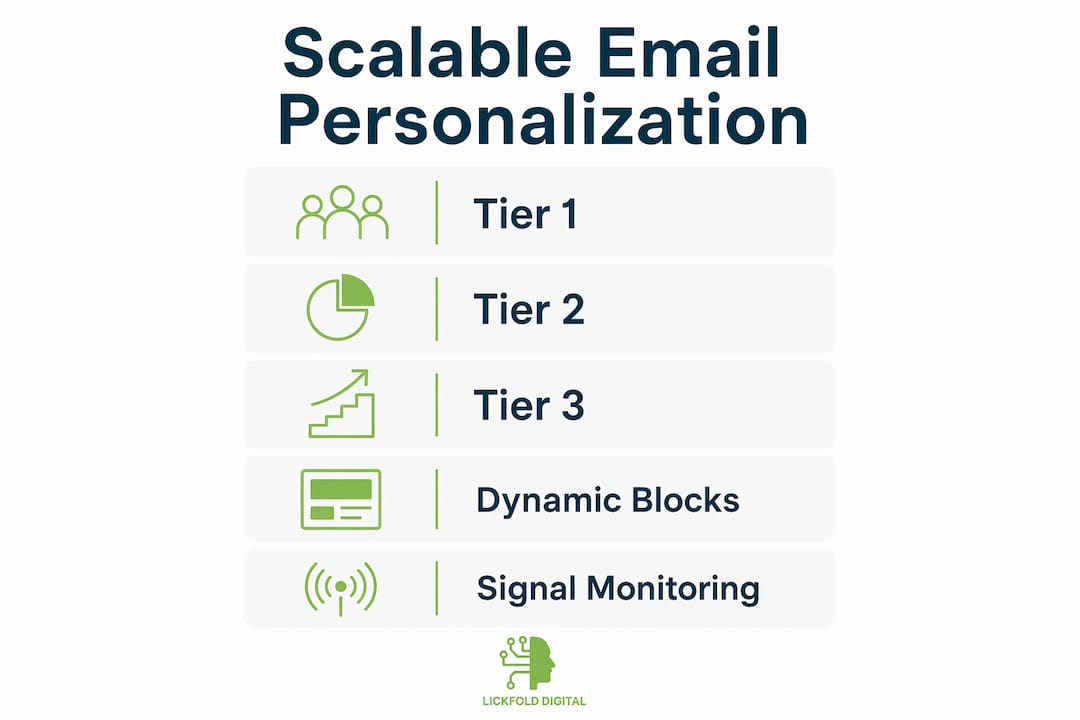
Pro Tip: Set up signal monitoring for your top-tier accounts using tools like Apollo.io or LinkedIn Sales Navigator. When a target company announces a new hire or raises funding, you have a 48-hour window to send a highly relevant message. Signal-based personalization takes 2 to 3 minutes to customize and consistently outperforms manual research-heavy approaches.
| Tier | Account type | Data points | Personalization method |
|---|---|---|---|
| 1 | Enterprise | 5 to 10 | Deep research, custom copy, signal monitoring |
| 2 | Mid-market | 2 to 3 | Industry triggers, firmographic data |
| 3 | Volume | 1 | Single behavioral or firmographic trigger |
What common pitfalls should agencies avoid when personalizing emails?
The most damaging mistake agencies make is treating personalization as cosmetic. Inserting "{{first_name}}` into a subject line is not personalization. It is a formatting trick that recipients recognize immediately. When the rest of the email reads like a broadcast message, the name token actually makes the disconnect more obvious, not less.
Broken merge tags are the second most common credibility killer. Sending an email that opens with “Hi ,” or “Dear [FIRST_NAME]” signals to the recipient that the sender does not test their own work. The fix is simple: always configure fallback values. Use “there” as the default for first name fields so a broken tag reads “Hi there” instead of exposing the variable. Test every template across Gmail, Outlook, and mobile clients before any send.
Other pitfalls that undermine personalization efforts:
- Data staleness: Personalization built on outdated contact records produces irrelevant or embarrassing messages. Data hygiene is foundational to any personalization strategy. Verify and refresh contact data before every major campaign.
- Intrusive specificity: Referencing information a prospect did not share publicly, such as internal company details or personal browsing behavior, feels surveillance-like and damages trust immediately.
- Over-personalizing low-value targets: Spending 20 minutes researching a contact worth a $500 deal destroys agency margins. Match research depth to deal potential.
- Ignoring list segmentation: Sending the same personalized template to an entire list without segmenting by behavior, industry, or funnel stage wastes the personalization investment.
Pro Tip: Before launching any personalized campaign, run a seed test with five internal addresses across different email clients. Check every dynamic field, every conditional block, and every image render. One broken tag in a 10,000-send campaign is 10,000 credibility problems.
How can agencies balance AI automation and human oversight?
AI accelerates every stage of personalized email production. It drafts opening lines from LinkedIn data, generates subject line variants for A/B testing, segments lists by behavioral signals, and populates dynamic content blocks at scale. For agencies managing dozens of client campaigns simultaneously, this capacity is transformative.
The risk is over-reliance. AI-generated email drafts require human review before sending. Without editing, AI content often carries a synthetic tone that experienced recipients detect within the first sentence. A message that reads as machine-generated undermines the entire purpose of personalization, which is to create a genuine human connection at scale.
The most effective workflow Lickfold has observed combines AI for speed with human judgment for quality:
- AI tools like GPT-4 or Claude generate first-draft opening lines based on scraped company data
- A human editor reviews for tone, accuracy, and brand voice before approval
- Dynamic content blocks handle mid-email personalization automatically
- A final human check confirms merge tags, fallback values, and send-time logic
“Personalization is about relevance, not artificial cleverness. AI generates options, but human tone and nuance are what preserve trust.” — Email Marketing for Agencies
Agencies that skip the human review step save time on individual campaigns but accumulate reputation damage over months. A single batch of robotic-sounding emails can suppress open rates for weeks as inbox providers register low engagement signals. The AI and human balance in outreach is not a philosophical question. It is a deliverability and conversion question.
What metrics should agencies track to optimize personalized campaigns?
Tracking the right metrics turns a personalized email program from a cost center into a strategic asset. Most agencies report open rates and click-through rates to clients. The agencies that retain clients longest go further.
The core metrics for any personalized campaign are open rate, click-through rate, conversion rate, bounce rate, unsubscribe rate, and reply rate segmented by personalization tier. That last metric is the one most agencies miss. Comparing reply rates across enterprise, mid-market, and volume tiers tells you exactly where your personalization investment is generating returns and where it is not.
Pro Tip: Track positive reply rate separately from total reply rate. A 20% reply rate with 80% negative responses is worse than a 10% reply rate with 70% positive responses. Quality of engagement predicts revenue outcomes far better than raw volume.
Email campaign reports serve a purpose beyond client recaps. They surface upsell opportunities. A report showing high open rates but low conversion rates points to a landing page problem, which is a billable optimization project. A report showing list fatigue signals a segmentation or re-engagement campaign opportunity. Agencies that read their own data strategically find new revenue inside existing client relationships.
| Metric | What it reveals | Action trigger |
|---|---|---|
| Open rate by segment | Subject line and sender name effectiveness | Rewrite subject lines if below 25% |
| Reply rate by tier | Personalization ROI per account size | Adjust tier thresholds if enterprise underperforms |
| Unsubscribe rate | List fatigue or relevance failure | Audit segmentation and send frequency |
| Conversion rate | Landing page and offer alignment | Optimize post-click experience |
| Bounce rate | Data hygiene status | Run list verification before next send |
Behavioral segmentation by feature usage or browsing history consistently outperforms demographic-only segmentation in SaaS and eCommerce campaigns. Agencies that build this capability for clients create a dependency that is difficult to replicate in-house, which is exactly the kind of value that justifies long-term retainers.
Key takeaways
Effective email personalization for agencies requires tiered frameworks, clean data, and human oversight of AI-generated content to consistently outperform generic campaigns.
| Point | Details |
|---|---|
| Tiered personalization scales efficiently | Match data depth to account value: 5 to 10 points for enterprise, 1 for volume outreach. |
| Data hygiene precedes everything | Stale or unverified contact data makes even sophisticated personalization fail. |
| AI needs human review | AI drafts accelerate production but require editing to avoid synthetic tone and deliverability damage. |
| Metrics reveal upsell opportunities | Campaign reports expose landing page gaps, list fatigue, and segmentation needs that generate new billable work. |
| Signal-based triggers outperform static templates | Monitoring funding, hires, and tech changes enables timely outreach that takes minutes to customize. |
Why I think most agencies are personalizing at the wrong layer
After working with B2B agencies across multiple verticals, the pattern I see most often is agencies investing heavily in subject line personalization while leaving the body copy generic. They A/B test first-name tokens and send-time optimization while the actual message reads like it was written for a trade publication, not a specific person at a specific company.
The agencies that actually move the needle treat personalization as a research discipline, not a template feature. They monitor signals. They know when a target company just hired a new VP of Marketing or closed a Series B round. They write the first two sentences of an email specifically for that moment, and then let automation handle the rest. That combination of signal awareness and operational efficiency is what separates a 4% reply rate from a 20% reply rate.
I am also skeptical of agencies that fully automate personalization without a human review step. The short-term efficiency gain is real. The long-term reputation cost is also real. Inbox providers measure engagement signals continuously. A batch of low-engagement sends from an AI-only workflow can suppress deliverability for weeks. The math rarely favors skipping the edit.
The agencies I respect most treat email personalization as a core competency, not a campaign feature. They invest in AI-driven prospecting tools that surface signals automatically, pair those signals with human judgment, and build reporting systems that turn every campaign into a source of strategic intelligence. That is the model worth building toward.
— Duarte
How Lickfold helps agencies scale personalized outreach
Lickfold Digital builds AI-driven outbound systems specifically for B2B agencies that need to scale personalized outreach without scaling headcount. The platform deploys dedicated AI agents to identify decision-makers, monitor company signals, and execute multi-touch campaigns with messaging tailored to each prospect’s actual situation. Every reply is qualified by a human before it reaches your sales team, so you receive warm opportunities rather than raw responses. Agencies using Lickfold reduce acquisition costs, improve reply rates, and build predictable pipelines without the overhead of a large outbound team. If you are ready to put personalization at the center of your growth strategy, reach out to Lickfold to see how the system works in practice.
FAQ
What is the role of email personalization for agencies?
Email personalization for agencies is the practice of tailoring campaign content to individual recipient data to improve open rates, click-through rates, and conversions. Agencies that apply advanced personalization see ROI gains up to 43% above standard campaigns.
How do you personalize emails at scale without losing quality?
Use a tiered framework that matches personalization depth to account value: 5 to 10 data points for enterprise accounts, 2 to 3 for mid-market, and a single trigger for volume outreach. Combine AI-generated drafts with human review to maintain tone and accuracy.
What are the biggest email personalization mistakes agencies make?
The most common mistakes are treating first-name tokens as sufficient personalization, sending emails with broken merge tags due to missing fallback values, and using stale contact data that makes tailored messaging inaccurate or irrelevant.
How does behavioral segmentation differ from demographic segmentation?
Behavioral segmentation groups contacts by actions like feature usage, browsing history, or purchase behavior, while demographic segmentation uses static attributes like job title or company size. Behavioral segmentation consistently drives higher engagement and lower churn in SaaS and eCommerce campaigns.
What metrics best measure personalized email campaign success?
Track open rate, click-through rate, conversion rate, and reply rate segmented by personalization tier. Positive reply rate is the strongest predictor of revenue outcomes and reveals where personalization investment is actually generating returns.