
What Is a B2B Distributor Network? A Strategic Guide
What Is a B2B Distributor Network? A Strategic Guide
TL;DR:
- A B2B distributor network is a coordinated system of partners that efficiently moves products from manufacturers to business customers. Effective networks include regional distributors, wholesalers, agents, and sub-distributors, each serving specific functions to create value and market reach. Successful management relies on verified partner selection, clear communication, and disciplined monthly oversight to build lasting competitive advantage.
A B2B distributor network is an organized system of partners that moves products from a manufacturer to business customers through wholesalers, regional distributors, agents, and sub-distributors. This network is not a passive logistics chain. It is a durable competitive advantage that gives manufacturers established local sales channels, consolidated logistics, and specialized order management without building those capabilities from scratch. For decision-makers evaluating supply chain efficiency and market reach, understanding how these networks function is the starting point for every serious distribution strategy.
What is a B2B distributor network made of?
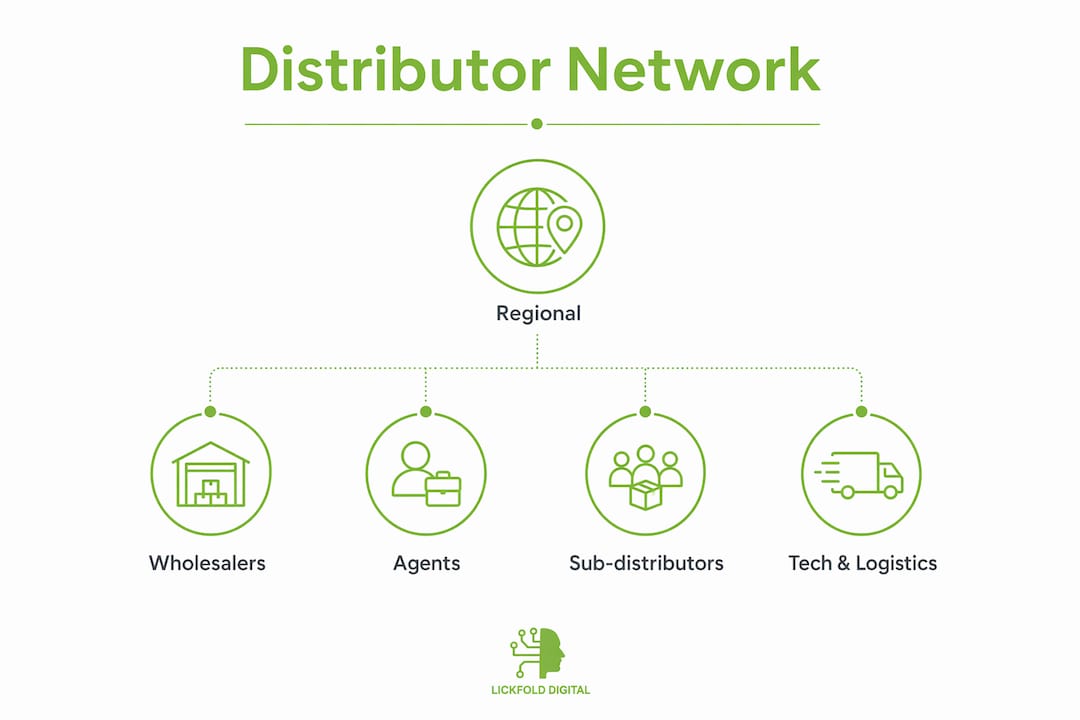
A B2B distributor network is built from several distinct partner types, each performing a specific commercial function. Confusing them leads to poor network design and misaligned expectations.

Regional distributors cover defined geographic territories. They hold inventory, manage local customer relationships, and handle last-mile delivery. Their value is proximity and market knowledge.
Wholesalers buy in bulk from manufacturers and resell to smaller distributors or retailers. They reduce the manufacturer’s transaction volume by consolidating many small orders into fewer, larger ones.
Agents and brokers do not take ownership of inventory. They represent the manufacturer in a market, generate orders, and earn a commission. They are useful for entering new markets with low upfront cost.
Sub-distributors sit below regional distributors and extend coverage into smaller towns or niche segments. They are common in markets where a single distributor cannot cover the full territory.
Technology platforms and third-party logistics providers complete the picture. Warehouse management systems, order tracking tools, and freight partners integrate into the network to give manufacturers visibility across the chain.
| Partner type | Primary function | Coverage strength |
|---|---|---|
| Regional distributor | Inventory, local sales, delivery | Geographic territory |
| Wholesaler | Bulk purchasing, resale | Broad, multi-channel |
| Agent/broker | Order generation, representation | Market entry, low cost |
| Sub-distributor | Extended reach, niche segments | Micro-territory |
| 3PL provider | Logistics, warehousing, fulfillment | Operational backbone |
A single distributor is not a network. A network is the coordinated operation of multiple partner types working under shared pricing rules, brand standards, and performance expectations.
How does a distributor network create value?
B2B distributors absorb complexity by consolidating demand from many small and mid-sized business customers. That consolidation lets manufacturers focus on production and product development instead of managing hundreds of fragmented customer relationships. The efficiency gain is real and measurable.
Key benefits of a well-run distributor network include:
- Market penetration at speed. Distributors bring existing customer relationships. A manufacturer entering a new region does not start from zero.
- Logistics cost reduction. Consolidated shipments through distributor warehouses cut freight costs compared to direct-to-customer delivery.
- Local inventory buffers. Distributors hold stock close to end customers, which shortens lead times and reduces stockout risk.
- Credit absorption. Distributors often extend credit to their customers, shielding the manufacturer from receivables risk.
- Localized sales expertise. Distributors understand local buying behavior, language, and regulatory requirements better than a central sales team.
Distributor margins typically range from 5–12%, with retailers adding 10–20% on top. Those margins are the cost of outsourcing market access. For most manufacturers, that cost is far lower than building an equivalent direct sales and logistics infrastructure.
Pro Tip: Ask your distributor to share their existing customer list before signing. If their current portfolio overlaps with your target segments by at least 60%, you will see faster product velocity from day one.
Localization is another underrated benefit. Distributors who already operate in a region know which trade shows matter, which local regulations apply, and which localized sales strategies move product. That knowledge takes years to build internally.
How to build and manage a high-performing distributor network
Building a distributor network is a process, not a single decision. The steps below reflect what separates networks that scale from those that stagnate.
- Define your ideal distributor profile. Set minimum criteria: annual turnover, warehouse capacity, existing customer base, and product category experience. Without a profile, selection becomes subjective.
- Source and shortlist candidates. Use trade directories, industry events, and B2B data platforms to identify candidates. Cross-reference multiple sources.
- Conduct structured due diligence. Request financials, customer references, and warehouse audits. A candidate who resists documentation is a candidate to eliminate.
- Run a pilot phase. Limit the initial agreement to a defined territory or account group. Pilot phases reveal whether a distributor respects your pricing, brand standards, and communication requirements before you grant full rights.
- Set contractual expectations clearly. Define minimum purchase volumes, exclusivity terms, reporting requirements, and exit clauses. Vague contracts create disputes.
- Onboard with training and field support. Manufacturers fail when they expect distributors to sell without active support. Provide product training, sales collateral, and a dedicated account manager.
- Manage with a monthly rhythm. A structured monthly cycle works as follows: Week 1 covers pipeline and forecast review, Week 2 captures field feedback, Week 3 addresses inventory planning, and Week 4 runs the performance scorecard review.
- Motivate with layered incentives. Volume rebates, co-marketing funds, and recognition programs keep distributors engaged. Passive partners underperform.
Pro Tip: Resist the urge to appoint many distributors quickly. Three distributors who each hit their targets are worth more than fifteen who collectively miss them. Expand based on proven product velocity, not headcount.
What challenges do businesses face with distributor networks?
The most common failure in B2B distribution is confusing activity with results. Appointing distributors feels like progress. Selling through them is the actual goal.
Expanding based on distributor count without verifying product velocity and funding capability leads to stagnant stock, high return rates, and channel paralysis. A distributor who cannot fund their own inventory growth becomes a bottleneck, not an asset.
Territory conflicts are another persistent problem. When two distributors serve overlapping geographies, they compete on price instead of growing the market. The result is margin erosion for both partners and reduced motivation to invest in your product.
| Ineffective approach | Effective approach |
|---|---|
| Appoint many distributors fast | Select fewer, verified partners |
| Rely on self-reported capabilities | Require documented financials and audits |
| Set targets once and wait | Review performance weekly and monthly |
| Ignore territory overlap | Define and enforce clear territory boundaries |
| Offer flat commission only | Use tiered rebates and performance incentives |
Pricing discipline is non-negotiable. Distributors who discount below your floor price to win volume destroy brand perception and undercut other channel partners. Clear pricing policies, enforced consistently, prevent this.
The first 60 to 90 days of any distributor agreement are the most revealing. Measure product velocity and active account growth during that window. If neither metric moves, the partnership is unlikely to improve with time.
How can companies evaluate prospective distributors effectively?
Distributor selection is where most networks succeed or fail before they even launch. Verification must go beyond trade directories and self-reported claims. Candidates who inflate their capabilities are common, and the cost of a bad appointment is high.
Key verification criteria to assess before signing any agreement:
- Annual turnover. Confirms the distributor has the financial base to fund inventory and operations.
- Existing customer access. Identifies whether their current accounts match your target segments. Use decision-maker identification methods to map their actual buyer relationships.
- Warehouse capacity and location. Physical infrastructure determines whether they can hold and move your product volumes.
- Portfolio complementarity. Their existing product lines should complement yours, not compete with them.
- Reputation in the market. Speak to their current suppliers and customers, not just the references they provide.
- Willingness to share documentation. Reluctance to provide financial statements or customer lists is a clear red flag.
Independent due diligence matters more than any sales pitch. A distributor who looks strong on paper but cannot produce a warehouse audit report or three years of financials is not ready to represent your brand. Pilot programs, as noted earlier, are the most reliable final filter before granting full distribution rights.
Key Takeaways
A B2B distributor network creates competitive advantage only when its partners are verified, supported, and managed with consistent operational discipline.
| Point | Details |
|---|---|
| Network composition matters | Regional distributors, wholesalers, agents, and sub-distributors each serve distinct functions. |
| Distributors absorb complexity | They consolidate fragmented SMB demand, freeing manufacturers to focus on production. |
| Pilot phases reduce risk | Testing a distributor in a limited territory reveals execution gaps before full rights are granted. |
| Monthly management rhythms drive results | Weekly pipeline, field, inventory, and scorecard reviews prevent underperformance from compounding. |
| Quality beats quantity | Fewer verified, high-performing distributors outperform a large network of unqualified partners. |
The uncomfortable truth about distributor networks I’ve learned the hard way
Most manufacturers treat distributor appointment as the finish line. It is actually the starting line.
I have seen companies spend months identifying the right distributor, negotiate a solid contract, and then disappear. No training. No monthly calls. No performance reviews. Six months later, the distributor is pushing a competitor’s product because that supplier showed up, ran a joint promotion, and made the distributor feel like a partner.
The networks that perform consistently share one trait: the manufacturer treats the distributor relationship like an internal sales team. That means regular contact, shared targets, honest feedback, and real consequences for missing commitments. It also means celebrating wins publicly. Distributors respond to recognition the same way any sales team does.
The other lesson I keep seeing ignored is patience during expansion. The instinct is to add more distributors when growth slows. The real answer is almost always to fix what is broken with the existing ones first. Adding a tenth underperforming distributor does not solve the problem that the first nine are not hitting their numbers. Selective expansion, based on proven product velocity in a territory, is the only kind that compounds.
If you are building a network from scratch, start with two or three partners in your highest-priority markets. Get those right. Then expand. The discipline required to hold that line is harder than it sounds, but the networks built that way are the ones that last.
— Duarte
How Lickfold helps you build a stronger distributor network
Finding the right distributor starts with finding the right decision-makers inside prospective partner organizations. That is where most companies lose time.

Lickfold uses AI-driven prospecting to identify and engage the specific buyers, procurement leads, and commercial directors inside distributor organizations that match your ideal partner profile. Instead of cold outreach to generic contacts, Lickfold’s system targets verified decision-makers with personalized, multi-touch campaigns that generate qualified conversations. The result is a faster path from prospecting to pilot agreement, with less wasted effort on partners who were never a real fit. If you are ready to put structure behind your distributor search, reach out to Lickfold and start building a network that performs.
FAQ
What is a B2B distributor network?
A B2B distributor network is an organized system of wholesalers, regional distributors, agents, and sub-distributors that moves products from a manufacturer to business customers. It provides market access, logistics consolidation, and local sales capability without requiring the manufacturer to build those functions directly.
What is the difference between a distributor and a wholesaler?
A distributor typically holds inventory, manages customer relationships, and provides after-sales support within a defined territory. A wholesaler buys in bulk and resells to other distributors or retailers, focusing on volume rather than end-customer relationships.
How long does it take to build a distributor network?
Building a functional network takes six to twelve months for the first tier of partners, depending on market complexity and due diligence depth. The first 60 to 90 days of each new partnership are the most critical for evaluating whether the relationship will perform.
What are the biggest risks in managing a distributor network?
The two largest risks are appointing unqualified partners based on self-reported claims and failing to manage distributors actively after signing. Both lead to stagnant inventory and poor product velocity.
How do you motivate distributors to prioritize your product?
Layered incentives work best: volume rebates, co-marketing funds, and public recognition programs. Active field support and consistent monthly management rhythms keep distributors engaged and aligned with your targets.