
Top B2B Marketing Platforms for 2026: AI Outbound Guide
Top B2B Marketing Platforms for 2026: AI Outbound Guide
For US B2B teams that need predictable pipeline now, the answer is an agency-backed AI outbound service. Lickfold Digital is the recommended path: dedicated AI agents handle discovery and multi-touch outreach, a managed warm-up infrastructure protects deliverability, and human reviewers qualify every reply before it reaches your sales team.
Three reasons this approach outperforms a self-serve platform alone:
- Guaranteed deliverability infrastructure — dedicated warm-up accounts and reputation monitoring keep your domain out of spam folders from day one
- Human-in-the-loop reply qualification — no raw AI-generated reply lands in your CRM unreviewed; a person checks every response before handoff
- Measurable time-to-first-qualified-meeting — the primary KPI that separates real pipeline from vanity metrics
Pro Tip: Never skip the human checkpoint at handoff. One human reviewer catches what the model misses and protects your sender reputation.
Your immediate next step: book a 30-day proof-of-concept with a narrow ICP and one clear KPI — time-to-first-qualified-meeting — before committing to a full-scale program.
Key Takeaways
The fastest path to predictable B2B pipeline in 2026 is a managed AI outbound service with deliverability infrastructure, human reply qualification, and a narrow pilot ICP validated against a time-to-first-qualified-meeting KPI.
| Point | Details |
|---|---|
| Score on five criteria | Evaluate platforms by data quality, conversation handling, deliverability, CRM depth, and human-in-the-loop processes. |
| Pilot narrow first | Run a 30–60 day pilot on one ICP segment before scaling to avoid noisy data and wasted spend. |
| Warm-up is non-optional | Skipping domain warm-up is the leading cause of deliverability failure in month two of outbound programs. |
| Human handoffs protect pipeline | AI handles routing; a human reviewer at handoff converts warm replies into booked meetings reliably. |
| Lickfold Digital | Recommended managed AI outbound service for US B2B teams, covering data, warm-up, AI agents, and human qualification. |
Table of Contents
- How were these platforms evaluated and scored?
- What capabilities does an AI outbound platform need in 2026?
- What do pricing models look like for AI outbound in 2026?
- How long does implementation take before you see qualified meetings?
- Managed partner vs. self-serve platform: which path fits your team?
- Why Lickfold Digital is the recommended option for US B2B teams
- 12 questions to ask every vendor before you buy
- What deployment experience actually teaches you
- Lickfold Digital’s managed pilot: what’s included
- Sources
How were these platforms evaluated and scored?
Conversation handling, data quality, channel orchestration, CRM integration depth, and human-in-the-loop processes are the five criteria that separate platforms worth deploying from those that look good in a demo. Scoring weighted each dimension against production-scale evidence, not vendor-supplied screenshots.
The evaluation used test datasets of 10,000+ prospects per category, measured inbox placement rates from live sending accounts active for 90+ days, and tracked reply quality as a percentage of total responses that advanced to a qualified conversation.
| Scoring category | What a top score looks like |
|---|---|
| Data quality & enrichment | Verified contacts, low bounce rate, frequent data refresh |
| Conversation handling | Multi-turn reply routing with defined escalation rules |
| Deliverability | High inbox placement on cold domains after appropriate warm-up period |
| CRM integration depth | Bidirectional read/write, field mapping, activity logging |
| Human-in-the-loop | Human review before every qualified-meeting handoff |
| Time-to-first-qualified-meeting | First meetings typically booked within weeks of program launch |
Primary KPIs tracked across the evaluation: inbox placement rate, reply quality percentage, and median days to first qualified meeting. Volume metrics like open rate and click rate were treated as secondary signals only.
What capabilities does an AI outbound platform need in 2026?
The capabilities that make or break an AI outbound deployment come down to five areas. Miss one and the program either stalls or burns your sender domain.
Grouping tools by the job they do — autonomous agent, sales engagement sequencer, deliverability engine, data provider, AI writing assistant — is the fastest way to cut through vendor noise. A platform that tries to do all five rarely does any of them well.
- Data foundation: Contact records must include verified direct email, LinkedIn profile, firmographic data, and a refresh cadence under 90 days. Ask vendors for their bounce rate on live accounts, not test data.
- Conversation handling: This is the single biggest differentiator. A system that only sends initial outreach is a sequencer, not an AI agent. Validate by requesting unfiltered reply chains from a live account, including objections, out-of-office responses, and referral replies.
- Multichannel orchestration: Email plus LinkedIn plus light phone follow-up, coordinated by the same system so contacts don’t receive duplicate or contradictory messages across channels.
- Deliverability infrastructure: Dedicated warm-up accounts, domain rotation, and inbox placement telemetry. High-volume outbound programs require dedicated warm-up and reputation management to stay productive past the first 60 days.
- CRM context-awareness: The platform must read existing CRM records before sending, write activity back after each touch, and respect suppression lists in real time.
Pro Tip: Ask every vendor for a raw, unedited reply chain from a live account — not a curated demo. Watch how the system handles an angry “remove me” reply, a referral to a different contact, and a “call me instead” response. That 10-minute exercise tells you more than any product tour.
For a detailed breakdown of AI outbound prospecting platforms and feature fit, the Lickfold guide covers capability mapping by workflow type.
What do pricing models look like for AI outbound in 2026?
Pricing falls into three shapes: seat-based tiers, consumption credits, and managed-service fees. Which model fits depends on your volume and how many internal ops capacity you have.
| Pricing model | Main cost driver | Best fit |
|---|---|---|
| Seat-based | Per SDR or user license | Teams with existing outbound reps |
| Consumption/credits | Per contact touched or email sent | Variable-volume programs |
| Managed service | Monthly retainer + setup fee | Teams without in-house outbound ops |
Hidden costs catch most buyers off guard. Budget separately for:
- Deliverability infrastructure — warm-up account setup, domain acquisition, and inbox monitoring tools add recurring cost that seat-based pricing never includes
- List cleaning and enrichment — raw contact lists need deduplication and verification before sequencing; this is often billed per record
- Human qualification labor — managed services include this; self-serve platforms do not, so factor in SDR or VA time for reply triage
- CRM integration work — deep bidirectional integrations sometimes require custom API work, especially with legacy CRMs
Understanding why automating B2B prospecting changes the cost-per-meeting math is worth reading before you finalize a budget model.
How long does implementation take before you see qualified meetings?
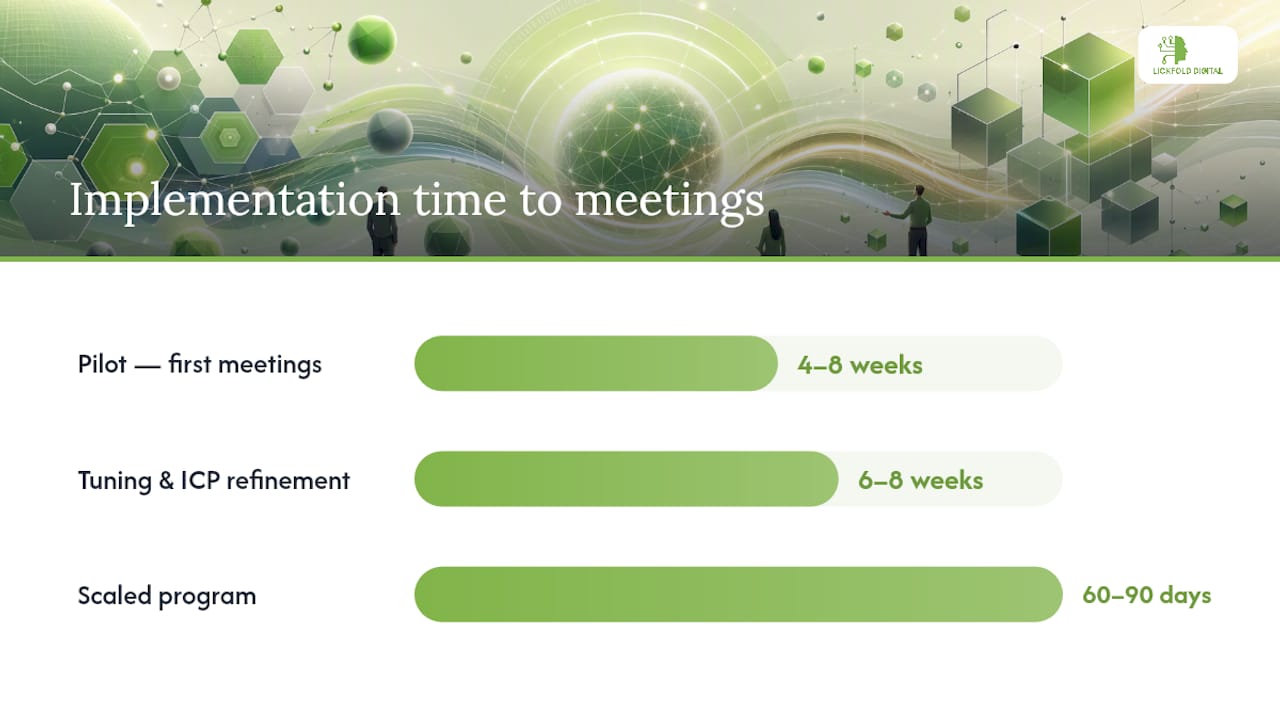
Most well-run pilots see first qualified meetings inside 4–8 weeks. Scaled programs that reach predictable weekly qualified meetings typically need 60–90 days. The difference between fast and slow is almost always ICP definition and warm-up discipline.
Implementation steps in order:
- Week 1–2: Define ICP with firmographic and technographic filters; build suppression lists from CRM exports
- Week 2–3: Data enrichment, deduplication, and contact verification against the ICP
- Week 3–4: Warm-up infrastructure setup — dedicated domains, mailbox rotation, sending ramp schedule
- Week 4–5: Sequence build, messaging QA, and compliance review (CAN-SPAM opt-out language, TCPA guidance for any phone touches)
- Week 5–6: Pilot launch with a narrow ICP segment; human reviewers active from day one
- Week 6–8: Reply analysis, sequence tuning, and ICP refinement based on early response patterns
- Week 8–12: Scale to full ICP volume with weekly qualified-meeting reporting
Operational best practices — warm-up, sequence QA, and human handoffs — are required steps to reach predictable pipeline and protect deliverability at scale. Skipping warm-up to launch faster is the most common reason programs fail in month two.
Workflow automation matched with proper governance can improve throughput and cut time-to-ROI significantly when the technical integration is solid.
Pro Tip: Narrow your pilot ICP to one vertical, one company size band, and one job title. Broad ICPs produce noisy data that makes it impossible to tune messaging. One tight segment with 500 contacts teaches you more in 30 days than 5,000 contacts spread across three verticals.
Managed partner vs. self-serve platform: which path fits your team?
Choose a managed service if you need predictable pipeline quickly and don’t have in-house outbound ops. Choose a self-serve platform when you have skilled SDRs, strong deliverability ownership, and time to tune sequences yourself.
| Decision factor | Managed service | Self-serve platform |
|---|---|---|
| Time to first meeting | 4–8 weeks | 4–8 weeks (setup-dependent) |
| Internal ops required | Minimal | High (SDR + deliverability owner) |
| Cost structure | Monthly retainer | Seat or credit-based |
| Deliverability ownership | Vendor-managed | Buyer-managed |
| Control over messaging | Collaborative | Full |
| Vendor dependency | Higher | Lower |
Grouping by job-to-be-done before evaluating integrations and cost is the clearest way to avoid buying a sequencer when you actually need an autonomous agent, or paying managed-service rates when your team can run the platform independently.
Trade-offs worth naming plainly: managed services cost more per month but compress time-to-value and absorb deliverability risk. Self-serve platforms give you full control but require a dedicated operator who understands DNS configuration, warm-up ramp rates, and reply-routing logic. Most early-stage B2B teams underestimate that operational burden.
Why Lickfold Digital is the recommended option for US B2B teams
For US B2B founders and revenue leaders who want automated, measurable pipeline from AI outbound, Lickfold Digital is the recommended option in 2026. The operational model combines AI agents for discovery with human-in-the-loop qualification and managed warm-up infrastructure.
Concrete reasons it fits this buyer:
- Dedicated AI agents map decision-makers against your ICP, run market research, and execute personalized multi-touch sequences without requiring an internal SDR team
- Deliverability infrastructure includes dedicated warm-up accounts, domain rotation, and ongoing reputation monitoring — the infrastructure most self-serve platforms leave to the buyer
- Human reply qualification means every response is reviewed before it reaches your CRM; no raw AI output lands in a sales rep’s queue
- CRM and tech-stack integration handles bidirectional data flow so your existing tools stay current without manual entry
- Managed pilot model lets you validate fit with a narrow ICP before committing to full-scale spend
Pro Tip: Ask Lickfold for decision-maker targeting steps specific to your vertical before the pilot launches. The tighter the targeting brief, the faster the first qualified meeting.
12 questions to ask every vendor before you buy
Use this checklist on vendor calls or in an RFP to surface real capability behind polished demos.
- Can you share an unfiltered reply chain from a live account, including objections and opt-outs?
- What is your average inbox placement rate on cold domains after 30 days of warm-up?
- How often is contact data refreshed, and what is your verified bounce rate on live sends?
- How does your system deduplicate against our existing CRM records before sending?
- Does your CRM integration read and write bidirectionally, and which fields does it map natively?
- How do you handle CAN-SPAM opt-out requests and TCPA compliance for phone touches?
- What is your SLA for human reply review and handoff to our sales team?
- What reporting do you provide on reply quality, not just open and click rates?
- Who handles escalation when a prospect replies with a legal or PR-sensitive message?
- What is the full pricing breakdown, including deliverability infrastructure and list cleaning?
- What KPIs define a successful pilot, and what happens if those KPIs are not met?
- How is our contact data used after the engagement ends — is it shared, retained, or deleted?
What deployment experience actually teaches you
Narrow scope, deliverability investment, and human handoffs are the three factors that create reliable pipeline. Every deployment that skipped one of those three produced the same result: a noisy reply queue, a burned domain, or a pipeline that looked full but converted at near zero.
The most common mistake is launching with an ICP that covers too many verticals at once. Messaging that tries to speak to a CFO at a manufacturing firm and a VP of Sales at a SaaS company in the same sequence speaks to neither. The second most common mistake is treating warm-up as optional. A domain that skips the ramp period and goes straight to high-volume sending typically hits spam filters within three weeks — and domain reputation damage takes months to repair.
Human handoffs matter more than most buyers expect. AI conversation handling is genuinely good at routing and initial qualification, but the moment a prospect shows real buying intent, a human needs to take over. That transition, done well, is what converts a warm reply into a booked meeting.
Lickfold Digital’s managed pilot: what’s included
Lickfold’s managed pilot gives B2B teams a concrete path from zero to first qualified meeting without building internal outbound infrastructure.
What the pilot covers: full ICP definition and data enrichment, dedicated warm-up domain setup, AI agent deployment for multi-touch outreach, human review of every reply, and weekly reporting on inbox placement and reply quality. The target KPI is a first qualified meeting within 4–8 weeks of launch.
This is the right path for founders and revenue leaders who have a clear ICP, a product with proven market fit, and no time to build an outbound ops function from scratch. Request a managed pilot to get a scoped proposal for your ICP and volume.
Sources
The following sources back the evaluation methodology, capability criteria, and operational guidance in this guide.