
The Role of Trust in B2B Services: 2026 Guide
The Role of Trust in B2B Services: 2026 Guide
TL;DR:
- Trust is the top driver in B2B purchasing and influences decisions beyond brand perception.
- Building trust requires addressing each stakeholder group’s specific concerns through transparent evidence, peer recommendations, and insightful content.
Trust is the number one driver of B2B purchasing decisions, ranking ahead of price, innovation, and functional performance for the third consecutive year. The role of trust in B2B services goes far beyond brand perception. It functions as a risk-reduction signal that enables buyers to commit, shortens sales cycles, and determines which vendors survive the shortlist. 78% of B2B buyers prefer products they were already familiar with before starting formal research. That figure tells you something critical: the buying decision is often made before your sales team ever speaks to a prospect.
How does trust influence B2B purchase decisions?
Trust shapes B2B decisions differently depending on who holds the pen. A single buying group typically includes procurement managers, technical evaluators, operational leads, and senior leadership. Each group applies a different trust lens, and failing to address all of them creates blind spots that cost deals.
Procurement teams prioritize transparency and compliance. They want to see clear pricing structures, documented processes, and verifiable credentials. A vendor that cannot produce audit-ready documentation or third-party certifications gets filtered out early. Trustworthiness in B2B transactions, from a procurement standpoint, is largely about reducing the risk of a bad internal decision.
Technical and operational stakeholders focus on expertise and reliable delivery. They want proof that your team has solved their specific problem before. Case studies, technical white papers, and reference calls carry more weight here than any marketing claim. A vendor with a strong track record in a relevant vertical earns trust faster than one with a broader but shallower portfolio.

Senior leadership evaluates long-term risk and adaptability. They ask whether a vendor will still be a good partner in three years. Stability, financial health, and a clear service roadmap matter here. Leadership also considers reputational risk: choosing a vendor that later fails publicly reflects on them personally.
The most common mistake organizations make is measuring trust through a single decision-maker rather than the full buying group. That approach produces an incomplete picture and leaves entire stakeholder segments unaddressed.
- Map every stakeholder role in your target accounts before outreach begins.
- Build separate trust signals for procurement, technical, and leadership audiences.
- Align your sales and marketing content to each role’s primary concern.
- Never assume that winning over one champion means the deal is secure.
Pro Tip: Create a simple stakeholder trust matrix for each major account. List each role, their primary trust concern, and the specific evidence you will use to address it. This single exercise prevents more lost deals than any pitch deck revision.
What mechanisms create and sustain trust in B2B relationships?
Trust in mature technical B2B markets builds primarily through communication and knowledge-sharing, not through price or product features alone. Research on the commitment-trust model confirms that communication strongly predicts trust, which is itself the strongest predictor of long-term commitment. That sequence matters. You cannot shortcut to commitment without first earning trust through consistent, substantive communication.
The mechanisms that build trust fall into three categories.
- Transparent evidence. Documented results, audit trails, and verifiable credentials reduce uncertainty. A vendor that publishes case studies with real metrics, shares incident reports openly, and maintains a public compliance record signals that it has nothing to hide.
- Peer recommendations. Positive word-of-mouth from recognized industry peers carries more weight than any first-party claim. Buyers treat peer recommendations as independent validation. Structured reference programs and client advocacy initiatives formalize this channel.
- Thought leadership content. Thought leadership builds trust at twice the rate of inactive brands, but only when the content delivers decision-supporting insight rather than generic advice. A white paper that helps a buyer solve a specific problem builds credibility. A blog post that restates industry definitions does not.
Trust in B2B is not a one-time achievement. It is rebuilt with every new project, every new stakeholder, and every new engagement. Calculative, cognitive, and affective trust operate independently and fluctuate across the relationship lifecycle. A vendor that earned deep trust on one contract cannot assume that trust transfers automatically to the next.
This non-linear nature of B2B trust development is the most underestimated risk in long-term client relationships. The practical implication is clear: treat every new engagement as a fresh trust-building opportunity, not a continuation of an existing account.
Building long-term client relationships requires ongoing investment in communication quality, not just service delivery. The vendors that sustain trust over years are the ones that keep showing up with relevant insight, honest updates, and proactive problem-solving.
Why operationalizing trust matters in 2026
Trust has become a measurable economic asset, not a soft metric. Cybersecurity incidents, ESG scrutiny, and rising transparency demands have changed what buyers expect from vendors before they sign. Organizations that adopt third-party security certifications and real-time compliance disclosures experience faster contract renewals and preferred vendor positioning. That is a direct financial return on trust investment.
Pro Tip: Treat your trust metrics as a quarterly business review item alongside revenue and margin. If you only review client satisfaction scores annually, you will miss early warning signals of eroding trust before they become lost contracts.
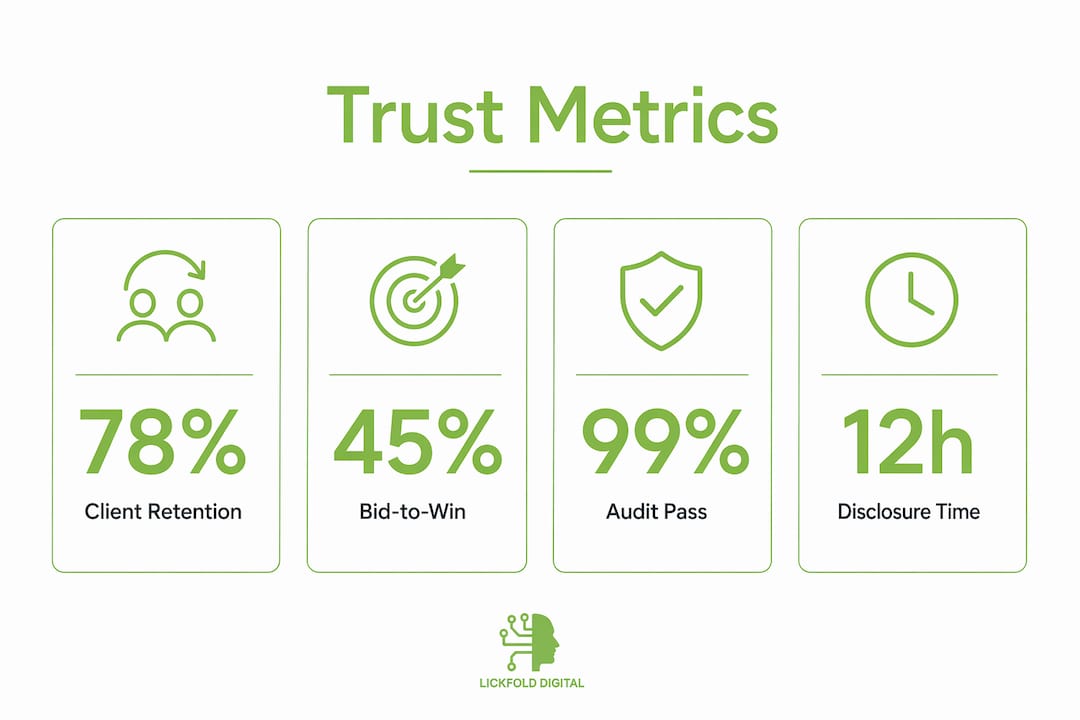
The table below shows the key metrics that leading B2B organizations use to track trust as a business asset.
| Metric | What it measures | Why it matters |
|---|---|---|
| Client retention rate | Percentage of clients renewing contracts | High retention signals sustained trust across the relationship |
| Bid-to-win ratio | Proportion of proposals that convert | Improving ratios indicate growing market trust and credibility |
| Audit pass rate | Compliance and certification outcomes | Demonstrates operational reliability to procurement teams |
| Incident disclosure time | Speed of transparent issue reporting | Faster disclosure builds trust; slow disclosure destroys it |
Embedding these metrics alongside growth and margin goals in strategic planning forces intentional trust-building. Most organizations track revenue and churn but ignore the leading indicators of trust erosion. By the time a client leaves, the trust deficit has been accumulating for months.
Trust also functions as a compression mechanism. It reduces the buyer’s decision space by filtering out vendors that increase perceived risk. A vendor with strong trust signals gets evaluated more quickly and more favorably. That compression effect compounds over time: the more consistently you demonstrate trustworthiness, the shorter your sales cycles become and the lower your cost of acquisition falls.
How to build trust throughout the buyer journey
Building trust across the full buyer journey requires alignment between marketing, sales, and service delivery. A buyer who receives one message from your marketing content and a different message from your sales team experiences cognitive dissonance. That gap erodes trust before the relationship even begins.
The most effective trust building strategies for B2B professionals center on consistency and defensibility. Buyers need to be able to justify their vendor choice internally. Your job is to make that internal defense easy.
- Align your narrative across all channels. Your website, proposals, and sales conversations must tell the same story. Inconsistency signals instability.
- Provide defensibility content. Give buyers the materials they need to advocate for you internally: ROI calculators, reference letters, and third-party validation reports.
- Use advocacy systematically. Client testimonials and case studies reduce perceived risk for new buyers. Structure your client success program to generate these assets continuously.
- Engage multiple stakeholders early. Trust built with one contact does not automatically transfer to others in the buying group. Engaging decision-makers across all relevant roles from the start prevents last-minute objections from unaddressed stakeholders.
- Maintain a stable, visible presence. Volume of content does not build trust. Consistent, relevant, and credible communication over time does.
Trust also operates as a political mechanism inside buyer organizations. Vendors perceived as safe and defensible choices internally win deals that technically superior but less familiar competitors lose. That political dimension means your trust-building effort must account for the internal dynamics of your buyer’s organization, not just their stated evaluation criteria.
Authenticity reinforces every trust signal you send. When your brand consistently delivers on what it promises, authentic brand behavior becomes a competitive differentiator that is genuinely hard to replicate. Buyers notice the difference between vendors who perform trust and vendors who demonstrate it through repeated, reliable action.
Key Takeaways
Trust is the primary economic and relational asset in B2B services, and organizations that measure, build, and sustain it across all stakeholder groups win more deals, retain more clients, and reduce acquisition costs over time.
| Point | Details |
|---|---|
| Trust outranks price | 78% of B2B buyers favor familiar vendors, making trust the top purchase driver. |
| Stakeholder alignment is non-negotiable | Procurement, technical, and leadership roles each require different trust evidence. |
| Communication drives commitment | Consistent, substantive communication is the strongest predictor of long-term commitment. |
| Trust is a measurable asset | Track retention rates, bid-to-win ratios, audit pass rates, and disclosure times. |
| Trust must be rebuilt continuously | Each new engagement requires fresh trust-building; past trust does not transfer automatically. |
Trust is not a soft metric. It is your growth engine.
After years of working with B2B organizations on outreach and pipeline strategy, the pattern I see most often is this: companies invest heavily in generating leads but almost nothing in the trust infrastructure that converts those leads into clients and keeps them.
The uncomfortable truth is that most B2B sales cycles are not lost on price or product fit. They are lost because a vendor failed to make the internal champion feel safe enough to advocate for them. That is a trust failure, and it happens long before the final proposal.
What surprises most decision-makers is how quickly trust erodes between engagements. A client who trusted you completely on one project will apply fresh scrutiny to the next. That is not disloyalty. That is how B2B trust actually works. The vendors who understand this rebuild trust proactively at the start of every new initiative rather than assuming goodwill carries forward.
The other pitfall I see regularly is measuring trust through a single relationship. One satisfied contact does not mean the buying group trusts you. When that contact leaves or a new stakeholder joins the evaluation, organizations that built trust broadly survive the transition. Those that relied on one champion often do not.
My advice: treat trust as a line item in your growth strategy. Assign metrics to it. Review it quarterly. Build it deliberately across every stakeholder group in every account. The organizations that do this consistently find that their sales cycles shorten, their renewal rates improve, and their cost of acquisition falls. That is not a coincidence.
— Duarte
How Lickfold helps B2B teams build trust at scale
Building trust across multiple stakeholders in complex B2B buying groups requires consistent, personalized outreach at a volume most sales teams cannot sustain manually. Lickfold deploys AI-driven prospecting workflows that identify the right decision-makers, deliver tailored messaging to each stakeholder role, and maintain the communication cadence that trust-building requires. Every outreach sequence is built around your ideal client profile, not generic templates. Human qualification ensures that only warm, trust-ready conversations reach your sales team. If you want a pipeline built on credibility rather than cold volume, reach out to Lickfold and see how the system works for your market.
FAQ
Why does trust outrank price in B2B purchasing?
Trust reduces the perceived risk of a wrong decision, which matters more to B2B buyers than saving money. B2B buyers prefer familiar vendors because familiarity signals safety, not just quality.
How do you build trust with multiple stakeholders in a buying group?
Address each stakeholder’s specific concern with targeted evidence: compliance documentation for procurement, case studies for technical teams, and risk management proof for leadership. Single-champion trust strategies leave most of the buying group unaddressed.
What metrics measure trust in B2B relationships?
Client retention rate, bid-to-win ratio, audit pass rate, and incident disclosure time are the four most reliable trust metrics. Embedding these alongside growth goals makes trust-building intentional rather than accidental.
Does trust built on one project carry over to the next?
No. B2B trust is non-linear and must be rebuilt with each new engagement. Assuming that past trust transfers automatically is one of the most common causes of unexpected client churn.
How does thought leadership content build trust?
Thought leadership builds trust at twice the rate of inactive brands when it delivers decision-supporting insight rather than generic information. Content that helps buyers solve a specific problem reduces uncertainty and positions your organization as a credible, expert partner.