
Scalable Outbound Campaigns: B2B Guide for 2026
Scalable Outbound Campaigns: B2B Guide for 2026
TL;DR:
- Scaling outbound campaigns requires robust infrastructure, signal-anchored sequences, and systematic feedback. Proper targeting, multi-channel coordination, and ongoing measurement are essential for generating predictable pipeline growth. Addressing infrastructure flaws and using structured experimentation drive successful outbound scaling efforts.
Creating scalable outbound campaigns means executing targeted, personalized, multi-touch sequences that generate qualified leads consistently as your outreach volume grows. Most B2B teams hit a ceiling not because their messaging fails, but because their infrastructure and sequencing logic cannot hold up under scale. This guide breaks down the core components, sequence design, optimization loops, and common failure points that separate teams generating predictable pipeline from those stuck in random acts of outreach. The frameworks here apply directly to marketing and sales teams running outbound in 2026.
What core components enable scalable outbound campaigns?
Scalable outbound is built on four pillars: precision targeting, signal-anchored sequencing, delivery infrastructure, and multi-channel coordination. Remove any one of them and your campaign either burns out your list or never reaches the inbox.

Precision targeting with ICP segmentation
Tight Ideal Customer Profile (ICP) segmentation is the starting point. A well-defined ICP goes beyond industry and company size. It includes technographic signals, hiring patterns, funding rounds, and behavioral triggers like pricing page visits or job postings for roles your solution addresses. Buying signals and reply rates between 15% and 25% are the benchmarks top B2B outbound teams hit when targeting 3–5 specific signals per campaign. That benchmark tells you exactly how tight your targeting needs to be before you send a single email.
Signal-anchored sequencing
Generic sequences fail because they give prospects no reason to respond at a specific moment. Signal-anchored sequences tie each touchpoint to a trigger or a concrete value point. Effective sequences run 8–12 touches, and the data shows that 44% of sales reps quit after one touchpoint. That gap is where most pipeline gets left behind. Each touch in your sequence should reference something real: a recent funding announcement, a competitor move, or a specific pain point tied to the prospect’s role.
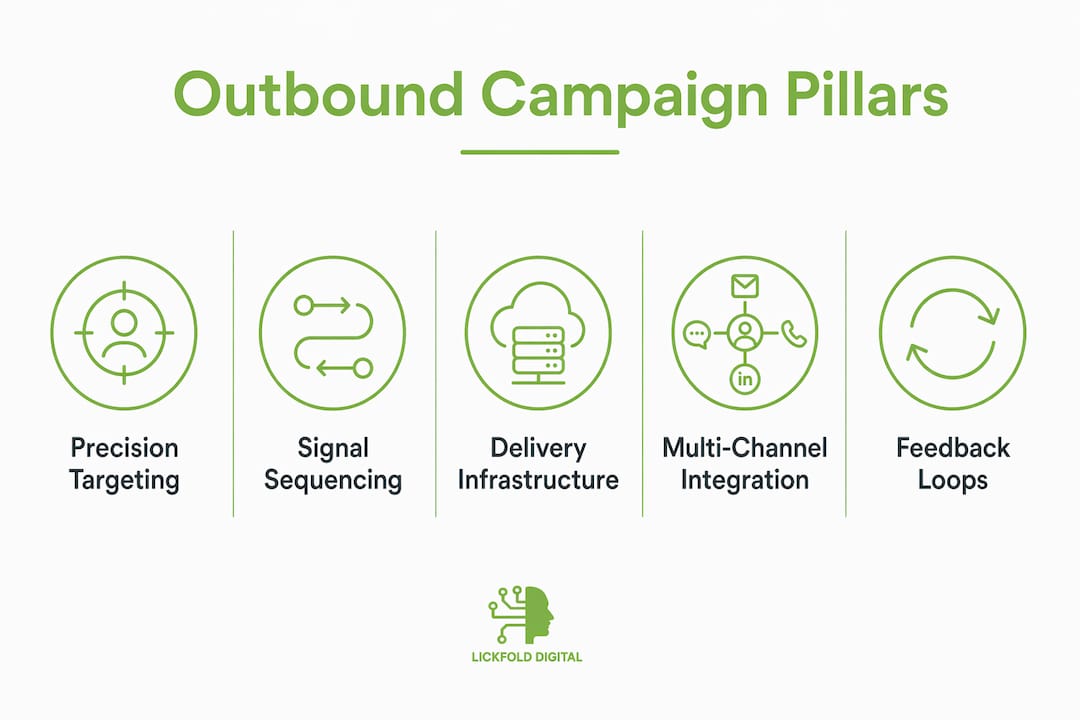
Delivery infrastructure
Scaling outbound campaigns requires multi-mailbox architecture with warmed accounts and strict segmentation to protect deliverability. The rule is simple: no more than 30–50 emails per mailbox per day. Each sending domain needs SPF, DKIM, and DMARC authentication. Warm-up periods of 3–4 weeks per new mailbox are non-negotiable before you add volume. Skipping this step is the single fastest way to land in spam across your entire prospect list.
Multi-channel integration
Email alone is not a channel strategy. LinkedIn connection requests, voice messages, and direct calls reinforce email touches and increase total reply rates. The sequence logic should treat each channel as a layer, not a replacement. Email opens the conversation, LinkedIn builds social proof, and calls close the loop on warm signals.
| Component | What It Does | Key Metric |
|---|---|---|
| ICP Segmentation | Filters prospects to highest-fit accounts | Signal-to-meeting rate above 3% |
| Signal-Anchored Sequences | Ties outreach to specific triggers | Reply rate 15%–25% |
| Delivery Infrastructure | Protects sender reputation at scale | Under 50 emails per mailbox daily |
| Multi-Channel Coordination | Reinforces messaging across touchpoints | Meeting bookings per sequence |
Pro Tip: Start each new campaign segment with under 50 recipients. Evaluate reply rate and positive reply rate before expanding. This protects your domain reputation and gives you clean data before you commit volume.
How do you design personalized outbound sequences at scale?
The biggest misconception in outbound is that personalization and scale are opposites. They are not. The key is building a sequence architecture that uses modular, variable messaging rather than one-size-fits-all templates.
Here is a proven framework for designing sequences that work at volume:
-
Open with a specific trigger. Reference the exact signal that put this prospect in your campaign. A recent product launch, a LinkedIn post, or a job listing for a VP of Sales tells the prospect you did your homework. Generic openers like “I came across your profile” are filtered out instantly.
-
Deliver a concrete value point in touch two. Do not ask for a meeting in the second email. Share a relevant case study, a data point specific to their industry, or a short insight tied to their business model. Value-driven touchpoints build trust better than robotic cadences and improve mid-sequence reply rates.
-
Address the most common objection in touch three or four. If your prospects typically push back on implementation time or switching costs, write that objection into the sequence before they raise it. This shows you understand their world.
-
Use behavioral triggers instead of fixed delays. If a prospect clicks a link in email two, move them to a faster-paced branch of the sequence. If they visit your pricing page, trigger a call task immediately. Variable delays of 2–4 days between emails outperform batch-and-blast timing.
-
Close each sequence with a low-friction ask. The final touch should not be a guilt trip for not responding. Offer a relevant resource, ask a single yes/no question, or provide a clear opt-out. Prospects who say no now are not lost forever.
-
Build a targeted outreach framework that maps each touch to a specific objection or value point. This turns your sequence into a structured conversation rather than a series of interruptions.
Pro Tip: Write every email as if you are sending it to one person. Then use merge fields and conditional logic in your sequencing tool to make it feel that way for thousands. The writing quality of the base template determines whether the personalization lands or falls flat.
How do data and feedback loops drive outbound scaling?
Measurement is what separates teams that scale from teams that just send more emails. Without systematic tracking, you are guessing at what works and burning budget in the process.
The metrics that matter most in outbound are:
- Reply rate: Total replies divided by emails delivered. Target 15%–25% for well-targeted campaigns.
- Positive reply rate: Replies showing genuine interest divided by total replies. This is your real signal quality indicator.
- Meeting booking rate: Meetings booked divided by positive replies. Tracks how well your qualification and follow-up process converts interest.
- Customer Acquisition Cost (CAC): Total campaign spend divided by new customers acquired. Tells you which channels and segments are worth scaling.
“Teams without systematic review are just guessing rather than scaling.” — Growth Marketing Framework
That quote captures the core problem. Most outbound teams review performance monthly, if at all. The teams that compound their results run weekly growth meetings where they review the previous week’s experiment data, document what worked, and set the next week’s test priorities.
ICE scoring is the prioritization method that makes this systematic. ICE stands for Impact, Confidence, and Ease. Score each experiment idea on a 1–10 scale for each dimension, multiply the scores, and rank your tests. Run 5–10 small tests per week and cut anything that underperforms after a statistically meaningful sample. This approach keeps your budget focused on the 2–3 channels with the lowest CAC rather than spreading thin across everything.
Personalized email outreach combined with documented feedback loops is what makes learning compound over time. The team that has run 200 documented experiments has a structural advantage over the team that has sent 200,000 emails without tracking what worked.
What pitfalls block outbound campaign scaling?
Most outbound campaigns stall for predictable reasons. Knowing them in advance saves months of troubleshooting.
- Volume from a single mailbox. Sending more than 50 emails per day from one address destroys deliverability. The fix is adding warmed mailboxes, not increasing per-mailbox volume.
- Generic check-in templates. “Just following up” is not a touchpoint. It is noise. Every email in your sequence needs a reason to exist tied to a trigger or a value point.
- List cannibalization. When cold, warm, and hot segments overlap, frequency inflation and broken attribution follow. Clean exclusion logic prevents the same prospect from receiving conflicting messages from different campaigns simultaneously.
- No creative refresh cycle. Sequences that run for more than 60 days without updating subject lines or body copy see declining reply rates. Build a monthly review into your campaign calendar.
- Skipping the diagnostic layer. When a campaign underperforms, most teams change the messaging first. The right diagnostic order is: deliverability first, then targeting, then messaging, then offer, then timing.
| Pitfall | Root Cause | Fix |
|---|---|---|
| Deliverability collapse | Too much volume per mailbox | Add warmed mailboxes; cap at 50 per day |
| Low reply rates | Generic templates with no trigger | Anchor every touch to a signal or value point |
| List cannibalization | No exclusion logic across campaigns | Build clean audience segments with hard exclusions |
| Stale creative | No refresh cycle | Review and update copy every 30–60 days |
Building a scalable outbound sales process requires treating each of these failure points as a layer in a diagnostic model. Fix the layer that is broken before adding more volume.
Key takeaways
Scalable outbound campaigns require infrastructure, signal-anchored sequencing, and systematic feedback loops working together. Volume alone does not produce pipeline.
| Point | Details |
|---|---|
| Infrastructure before volume | Add warmed mailboxes and authenticate domains before increasing send volume. |
| Signal-anchored sequences | Tie every touchpoint to a specific trigger or value point, not a fixed calendar delay. |
| Start small, then scale | Test with under 50 recipients per segment and expand only winning campaigns. |
| Weekly feedback loops | Run structured growth meetings to document learnings and prioritize ICE-scored experiments. |
| Exclusion logic is non-negotiable | Clean audience segmentation prevents list overlap and protects attribution accuracy. |
The infrastructure problem nobody talks about
Most marketing teams I work with come in asking about messaging. They want better subject lines, shorter emails, more personalized openers. Those things matter, but they are rarely the actual bottleneck. The real problem is almost always infrastructure.
I have seen teams with genuinely good copy land in spam because they were sending 200 emails a day from one domain that had never been warmed. I have seen campaigns with mediocre messaging generate strong reply rates simply because the sending architecture was clean and the targeting was tight. The sequence was hitting the right people at the right moment, and the emails were actually arriving.
The shift toward conversational outreach is real and worth taking seriously. Prospects in 2026 have seen every template variation. The ones that get replies read like they were written by a person who actually read the prospect’s LinkedIn profile that morning. AI tools accelerate this, but they do not replace the judgment required to know which signal to reference and why it matters to that specific buyer.
My honest advice: before you write a single email, spend a week on your infrastructure and your ICP definition. Get your mailboxes warmed, your domains authenticated, and your segment logic clean. Then write messaging that treats each prospect like the only person on your list. That combination is what actually scales.
— Duarte
How Lickfold builds outbound campaigns that scale
Lickfold specializes in the exact infrastructure and sequencing work that most B2B teams struggle to build internally. The platform deploys AI agents to identify decision-makers within your ICP, set up warmed sending accounts, and execute personalized multi-touch sequences across email and LinkedIn. Every reply is human-qualified before it reaches your sales team, so you spend time on real opportunities rather than sorting through noise.
If your outbound campaigns are hitting a ceiling on volume or reply quality, Lickfold’s outbound workflow system handles the infrastructure, sequencing, and optimization layers for you. The result is a predictable pipeline built on signal-driven outreach rather than batch-and-blast volume. Reach out to Lickfold to discuss how the system fits your current sales motion.
FAQ
What is a scalable outbound campaign?
A scalable outbound campaign is a structured, multi-touch outreach system that maintains personalization and deliverability as prospect volume increases. It relies on warmed mailboxes, tight ICP segmentation, and signal-anchored sequences rather than raw volume.
How many touches should an outbound sequence have?
Effective outbound sequences run 8–12 touches, with 42% of replies arriving after the first email. Stopping at one or two touches leaves the majority of potential responses on the table.
What metrics should i track for outbound campaigns?
Track reply rate, positive reply rate, meeting booking rate, and CAC from day one. These four metrics tell you whether your targeting, messaging, and offer are working before you commit to scaling volume.
How do i prevent deliverability problems when scaling?
Cap each mailbox at 30–50 emails per day, authenticate every sending domain with SPF, DKIM, and DMARC, and warm new accounts for 3–4 weeks before adding campaign volume. Proper exclusion logic across segments also prevents frequency inflation that damages sender reputation.
What is ICE scoring in outbound marketing?
ICE scoring rates each experiment on Impact, Confidence, and Ease on a 1–10 scale. Multiplying the three scores ranks your tests by expected return, helping you prioritize weekly experiments and focus budget on the channels with the lowest CAC.