
Personalization at Scale: A Playbook for Marketing Leaders
Personalization at Scale: A Playbook for Marketing Leaders
Personalization at scale means delivering individually relevant experiences to every customer or prospect, automatically, across every channel, using real-time data and AI decisioning. Done right, McKinsey reports that it can generate 10–30% uplift in revenue and retention alongside 10–20% gains in marketing efficiency. Three things you can do this week to build momentum: audit what first-party identity data you already capture and where it lives; pick one high-traffic use case (a welcome email sequence or a homepage hero variant) as your pilot; and define a single success metric before you write a line of logic.
Key Takeaways
Personalization at scale delivers measurable revenue and retention lift only when a unified first-party data foundation, a disciplined pilot process, and a cross-functional operating model are in place from the start.
| Point | Details |
|---|---|
| Start with data you have | Launch a pilot on existing first-party signals rather than waiting for a complete customer view. |
| Expect 10–30% uplift | McKinsey’s consulting-reported ranges show 10–30% revenue and retention gains when personalization is fully implemented. |
| Measure causation, not correlation | Use A/B or holdout testing to prove incremental lift; self-selected engagement data proves nothing. |
| Privacy is a design constraint | Build CCPA/CPRA consent flows and data minimization into the architecture before scaling, not after. |
| Lickfold handles outbound at scale | Lickfold’s AI agents cover ICP targeting, multi-touch outreach, infrastructure, and human reply qualification end to end. |
Table of Contents
- What does personalization at scale actually include?
- What business outcomes and KPIs should you track?
- What technical components do you need to deliver this?
- How should you organize teams and governance?
- What does a realistic implementation roadmap look like?
- How do you measure incremental impact reliably?
- What privacy and compliance guardrails apply in the US?
- What are the most common mistakes teams make?
- What does personalization at scale look like across channels?
- A practical B2B outbound example: operationalizing personalization
- What actually separates programs that work from those that stall
- Lickfold builds the outbound personalization infrastructure for you
- Sources
What does personalization at scale actually include?
Basic personalization is a name token in a subject line or a static segment labeled “high-value customers.” Personalization at scale is something structurally different. It means the system reads a real-time signal, runs a decisioning model, selects the right content variant, delivers it across whatever channel the customer is on, and logs the outcome for continuous learning, all in milliseconds, for audiences of millions.
Five dimensions define the scope:
- Identity: a persistent, unified profile that resolves the same person across devices, sessions, and channels
- Signals: behavioral, transactional, contextual, and declared data feeding the decisioning layer in real time
- Models and decisioning: rules, ML models, or AI agents that select the next best action or content variant
- Content and distribution: a library of modular variants and the channel connectors to deliver them
- Measurement: instrumented experiments that prove incremental lift, not just correlation
Maturity tends to fall into three levels. At the foundational level, teams work with batch segments, rule-based triggers, and manual content production. Results are real but limited: better open rates, modest conversion lifts. At the programmatic level, a customer data platform (CDP) unifies profiles, ML models score propensity, and content is dynamically assembled from a component library. This is where double-digit revenue lifts become achievable. At the always-on AI-driven level, Braze describes unified profiles combined with AI decisioning and cross-channel orchestration so every interaction is context-aware and consistent. Reinforcement learning continuously optimizes journeys without manual intervention.
Most organizations sit between foundational and programmatic. The gap between those two levels is usually a data architecture problem, not a technology budget problem.
What business outcomes and KPIs should you track?
The ROI case for automated personalization is well-documented, though results vary by category, channel maturity, and data quality. McKinsey’s analysis puts the consulting-reported range at notable uplifts in revenue and retention along with marketing efficiency gains. iCrossing notes that a large majority of customers in some surveys prefer personalized experiences, yet only a minority of organizations have enabled behavioral personalization despite the expected impact.
That gap is the opportunity. The primary KPIs worth tracking fall into four buckets:
Conversion and revenue: conversion rate by segment, average order value (AOV), revenue per visitor, and pipeline velocity for B2B.
Retention and lifetime value: customer lifetime value (CLV), churn rate, repeat purchase rate, and net revenue retention for subscription businesses.
Marketing efficiency: cost per acquisition (CPA), return on ad spend (ROAS), and email revenue per send.
Engagement: click-through rate, session depth, time on site, and feature adoption for product-led companies.
An Adobe industry whitepaper frames personalization as a coordinated program of people, process, and technology, and provides case-based examples of business impact across these metrics. The practical implication: track a primary metric (conversion rate or pipeline) and one efficiency metric (CPA or ROAS) from day one. Everything else is secondary until the pilot proves lift.
What technical components do you need to deliver this?
The stack has six layers. Skipping any one of them creates a ceiling on what you can personalize and how fast you can move.
First-party data foundation and CDP. Adobe emphasizes that unifying fragmented first-party data into a single foundation is critical for scaling personalization while meeting privacy expectations. A CDP ingests events from web, app, CRM, and offline sources, resolves them to a persistent profile, and makes that profile available to downstream systems in near real time.
Identity resolution graph. A deterministic and probabilistic matching layer that links anonymous sessions to known profiles across devices. Without this, your personalization logic fires on incomplete or duplicated profiles.
Decisioning engine. The brain of the system. It reads the profile and signals, runs a model or rule set, and selects the next best action or content variant. This can range from a simple rules engine to a full reinforcement-learning system. Braze’s documentation notes that AI decisioning engines make continuous optimization possible, with reinforcement learning reducing the manual work required to sustain personalized journeys.
Content and distribution layer. A modular content library (structured as components, not monolithic pages) connected to channel delivery systems: email service providers, CMS, ad platforms, push notification services, and SMS gateways.
Experimentation and analytics layer. Instrumented A/B and holdout testing infrastructure, plus a data warehouse or lakehouse for cohort analysis and attribution. Without this, you cannot prove that personalization caused the lift.
Model and AI infrastructure. For teams moving to AI-driven personalization, Salesforce documents how AI enables both predictive personalization (propensity models) and generative personalization (producing many tailored content variants), optimizing content and send times at a scale no human team can match.
On the engineering side, Microsoft’s documentation warns that system design must minimize lock durations and avoid long synchronous chains to prevent timeouts and performance degradation when processing high-volume personalization workloads. For teams deploying fine-tuned models on proprietary data, parameter-efficient techniques like PEFT/LoRA and inference optimizations such as quantization can reduce latency and operational cost meaningfully.
Integration checklist:
- CRM to CDP: bidirectional sync of contact and account data, updated at least daily
- Web and app event streams: real-time behavioral events via a tag manager or SDK
- Email and ad platforms: profile segment exports and suppression lists, refreshed on a defined cadence
- Content management: API-accessible component library with variant tagging
- Data warehouse: event-level data for experimentation and attribution analysis
A short glossary for alignment across teams:
- CDP (Customer Data Platform): a system that collects, unifies, and activates first-party customer data across sources
- Decisioning engine: the logic layer that selects the right action or content for a given profile and context
- Identity graph: a database that links multiple identifiers (email, cookie, device ID) to a single persistent profile
- Real-time event stream: a continuous feed of behavioral signals (page views, clicks, purchases) processed with low latency
How should you organize teams and governance?
Technology alone does not scale personalization. Adobe’s research is direct: many organizations fail because of siloed teams, and embedding cross-functional squads with clear prioritization rubrics matters as much as technology selection.
The operating model that works at scale has a central “personalization center of excellence” (CoE) that owns the data architecture, decisioning standards, and measurement methodology. Channel teams (email, onsite, paid, B2B outbound) own use-case execution within those standards. Legal and compliance sit at the CoE level and review any new data source or targeting attribute before it enters production.
Role-level responsibilities break down like this:
- Product owner / personalization program lead: owns the roadmap, prioritization rubric, and stakeholder alignment
- Data engineer: builds and maintains the CDP integrations, identity graph, and event pipelines
- Analytics / data scientist: designs experiments, builds propensity models, and owns measurement
- Content ops: manages the variant library, naming conventions, and content governance
- Legal / privacy counsel: reviews consent flows, data retention policies, and new targeting attributes
- Channel marketers: execute campaigns within the decisioning framework and surface use-case ideas
Centralize data architecture, measurement standards, and privacy review. Decentralize use-case ideation and content production to channel teams. That split keeps quality high without creating a bottleneck.
For use-case prioritization, score each candidate on three axes: expected lift (based on comparable benchmarks), data readiness (signals already available vs. requiring new collection), and implementation effort. High lift, high data readiness, low effort wins the pilot slot.
Pro Tip: Before launching a test-and-learn program, run a 30-minute “kill the HiPPO” session where the highest-paid person’s opinion is explicitly set aside and every use case is scored on the rubric, not on gut feel. Teams that do this consistently ship more experiments and waste less time on low-ROI personalization.
What does a realistic implementation roadmap look like?
Contentful’s framework structures the journey as: strategize, plan, activate, personalize, optimize. That maps cleanly to three phases.
Phase 1: Pilot (weeks 1–12)
The goal is a working MVP that proves lift on one use case with the data you already have. McKinsey advises starting with the data already available rather than waiting for a complete 360-degree customer view.
Pilot selection checklist:
- High traffic volume (enough for statistical significance within 4–6 weeks)
- Clear, measurable primary metric already tracked
- Data signals available without new collection infrastructure
- Content variants producible within 2 weeks
- One accountable owner across data, content, and channel
Success criteria: statistically significant lift on the primary metric, experiment infrastructure validated, and a documented playbook for the use case.
Phase 2: Scale (months 3–9)
Expand to 3–5 additional use cases across at least two channels. Stand up the CDP if not already in place. Build the content component library. Hire or contract the analytics and data engineering roles if they are gaps.
Success criteria: consistent lift replicated across multiple use cases, CDP live with at least three integrated sources, and a prioritization backlog with 10+ scored candidates.
Phase 3: Institutionalize (months 9–18)
Automate the experiment-to-production pipeline. Implement AI decisioning for the highest-volume use cases. Establish the CoE governance model, including a quarterly review of data sources, consent flows, and model performance.
Success criteria: AI decisioning live on at least one high-volume channel, governance model documented and operating, and personalization KPIs embedded in the marketing scorecard.
- Audit existing first-party data sources and map gaps
- Select pilot use case using the prioritization rubric
- Define primary success metric and instrument tracking
- Build two to three content variants and set up A/B test
- Run pilot for minimum four weeks, analyze results
- Document learnings and publish the use-case playbook
- Present results to leadership with a Phase 2 proposal
For B2B teams building scalable outbound campaigns, the same phased logic applies: start with one segment, one message variant, one clear conversion event.
How do you measure incremental impact reliably?
The core measurement question is always: did personalization cause the outcome, or would it have happened anyway? Two methods answer that.
A/B testing splits a population randomly into a control group (no personalization or a baseline experience) and a treatment group (personalized experience). It works well when you have enough volume for significance and when the treatment is discrete. For email, this is the default approach.
Holdout testing withholds personalization from a randomly selected percentage of the eligible population (typically 10–20%) for a defined period. The holdout group receives no treatment and serves as the counterfactual. This is more conservative than A/B testing and better suited to always-on programs where there is no clean “off” state to compare against.
Experiment checklist:
- Randomization unit matches the unit of analysis (user-level, not session-level, for most personalization tests)
- Pre-experiment period analyzed for baseline metric stability
- Primary metric and guardrail metrics defined before launch
- Minimum detectable effect (MDE) calculated before sizing the test
- Test duration set to cover at least one full business cycle (avoid stopping early)
- Results reviewed by someone not running the campaign
Pro Tip: For email personalization tests, run a minimum of two send cycles before calling results. A single send can be skewed by day-of-week effects, list recency, or a one-time external event. Two cycles give you a cleaner signal.
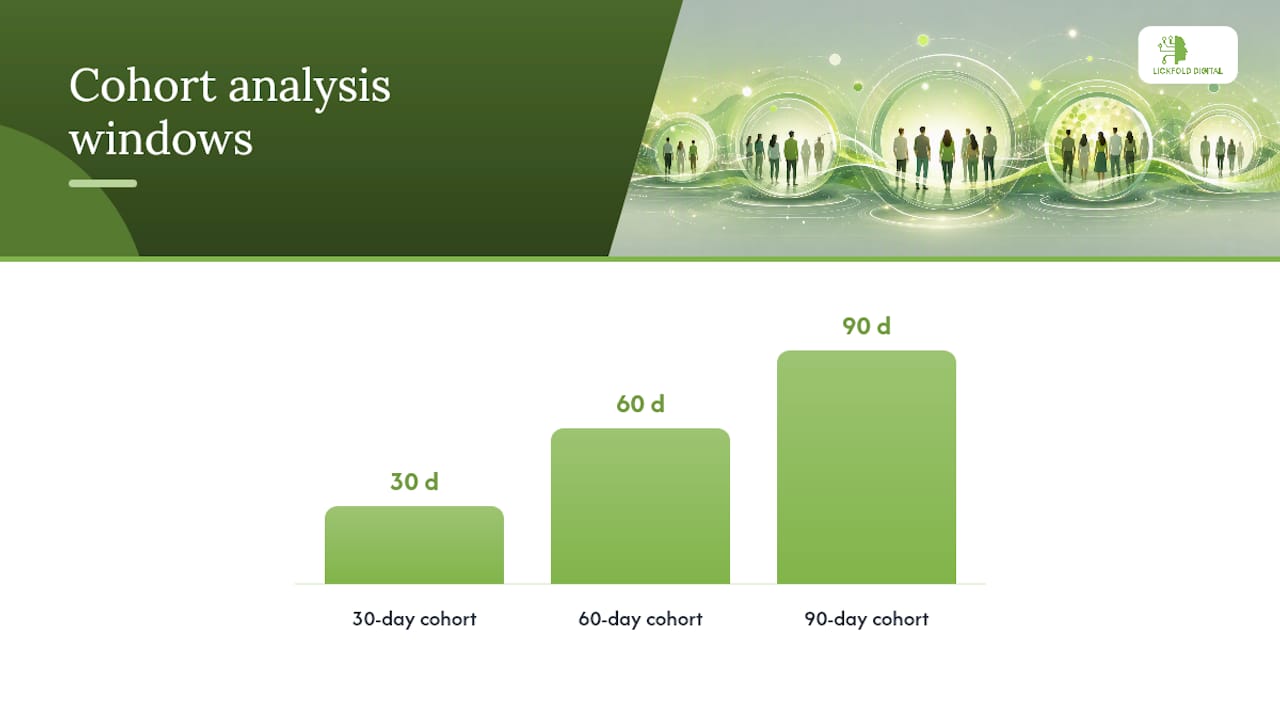
For attribution, cohort analysis is more honest than last-touch. Group users by when they first received a personalized experience and track their behavior over 30, 60, and 90 days. When presenting lift to stakeholders, show the absolute difference in the primary metric between treatment and control, the confidence interval, and the revenue implication at current volume. Avoid percentage-of-percentage framing, which inflates the apparent impact.
Messaging customization and testing at the message level follows the same logic: isolate one variable per test, measure at the right unit, and document every result regardless of outcome.
What privacy and compliance guardrails apply in the US?
The US privacy framework for personalization is anchored in California’s CCPA/CPRA, with a growing patchwork of state laws (Virginia’s VCDPA, Colorado’s CPA, Connecticut’s CTDPA, and others) that share similar principles. No single federal privacy law governs all personalization today, but the direction of travel is clear: first-party data with explicit consent is the durable foundation.
Privacy-safe personalization checklist:
- Collect only the data signals your use cases actually require (data minimization)
- Provide clear notice at the point of collection, including what data is used for personalization
- Honor opt-out requests for sale/sharing of personal information under CCPA/CPRA within the required timeframe
- Implement a consent management platform (CMP) that logs consent signals and integrates with your CDP
- Define data retention schedules for each signal type and automate deletion at expiry
- Restrict sensitive attribute usage (health, financial status, precise geolocation) to contexts where the customer has explicitly consented
- Conduct a data protection impact assessment (DPIA) before launching any new AI-driven decisioning model
- Encrypt personal data at rest and in transit; restrict access to profile data by role
CCPA/CPRA gives California consumers the right to know what data is collected, the right to delete it, the right to opt out of its sale or sharing, and the right to correct inaccurate data. For personalization programs, the “sharing” provision is the one most teams miss: passing profile data to an ad platform for targeting can qualify as “sharing” under CPRA even without a monetary transaction.
Ethical red flags to watch:
- Personalization that uses inferred sensitive attributes (race, religion, health status) without explicit consent
- Frequency and cadence that feels surveillance-like to customers (iCrossing notes that excessive or poorly timed personalization can feel unnerving and erode trust)
- Opaque automated decisions with no human review path for consequential outcomes
- Targeting minors with behavioral personalization
What are the most common mistakes teams make?
Data silos. The single biggest implementation killer. Teams build personalization logic on top of channel-specific data (email engagement data that never syncs to the CRM, web behavior that never reaches the decisioning engine) and wonder why the experience feels disconnected. Fix: make CDP integration a prerequisite, not a Phase 2 item.
Chasing perfect data. Waiting for a complete customer view before launching anything. The data will never be complete. Start with the signals you have and add sources iteratively.
Over-personalization. Showing a customer that you know exactly where they were, what they read, and what they almost bought can cross from helpful to unsettling. Define a “sweet spot” for depth and frequency before automating broadly.
Governance gaps. No documented owner for the decisioning logic, no review process for new targeting attributes, no sunset criteria for underperforming models. These gaps compound over time.
Measuring correlation instead of causation. Reporting that “personalized users convert at 3x the rate” without a holdout group proves nothing. Personalized users are self-selected for engagement.
Five best-practice rules:
- Start small and measure. One use case, one metric, one owner. Prove lift before expanding.
- Prioritize first-party signals. Behavioral and transactional data you collected directly is more accurate, more durable, and more privacy-compliant than third-party data.
- Build the content library before the decisioning engine. A sophisticated model with three content variants produces mediocre results. Invest in modular content production early.
- Document every experiment. Win or lose, a documented result is institutional knowledge. Teams that skip this repeat the same tests.
- Set frequency caps in the decisioning layer. Not in each channel tool separately. A customer who receives five personalized touchpoints in one day across email, push, and onsite has not been well-served.
Stop signs:
- Do not launch AI decisioning before your identity graph resolves at least 70% of your known audience
- Do not use inferred sensitive attributes without legal review
- Do not call a test complete before it reaches statistical significance
What does personalization at scale look like across channels?
AI-driven email personalization
The signals: purchase history, email engagement recency, product category affinity, and lifecycle stage. The decisioning: a propensity model scores each contact for the next best product category, a send-time optimization model selects the delivery window, and a generative layer produces subject line variants. Salesforce documents how AI enables both predictive and generative personalization for email, producing many tailored variants and optimizing send times at a scale no human team can replicate. The organizational owner is typically the email marketing manager working within a decisioning framework owned by the analytics team. For agencies building this capability, the email personalization guide for agencies covers the operational setup in detail.
Onsite product recommendations
The signals: session behavior (pages viewed, search queries, cart additions), purchase history, and collaborative filtering (what similar users bought). The decisioning: a recommendation model ranks items by predicted conversion probability, filtered by inventory and margin rules. The content layer swaps the recommendation widget dynamically on product detail pages, category pages, and the cart. The owner is typically a product manager or growth engineer, with analytics owning the experiment design.
B2B outbound personalization
The signals: firmographic data (industry, company size, tech stack), intent data (content consumption on third-party review sites), and CRM history (prior touches, deal stage). The decisioning: an AI agent matches each prospect to a message variant based on their role, industry pain point, and engagement history. Multi-touch sequences vary the channel (email, LinkedIn, phone) and the message angle across touches. Personalization in B2B outreach consistently outperforms generic sequences on reply rate and meeting conversion. The owner is the sales development team, with marketing ops owning the data feeds and sequence logic.
A practical B2B outbound example: operationalizing personalization
Here is how a B2B team operationalizes data-driven personalization for outbound, step by step.
- Define the ideal customer profile (ICP). Firmographic filters: industry, headcount range, revenue band, geography, and technology stack signals from tools like BuiltWith or Clearbit.
- Build the prospect list. AI agents query databases and LinkedIn to identify decision-makers matching the ICP, resolving contacts to verified email addresses and LinkedIn profiles.
- Enrich with intent signals. Layer in third-party intent data (topics the company is researching) and first-party signals (prior website visits, content downloads) to prioritize the warmest accounts.
- Segment by message variant. Group prospects by role (economic buyer vs. technical evaluator) and pain point (cost reduction vs. speed to market). Each segment gets a distinct message angle, not just a name swap.
- Set up dedicated email infrastructure. Warm-up accounts on dedicated domains, separate from the primary domain, to protect sender reputation. Monitor deliverability metrics (bounce rate, spam complaint rate) daily.
- Execute multi-touch sequences. Touch 1: personalized cold email referencing a specific company signal. Touch 2: LinkedIn connection request with a brief note. Touch 3: follow-up email with a relevant case reference. Touch 4: phone or voicemail. Cadence: 3–5 business days between touches.
- Human-qualify replies. Before passing a response to the sales team, a human reviewer confirms intent and enriches the CRM record with context from the reply.
- Measure and iterate. Track reply rate, positive reply rate, and meeting booked rate by segment and message variant. Kill underperforming variants after 50 sends; promote winners to the default sequence.
Infrastructure checklist:
- Dedicated sending domains, warmed over 4–6 weeks before full volume
- SPF, DKIM, and DMARC records configured on all sending domains
- Bounce and complaint monitoring with automatic suppression
- CRM integration for two-way sync of contact status and reply data
- Human review queue for all replies before CRM handoff
Realistic outcome benchmarks for a well-executed program: reply rates in the 3–8% range and positive reply rates (interested or requesting a meeting) in the 1–3% range, depending on ICP quality, message relevance, and list freshness. These are expectations, not guarantees, and vary significantly by industry and offer.
What actually separates programs that work from those that stall
Most personalization programs that fail do not fail on technology. They fail on prioritization and patience.
The teams that get real results pick one use case, instrument it properly, run it long enough to get a clean signal, and then document what they learned before moving to the next one. That sounds obvious. In practice, most teams launch three use cases simultaneously, measure them inconsistently, and declare the program a success or failure based on a 30-day snapshot that proves nothing.
The other pattern worth naming: organizations that treat personalization as a marketing project rather than a cross-functional program. When data engineering is not in the room from day one, the CDP integration gets deprioritized. When legal is not involved until launch, the consent flow gets redesigned at the worst possible moment. The operating model described earlier is not bureaucracy. It is the difference between a program that compounds over time and one that resets every 18 months when a new CMO arrives.
The AI content personalization tips that actually move the needle are almost always about signal quality and message relevance, not about the sophistication of the model. A well-structured first-party data foundation with a simple rules-based decisioning engine will outperform a complex AI model running on stale or incomplete data.
Lickfold builds the outbound personalization infrastructure for you
Most B2B teams understand the playbook above. The gap is execution capacity: building the data infrastructure, warming the sending domains, writing and testing message variants, and qualifying replies takes a team that most organizations do not have in-house.
Lickfold deploys dedicated AI agents that handle the full outbound personalization stack: ICP definition, decision-maker identification, multi-touch sequence execution, email infrastructure setup and reputation management, and human qualification of every reply before it reaches your sales team. The result is a predictable pipeline of qualified meetings without the overhead of building and managing an SDR team from scratch. If you are ready to run a personalized outbound program at scale, reach out to Lickfold to discuss your ICP and get a program scoped.
Sources
- Personalization at scale: First steps in a profitable journey to growth
- Personalization At Scale: Five-Step Guide
- Personalization at Scale: A Complete Guide | Braze
- AI-Powered Email Personalization Solution | Salesforce
- Scalable customization design (Microsoft Docs)
- Personalization At Scale: Bring Forth The Customer And Business Benefits (Adobe PDF)
- Everything you need to know about personalization at scale