
Cut Blended CAC: Outbound vs Inbound Cost Data for Marketing & Sales
Cut Blended CAC: Outbound vs Inbound Cost Data for Marketing & Sales
Inbound usually costs less per lead once it matures, but it takes 6 to 12 months or longer to get there. Outbound costs more per lead and per meeting from day one, but it fills your pipeline on a predictable schedule almost immediately. The metric that actually matters is not cost per lead. It’s cost per qualified meeting, and eventually blended customer acquisition cost (CAC), because a cheap lead that never books a call is worthless.
TL;DR:
- Outbound costs per meeting range from $500 to $1,200, while inbound costs can drop to $200 to $800 once channels mature, largely due to organic content.
- Outbound is front-loaded with higher initial expenses, but delivers predictable immediate meetings, whereas inbound is cheaper long-term but slower to scale.
- Tracking cost per qualified meeting provides a more accurate measure of channel efficiency than raw cost per lead, especially since inbound leads often ghost.
- The average inbound cost per lead is around $135, compared to $346 for outbound, with outbound response rates declining as inboxes fill.
- Blended customer acquisition cost, combining inbound and outbound, is the key metric to evaluate overall profitability rather than relying solely on individual channel costs.
Table of Contents
- Outbound vs Inbound Cost: The Benchmark Numbers
- What Inbound Marketing Expenses Actually Buy You
- Breaking Down Outbound Marketing Costs Per Meeting
- Turning Channel Costs Into CAC and Blended CAC
- When to Choose Inbound, Outbound, or Both
- How to Model a 12-Month Inbound and Outbound Budget
- What Actually Lowers Outbound’s Per-Meeting Cost
- Impact on Customer Lifetime Value
- Lead Quality Differences and Conversion Rates
- Scaling Inbound and Outbound: Different Ceilings, Different Traps
- My Take on Blending Inbound and Outbound Spend
- Get Predictable Meetings Without the Outbound Overhead
- Sources
Outbound vs Inbound Cost: The Benchmark Numbers
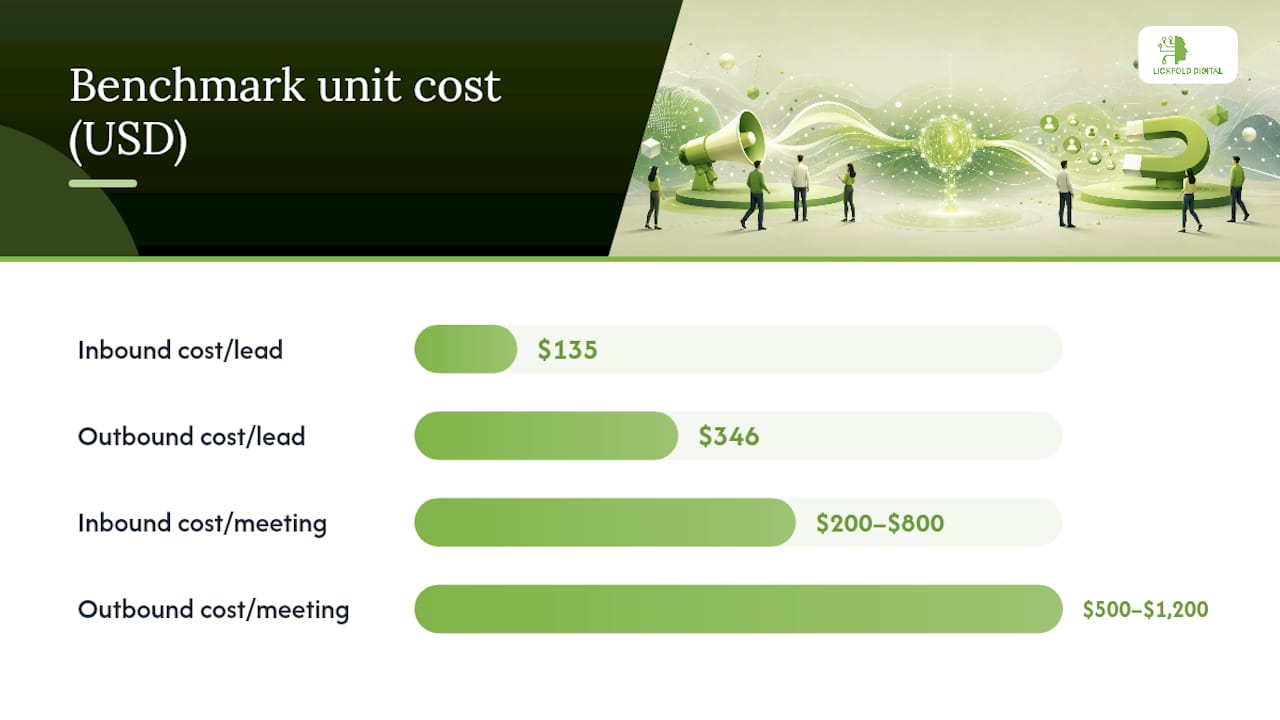
The gap between the two channels is wider than most budget conversations assume. Industry benchmarks compiled across multiple B2B sources put average inbound cost per lead around $135, against roughly $346 for outbound, a gap of more than double.
That spread has been growing, not shrinking. As inboxes fill up and spam filters get more aggressive, cold outreach response rates have kept sliding while inbound’s cost advantage widens, largely because inbound content keeps generating leads long after you’ve stopped paying to produce it.
Cost per meeting tells a similar story, but the numbers shift once you factor in sales capacity. Outbound cost per meeting commonly lands between $500 and $1,200 once you include a fully loaded sales development rep (SDR) salary, tools, and data. Inbound cost per meeting can drop to $200 to $800 once your organic and paid channels have matured.
| Metric | Inbound | Outbound |
|---|---|---|
| Cost per lead | ~$135 | ~$346 |
| Cost per meeting | $200–$800 | $500–$1,200 |
| Time to ROI | 6–12+ months | a few weeks to a few months |
| Scalability | Compounds, slow to scale up | Fast, linear with headcount |
Pro Tip: Don’t compare raw cost per lead across channels. An inbound lead that ghosts after downloading a whitepaper costs more, in practical terms, than an outbound lead that shows up to a call. Tracking cost per qualified meeting instead of cost per lead exposes which channel is actually productive, not just which one is cheap on paper.
The takeaway from these ranges: outbound is expensive but front loaded, inbound is cheaper but back loaded. Neither number tells you which one is “right.” That depends on how your budget, ACV, and sales cycle interact, which the next sections break down.
What Inbound Marketing Expenses Actually Buy You
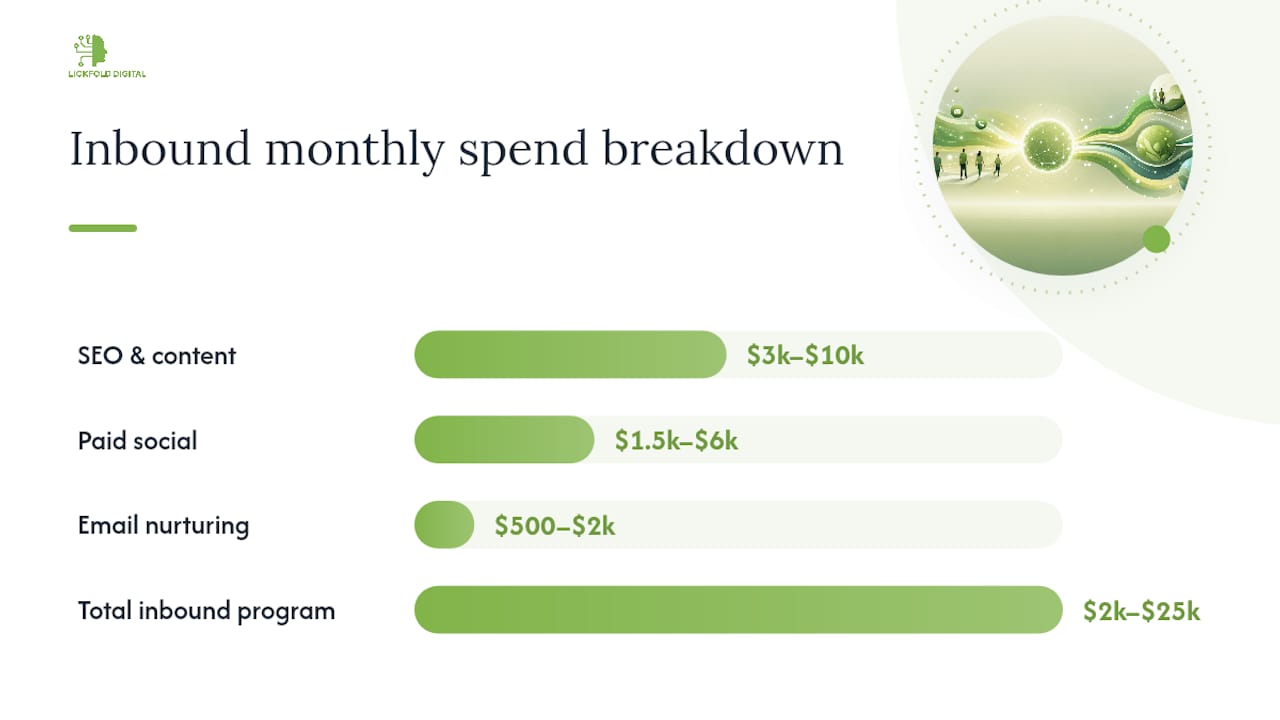
Inbound marketing expenses split across a handful of recurring line items: content production, SEO, paid search, paid social, and email nurturing. For a small or mid-sized B2B company, total inbound program budgets commonly fall between $2,000 and $25,000 per month, depending on company size and how aggressive the content calendar is.
Here’s roughly where that money goes for a mid-market B2B team:
- SEO and content production: $3,000 to $10,000/month for writing, editing, technical SEO, and link building.
- Paid search (PPC): $50 to $200 per lead for B2B SaaS, scaling directly with spend.
- Paid social: Usually $1,500 to $6,000/month, with lead costs that vary heavily by platform and targeting precision.
- Email nurturing and marketing automation tools: $500 to $2,000/month, mostly fixed regardless of volume.
The part that makes inbound different from every paid channel is compounding. A blog post published in month one can still be generating leads in month eighteen at zero incremental cost. That’s why inbound’s marginal cost per lead tends to fall sharply after 6 to 12 months as older content keeps ranking and converting while you’re not paying for it anymore.
Paid search behaves the opposite way. It delivers leads immediately, but the cost stays flat or rises as competition for keywords increases. Organic SEO is slower to start, sometimes taking a full quarter before it produces a meaningful lead volume, but its per-lead cost keeps dropping as the content library grows.
Here’s a simplified way to turn monthly channel spend into a real number you can act on:
Cost per lead = Total channel spend ÷ Leads generated Cost per meeting = Cost per lead ÷ Lead-to-meeting conversion rate
Say you spend $8,000/month across SEO and paid search, generating 100 leads, of which 15 convert to booked meetings. That’s $80 cost per lead and roughly $533 cost per meeting, a number that should fall as your content library matures and your landing pages improve. Run this calculation monthly, not quarterly. It’s the fastest way to catch a channel that’s quietly getting more expensive.
Breaking Down Outbound Marketing Costs Per Meeting
Outbound marketing costs concentrate in three buckets: people, tools and data, and management overhead. Unlike inbound, almost none of it compounds. Every meeting you book next month costs roughly the same as the one you booked this month, which is exactly why outbound is predictable but rarely gets cheaper on its own.
A fully loaded SDR, including salary, benefits, and management overhead, typically runs $70,000 to $110,000 per year depending on market and seniority. A productive rep books somewhere between 10 and 25 qualified meetings per month once ramped, which puts implied cost per meeting anywhere from $300 to $900 before you even add tooling.
Tools and data stack on top of that. Sequencing platforms, data enrichment providers, LinkedIn Sales Navigator, and dialers commonly add $400 to $800 per month per rep before productivity even enters the equation. That overhead is why fully loaded outbound cost per meeting lands in the $500 to $1,200 range for most B2B teams, and it climbs fast if deliverability or targeting is off.
A few levers move that number more than anything else:
- Tighter ideal customer profile (ICP) targeting cuts wasted sends and raises reply rates, which lowers cost per meeting directly.
- Deliverability infrastructure (warmed domains, proper sender reputation) determines whether your messages land in an inbox or a spam folder before anything else matters.
- Human qualification of replies prevents reps from wasting call time on unqualified leads that inflate your effective cost per meeting.
- Faster follow-up cadence on inbound-to-outbound handoffs improves conversion without adding spend.
The complete guide to outbound workflow design covers how these pieces fit together operationally, which matters more than any single tool choice.
None of this means outbound is inefficient by default. It means outbound’s efficiency is almost entirely a function of execution quality, not channel choice, which is different from inbound, where efficiency mostly comes from patience and content volume.
Turning Channel Costs Into CAC and Blended CAC
Cost per lead and cost per meeting are useful diagnostics, but the number that determines whether either channel is actually working is CAC, and eventually blended CAC once you’re running both.
Here’s how the core metrics break down:
- Customer acquisition cost (CAC) = Total sales and marketing spend on a channel ÷ Customers closed from that channel.
- Cost per qualified meeting = Channel spend ÷ Number of meetings that met your qualification bar (not just booked calls).
- Blended CAC = Total combined inbound and outbound spend ÷ Total customers closed across both channels.
- LTV:CAC ratio = Customer lifetime value ÷ CAC, with 3:1 widely treated as a healthy floor.
The channel that wins depends heavily on average contract value (ACV). A company selling a $3,000/year product cannot sustain a $900 outbound cost per meeting if close rates are modest. The math simply doesn’t clear a reasonable LTV:CAC ratio. That business needs inbound’s lower cost per meeting, even if it means waiting longer for volume.
A company selling a $40,000/year contract can absorb a $900 cost per meeting without blinking, because even a mediocre close rate produces a CAC that’s a small fraction of the deal’s lifetime value. That’s why enterprise and mid-market B2B software leans outbound so heavily. The high ACV makes even outbound’s higher cost per meeting affordable relative to what each closed deal is worth. For a deeper walkthrough of how these formulas apply to specific deal sizes, the guide to sales acquisition cost works through the math in more detail.
If you report only one number monthly to leadership, make it blended CAC against LTV:CAC. It’s the only metric that captures whether your entire acquisition motion, inbound and outbound combined, is actually profitable rather than just busy.
When to Choose Inbound, Outbound, or Both
Urgency decides more of this than most budgeting spreadsheets admit. If you need pipeline this quarter, inbound cannot deliver on that timeline no matter how much you spend, because content and SEO need months to rank and convert. Outbound can produce booked meetings within 30 to 60 days of launch.
ACV and sales cycle complexity matter just as much:
- Low ACV, short sales cycle: Inbound wins on unit economics almost every time. Outbound’s per-meeting cost is too high to justify against a small contract.
- High ACV, complex sales cycle: Outbound is often the only channel fast enough to reach the specific decision makers a long, considered sale requires.
- Uncertain runway or new market entry: Start outbound first to generate signal and revenue fast, then layer inbound in behind it for months one through twelve as content matures.
A common sequencing pattern looks like this: run outbound hard for the first 90 days to generate immediate pipeline and market feedback, while simultaneously building the content and SEO foundation that won’t pay off until month six or later. By month twelve, inbound should be carrying a growing share of total leads, lowering blended CAC even as outbound continues delivering the fast, predictable meetings inbound alone can’t guarantee.
Watch for two traps that quietly inflate CAC on either side: slow follow-up on inbound leads (a lead that waits 24 hours for a reply converts far worse than one contacted within the hour), and measuring raw lead volume instead of qualified meetings on outbound, which hides a targeting problem behind a vanity number.
How to Model a 12-Month Inbound and Outbound Budget
Building a defensible budget model takes less time than most teams assume, but it needs the right inputs in the right order.
- Set the target: number of qualified meetings or closed customers needed per quarter.
- Gather channel inputs: current or estimated cost per lead for each channel, plus lead-to-meeting and meeting-to-close conversion rates.
- Apply ramp assumptions: outbound reaches full productivity in 60 to 90 days; inbound reaches meaningful volume in 6 to 12 months.
- Forecast monthly output: multiply projected spend by expected conversion rates to get monthly meetings and closed deals per channel.
- Set reallocation triggers: if outbound cost per meeting exceeds your ceiling for two consecutive months, shift budget toward inbound content, and vice versa.
Pro Tip: Build the model in a spreadsheet with one tab per channel and a summary tab that calculates blended CAC automatically. Reviewing that summary tab monthly, rather than quarterly, catches cost creep before it becomes a budget crisis. The guide to lowering B2B lead costs has additional tactics worth folding into the reallocation rules.
What Actually Lowers Outbound’s Per-Meeting Cost
Outbound gets expensive fast when execution is sloppy, and cheap relative to outbound benchmarks when it isn’t. The difference usually comes down to a handful of operational choices rather than raw budget.
- AI-assisted ICP targeting and research narrows outreach to accounts that actually match a buyer profile, which raises reply rates and lowers cost per meeting without adding spend.
- Dedicated warm-up infrastructure for sending domains keeps deliverability high, since a message that lands in spam costs the same to send but produces zero return.
- Ongoing reputation management prevents the slow decay in deliverability that quietly erodes outbound performance over months.
- Human qualification of replies before handoff to sales stops reps from spending time on meetings that were never going to close.
These levers are why some AI-driven outbound systems, including the workflow Lickfold Digital runs for clients, can push per-meeting costs toward the lower end of typical outbound benchmarks rather than the higher end.
Impact on Customer Lifetime Value
The channel a customer comes from can shape how long they stick around, though the effect is often smaller than the acquisition cost gap suggests. Inbound customers frequently arrive with more self-education already done. They found your content, read your comparison pages, and decided you fit before a rep ever spoke with them, which tends to produce smoother onboarding and modestly better retention.
Outbound customers can convert just as well long term, but the sales process did more of the convincing work upfront. That means the qualification step matters more. A well-qualified outbound meeting, where a rep confirmed real budget, timeline, and fit before booking, tends to produce a customer whose lifetime value looks a lot like an inbound customer’s. A poorly qualified one, booked just to hit an activity quota, often churns faster and drags down blended LTV.
The practical implication for budgeting: don’t treat CLV as fixed by channel. Treat it as a function of qualification quality within each channel. An outbound program with weak filtering can produce cheap meetings and expensive churn, which erases whatever CAC advantage the channel appeared to have. Track LTV by channel for at least two full sales cycles before drawing conclusions, since first-quarter numbers rarely reflect steady-state retention.
Lead Quality Differences and Conversion Rates
Inbound leads self-select. Someone who filled out a demo request after reading three blog posts has already decided your category matters to them, which usually shows up as a higher close rate once a meeting happens. Outbound leads haven’t gone through that filtering. A rep is reaching out cold, which means the prospect may not know they have the problem your product solves yet.
That difference shows up most clearly at the meeting stage, not the lead stage. Raw outbound lead volume can look enormous next to inbound, but a much smaller share of those leads ever convert to a genuinely qualified conversation. This is exactly why cost per qualified meeting, not cost per lead, is the number worth reporting: it strips out the volume noise and isolates what each channel is actually delivering.
Sales cycle length often reflects this gap too. Inbound-sourced deals frequently close faster once a meeting is booked, because less education is needed mid-cycle. Outbound deals can take longer to close even after a strong first meeting, since the buyer is still working through whether the problem is urgent enough to solve now. Neither pattern is universal, but both are common enough that sales teams should track close rate and cycle length by source separately, not just conversion rate as a single blended number.
Scaling Inbound and Outbound: Different Ceilings, Different Traps
Outbound scales almost linearly with headcount and budget. Add another rep with proper ramp time and tooling, and you get a roughly proportional increase in meetings, at roughly the same cost per meeting, assuming your ICP and messaging hold up at volume. The ceiling on outbound scaling is usually market size and deliverability infrastructure, not budget. Send too aggressively without proper domain warm-up and reputation management, and your entire sending infrastructure can degrade, raising cost per meeting across every rep at once.
Inbound scales differently and less predictably. Doubling content output doesn’t double lead volume on any fixed timeline. It compounds slowly, and the ceiling is often organic search competition rather than internal capacity. The upside is that inbound’s marginal cost keeps falling as the content library grows, so a mature inbound program can eventually produce leads at a cost outbound structurally cannot match at any volume.
Outbound cost per meeting tends to rise if you scale reps faster than you can train and qualify them properly. Inbound cost per meeting can rise too, if you chase harder keywords than your domain authority supports. Model both scenarios before committing to an aggressive scale up on either channel.
My Take on Blending Inbound and Outbound Spend
Most companies treat this as a philosophical choice when it’s really a runway calculation. If you need meetings this quarter, run outbound hard for 90 days while your inbound foundation gets built in parallel, then let inbound take over a growing share of volume across the following year. Report cost per qualified meeting and blended CAC monthly, not cost per lead. Cost per lead flatters whichever channel produces more junk, and that’s exactly the number that gets budgets misallocated.
— Duarte
Get Predictable Meetings Without the Outbound Overhead
If the cost math above made outbound’s people and tooling overhead look heavy, that’s the actual friction most B2B teams hit once they try to scale it. Some AI-driven outbound systems run AI-driven prospecting and outbound automation designed to cut through exactly that friction: precise decision-maker targeting, warmed and reputation-managed sending infrastructure, and human-qualified replies before anything reaches sales teams. The outcome is fewer wasted sends and a lower cost per qualified meeting, without hiring and training an SDR team from scratch.
If you’re weighing whether to build outbound in house or automate it, book a free session to walk through your ACV, sales cycle, and current cost per meeting, and see where automated outbound would land on the benchmarks above.
Sources
- Inbound vs. Outbound Marketing: A Guide
- Inbound vs outbound: Sales, marketing & leads compared 2026 - Dashly blog
- Outbound vs Inbound Sales: Data-Backed Comparison | CRO Report
- How Much Does Inbound Marketing Cost? Budgets by Channel - LegalClarity
- Inbound vs Outbound Sales: 62% Cost Difference, 2x Conversions, & How To Get The Best Of Both