
Meeting Booking Automation That Fills Your B2B Pipeline
Meeting Booking Automation That Fills Your B2B Pipeline
Meeting booking automation, in the context of this guide, means an AI-driven outbound system that identifies target decision-makers, runs personalized multi-touch outreach, and schedules qualified sales meetings directly on your calendar. Not a scheduling page. Not a calendar widget. A full pipeline engine.
The recommended deployment pattern combines three non-negotiable layers:
- AI agents for prospect research, ICP scoring, and message drafting
- Deliverability infrastructure including dedicated sending domains, progressive warm-up, and SPF/DKIM/DMARC authentication
- Human approval gates before messages go out and before positive replies route to your AEs
- CRM and calendar integration for automatic handoff and round-robin scheduling to the right rep
Skip any one of those layers and you are not running a system. You are running a risk.
Key Takeaways
AI-driven meeting booking automation requires deliverability infrastructure, human approval gates, and signal-led targeting to produce consistent, qualified pipeline at scale.
| Point | Details |
|---|---|
| Infrastructure before volume | Warm dedicated domains for 4–6 weeks before scaling sends; skipping this collapses reply rates within 90 days. |
| Human gate is non-negotiable | AI drafts every message; a human approves before it sends and owns every positive reply. |
| Signal-led beats cold lists | Outreach tied to buying signals (funding, job changes) consistently outperforms static list blasts on reply and meeting rates. |
| Seed test before scaling | Run 200–500 prospects first, check domain reputation and reply quality, then scale only when both are stable. |
| Lickfold handles the full stack | Lickfold provides AI agents, deliverability setup, human qualification, and CRM/calendar integration as a managed service. |
Table of Contents
- What does meeting booking automation actually cover?
- How does an AI-driven meeting booking system work?
- Who gets the most value from automated meeting scheduling?
- How to implement a meeting booking program in 6 steps
- What metrics and benchmarks should you track?
- What does meeting booking automation cost, and how do you model ROI?
- Deliverability, compliance, and security for U.S. operations
- What should you ask vendors before buying?
- A real-world example: signal-led outbound for a B2B services firm
- When should you actually invest in this, and when should you wait?
- Lickfold Digital books qualified meetings so your team can close them
- Sources
What does meeting booking automation actually cover?
This guide covers AI-driven outbound meeting booking: the full workflow from signal detection through prospect enrichment, personalized sequence execution, reply classification, and calendar scheduling. It does not cover general appointment-scheduling tools or calendar-sync apps — those solve a different problem for a different audience.
A complete system handles:
- Signal detection (funding rounds, job changes, tech-adoption events)
- Contact enrichment and ICP fit scoring
- AI-drafted, personalized outreach across email channels
- Sequence orchestration with automated follow-ups
- Reply classification (interested, not interested, wrong person, needs info)
- Calendar booking and CRM handoff
Pro Tip: The two structural ceilings that kill outbound programs are inbox placement and buyer trust. Autonomous, high-volume AI SDR models broke on both — deliverability-first infrastructure and human judgment are what survived.
How does an AI-driven meeting booking system work?
The data flow moves through six stages, each with a clear automation-versus-human split.
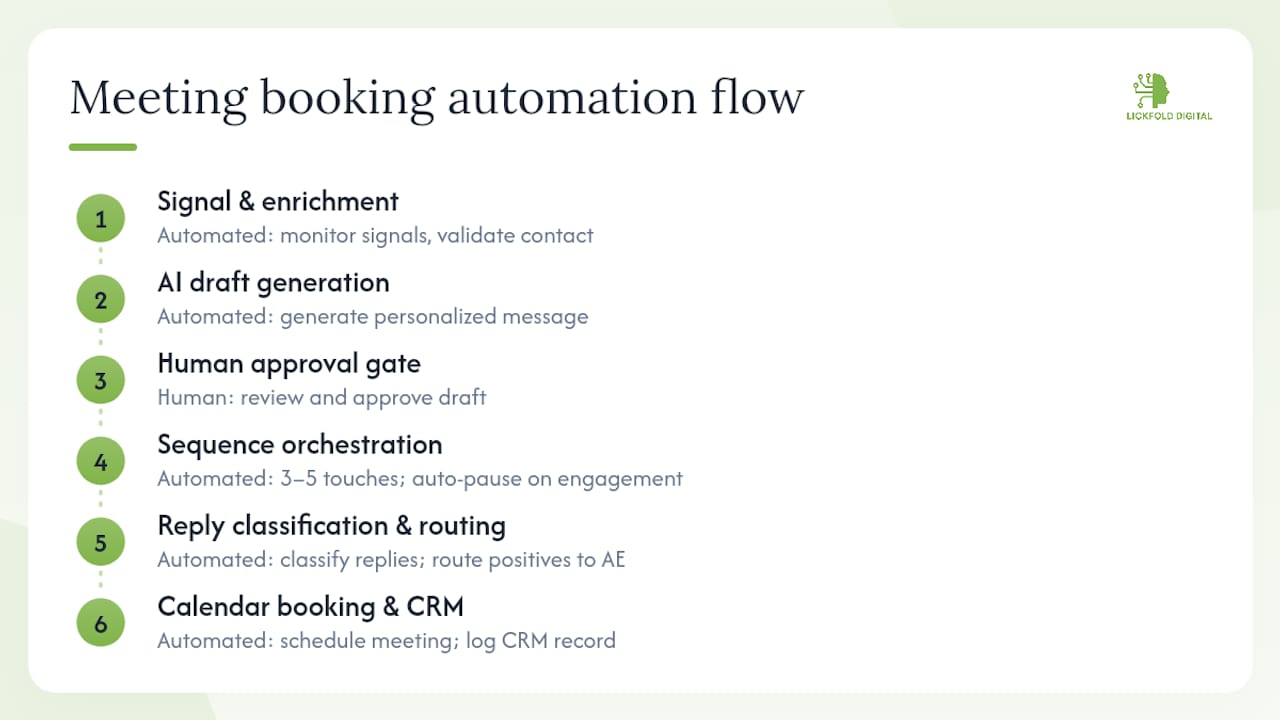
Stage 1: Signal and enrichment. The system monitors sources like LinkedIn, funding databases, and job boards for buying signals. When a trigger fires, it enriches the contact record in real time — verifying email via MX checks, confirming role, and scoring ICP fit. Bad data breaks even the best sequence, so enrichment validation is a precondition, not an afterthought.
Stage 2: AI draft generation. The AI writes a personalized message tied to the specific signal. Not a template with a first-name token. A message that references the trigger — the new VP of Sales hire, the Series B close, the tech stack change.
Stage 3: Human approval gate. A human reviews and approves before anything sends. The pragmatic 2026 standard is AI drafts, human approval — this preserves inbox health and keeps buyer trust intact.
Stage 4: Sequence orchestration. Approved messages enter a 3–5 touch sequence over 2–3 weeks. The system pauses automatically the moment a prospect opens, clicks, or replies — no more automated follow-ups chasing someone who already responded.
Stage 5: Reply classification and routing. Positive replies route to the AE with full context and an embedded calendar link. Speed matters here — first-hour responses materially outperform slower handoffs.
Stage 6: Calendar booking and CRM logging. The meeting lands on the right rep’s calendar via round-robin scheduling or territory rules. The CRM record updates automatically with sequence history, signal context, and reply classification.
Who gets the most value from automated meeting scheduling?
The model fits best when you have a defined ICP, a sales motion that depends on outbound, and at least one human available to own the approval gate and reply follow-through.
Strong fits include:
- SMB growth teams running outbound without a full SDR bench
- Agencies acquiring new clients through targeted outreach to marketing directors, ops leads, or founders
- B2B product vendors booking demos with target accounts after trial signups or intent signals
- Signal-led programs triggering outreach after funding events, leadership changes, or tech-adoption signals
Signal-led outbound consistently outperforms static list blasts, with practitioners reporting substantially higher sales-ready lead counts when outreach is tied to a real buying trigger. For agencies specifically, prospecting automation changes the client acquisition math entirely.
Avoid this model if your team is purely inbound-driven with no capacity to handle outbound replies, you are selling B2C, or your ICP is not yet defined well enough to score prospects reliably.
How to implement a meeting booking program in 6 steps
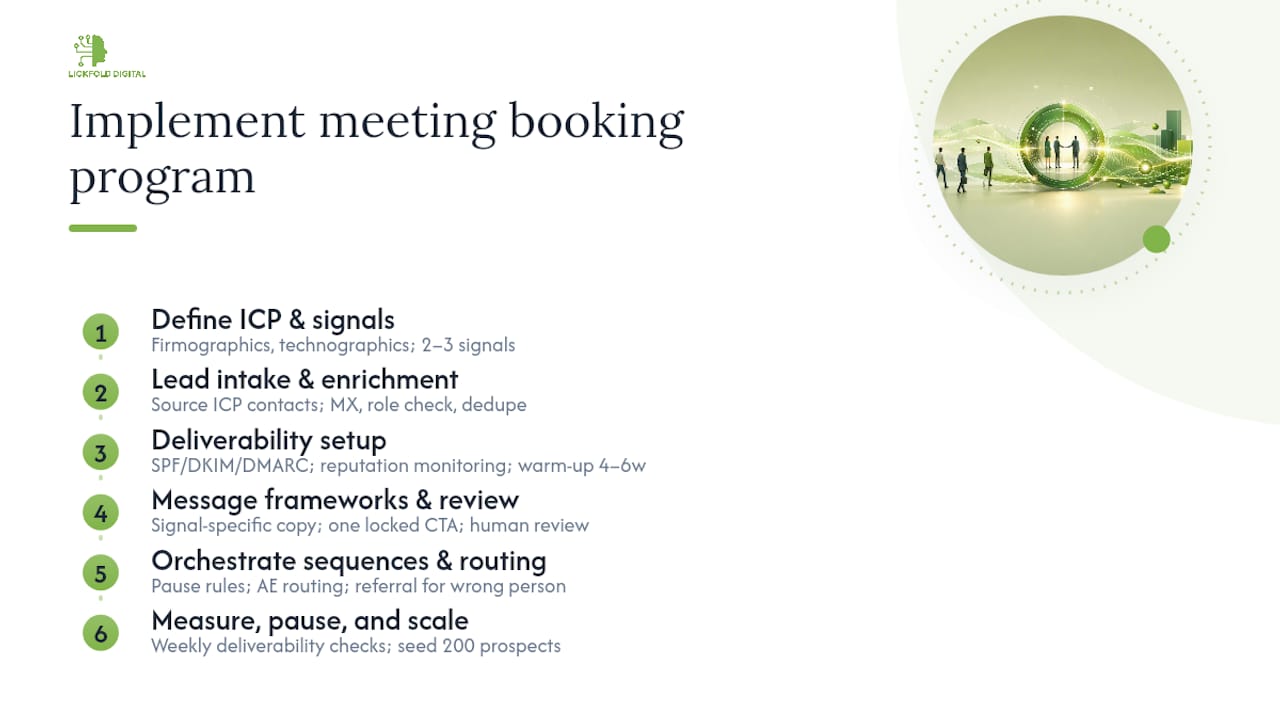
Step 1: Define ICP and signal triggers. Document firmographic and technographic criteria. Identify two or three signal types you will monitor. Set success criteria before you start — meetings booked per 1,000 contacts, reply rate, pipeline conversion.
Step 2: Build lead intake and enrichment pipelines. Source contacts from databases that match your ICP. Run MX verification, role confirmation, and duplicate checks before any contact enters a sequence. Garbage in, garbage out.
Step 3: Set up deliverability infrastructure. Dedicated sending domains (separate from your primary domain), progressive warm-up over 4–6 weeks, SPF/DKIM/DMARC authentication, and a reputation monitoring tool. Fully autonomous deployments that skipped this failed within roughly 90 days as domain reputation collapsed.
Step 4: Build message frameworks and run human review on first sends. Write signal-specific message frameworks with a single, locked CTA — one ask per email. Have a human review every draft in the first 50–200 sends before approving. This is where you catch tone problems and ICP mismatches early.
Step 5: Orchestrate sequences and automate reply classification. Configure pause rules for opens, clicks, and replies. Set routing logic: positive replies go to AE with calendar link, negative replies suppress the contact, wrong-person replies trigger a referral ask.
Step 6: Measure, pause, and scale. Review deliverability health and reply rates weekly. Do not scale volume until domain reputation is stable and reply quality is consistent. A practical automation checklist helps ops teams track each gate before moving to the next phase.
Pro Tip: Run a seed batch of 200 prospects before scaling. Check domain reputation scores, inbox placement rates, and reply quality. If any metric is off, diagnose before adding volume — not after.
What metrics and benchmarks should you track?
Primary KPIs for any automated meeting scheduling program:
| Metric | Definition | Calculation |
|---|---|---|
| Deliverability rate | % of sends reaching inbox | Inbox placements ÷ total sends |
| Reply rate | % of delivered emails that get a reply | Replies ÷ delivered emails |
| Positive reply rate | % of replies showing interest | Positive replies ÷ total replies |
| Meeting conversion rate | % of positive replies that book | Meetings booked ÷ positive replies |
| Meetings per 1,000 contacts | Pipeline throughput measure | Meetings booked ÷ contacts × 1,000 |
Realistic ranges vary by signal quality. Cold static-list outreach typically sits well below those numbers. Teams typically see early lift signals within 2–3 weeks and meaningful pipeline impact over 3–6 months of consistent operation.
What does meeting booking automation cost, and how do you model ROI?
Cost line items to budget:
- Tooling: sequence orchestration, AI drafting, reply classification
- Data and enrichment: contact sourcing, verification credits, signal monitoring
- Deliverability: dedicated domain registration, warm-up tooling, reputation monitoring
- Human reviewer time: approval gate, positive reply follow-through, weekly reporting
- CRM and calendar integration: setup and ongoing maintenance
A simple ROI frame: multiply meetings booked per month by your average close rate and average deal value. Compare that pipeline contribution against total monthly program cost. For most B2B teams with average deal values above $10,000, a program booking even 8–12 qualified meetings per month covers its cost in the first closed deal. AI workflow automation examples show how these integrations reduce manual hours and lower the effective cost per meeting over time.
Deliverability, compliance, and security for U.S. operations
Deliverability is the operational risk most likely to sink your program before it produces results. Young domains sent at high volume accumulate reputation damage that can take months to reverse.
Deliverability controls:
- Dedicated sending domains and mailboxes, never your primary domain
- Progressive warm-up: start at 20–30 sends per day, increase over 4–6 weeks
- Daily sending limits per mailbox (typically 50–100 for warmed domains)
- Weekly inbox placement monitoring via tools like Google Postmaster Tools or MXToolbox
CAN-SPAM compliance (U.S.): Every commercial email must include a physical mailing address, a clear opt-out mechanism, and honor opt-out requests within 10 business days. Subject lines must not be deceptive. Keep records of opt-outs and suppress those contacts permanently.
Security basics: Minimize contact data to what the sequence actually needs. Encrypt API keys and CRM credentials. Test integrations in a sandbox environment before connecting to production systems. Restrict access to enrichment databases to the team members who need it.
What should you ask vendors before buying?
Must-have capabilities:
- Dedicated deliverability infrastructure (not shared IP pools)
- Real-time enrichment with verification (MX checks, role confirmation)
- Native CRM and calendar integrations
- Automated reply classification with routing rules
- Human approval gate built into the workflow, not bolted on
Trust signals to require:
- Documented warm-up and reputation monitoring process
- Case studies with specific outcome metrics
- SLA for data accuracy and bounce rates
- Security certifications or documented access controls
- References from clients in your vertical
Operational questions worth asking: How do they handle domain reputation drops? What triggers an automatic pause? What is their support SLA when deliverability degrades? If a vendor cannot answer those three questions specifically, their infrastructure is probably shared and their process is probably manual.
A real-world example: signal-led outbound for a B2B services firm
A B2B services firm targeting mid-market operations directors set up a signal-led program monitoring job changes and funding events within their ICP. They used dedicated sending domains warmed over five weeks, AI-drafted messages tied to each signal type, and a human approval gate on every draft.
By week 10, the program was booking a consistent volume of qualified meetings per week, with the sales team reporting higher call quality because prospects already had context from the outreach. The key operational shift: AEs stopped spending time on prospecting and started spending it on conversations. The lesson from that rollout was straightforward — the signal specificity in the opening line drove the reply rate more than any other variable.
When should you actually invest in this, and when should you wait?
The teams that get the most from automated meeting booking are not the ones with the biggest budgets. They are the ones with the clearest ICP, a human who owns the approval gate, and a CRM that is clean enough to route leads without manual cleanup.
Three decision rules before committing:
- Data readiness: Can you source 500 verified contacts matching your ICP within two weeks? If not, fix the data problem first.
- ICP clarity: Can you write a two-sentence description of your ideal buyer that your whole team agrees on? Vague ICPs produce vague sequences and low reply rates.
- Human capacity: Do you have someone who can review drafts daily and respond to positive replies within an hour? Automation handles the mechanical work. Judgment still requires a person.
Automation supports scale. It does not replace the sales instinct that knows when a prospect is actually ready versus just politely curious. The case for automating B2B prospecting is strong — but only when the human layer is genuinely in place, not just assumed.
Lickfold Digital books qualified meetings so your team can close them
Most B2B teams that try to build this in-house spend the first three months on infrastructure problems — domain warm-up, enrichment pipelines, CRM routing — before they send a single sequence. Lickfold skips that ramp entirely.
Lickfold deploys dedicated AI agents that handle prospect research, decision-maker mapping, personalized multi-touch outreach, and deliverability infrastructure from day one. Human qualification of every positive reply happens before anything reaches your sales team. CRM and calendar integration means booked meetings land in the right rep’s queue automatically, with full context attached.
The best-fit buyer is a B2B team with a defined ICP, an outbound motion, and a sales team that needs qualified meetings, not more prospecting tasks. If that describes your situation, book a free session and see what a fully operational outbound system looks like for your specific market.
Sources
- Why AI SDRs Are Failing in 2026 (And What Actually Works): An Operator Analysis
- Why AI SDRs Fail: The 3-Month Churn Problem
- Signal-Led Outbound: 5 Steps From Buying … | PlusClouds Blog
- AI for Outbound Lead Generation: B2B