
Lead Nurturing Strategies List for B2B Sales Teams
Lead Nurturing Strategies List for B2B Sales Teams
The most effective lead nurturing strategies are behavioral-triggered email sequences, multi-threaded buying-committee engagement, role-based content paths, AI-assisted qualification, predictive lead scoring with documented SLAs, and re-engagement tracks for cold pipeline. Forrester’s benchmark shows companies that excel at nurturing generate 50% more sales-ready leads at 33% lower cost. That gap is wide enough to determine whether a sales team hits quota.
Pick your first tactic by multiplying impact by ease of implementation. Behavioral triggers on existing email traffic score highest on both axes. Multi-threaded committee outreach scores highest on impact but requires more setup. Start with triggers, then layer in committee paths once scoring is live.
- Behavioral-triggered sequences — highest ROI, lowest ramp time
- Multi-threaded committee engagement — highest pipeline impact for enterprise deals
- Role-based content paths — accelerates decisions when IT, finance, and ops each get relevant material
- AI-assisted qualification — cuts sales time wasted on unready leads
- Predictive lead scoring + SLA — aligns marketing and sales on a shared definition of “ready”
- Re-engagement tracks — recovers pipeline that would otherwise be written off
- Intent-based retargeting — keeps your brand visible between email touches
Table of Contents
- 1. The complete lead nurturing strategies list
- How to turn individual tactics into automated workflows
- Which content types and channels work at each buyer journey stage
- How to segment, score, and personalize at scale
- Align marketing and sales: define handoff signals and SLAs
- KPIs, reporting cadences, and how to optimize nurturing programs
- Practical templates: email copy, cadences, and subject lines you can copy
- Common mistakes, deliverability traps, and best-practice guardrails
- How AI-driven agents change lead nurturing
- Key Takeaways
- The lesson most nurture programs learn too late
- Lickfold builds the pipeline your nurture program needs to work
- Useful sources and further reading
1. The complete lead nurturing strategies list
The four core tactical categories practitioners return to consistently are email sequences, behavioral triggers, personalized role-based content, and timely sales follow-up or AI handoff. The 14 strategies below build on that foundation.
1. Behavioral-triggered email sequences
Why it works: A prospect who downloads a pricing page or watches a demo video has signaled intent. Responding to that signal within minutes beats any scheduled drip. Behavioral triggers and automated lead scoring are what let sales see only genuinely ready leads.
When to use it: Any segment with trackable web or email activity.
Implementation:
- Tag key intent events in your CRM or marketing automation platform (page visits, content downloads, email clicks).
- Build a trigger rule: event fires → contact enters sequence → first email sends within 15 minutes.
- Set a scoring increment per event; cap the sequence at 3 touches before routing to sales review.
KPI: MQL-to-SQL conversion rate. Effort: Quick win.
2. Multi-threaded buying-committee engagement
Why it works: B2B buying is decentralized. Focusing on one contact means the deal dies when that person goes quiet. Engaging multiple stakeholders simultaneously keeps momentum alive.
When to use it: Enterprise accounts with higher deal values or longer sales cycles.
Implementation:
- Map the buying committee: economic buyer, technical evaluator, end user, and procurement.
- Assign a separate content path to each role (see Strategy 6 for role-specific hooks).
- Track engagement per contact, not per account, so you can spot the champion and the blocker.
KPI: Number of engaged contacts per account. Effort: Medium.
3. Progressive profiling
Why it works: Asking for 12 fields on a first form kills conversions. Progressive profiling collects one or two new data points per subsequent interaction, building a complete picture without friction.
When to use it: Any gated content program where you already have basic contact data.
Implementation:
- Set your marketing automation tool to suppress fields already collected.
- Prioritize fields by sales value: company size, budget authority, timeline.
- Use the enriched data to trigger a more specific follow-up sequence.
KPI: Form completion rate and data completeness score. Effort: Quick win.
4. Predictive lead scoring
Why it works: Manual scoring decays fast. Predictive models trained on closed-won data weight signals automatically and surface the leads most likely to convert.
When to use it: When you have at least 200 closed deals in your CRM to train a model.
Implementation:
- Export closed-won and closed-lost contacts; identify the top 10 behavioral and firmographic signals that separate them.
- Build a scoring model in your platform (HubSpot, Salesforce, or Marketo all support this natively).
- Set a threshold score that triggers a sales-ready alert and a 24-hour SLA.
KPI: Score accuracy (% of sales-alerted leads that convert to opportunity). Effort: Medium.
5. Role-based content paths
Why it works: Technical specs accelerate IT evaluators; ROI and risk data move CFOs. Generic content serves neither. Role-specific paths cut time-to-decision because each stakeholder gets exactly the evidence they need.
When to use it: Complex B2B sales with multiple evaluators.
Implementation:
- Create three content variants per funnel stage: technical, financial, and operational.
- Route contacts to the right variant based on job title or declared role.
- Track which variant drives the most demo requests and double down on it.
KPI: Demo conversion rate by role. Effort: Medium.
6. Multi-channel orchestration
Why it works: Email, social, chat, retargeting, and phone together reach buying-committee members who ignore any single channel. Coordinated sequences reduce single-channel drop-off.
When to use it: Mid-market and enterprise accounts; any segment where email open rates fall below 20%.
Implementation:
- Map a 5-touch sequence: email → LinkedIn connection → retargeting ad → email → phone or direct message.
- Suppress contacts from ads once they book a meeting to avoid wasted spend.
- Use UTM parameters to attribute pipeline to each channel.
KPI: Pipeline influenced per channel. Effort: High.
7. Intent-based retargeting
Why it works: A prospect who visited your pricing page but did not convert is still in the market. Retargeting ads keep your brand present between email touches without requiring a new outreach action.
When to use it: Any account with website traffic above 500 monthly unique visitors.
Implementation:
- Build pixel-based audiences segmented by page visited (pricing, case studies, product).
- Serve ads with content that matches the page intent (pricing visitors see ROI proof; case-study visitors see a demo invite).
- Set a frequency cap of 5 impressions per week to avoid fatigue.
KPI: Retargeting click-to-demo rate. Effort: Quick win.
8. Re-engagement campaigns
Why it works: Leads that go quiet are not dead. Building re-engagement tracks for dormant contacts often recovers otherwise-lost pipeline at a fraction of the cost of new acquisition.
When to use it: Contacts with no engagement in 60–90 days who have not been disqualified.
Implementation:
- Define “dormant”: no email open, click, or web visit in 60 days.
- Send a 3-touch re-engagement sequence: a pattern-interrupt subject line, a new asset, and a direct “still interested?” ask.
- Move non-responders to a suppression list to protect sender reputation.
KPI: Re-engagement rate (dormant contacts returning to active status). Effort: Quick win.
9. AI-assisted qualification
Why it works: AI-driven agents perform human-level qualification of conversational replies before handing prospects to sales, cutting the “spray and pray” waste that burns rep time.
When to use it: High-volume outbound programs where reps cannot review every reply manually.
Implementation:
- Deploy an AI agent to read and categorize inbound replies (interested, objection, not now, wrong contact).
- Set escalation rules: “interested” replies route to a human within 4 hours; objections trigger an automated rebuttal sequence.
- Log every classification for weekly accuracy review.
KPI: Qualification accuracy rate and time-to-first-human-response. Effort: Medium.
10. Account-based nurturing
Why it works: ABM flips the funnel. Instead of waiting for inbound signals, you select target accounts and orchestrate outreach to every stakeholder simultaneously.
When to use it: When your ICP is narrow (fewer than 500 target accounts) and deal value justifies high-touch investment.
Implementation:
- Build a tiered account list: Tier 1 (fully orchestrated), Tier 2 (semi-automated), Tier 3 (programmatic only).
- Assign a named rep to each Tier 1 account and build a custom sequence for that account’s specific pain points.
- Review account engagement scores weekly and promote Tier 2 accounts showing intent signals.
KPI: Account engagement score and pipeline created per account tier. Effort: High.
11. Demo and case-study drip
Why it works: Social proof at the decision stage removes the last objection. A timed drip of relevant case studies, followed by a direct demo invite, converts consideration-stage leads faster than any single email.
When to use it: Leads who have engaged with at least two mid-funnel assets but have not requested a demo.
Implementation:
- Identify three case studies that match the prospect’s industry or use case.
- Send one per week over three weeks, each with a low-friction CTA (“See how they did it” rather than “Book a demo”).
- On day 22, send a direct demo invite referencing the case studies they opened.
KPI: Case-study-to-demo conversion rate. Effort: Quick win.
12. SMS and phone for high-intent segments
Why it works: SMS open rates far exceed email for time-sensitive messages. A well-timed text after a pricing page visit can trigger a same-day conversation.
When to use it: High-intent segments only (score above threshold, pricing page visit, or trial signup). Comply with TCPA requirements for U.S. contacts.
Implementation:
- Collect explicit SMS consent at the form level.
- Limit SMS to 1–2 messages per sequence; use them as a pattern interrupt after email touches 2 and 4.
- Always include an opt-out instruction in every message.
KPI: SMS reply rate and meetings booked per SMS touch. Effort: Medium.
How to turn individual tactics into automated workflows
A tactic sitting in a slide deck does nothing. The workflow blueprint that makes it run looks like this: trigger → content path → scoring update → handoff.
Start by mapping every touchpoint before you build anything. List the trigger event, the content asset, the channel, the timing, and the scoring increment. That map becomes your QA checklist later.
Two workflow examples:
SMB demo cadence (7 touches, 14 days): Day 1: trigger email (behavioral event) → Day 3: follow-up with case study → Day 5: LinkedIn connection request → Day 7: retargeting ad activates → Day 9: second email with ROI data → Day 12: direct demo invite → Day 14: sales alert if no response.
Enterprise buying-committee path (14–30 days): Week 1: role-specific email to each identified stakeholder → Week 2: retargeting ads by role → Week 3: personalized LinkedIn outreach from assigned rep → Week 4: account-level engagement review; sales call if score threshold met.
QA checklist before going live:
- Does every branch have an exit condition?
- Are suppression lists applied (unsubscribes, current customers, active opportunities)?
- Is scoring logic tested with dummy contacts?
- Has deliverability been checked (SPF, DKIM, DMARC all passing)?
- Is there a human review step before the first sales-alert fires?
Progressive cadences based on deal size and intent outperform fixed schedules because they respond to what the prospect actually does, not what you hope they will do.
Which content types and channels work at each buyer journey stage
The right asset at the wrong stage wastes both the content budget and the prospect’s patience.
| Funnel Stage | Content Types | Best Channels | Gate? |
|---|---|---|---|
| Awareness | Blog posts, short videos, LinkedIn posts | Organic search, social, paid social | No |
| Consideration | White papers, webinars, comparison guides | Email, retargeting, LinkedIn ads | Yes (light: name + email) |
| Decision | Case studies, demos, ROI calculators | Email, direct outreach, phone | No (remove friction) |
| Retention | Onboarding guides, product updates, success stories | Email, in-app, SMS | No |
Gate content when the asset has enough perceived value to justify the exchange and when you need the data to route the lead correctly. A 20-page white paper earns a gate. A 600-word blog post does not. At the decision stage, remove gates entirely; a prospect who has to fill out a form to see a case study will find a competitor’s case study instead.
Channel sequencing for a typical B2B journey: email → website retargeting → LinkedIn ad → direct outreach. Multi-channel orchestration reduces the single-channel drop-off that kills nurture programs when a prospect simply stops opening email.
How to segment, score, and personalize at scale
Generic lists produce generic results. The segmentation checklist that actually drives relevance:
- ICP firmographics: industry, company size, revenue band, geography
- Behavioral signals: pages visited, content downloaded, email engagement recency
- Buying stage: first touch, active evaluation, stalled, dormant
- Role and persona: economic buyer, technical evaluator, end user
- Intent data: third-party intent signals (G2 category research, review activity)
For role-based personalization, the content hooks that move each stakeholder are specific. IT evaluators want integration documentation and security specs. Finance stakeholders want total cost of ownership and payback period. Operations wants implementation timelines and support SLAs. Showing the wrong content to the wrong person does not just fail to help — it signals you do not understand their job.
Pro Tip: Set a “personalization ceiling” before you build. Hyper-specific messaging based on inferred personal data (location, browsing history outside your own site) can feel intrusive. Stick to data the prospect gave you directly or generated on your own properties.
Progressive profiling feeds this engine over time. Each form interaction adds one or two fields, so by the third asset download you have enough data to route the contact into a precise segment without ever asking for everything at once.
Align marketing and sales: define handoff signals and SLAs
The single most common reason nurture programs fail is not bad content. It is a missing or ignored SLA between marketing and sales.
Sample SLA structure:
A lead is sales-ready when it meets ALL of the following: lead score ≥ 75, at least two mid-funnel asset engagements in the last 30 days, job title matches ICP, and company size is within target range. Sales must make first contact within 4 business hours of the alert. Sales must log a disposition (qualified, not now, disqualified) within 48 hours. Marketing reviews all “not now” and “disqualified” dispositions weekly to update scoring logic.
Handoff checklist (fields that must be populated before alert fires):
- First name, last name, verified business email
- Company name, size, and industry
- Job title and seniority level
- Lead score and score breakdown
- Last three engagement events with dates
- Any notes from AI qualification or chat interactions
Red flags that break handoffs:
- Lead score threshold set too low (sales gets flooded with unready contacts and stops trusting alerts)
- Missing contact history (rep has no context for the first call)
- No feedback loop (marketing never learns which alerts converted)
A documented SLA that defines exact sales-ready signals and response times is not optional. Without it, the same lead gets called three times by three reps or never called at all.
KPIs, reporting cadences, and how to optimize nurturing programs
| Metric | Why It Matters | How to Calculate |
|---|---|---|
| MQL-to-SQL rate | Shows whether marketing is sending sales the right leads | MQL-to-SQL conversion rate |
| Time-in-stage | Identifies where pipeline stalls | Average days between stage transitions |
| Email click-to-demo rate | Measures content-to-meeting conversion | Demo conversion rate by role |
| Pipeline influenced | Quantifies nurture’s revenue contribution | Total pipeline value of deals with ≥1 nurture touch |
| Re-engagement rate | Tracks dormant lead recovery | Re-engagement rate (dormant contacts returning to active status) |
| Cost per SQL | Benchmarks efficiency against acquisition alternatives | Total nurture spend ÷ SQLs generated |
Reporting cadence: Daily: deliverability alerts (bounce rate, spam complaints). Weekly: MQL volume, sequence engagement rates, sales alert dispositions. Monthly: MQL-to-SQL rate, pipeline influenced, cost per SQL, A/B test results.
Optimization decisions: Stop sequences with click-to-demo rates below 1% after 200 sends. Scale sequences where cost per SQL is at least 30% below your paid acquisition benchmark. Test one variable at a time: subject line first, then send time, then content order.
Practical templates: email copy, cadences, and subject lines you can copy
Cold-to-warm email (Touch 1): Subject: [Company] + [specific pain point] Body: One sentence on why you reached out (specific trigger). One sentence on the outcome you help with. One low-friction CTA: “Worth a 15-minute call this week?”
Demo invite (Touch 4): Subject: Quick demo for [Company]? Body: Reference the content they engaged with. State one specific outcome from a relevant case study. Direct CTA: “Book a 20-minute slot here: [link].”
Re-engagement (Touch 1 of 3): Subject: Still thinking about [problem]? Body: Acknowledge the gap. Offer one new piece of value (a recent case study or a changed product feature). Ask a yes/no question to confirm interest.
Handoff-to-sales notification (internal): Subject: Hot lead: [Name] at [Company] — score [X] Body: Last three engagement events. Recommended opening line for the first call. Link to contact record.
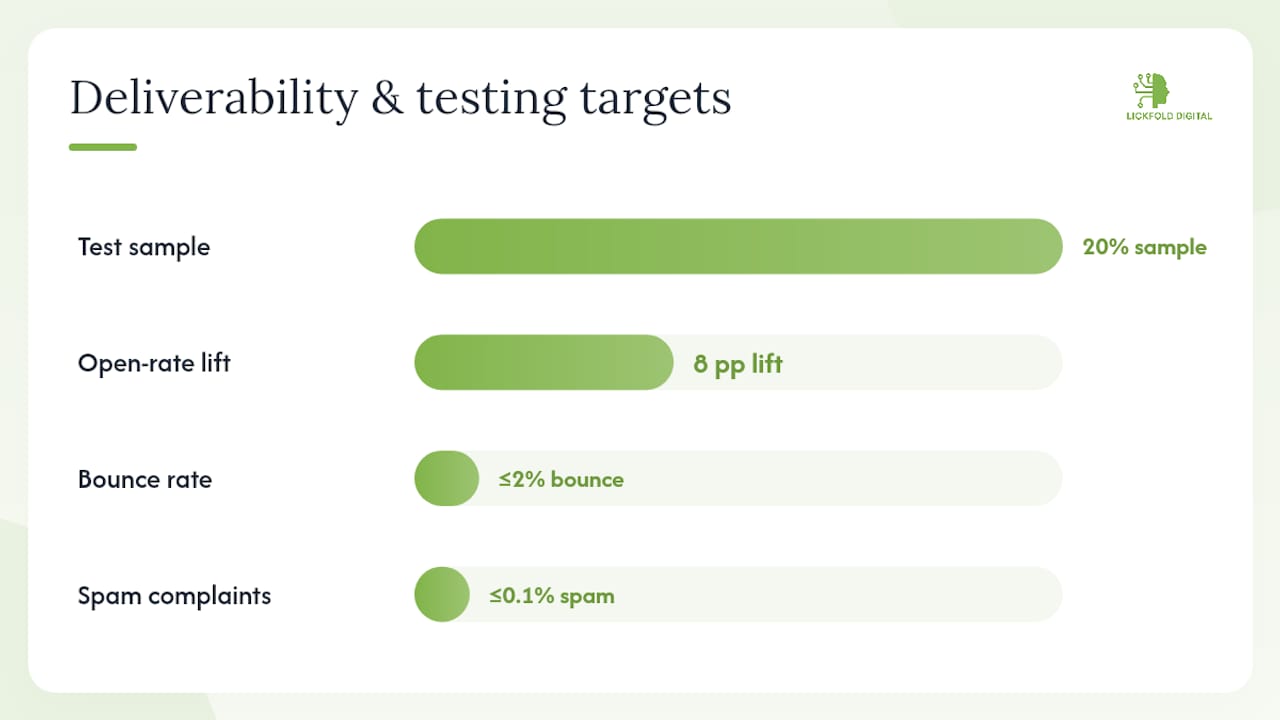
7-touch SMB demo cadence timing: Day 1 → Day 3 → Day 5 → Day 7 → Day 9 → Day 12 → Day 14.
Deliverability micro-checklist:
- SPF, DKIM, and DMARC records verified
- Sending domain warmed up for at least 4 weeks before full-volume sends
- Bounce rate below 2% and spam complaint rate below 0.1%
- Unsubscribe link present and functional in every email
- Suppression list applied before every send
Pro Tip: Test subject lines on a 20% sample before sending to the full list. A subject line that lifts open rate by 8 percentage points on a 10,000-contact list is worth the extra day.
Common mistakes, deliverability traps, and best-practice guardrails
The most reliable sign of a broken nurture program is not low open rates. It is sales reps who stop acting on marketing alerts. That behavior tells you the leads are not ready, the data is incomplete, or the SLA is not enforced.
Red flags:
- Email bounce rate above 3% (list hygiene problem)
- Sequence engagement dropping after touch 2 (content relevance problem)
- Sales disposition rate below 50% (scoring threshold too low)
- Re-engagement rate near zero (dormant segment too old or too cold)
List hygiene actions: Remove hard bounces immediately. Suppress contacts with no engagement in 180 days. Run email validation on any list older than 6 months before importing. Never purchase lists and import them directly into an active sending domain.
Legal and privacy (U.S.): For email, follow CAN-SPAM opt-out requirements. For SMS and phone outreach, TCPA rules require prior express written consent for marketing messages; consult legal counsel to confirm your consent records are compliant before launching SMS sequences.
Pro Tip: Set up a dedicated subdomain for marketing email (mail.yourdomain.com) and keep it separate from your transactional sending domain. A spam complaint on your marketing subdomain will not tank your transactional deliverability.
How AI-driven agents change lead nurturing
The traditional qualification bottleneck is a human rep reading every reply and deciding what to do next. At scale, that breaks. AI-driven agents enable human-level pre-qualification of conversational replies and reduce time-to-qualification, so sales spends time only on intent-qualified prospects.
What this looks like in practice: An AI agent reads every inbound reply to an outbound sequence, classifies it (interested, objection, referral, wrong contact, out of office), and routes it accordingly. Interested replies go to a human within 4 hours. Objections trigger an automated rebuttal. Wrong contacts trigger a re-research step to find the right person.
AI agents do not replace the human judgment that closes deals. They remove the sorting work that prevents reps from getting to those conversations in the first place. The programs that see the biggest lift are the ones that combine AI pre-qualification with a strict human escalation rule: every “interested” reply gets a human touch before any meeting is booked.
Implementation checklist for AI-assisted qualification:
- Define the classification categories and the routing rule for each.
- Set a confidence threshold: replies below 80% confidence go to human review.
- Build a weekly accuracy audit: compare AI classifications to human review outcomes.
- Log every escalation and use it to retrain the model quarterly.
- Maintain warm-up infrastructure and reputation monitoring on all sending domains.
Lickfold’s AI-driven outreach system applies this model at scale, combining dedicated warm-up accounts, ongoing reputation management, and human review of every qualified reply before it reaches a sales rep. For teams building this capability, AI pre-qualification workflows are the fastest path to a cleaner pipeline.
Metrics to track immediately after deploying AI qualification:
- Qualification accuracy rate (target: above 85%)
- Time-to-first-human-response (target: under 4 hours)
- Pipeline influenced by AI-qualified leads vs. manually qualified leads
For a deeper look at engaging multiple decision-makers across the buying committee, the multi-threaded approach pairs directly with AI qualification to keep every stakeholder moving.
Key Takeaways
The highest-impact lead nurturing programs combine behavioral triggers, role-based content, a documented SLA, and AI-assisted qualification to move prospects from first touch to sales-ready faster and at lower cost.
| Point | Details |
|---|---|
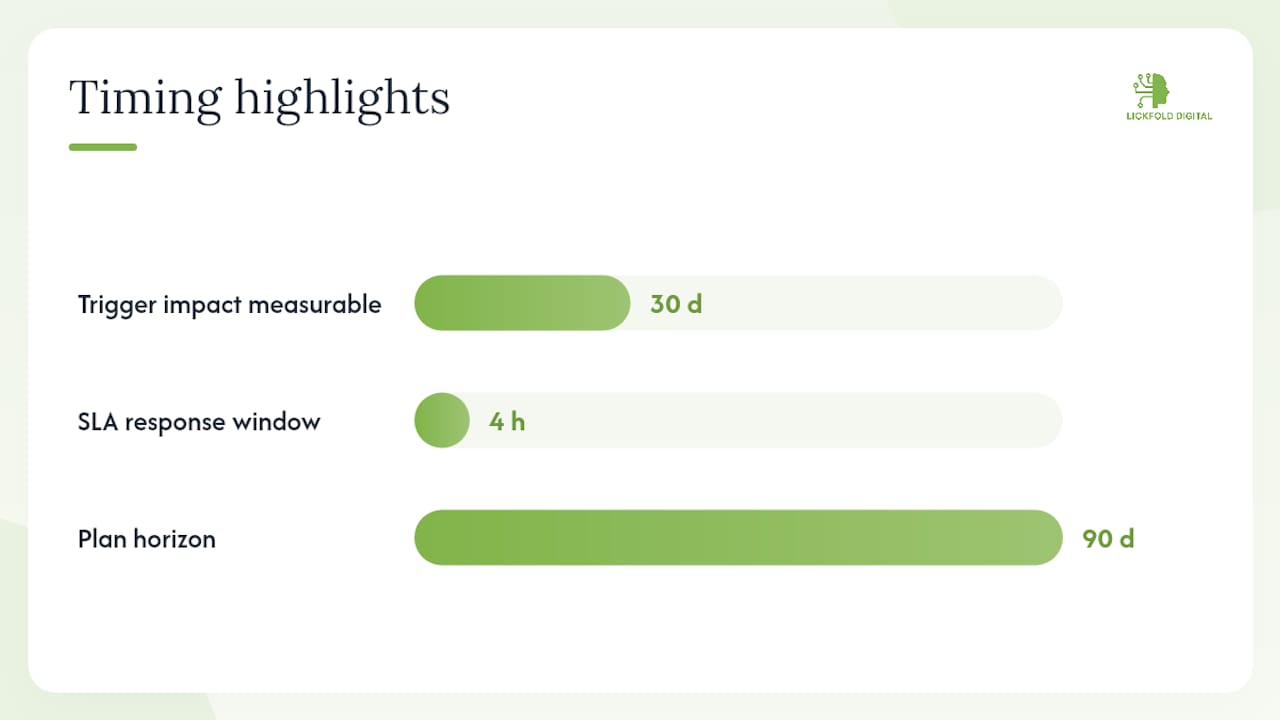
| Start with behavioral triggers | Trigger-based sequences are the fastest win: high impact, low setup time, measurable within 30 days. |
| Document the SLA in week 1 | Agree with sales on the exact score threshold, required fields, and 4-hour response window before launching any sequence. |
| Segment by role, not just company | IT, finance, and ops each need different content; generic paths slow decisions and lose committee members. |
| Measure MQL-to-SQL rate monthly | This single metric tells you whether scoring, content, and handoff are all working together. |
| Lickfold for AI-driven scale | Lickfold’s AI agents handle reply classification, warm-up infrastructure, and human escalation so sales only sees intent-qualified prospects. |
30/60/90-day plan:
- Day 1–30: Audit existing contacts, define ICP segments, build behavioral trigger sequences, agree on SLA with sales.
- Day 31–60: Launch role-based content paths, activate retargeting, run first A/B tests on subject lines, review MQL-to-SQL weekly.
- Day 61–90: Deploy re-engagement tracks for dormant contacts, introduce predictive scoring, review cost per SQL, scale what works.
The lesson most nurture programs learn too late
Most teams build their nurture program around content volume. More emails, more assets, more touches. The programs that actually move pipeline are built around signal quality. The difference is not how much you send — it is whether each send responds to something the prospect actually did.
The SLA is where this breaks down most visibly. Marketing and sales agree on a score threshold in a meeting, then never revisit it. Six months later, sales is ignoring alerts because the leads are not ready, and marketing is frustrated that their work is not being followed up. The fix is a weekly 15-minute review of dispositions: which alerted leads converted, which were disqualified, and why. That feedback loop is what makes scoring models improve instead of decay.
One practical move you can replicate immediately: add a single required field to your sales alert notification — “recommended opening line” — generated from the prospect’s last three engagement events. Reps who have a specific conversation starter act on alerts faster. That one change, in programs that have tested it, cuts the time between alert and first contact by more than half.
The partner resource on lead nurturing conversions covers additional practitioner angles worth reviewing alongside the frameworks here.
Lickfold builds the pipeline your nurture program needs to work
Most nurture programs stall not because the sequences are wrong, but because the top of the funnel is thin. You cannot nurture leads you do not have.
Lickfold’s AI-driven prospecting fills that gap with a system that identifies decision-makers matching your ICP, runs personalized multi-touch outreach across email and LinkedIn, and delivers only human-qualified replies to your sales team. Every sending domain is warmed up and reputation-monitored before a single sequence goes live. The AI pre-qualifies every reply before a rep sees it, so your team spends time on conversations, not inbox triage.
Three use cases where this accelerates results: launching a new segment with no existing contacts, recovering pipeline after a slow quarter, and scaling outbound without adding headcount. If your nurture sequences are ready but the pipeline feeding them is not, reach out to Lickfold to see how the system runs.
Useful sources and further reading
- Forrester: Self-service buying is a wake-up call for B2B sales — Forrester’s analysis of decentralized B2B buying behavior; supports the buying-committee and multi-threaded engagement strategies.
- Dashly: B2B lead nurturing strategies that convert — Practitioner-level breakdown of AI-assisted qualification and progressive cadences; supports the EEAT section.
- HubSpot: 7 effective lead nurturing tactics — Re-engagement campaign guidance and foundational nurturing tactics.
- WordStream: 7 unbeatable lead nurturing strategies — Practical channel-level examples including SMS, retargeting, and social; useful for templates and examples section.
- Lickfold: What is lead nurturing in B2B — Foundational B2B guide covering multi-stakeholder engagement and best practices.
- Lickfold: AI qualification methods for B2B sales teams — Detailed breakdown of AI qualification approaches relevant to the EEAT and SLA sections.