
How to Use AI to Pre-Qualify Leads for Closers
How to Use AI to Pre-Qualify Leads for Closers
TL;DR:
- AI pre-qualification automates the screening process to focus sales efforts on high-potential leads. Most sales teams are adopting AI to improve accuracy and close rates, recognizing its strategic importance. Proper implementation involves clear criteria, conversational flows, and ongoing calibration to ensure success.
AI pre-qualification is the practice of using automated intelligence to screen, score, and route leads before a closer ever enters the conversation. Knowing how to use AI to pre-qualify for closers is the difference between a sales team that chases every lead and one that closes the right ones. 81% of sales teams are already exploring or implementing AI to improve lead qualification. That number signals a structural shift, not a trend. This guide gives B2B sales and marketing leaders a concrete framework to build that system and make it work.
How to use AI to pre-qualify leads for your closers
AI pre-qualification, also called AI-driven lead qualification in formal sales operations literature, is the process of using machine learning, natural language processing, and behavioral scoring to determine whether a lead is worth a closer’s time. The goal is not to replace your sales team. The goal is to front-load the screening so closers only talk to prospects who are able and ready to buy.
Gartner projects that 70% of routine sales tasks will be automated by AI by 2030. That projection reframes the question. The issue is no longer whether AI belongs in your sales process. The issue is how fast you build the system before your competitors do.
The core value is predictability. When AI handles initial screening, your pipeline reflects real buying intent rather than optimistic guessing. CRM data stays clean, forecasts become more accurate, and your closers spend their hours on conversations that actually convert.

What data inputs and tools does AI need to qualify leads?
Effective AI pre-qualification runs on three categories of input: firmographic data, behavioral signals, and engagement history. Firmographics tell the AI who the lead is. Company size, industry, revenue, and tech stack determine whether the prospect fits your ideal customer profile. Behavioral signals, such as page visits, content downloads, and email opens, reveal what the prospect cares about. Engagement history from your CRM shows where they are in the buying cycle.
Sales AI tools fall into three categories: automation, intelligence, and augmentation. Each category supports a different stage of the qualification process.
- Automation tools handle repetitive tasks: data capture, lead enrichment, and follow-up sequencing.
- Intelligence tools analyze patterns across your CRM and market data to score leads and predict conversion likelihood.
- Augmentation tools assist reps in real time during calls with suggested responses, objection handling, and live scoring updates.
The integrations matter as much as the tools themselves. Your AI system must connect directly to your CRM so that enriched lead data flows without manual entry. It also needs access to your live communication platforms, whether that is email, chat, or phone, so it can capture behavioral signals at every touchpoint. A disconnected stack produces incomplete data, and incomplete data produces bad scores.
| AI category | Primary function | Qualification stage |
|---|---|---|
| Automation | Data capture and enrichment | Top of funnel |
| Intelligence | Lead scoring and intent analysis | Mid-funnel |
| Augmentation | Real-time rep assistance | Active call and handoff |
Pro Tip: Before selecting any AI tool, audit your CRM data quality first. Garbage in, garbage out. AI scoring is only as accurate as the data it reads.
Step-by-step process for AI-driven lead pre-qualification
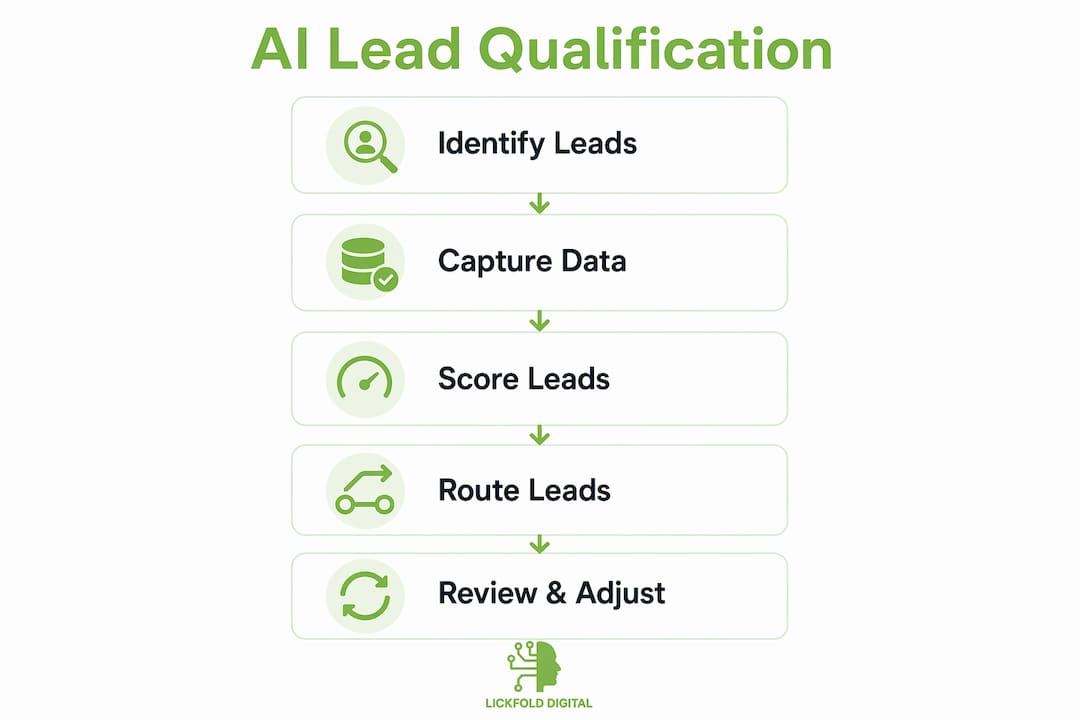
A structured implementation prevents the most common failure mode: deploying AI tools without a clear qualification logic. Follow this sequence to build a system that actually routes the right leads to your closers.
-
Capture and enrich lead data automatically. Connect your lead sources, web forms, ad platforms, and inbound channels, directly to your CRM. Use an enrichment layer to append firmographic and technographic data to every new record. AI lead qualification involves capturing lead data, enriching profiles, and scoring fit before any human touches the record.
-
Define your qualification criteria explicitly. Your AI needs four signal types: fit (does the company match your ICP?), intent (are they actively researching a solution?), urgency (do they have a timeline?), and negative signals (are there disqualifying factors like wrong company size or geography?). Write these criteria down before configuring any scoring model.
-
Build a conversational qualification flow. AI should not fire all qualification questions at once. Interleaving questions naturally, one at a time within a conversational exchange, maintains engagement and improves completion rates. Think of it as a dialogue, not a survey. A well-designed flow keeps the interaction under five minutes and feels like a helpful exchange rather than an interrogation.
-
Set routing rules based on score thresholds. Define what score triggers a handoff to a closer. High-fit, high-intent leads go directly to your best closers. Mid-range leads enter a nurture sequence. Disqualified leads exit the active pipeline and get tagged for future re-engagement.
-
Create a structured handoff summary. Effective AI handoffs include a 3–5 sentence concise summary of the lead’s situation and a recommended next action. This gives closers immediate context without requiring them to read a full transcript. The closer walks into the call already knowing the prospect’s pain point, timeline, and budget range.
-
Test, measure, and refine. Run your scoring model against historical closed-won and closed-lost deals. Adjust thresholds based on what the data shows. Qualification criteria that worked six months ago may not reflect current buyer behavior.
Pro Tip: Set a 30-day review cycle for your scoring thresholds. Markets shift, and a static model will drift out of alignment with your actual buyers.
How does AI improve closing rates by focusing reps on better leads?
The direct benefit of AI pre-qualification is that closers stop wasting time on leads that were never going to buy. High-performing sales teams are 2.8x more likely to use AI and can increase qualified leads by up to 50%. That is not a marginal improvement. It changes the economics of your entire sales operation.
Most teams that offload qualification to AI see 2–3x more qualified conversations per day without adding headcount. The math is straightforward: if a closer currently handles 10 conversations a day and only 3 are genuinely qualified, AI pre-screening can flip that ratio so 7 or 8 of those conversations have real conversion potential.
The benefits extend beyond volume:
- CRM hygiene improves because AI only routes records that meet defined criteria, reducing junk data in your pipeline.
- Forecast accuracy increases because the leads in your pipeline reflect real intent rather than wishful thinking.
- Closer morale rises because reps spend their time on winnable deals instead of dead-end calls.
- Deal slippage drops because AI flags urgency signals early, giving closers the context to move fast when a buyer is ready.
AI pre-qualification does not make closers redundant. It makes them more effective by removing the noise so they can focus entirely on the signal. The closer’s job becomes converting, not filtering.
The most effective AI implementations embed directly in the call workflow at pre-call, active-call, and post-call stages. Pre-call, the AI delivers the enriched summary. During the call, augmentation tools surface relevant information in real time. Post-call, the AI logs outcomes and updates the lead score automatically. That full-cycle integration prevents deal slippage and reduces the administrative burden on your closers.
Common challenges in AI pre-qualification and how to fix them
Even well-designed systems run into problems. Knowing the failure points in advance saves weeks of troubleshooting.
-
Qualification conversations run too long. If your AI asks more than five or six questions in a single session, completion rates drop sharply. Keep the flow under five minutes. Prioritize the two or three signals that most reliably predict conversion for your specific product.
-
Warm leads go cold before handoff. Delays in handing off warm leads result in lost sales. Your routing rules must trigger an immediate alert to a closer the moment a lead signals urgent intent. A lead that says “we need a solution by end of quarter” cannot wait 24 hours for follow-up.
-
Scoring thresholds are set too high or too low. A threshold that is too high starves your closers of leads. A threshold that is too low floods them with unqualified prospects and defeats the purpose of the system. Calibrate against your historical win rate data, not intuition.
-
AI summaries are too long. Closers do not have time to read a 10-paragraph transcript before a call. Concise 3–5 sentence summaries with clear recommended next steps are the standard. If your summaries are longer, your AI is not summarizing. It is transcribing.
-
Sales team resistance slows adoption. Reps who feel the AI is judging their leads will push back. Involve closers in defining the qualification criteria from the start. When they own the criteria, they trust the output.
Pro Tip: Run a two-week pilot with one closer before rolling out to the full team. Use their feedback to refine the scoring model and the handoff format. A successful pilot creates internal advocates who accelerate adoption.
Key Takeaways
AI pre-qualification works because it front-loads lead screening with defined criteria, so closers spend their time only on prospects who fit, intend to buy, and have a timeline.
| Point | Details |
|---|---|
| Define criteria before configuring AI | Set fit, intent, urgency, and negative signals explicitly before building any scoring model. |
| Use conversational qualification flows | Ask one question at a time to keep interactions under five minutes and maintain completion rates. |
| Automate handoffs with concise summaries | Provide closers with 3–5 sentence briefings and a recommended next action, not full transcripts. |
| Calibrate scoring thresholds regularly | Review thresholds every 30 days against closed-won and closed-lost data to stay accurate. |
| Embed AI across the full call cycle | Deploy AI at pre-call, active-call, and post-call stages to prevent deal slippage and reduce admin work. |
What I’ve learned from watching AI pre-qualification succeed and fail
The teams that get the most from AI pre-qualification share one trait: they did the hard thinking about their ideal customer before they touched any technology. They knew exactly what a qualified lead looked like, in writing, before they asked an AI to find one. The teams that struggled skipped that step and expected the AI to figure it out from their messy CRM data.
The second pattern I’ve noticed is that the best implementations treat AI and human judgment as a partnership, not a handoff. The AI does not make the final call on whether a lead is worth pursuing. It surfaces the evidence. The closer makes the judgment. That distinction matters enormously for team buy-in and for deal quality. When closers understand that AI is doing the filtering work they hate, they become the system’s biggest advocates.
The third thing I’d push back on is the instinct to automate everything at once. The teams that see the fastest results start with one qualification stage, usually the initial inbound response, and prove the model before expanding it. Incremental implementation lets you measure impact clearly and build confidence in the system before it touches your most valuable pipeline stages.
AI pre-qualification is not a shortcut. It is a discipline. The step-by-step qualification frameworks that work long-term are the ones built on clear criteria, clean data, and a genuine commitment to measuring what changes. If you build it that way, the results compound over time.
— Duarte
How Lickfold supports B2B teams with AI pre-qualification
Lickfold builds AI-driven outbound and qualification systems for B2B sales teams that need a predictable pipeline without adding headcount. The platform deploys dedicated AI agents that identify decision-makers, execute personalized outreach, and qualify replies before passing opportunities to your closers. Every handoff includes human-reviewed context so your team walks into each conversation with full situational awareness.
If you want to see how AI qualification methods can be applied to your specific sales process, Lickfold’s team works directly with sales leaders to design and implement the right system. Reach out through the contact page to start the conversation.
FAQ
What is AI pre-qualification in B2B sales?
AI pre-qualification is the automated process of scoring, screening, and routing leads based on fit, intent, and urgency before a human closer engages. It uses machine learning and behavioral data to filter out low-potential prospects at scale.
How does AI improve closing rates for sales teams?
High-performing sales teams using AI are 2.8x more likely to increase qualified leads by up to 50%, because closers spend their time only on prospects who match the ideal customer profile and show active buying intent.
What data does AI need to qualify leads effectively?
AI qualification requires firmographic data (company size, industry, revenue), behavioral signals (page visits, content downloads), and CRM engagement history. Clean, connected data across these three sources produces accurate lead scores.
How long should an AI qualification conversation take?
AI qualification conversations should stay under five minutes. Asking one question at a time within a natural conversational flow, rather than presenting a block of questions, keeps completion rates high and avoids frustrating prospects.
What should an AI handoff summary include?
An effective AI handoff summary contains 3–5 sentences covering the lead’s situation, pain point, timeline, and a recommended next action. That format gives closers immediate context without requiring them to review a full conversation transcript.