
Run 8–12 Interviews: ICP Research for B2B Teams
Run 8–12 Interviews: ICP Research for B2B Teams
ICP research is the systematic study of the accounts and buying roles that convert reliably, using interviews, CRM data, and stakeholder mapping to find the pattern. The single outcome that matters is an operational ICP: a profile with fields that plug directly into CRM filters and outreach lists. Start now by running 8 to 12 customer and lost-deal interviews before you touch a targeting spreadsheet.
TL;DR:
- ICP research should focus on firmographics, technographics, buying roles, trigger events, and negative signals to create actionable segmentation filters.
- Conducting both qualitative interviews and quantitative data analysis helps identify high-value account attributes that influence purchase likelihood.
- Results from ICP research should be measured quarterly through engagement, conversion rates, CAC, and win rate, with regular updates for rapid market changes.
- Avoid bias by including churned accounts and prospects mid-evaluation to obtain a complete picture of buying signals and decision-making patterns.
- Once validated, the ICP can be operationalized into automated AI prospecting workflows that target, map, and reach decision-makers at scale.
Table of Contents
- What Is ICP Research, and How Does It Differ From Buyer Personas?
- Why ICP Research Matters: What It Actually Moves
- ICP Research Methods and Where to Find the Data
- Step-by-Step: Planning, Running, and Documenting ICP Research
- Turning Findings Into Targeting Rules and Messaging
- Measuring Impact and Knowing When to Refresh
- How Lickfold Digital Operationalizes ICP Research Into AI-Driven Prospecting
- What Teams Get Wrong About ICP Research
- Lickfold Digital: A Practical Way to Turn ICP Research Into Pipeline
- Sources
What Is ICP Research, and How Does It Differ From Buyer Personas?
ICP research examines both current customers and lookalike noncustomers to compile evidence about who actually buys and why, combining qualitative interviews with quantitative analytics to guide targeting and messaging, according to ROI Revolution’s explainer. The deliverable is a company-level profile, not a person-level one.
That distinction trips up a lot of teams. A buyer persona describes an individual’s goals, objections, and daily frustrations. An ICP describes the account: firmographics, technographics, buying roles present, trigger events, and negative signals that predict churn or bad fit. A buyer persona framework tells you how to talk to the champion once you’re in the door. ICP research tells you which doors to knock on.
Core fields an ICP should capture:
- Firmographics: revenue band, headcount, industry vertical, geography
- Technographics: existing tech stack, integration requirements
- Buying roles present: economic buyer, champion, technical evaluator
- Trigger events: funding rounds, leadership changes, compliance deadlines
- Negative signals: attributes correlated with churn or long, unwinnable cycles
Run this research when you’re entering a new segment, when win rates have stalled, or before scaling outbound spend. Skip it if your pipeline is already concentrated and converting well. Fixing that isn’t a research problem.
Why ICP Research Matters: What It Actually Moves
Teams that tighten targeting around a validated ICP typically see better lead quality, higher conversion rates, lower customer acquisition cost, and shorter sales cycles, because reps stop chasing accounts that were never going to close. Those are the four numbers worth reporting to leadership: conversion lift, CAC change, win rate, and deal velocity.
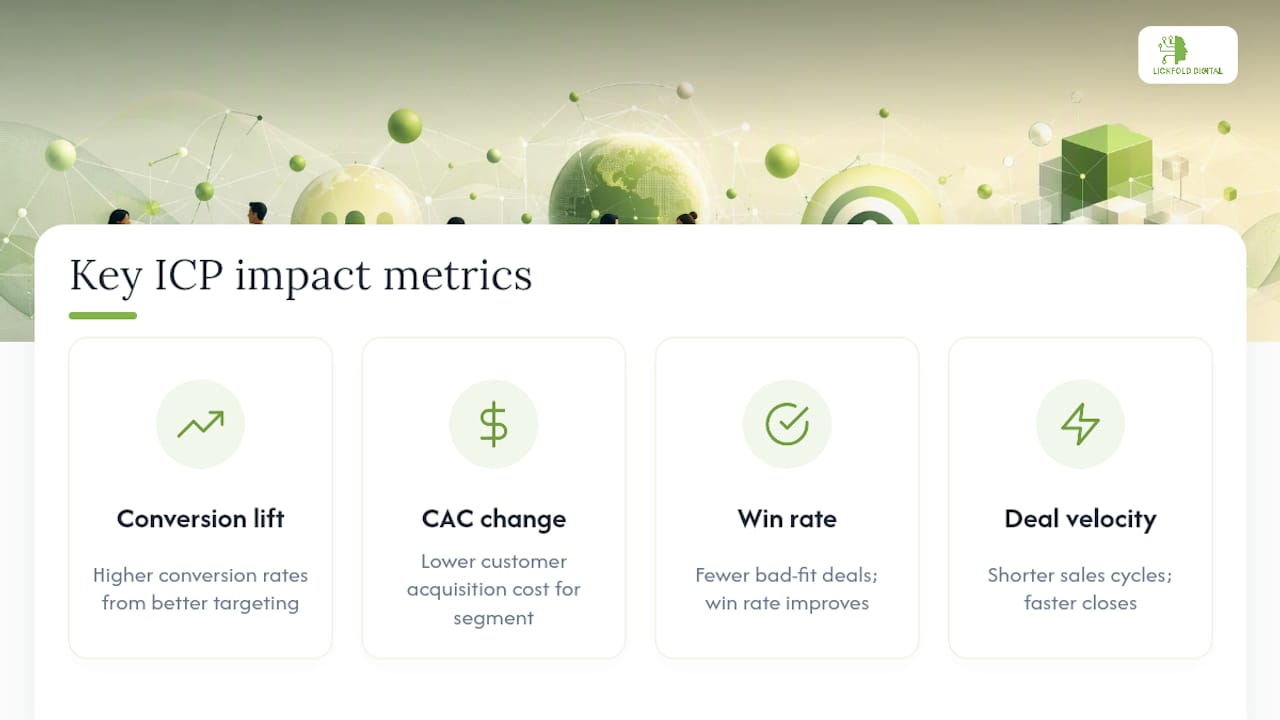
Quick math on this: a mid-market software company narrowing outbound from “any company with a website” to a validated segment often sees win rate improve notably simply because fewer bad-fit deals clog the pipeline. The revenue impact isn’t from more leads. It’s from fewer wasted ones.
Report these numbers quarterly, tied to the segment definition you tested, not to overall pipeline. Mixing ICP-driven results with legacy pipeline hides the signal you’re trying to prove.
ICP Research Methods and Where to Find the Data
Qualitative and quantitative methods answer different questions, and you need both.
- Customer interviews — 30 to 45 minutes with recent buyers, focused on the trigger that started their search and who else was in the room.
- Win/loss interviews — run these on both closed-won and closed-lost deals; losses expose the boundary conditions of your ICP that wins never will.
- Stakeholder mapping and discovery calls — capture every role touched during the deal, not just the signer.
- CRM segmentation and product usage analytics — pull closed-won accounts and look for firmographic and behavioral clusters your gut missed.
- Surveys and intent/firmographic data overlays — scale the qualitative findings across a larger account universe.
For mapping decision-makers specifically, org-chart tools that import a CSV or sync with Google Sheets can auto-generate a hierarchy in minutes, which is faster than sketching one by hand in a slide deck. Lucidchart’s org chart maker works this way, and its AI-assisted generator builds the chart straight from a spreadsheet export.
For recruitment, pull from three pools:
- Recently closed-won customers (last 90 days, while memory is fresh)
- Churned accounts and lost deals (for negative signal)
- A small panel of prospects mid-evaluation, if you can get access
Pro Tip: Never run ICP research on customers alone. Every finding will be biased toward whoever you already sell to, which is exactly the group that can’t tell you who you’re missing.
Step-by-Step: Planning, Running, and Documenting ICP Research
A research cycle that produces something usable takes 4 to 8 weeks. Here’s the sequence.
- Define a hypothesis and scope. Write down what you think the ICP is before you research it, so you can measure how wrong you were.
- Select the sample frame. Mix current customers, churned accounts, lost deals, and a handful of active prospects.
- Write recruitment scripts and screening criteria. Screen for role (economic buyer, champion, evaluator) and recency of the buying decision.
- Draft interview and survey questions. Ask about the trigger event, the evaluation criteria, and who else weighed in, not just satisfaction scores.
- Set a collection cadence. Two to three interviews per week keeps momentum without burning out whoever’s running it.
- Assign responsibilities. One owner for interviews, one for CRM data pulls, one for synthesis. Diffuse ownership is how these projects stall.
- Document deliverables. A stakeholder matrix and a validated ICP template, both stored somewhere the sales team will actually open.
Screening questions worth asking every recruit:
- What triggered you to start looking for a solution?
- Who else was involved in the final decision?
- What almost made you choose a different vendor, or none at all?
Turning Findings Into Targeting Rules and Messaging
Raw interview transcripts don’t help anyone until you synthesize them. Affinity mapping (grouping similar quotes and observations into themes) and coding transcripts against a fixed set of tags work faster than trying to remember every conversation. Cross-reference what you hear against CRM signals: does the trigger event pattern show up in your closed-won data too?

Once you have themes, score each candidate ICP attribute on two axes: lift (how much it correlates with winning) and addressability (how easy it is to actually filter for in your tools). An attribute like “had a recent Series B” scores high on both. Something like “values our company culture” might be real, but you can’t build an outbound list filter around it.
Concrete translation examples:
- Firmographic attribute → CRM saved segment → outbound list filter
- Trigger event (“hired a new VP of Sales”) → intent signal → sequence trigger
- Common objection from win/loss calls → messaging pillar in cold email copy
- Technographic fit → integration-specific case study in follow-up sequence
An operational ICP is only useful once every attribute maps to a filter or segmentation rule your systems can actually apply. Anything that doesn’t map to a filter is a nice observation, not a targeting rule.
Measuring Impact and Knowing When to Refresh
Track leading indicators (engagement rate, MQL to SQL conversion) alongside lagging ones (CAC, win rate) so you catch drift before a quarter closes badly. A/B test messaging and targeting variants against your ICP segment specifically, not against your whole database.
Enterprise deal maps commonly involve 6 to 12 stakeholders per deal, which is exactly why static ICP definitions age fast. Set a quarterly check on core metrics and a full ICP refresh annually, or sooner if win rate drops more than a few points in a single quarter.
- Leading: engagement rate, reply rate, meeting-to-opportunity ratio
- Lagging: CAC, win rate, deal velocity
- Trigger to refresh: quarterly review, annual full rebuild, or a sudden win-rate drop
How Lickfold Digital Operationalizes ICP Research Into AI-Driven Prospecting
Lickfold Digital takes a validated ICP and runs it through dedicated AI agents that research target accounts, map decision-makers, and launch personalized multi-touch outreach. Warm email infrastructure, ongoing reputation management, and human qualification of replies sit underneath, so revenue teams get a predictable pipeline without inheriting deliverability headaches or lower acquisition costs from guesswork-driven lists.

What Teams Get Wrong About ICP Research
Single-customer bias kills more ICP projects than bad data does. Teams interview five happy customers, skip the churned ones, and never touch stale CRM fields again. Build negative signals in from day one and put a quarterly review on the calendar, not a “someday” list.
— Duarte
Lickfold Digital: A Practical Way to Turn ICP Research Into Pipeline
Once you’ve validated an ICP, the harder problem is execution: finding the right accounts, mapping the right people inside them, and reaching out without sounding like a template. That’s the exact job Lickfold Digital is built for.
Working with Lickfold Digital starts with your validated ICP fields, which feed dedicated AI agents that research accounts, identify decision-makers, and run personalized multi-touch sequences across email. Reputation management and warm-up run in the background, and every reply gets human qualification before it lands in your pipeline as a real opportunity, not a maybe. If you’ve already done the interviews and built the stakeholder matrix, the next step is putting that profile to work. See how Lickfold Digital’s AI prospecting works and get a sense of what a validated ICP looks like once it’s running outbound for you around the clock.
Sources
For deeper templates and workflows referenced above, see the stakeholder matrix guide for enterprise account teams, Salesforce’s ICP framework, and Lickfold Digital’s AI prospecting guide for connecting research to outbound execution.
- Unlocking strategic insights with ICP research — ROI Revolution
- Organizational chart maker | Lucidchart
- Stakeholder mapping template for B2B sales teams — Prolifiq