
How market research drives B2B sales pipeline growth
How market research drives B2B sales pipeline growth
TL;DR:
- Most B2B sales teams treat market research as a one-time pre-campaign task, which limits qualified meetings.
- Modern AI-driven research creates a continuous, dynamic intelligence system that improves targeting and pipeline speed.
- Consistent methodology adherence and real-time insights significantly enhance sales outcomes and pipeline health.
Most B2B sales leaders think of market research as a pre-campaign task: pull a list, verify some emails, and start dialing. That assumption quietly costs you qualified meetings every single quarter. The reality is that structured, AI-driven market intelligence is an ongoing operational engine, not a one-time deliverable. When done right, it reshapes who you target, how you message them, and how fast opportunities move through your pipeline. This article breaks down exactly how to make that shift and what metrics prove it’s working.
Table of Contents
- What is market research in sales?
- How AI is transforming market research for sales teams
- Critical KPIs: Measuring the impact of market research on your pipeline
- Translating insight into action: Proven strategies for sales teams
- Why most sales teams underestimate market research: Our take
- Boost your pipeline with tailored AI solutions
- Frequently asked questions
Key Takeaways
| Point | Details |
|---|---|
| AI revolutionizes sales research | Modern B2B market research leverages AI to find deeper insights, faster, and with greater accuracy than legacy methods. |
| KPIs drive sales success | Tracking metrics like pipeline velocity and signal-to-meeting rates reveals where market research truly impacts the sales funnel. |
| Human oversight is essential | Integrating human review with AI-automated research prevents errors and ensures actionable, reliable intelligence. |
| Discipline outperforms instinct | Sales teams adhering to defined, research-backed processes outperform peers by wide margins in conversion and pipeline growth. |
What is market research in sales?
Market research in sales is the systematic process of gathering, validating, and acting on data to identify the right buyers, understand their context, and prioritize outreach accordingly. It’s not a synonym for “buying a contact list.” It’s closer to building a continuously updated map of your addressable market.
For B2B teams specifically, that map needs to include several distinct layers:
- Target profiling: Defining your ideal customer profile (ICP) with precision, including firmographic data (company size, industry, revenue), technographic data (what tools they use), and behavioral signals (recent funding rounds, hiring patterns, leadership changes).
- Market segmentation: Breaking your total addressable market into sub-segments based on fit, timing, and likelihood to convert, rather than treating every company the same.
- Competitive analysis: Understanding who else is competing for your buyer’s attention and what gaps or objections you’ll face.
- Decision-maker mapping: Identifying not just companies but the specific individuals who hold budget authority and influence purchase decisions.
The traditional approach leaned heavily on gut instinct, sales rep experience, and static reports published months before you read them. That approach has a fundamental problem: it’s slow and it doesn’t scale.
“Top performers are 588% better at methodology adherence compared to average performers, making structured research discipline one of the highest-leverage habits in B2B sales.”
Modern market research replaces static data dumps with dynamic, actionable intelligence. The shift toward AI transformation in B2B research means teams can now triangulate multiple data sources simultaneously, apply validation layers to filter noise, and surface KPIs like pipeline velocity and signal-to-meeting rates that directly connect research effort to revenue outcomes. For practical sales growth tips built on this foundation, the key is treating research not as a department but as a workflow baked into every prospecting motion.
How AI is transforming market research for sales teams
AI isn’t just making research faster. It’s changing what’s possible. Tasks that previously required a team of analysts working for weeks can now execute in hours, with higher accuracy and greater breadth.
Here’s what AI can realistically automate and enhance in your research process:
- Signal detection: AI monitors news feeds, job boards, SEC filings, LinkedIn activity, and firmographic databases simultaneously to surface “trigger events,” moments when a company is most likely to buy. A new VP of Sales hired at a target account is a trigger. A Series B funding announcement is a trigger.
- ICP validation: AI cross-references company data against your historical win data to score accounts by fit before a single rep spends time on them.
- Personalization at scale: Rather than blasting generic templates, AI can generate context-specific messaging informed by each company’s recent activity, industry pain points, and stakeholder profile.
- Contact verification: AI agents continuously validate email addresses and phone numbers, reducing bounce rates and protecting sender reputation.
The contrast with legacy research is stark:
| Capability | Legacy approach | AI-enhanced approach |
|---|---|---|
| Data freshness | Static, updated quarterly | Real-time, continuous |
| Coverage | Limited by analyst capacity | Thousands of accounts simultaneously |
| Personalization | Template-based | Context-driven per account |
| Signal detection | Manual scanning | Automated trigger monitoring |
| Validation | Spot-check manual review | Multi-source triangulation |
| Time to insight | Days to weeks | Hours |
One critical risk to understand here is AI hallucination, where AI systems generate plausible-sounding but factually incorrect data. This is a real operational hazard. The solution is keeping a human in the loop: AI handles scale and pattern recognition, while a human reviewer validates key claims and qualifies replies before they reach your sales team. As the Market Research Guide makes clear, you must triangulate sources for validation and maintain human oversight to avoid compounding errors downstream.
Pro Tip: Build a two-step review gate into your AI research workflow. Let AI surface the top 20% of accounts by fit score, then have a trained researcher or SDR (sales development representative) validate the top signals before they enter the outreach sequence. This catches hallucinations before they waste rep time.
Reviewing an AI-driven research workflow gives you a concrete picture of how this validation layer works in practice. For broader context on how AI sales efficiency connects research to revenue, the evidence is compelling across multiple industries. The teams winning with AI research aren’t replacing human judgment. They’re amplifying it by reviewing AI B2B outreach success stories that include human-in-loop review as a core feature.
Critical KPIs: Measuring the impact of market research on your pipeline
You can’t improve what you don’t measure. This is especially true for market research, which often gets treated as a cost center because teams haven’t defined clear success metrics tied to pipeline outcomes.
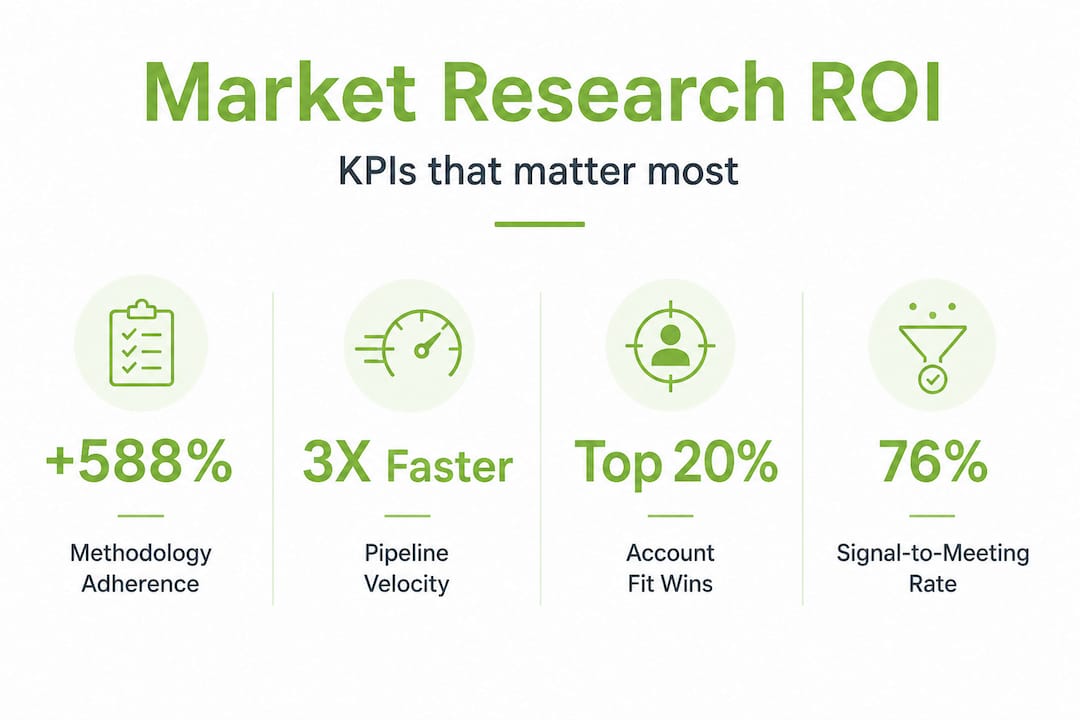
There are three KPIs that matter most:
- Pipeline velocity: How fast qualified opportunities move from first contact to closed deal, measured in days. Higher quality research reduces the time reps spend on wrong-fit accounts, accelerating the entire funnel.
- Signal-to-meeting rate: Of the trigger signals your research process surfaces, what percentage convert into booked meetings? This metric directly measures research quality. If your rate is low, your signals are noisy or your ICP is too broad.
- Methodology adherence rate: Are your reps actually following the research-driven process? Top performers are 588% better at sticking to validated methodology than average performers. This single variable explains more performance variance than almost anything else.
Here’s a practical framework for tracking these:
| KPI | Definition | Target benchmark | How to improve |
|---|---|---|---|
| Pipeline velocity | Days from first contact to closed deal | 20% reduction quarterly | Tighten ICP, reduce noise in signal sources |
| Signal-to-meeting rate | Meetings booked per trigger signal acted on | 8 to 12% | Improve signal quality, sharpen messaging |
| Methodology adherence | % of reps following research process consistently | 90%+ | Train, reinforce, and automate compliance checkpoints |
| Research-to-pipeline ratio | Pipeline value generated per research hour invested | Track trend over 90 days | Automate low-value research tasks first |
Pro Tip: Run a 30-day sprint where you track signal-to-meeting rate for AI-identified accounts separately from manually identified accounts. The comparison will tell you more about AI’s actual contribution to your pipeline than any vendor claim ever will.
Key stat: Top performers excel at methodology adherence by a factor of 5.88x compared to average performers. That’s not a small edge. That’s the difference between consistent quota attainment and unpredictable results.
When you’re evaluating tools or agencies to support this work, automating market research decisions should start from these KPIs, not from feature lists. Buy outcomes, not features.
Translating insight into action: Proven strategies for sales teams
Data without action is just storage. The teams that consistently outperform use a tight process for converting research outputs into immediate sales plays. Here’s how the best do it.
Rapid-execution plays:
- Signal-triggered sequences: When your research system detects a trigger event, a new leader joining a target company, a competitor losing a key account, or a target company announcing a new initiative, activate a pre-built outreach sequence within 24 hours. Speed matters. The best window for reaching a new VP is their first 90 days.
- Persona-specific messaging libraries: Organize your message variants by persona and pain point, informed by your ICP research. A CFO at a manufacturing company has different pressures than a VP of Sales at a SaaS startup. Your first touch should reflect that.
- Account tiering: Use your research to rank accounts into tiers (Tier 1, Tier 2, Tier 3) based on fit and signal strength. Allocate your highest-effort, most personalized outreach to Tier 1 only. Scale automated touchpoints for Tier 2 and 3.
Common failure points and how to avoid them:
- Treating research as a one-time setup: Markets move. Decision-makers change jobs. Funding rounds shift priorities. Research has to be continuous, not a quarterly event. Teams that refresh account intelligence monthly see significantly better response rates than those relying on six-month-old data.
- Ignoring negative signals: Research should tell you who NOT to call as clearly as who to target. Accounts with low fit scores, known budget freezes, or recent bad press are signals to pause or deprioritize. Chasing them wastes capacity.
- Skipping methodology review: Top performers maintain 588% better adherence to validated research methods. The teams that treat process as optional are the ones with inconsistent pipelines.
Following prospecting tips with AI that are grounded in signal-based targeting can dramatically reduce wasted outreach cycles. Combining those with AI sales tips for B2B focused on outbound efficiency creates a compound effect on pipeline quality. For teams looking to build a long-term foundation, reviewing sales growth strategies that integrate ongoing research discipline is worth the investment.

Pro Tip: Create a “research-to-action” SLA (service level agreement) within your sales team. For example, every Tier 1 trigger signal must result in a personalized first touch within 48 hours. This closes the gap between insight and revenue.
Why most sales teams underestimate market research: Our take
Here’s what we’ve seen repeatedly working with B2B sales organizations: teams that struggle with pipeline consistency almost always have the same root problem. They treat market research as a campaign input rather than an operating system.
They’ll invest heavily in research before a product launch or a new market entry, generate a solid list, run their campaign, and then let the research function go dormant. Six months later, they’re back to cold outreach on stale data wondering why results have dropped off.
The uncomfortable truth is that sporadic research is often worse than no formal research at all. It creates false confidence. Teams assume they understand their market because they did the work last quarter. But the landscape has shifted. New competitors have emerged. Decision-makers have changed roles. Budget cycles have reset. The old map is no longer accurate, but teams keep using it.
What separates the organizations that consistently outperform? They’ve built research into their operational rhythm. It’s not a project. It’s a practice. Weekly signal reviews, monthly ICP validation, quarterly competitive refreshes. Each layer builds on the last, creating a living model of the market rather than a snapshot.
The data supports this sharply. Top performers lead peers by 588% on methodology adherence, not on talent or territory size. This suggests that the discipline of consistent research application matters far more than most leaders realize.
We also see a cultural element. In organizations where research is respected as a core sales skill, not just an SDR task or a marketing function, close rates are higher and ramp times for new reps are shorter. New hires inherit a model of the market, not a blank slate. That’s a compounding advantage. Staying current on AI sales trends in 2026 is part of keeping that model sharp.
The teams winning in 2026 aren’t necessarily spending more on research. They’re being more disciplined about acting on what they already know, faster.
Boost your pipeline with tailored AI solutions
If this article has made one thing clear, it’s that the gap between knowing and doing is where most pipeline opportunities are lost. You can have the best research framework in the world and still fail to capitalize if your execution layer isn’t built for speed and precision.
That’s where Lickfold Digital comes in. We deploy dedicated AI agents that perform continuous market research, identify decision-makers matching your ICP, and execute personalized multi-touch outreach campaigns on your behalf. Every reply is human-qualified before it reaches your sales team, so you’re only engaging with warm, relevant opportunities. From infrastructure setup to ongoing reputation management, we handle the entire pipeline engine so your team can focus on closing. If you’re ready to turn research discipline into a predictable revenue system, let’s talk.
Frequently asked questions
Why is market research essential for B2B sales prospecting?
Market research uncovers high-value accounts, pinpoints decision-makers, and validates sales strategies, leading to more targeted and effective prospecting. Strong research also helps teams triangulate sources and focus on actionable KPIs rather than chasing low-fit leads.
How can AI improve the accuracy of market research results?
AI enhances market research by automating large-scale data analysis and surfacing patterns humans would miss, but accuracy improves significantly when a human-in-loop review catches AI hallucinations before they reach your outreach pipeline.
What are the most important KPIs to track for market research in sales?
Signal-to-meeting rates and pipeline velocity are the most critical, as they directly quantify research impact on actual sales outcomes rather than vanity metrics like contact list size.
How does adherence to methodology impact sales outcomes?
Teams that consistently follow research-driven methodologies dramatically outperform peers, with top performers exceeding others by 588% on methodology adherence. This discipline compounds over time into a sustainable pipeline advantage.
Recommended
- B2B market research: How it drives real lead quality
- Why automate market research? Boost B2B growth & efficiency
- How to use AI market research for B2B outreach success
- How AI transforms market research for B2B sales in 2026
- B2B Email Marketing Process for Lead Generation Success | spherescout.io Blog