
Why B2B Sales Cycles Are Long: A 2026 Guide
Why B2B Sales Cycles Are Long: A 2026 Guide
TL;DR:
- Long B2B sales cycles result from larger decision-making committees, procurement reviews, and internal buyer evaluations. Addressing these structural causes through early stakeholder mapping, parallel procurement processes, and targeted content can significantly shorten deal timelines. Many deals stall due to internal friction, emphasizing the importance of process improvements over motivation tactics.
B2B sales cycles are long because deals now require sign-off from larger buying committees, pass through formal procurement and compliance reviews, and stall while buyers independently form conclusions between vendor meetings. The median B2B SaaS sales cycle reached 84 days by Q2 2026, a 22–31% rise since 2022, with average cycles stretching to 6.7 months across industries. These numbers reflect a structural shift, not a temporary slowdown. Understanding the root causes is the first step toward doing something about them.
Why B2B sales cycles are long: the structural causes
The length of B2B sales cycles traces back to three compounding forces: more people involved in every decision, more process required before a contract is signed, and buyers who spend the majority of their time evaluating options without any input from the seller. Each force adds weeks or months independently. Together, they explain why deals that once closed in 60 days now routinely take six months or longer.
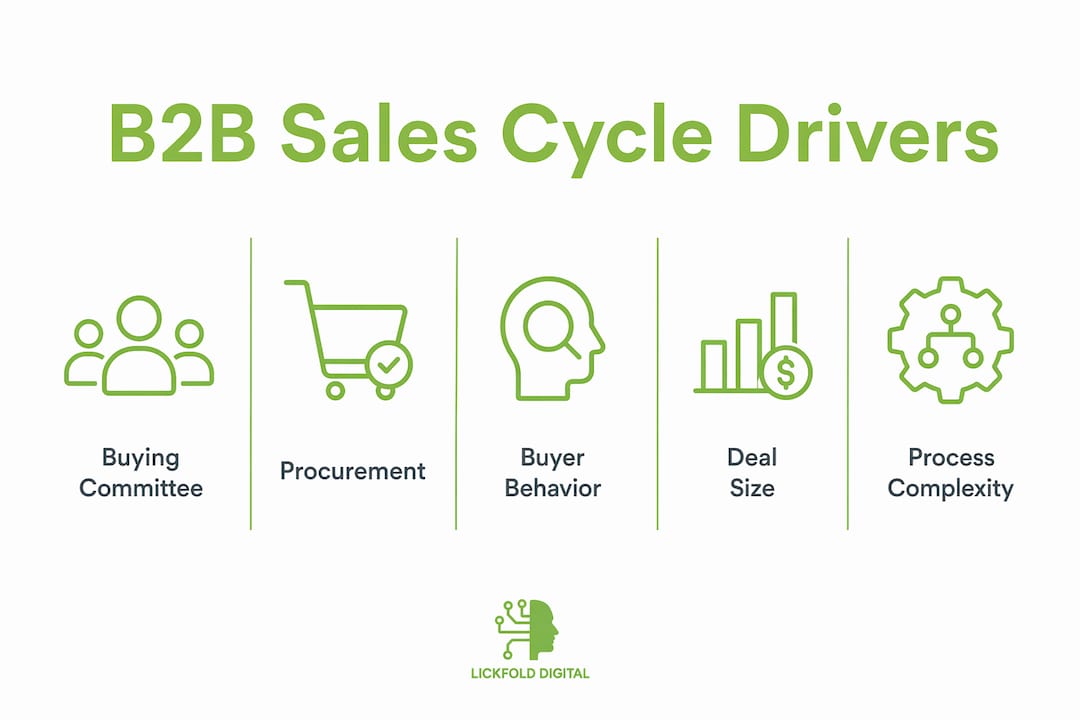
Deal size amplifies every factor. Sub-$10K deals close in 14–30 days, while enterprise deals take 6–12 months. Each added stakeholder adds 1–3 weeks to the timeline. That math compounds fast when you are selling to a committee of ten or more people.
How does a growing buying committee extend B2B sales cycles?
The buying committee is the single biggest driver of B2B sales cycle duration. The average buying committee grew from 5.4 stakeholders in 2020 to over 6.8 in 2026. Enterprise deals routinely feature 11–13 decision-makers. Every person added to that group introduces a new set of requirements, a new review cycle, and a new potential veto.

The coordination problem is not just logistical. Each stakeholder evaluates the purchase through a different lens. Finance wants ROI justification. Legal wants contract language reviewed. IT wants security documentation. Operations wants implementation timelines. Getting all of those perspectives aligned before a deal can advance is the gating factor in most lengthy B2B sales processes.
The data on no-decisions makes this concrete. 56% of forecasted deals end in no decision rather than a competitive loss. The real competitor in most deals is internal friction, not another vendor. Buyers default to the status quo when the complexity of aligning a large committee feels greater than the cost of doing nothing.
Key patterns that emerge in committee-driven delays:
- A single missing stakeholder can pause a deal for weeks while schedules align.
- Late-stage additions of new decision-makers restart evaluation cycles from scratch.
- Misaligned priorities between departments create internal debates that sellers cannot directly resolve.
- Single-threaded deals, where the rep has only one contact, stall far more often than multi-threaded ones.
Pro Tip: Map the full buying committee by the second meeting. Use LinkedIn and your champion to identify every person who will touch the approval. Name them in your CRM before the deal advances to the next stage.
What role do procurement and compliance reviews play in lengthening sales cycles?
Procurement and compliance reviews are now a standard part of the B2B buying process, even for mid-market deals. Formal reviews like SOC 2 and GDPR assessments add 30–45 days to deals over $25K ACV. That delay is baked into the buyer’s process before a rep even knows it is coming.
The mistake most sales teams make is treating procurement as a late-stage obstacle. By the time a rep discovers that legal needs to redline the contract or that IT requires a vendor risk assessment, the deal has already been stalled for weeks. Starting procurement discovery in early meetings avoids that surprise entirely.
The documents buyers need are predictable. Preparing them in advance removes the waiting time from the equation:
- Security questionnaire responses and SOC 2 reports
- GDPR or data processing agreements
- Standard contract redlines and approved legal language
- Vendor risk assessment documentation
- Reference contacts for procurement interviews
Pro Tip: Ask about procurement requirements in your discovery call. A simple question like “What does your vendor approval process look like?” surfaces the timeline and documentation requirements before they become blockers.
The payoff for early procurement engagement is measurable. Deals with 3+ active contacts close 2.4x faster, and Mutual Action Plans correlate with 20–35% faster closures. Both tactics work because they pull procurement and legal into the process earlier, reducing the time those reviews add at the end.
How does buyer behavior extend B2B sales timelines?
Buyers spend 83% of their journey internally, evaluating options without direct input from sellers. That is not a negotiating tactic. It is how modern B2B buying works. Buyers read analyst reports, talk to peers, watch product demos from multiple vendors, and form firm conclusions, all before their next scheduled call with a rep.
The problem is that those conclusions are often wrong. This is what researchers call “confident misunderstanding.” A stakeholder reads a competitor’s white paper and concludes your product cannot handle their use case. Another reads a Reddit thread and decides your pricing model does not scale. Neither belief is accurate, but both are firmly held by the time the next meeting happens.
Buyers arrive at meetings with confident misunderstandings formed from sources outside the seller’s control. More meetings do not fix this. The only solution is a continuous flow of accurate, role-specific information that reaches every stakeholder between interactions.
Multiple stakeholders forming divergent misunderstandings is particularly damaging. When the CFO and the IT director have reached different wrong conclusions, internal consensus becomes nearly impossible without significant backtracking. Tailored asynchronous content is the mechanism that prevents this. Role-specific white papers, ROI calculators, and case studies delivered between meetings give each stakeholder accurate information in the format they prefer.
Scheduling another call is not the answer. Buyers who have already formed a confident misunderstanding will not abandon it in a 45-minute Zoom meeting. The information needs to reach them before the belief solidifies. That requires building what practitioners call an explanation infrastructure: a library of assets mapped to each stakeholder role and each stage of the buying process.
What strategies actually shorten a lengthy B2B sales process?
Shortening the B2B sales timeline requires addressing each structural cause directly. Motivation and urgency tactics do not move deals that are stalled in procurement review or waiting for a committee to align. Process changes do.
Multi-threading from the start
Multi-threading with 3+ stakeholders engaged by stage two shortens sales cycles by about 35%. The rule is simple: reps must name three or more contacts in the CRM by the second meeting, or the deal gets flagged. Single-threaded deals stall because one person leaving, going on vacation, or losing internal support kills the entire opportunity. Engaging multiple decision-makers early distributes that risk.
Mutual Action Plans
A Mutual Action Plan, or MAP, is a shared document that lists every step required to close the deal, assigns ownership to both the buyer and the seller, and sets target dates for each milestone. MAPs work because they make the buyer’s internal process visible. When procurement review is on the MAP with a date attached, it stops being a surprise and becomes a scheduled event. The 20–35% faster closure rate associated with MAPs reflects this directly.
Champion enablement
Your champion is the person inside the buying organization who wants the deal to happen. Giving them the right materials to sell internally is one of the highest-leverage activities in a long sales cycle. Champion enablement materials can shorten close times by 27%. That means building a business case deck they can present to the CFO, a one-page summary for the executive sponsor, and a technical FAQ for the IT team.
Time-in-stage analytics
Most sales teams measure total cycle length. The more useful measurement is time spent in each stage. Time-in-stage analytics identify exactly where deals are leaking time, whether that is in the initial evaluation, the procurement review, or the legal redline phase. Fixing the longest stage produces faster results than broad process changes. Pairing this with marketing analytics gives sales leaders a complete picture of where buyer momentum slows.
Pipeline segmentation
Segmenting pipeline by deal size and buyer profile is critical for accurate forecasting. A $5K deal and a $500K deal should not share the same sales cadence or the same forecast assumptions. Segmentation lets teams apply the right level of resources to each deal type and set realistic timelines for each segment.
| Strategy | Primary benefit | Time impact |
|---|---|---|
| Multi-threading | Reduces single points of failure | Up to 35% faster |
| Mutual Action Plans | Makes buyer process visible | 20–35% faster |
| Champion enablement | Accelerates internal approvals | Up to 27% faster |
| Early procurement engagement | Eliminates late-stage surprise delays | 30–45 days saved |
| Time-in-stage analytics | Targets fixes at the right stage | Varies by bottleneck |
Pro Tip: Use strategic follow-up campaigns to maintain buyer momentum between meetings. Async touchpoints that deliver relevant content keep your deal top of mind without requiring another call on the calendar.
Key Takeaways
B2B sales cycles are long because buying committees have grown, procurement requirements have expanded, and buyers form firm conclusions independently between vendor interactions.
| Point | Details |
|---|---|
| Committee size drives delays | Average buying committees now exceed 6.8 stakeholders, with enterprise deals involving 11–13 decision-makers. |
| Procurement adds 30–45 days | Compliance reviews for deals over $25K ACV are now standard; engaging procurement early removes the delay. |
| Buyers form confident misunderstandings | 83% of the buying journey happens without seller input; role-specific async content corrects this. |
| Multi-threading cuts cycle time | Engaging 3+ stakeholders by stage two shortens cycles by about 35%. |
| Measure stages, not totals | Time-in-stage analytics pinpoint where deals stall so fixes can be targeted and effective. |
The uncomfortable truth about long sales cycles
Sales leaders often frame a long cycle as a motivation problem. Reps need to create more urgency. Buyers need to feel the pain more acutely. That framing is wrong, and it leads to the wrong fixes.
The structural causes of today’s lengthy B2B sales process are buyer-driven. Legal redlining, procurement reviews, and security assessments are not obstacles a rep can charm their way past. They are requirements built into the buyer’s organization. The sales teams that shorten cycles are the ones that treat these requirements as part of their own workflow, not as someone else’s problem.
The other shift worth making is from measuring average cycle length to measuring time in each stage. An average hides everything. A deal that spends 90 days in procurement review and 10 days everywhere else needs a completely different fix than one that stalls in the initial evaluation. Granular measurement leads to surgical fixes.
Multi-threading and pipeline discipline are not tactics. They are competitive advantages. The rep who has three contacts in every account is harder to stall than the rep who has one. The team that segments its pipeline by deal size forecasts more accurately and allocates resources more effectively. These habits compound over time.
— Duarte
How Lickfold helps you reach the right people faster
Long sales cycles often start with the wrong entry point into an account. When outreach lands on a gatekeeper instead of a decision-maker, the timeline extends before the deal even begins.
Lickfold builds AI-driven outbound systems that identify and engage the right decision-makers from the first contact. The platform maps buying committees, executes personalized multi-touch campaigns, and delivers qualified sales opportunities directly to your team. Every reply is human-qualified before it reaches a rep, so the pipeline that enters your CRM is already warm. If your sales cycle feels long before it even starts, reach out to Lickfold to see how AI-powered prospecting changes the entry point.
FAQ
What is the average B2B sales cycle length in 2026?
The median B2B SaaS sales cycle reached 84 days by Q2 2026, with average cycles across industries stretching to 6.7 months. Enterprise deals typically take 6–12 months depending on deal size and committee complexity.
Why are B2B sales cycles slower than B2C?
B2B deals require approval from multiple stakeholders, formal procurement and compliance reviews, and internal consensus across departments. B2C purchases typically involve one decision-maker and no procurement process.
How many decision-makers are involved in a typical B2B deal?
The average B2B buying committee exceeded 6.8 stakeholders in 2026. Enterprise deals often involve 11–13 decision-makers, each with distinct requirements and review timelines.
What is the fastest way to shorten a B2B sales cycle?
Multi-threading with 3+ active contacts by stage two shortens cycles by about 35%. Combining that with a Mutual Action Plan and early procurement engagement produces the largest time savings.
What causes most B2B deals to end without a decision?
56% of forecasted B2B deals end in no decision rather than a competitive loss. The primary cause is internal friction within the buying organization, not competition from other vendors.