
What Is Automated Lead Nurturing for B2B Teams
What Is Automated Lead Nurturing for B2B Teams
TL;DR:
- Automated lead nurturing uses marketing automation and AI tools to deliver personalized, timely content that guides prospects through the buyer journey. It enhances scalability, consistency, and faster sales cycles, especially for short-duration B2B sales, by leveraging precise segmentation, behavioral triggers, and AI-driven personalization. However, its effectiveness declines in complex deals, requiring human judgment and ongoing data quality management to maximize ROI.
Automated lead nurturing is the practice of using marketing automation software and AI-powered sales tools to deliver personalized, timely content that advances prospects along the buyer journey without requiring constant manual effort. Platforms like Salesforce, HubSpot, and AI sales engagement tools engage prospects with personalized content based on demographics, behavior, and buyer journey stage. The result is a system that educates and guides leads toward purchase readiness at scale. For B2B marketing and sales teams managing hundreds or thousands of contacts, this is the difference between a predictable pipeline and a leaky one.
What is automated lead nurturing and how does it work?
Automated lead nurturing operates through a sequence of interconnected components: a CRM or marketing automation platform, behavioral triggers, lead scoring logic, and content delivery rules. When a prospect downloads a white paper or registers for a webinar, engagement data triggers nurture sequences that deliver relevant emails, case studies, or offers over time. The system builds a unified contact profile by combining firmographic data, browsing behavior, and interaction history. This profile determines what content a lead receives and when.
The process works in five distinct stages:
- Data capture and profile building. The automation platform pulls data from form fills, website visits, and CRM records to construct a complete picture of each prospect.
- Segmentation. Leads are grouped by industry, role, funnel stage, or behavior. A CFO at a 500-person SaaS company gets different content than a marketing manager at a 20-person agency.
- Content delivery. Triggered by specific actions or time intervals, the system sends emails, serves ads, or schedules calls based on the segment and stage.
- Lead scoring. Each interaction adds or subtracts points from a lead’s score. A demo request scores higher than a blog visit. Lead scoring and behavioral signals stop nurture sequences and trigger sales handoffs when a threshold is crossed.
- Exit conditions and handoff. When a lead hits an MQL score threshold or requests a demo, the automation stops, the CRM updates, and a sales task fires. This prevents duplicate outreach and conflicting messaging.
Pro Tip: Set explicit exit conditions before you launch any nurture sequence. Without them, a lead who books a demo can still receive a top-of-funnel educational email the next morning, which signals disorganization to a prospect who is already close to buying.
Multi-channel nurturing extends well beyond email. Mature programs include LinkedIn touchpoints, retargeting ads, webinar invitations, and direct mail for high-value accounts. Automation replaces spreadsheet tracking with unified CRM profiles and automated content flows, which is especially critical for small teams managing leads at scale.

What are the benefits and limitations of automated lead nurturing?
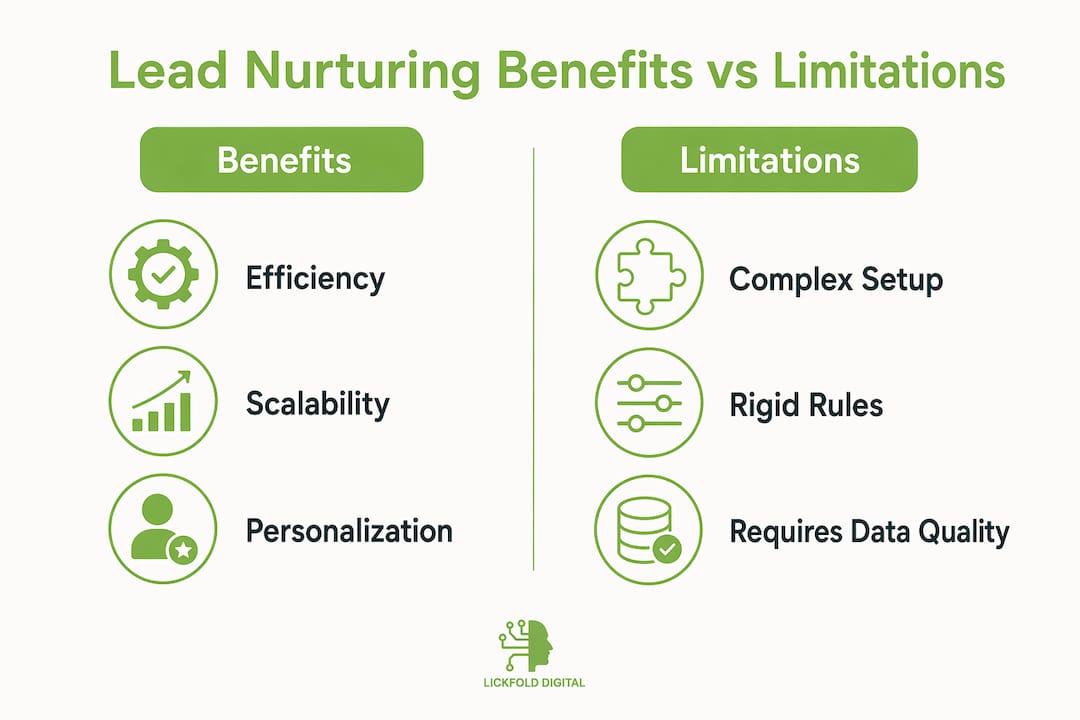
The case for lead automation is strong in the right context. Research shows automated lead nurturing can improve conversion by 23 percentage points for new leads with short sales cycles and lower deal values. That is a meaningful lift, and it reflects how automation reduces friction and uncertainty for prospects who are evaluating straightforward solutions.
The core benefits for B2B teams include:
- Scale without headcount. One marketer can run personalized nurture programs for thousands of contacts simultaneously.
- Consistent follow-up. Automation never forgets to send the third email or the case study that closes the deal.
- Faster sales cycles. Pre-educated leads arrive at sales conversations already familiar with your value proposition, which compresses the time to close.
- Better sales and marketing alignment. Shared lead scoring definitions and automated handoff protocols reduce the “this lead isn’t ready” friction between teams.
The limitations are equally real, and ignoring them leads to wasted budget.
Automated lead nurturing is most effective at reducing uncertainty for new leads in short sales cycles, but its benefits decline significantly in complex, high-value B2B deals where relationship-building and nuanced judgment cannot be automated away. — American Marketing Association, 2025
For enterprise deals with 9-to-18-month cycles and multiple stakeholders, automation handles the early education phase well. It cannot replace the account executive who reads the room in a discovery call. The other common trap is measuring the wrong things. Focusing on vanity metrics like open rates and click-through rates can mislead teams into overestimating program effectiveness. Revenue impact, lead-to-meeting conversion rate, and sales cycle speed are the metrics that tell the real story.
How AI takes lead nurturing beyond traditional automation
Traditional rule-based automation follows fixed logic: if a lead does X, send email Y after Z days. AI-powered nurturing replaces those static rules with adaptive models that learn from patterns across your entire contact database.
The practical difference is significant:
| Capability | Rule-based automation | AI-powered nurturing |
|---|---|---|
| Lead scoring | Static point values per action | Dynamic scores updated by machine learning models |
| Content selection | Predefined sequence by segment | Personalized recommendations based on real-time behavior |
| Outreach timing | Fixed time delays | Optimized send times per individual contact |
| Sales handoff | Manual threshold review | Automatic priority surfacing with next-best-action prompts |
| Data dependency | Works with basic CRM fields | Requires clean, rich CRM data to perform accurately |
Machine learning models recommend next-best actions and identify sales readiness dynamically, rather than waiting for a lead to hit an arbitrary score. Salesforce Agentforce, for example, integrates with Salesforce CRM to surface priority leads and suggest personalized talking points for calls based on historical interaction data. This means a sales rep opens their morning queue and sees not just a list of leads, but a ranked list with context: what the lead read, what they ignored, and what to say next.
AI also generates personalized email copy and recommends relevant case studies to match a prospect’s industry and pain points. The catch is that AI recommendations are only as good as the data behind them. Dirty CRM data, duplicate records, and inconsistent field mapping produce confident-sounding recommendations that are simply wrong.
Pro Tip: Before deploying any AI lead scoring tool, audit your CRM for duplicate contacts, missing company data, and inconsistent job title formats. A clean data foundation is not optional. It is the prerequisite for AI to function correctly.
For B2B teams exploring AI-powered predictive lead generation, the shift from rule-based to AI-driven nurturing is where the real efficiency gains live.
Best practices for implementing lead nurturing in B2B workflows
Effective implementation starts with clarity on what you are trying to accomplish. A nurture program without defined goals produces activity, not results. HubSpot categorizes nurture programs into three types: engagement nurturing for cold or inactive leads, education nurturing for leads learning about a problem, and active-funnel nurturing for leads evaluating solutions. Each type requires different content, cadence, and success metrics.
The following practices separate programs that generate revenue from those that generate reports:
- Define success metrics before launch. Track lead-to-meeting conversion rate, sales cycle length, and pipeline contribution. Not open rates.
- Segment with precision. A single nurture track for all leads is the fastest way to produce irrelevant content. Segment by industry, company size, role, and funnel stage at minimum.
- Build explicit exit conditions. Top practitioners use lead scores and behavior thresholds to stop nurturing immediately when a lead is ready for sales, triggering CRM updates and sales tasks automatically.
- Coordinate marketing and sales handoffs. Shared definitions of lead quality and score thresholds between marketing and sales teams are the foundation of timely handoffs and faster sales cycles. Without this alignment, marketing sends leads that sales ignores.
- Treat automation as a logic engine, not an email drip. Mature nurture workflows orchestrate scoring, multi-channel actions, qualification, and pipeline alignment. Teams that treat automation as a sequence of scheduled emails miss most of the available value.
- Audit and refine quarterly. Review which sequences produce meetings, which produce unsubscribes, and which produce silence. Kill what does not work. Double down on what does.
For teams looking to sharpen their outreach alongside nurturing, AI-driven sales tips for B2B provide a practical complement to the nurture layer.
Key takeaways
Automated lead nurturing works when it combines precise segmentation, behavioral triggers, explicit exit conditions, and AI-driven personalization within a shared marketing-sales framework.
| Point | Details |
|---|---|
| Definition is specific | Automated lead nurturing uses software and AI to deliver personalized content triggered by prospect behavior, not batch schedules. |
| AI outperforms static rules | Machine learning models update lead scores and recommend next actions dynamically, which static rule-based tools cannot do. |
| Short cycles benefit most | A 23-percentage-point conversion lift applies to new leads with short sales cycles; complex enterprise deals still require human judgment. |
| Exit conditions are non-negotiable | Explicit score thresholds that stop nurturing and fire sales tasks prevent conflicting outreach and signal professionalism to prospects. |
| Measure revenue, not vanity | Lead-to-meeting conversion rate and sales cycle speed reveal true program ROI; open rates and clicks do not. |
Why most B2B teams are doing this wrong
I have reviewed dozens of B2B nurture programs, and the most common failure is not technical. It is conceptual. Teams build a six-email drip sequence, call it a nurture program, and then wonder why pipeline numbers do not move. The sequence runs, the open rates look fine, and nothing changes in revenue. The problem is that they built a broadcast system and labeled it personalization.
Nurturing is a staged, purposeful program that must be tailored to funnel stage and triggered by prospect activity. The moment you send the same content to a lead who just requested a demo and a lead who downloaded a top-of-funnel guide three months ago, you have lost the thread. Automation should feel like a well-informed colleague who knows exactly where a prospect is in their thinking, not a newsletter that arrives on a schedule.
The second mistake I see consistently is treating automation as a replacement for sales judgment. In complex B2B deals, the automation layer handles education and qualification. The human layer handles trust, negotiation, and the nuanced reading of stakeholder dynamics that no algorithm currently replicates. The teams that get this right use automation to make their salespeople more informed and better prepared, not to replace the conversations that close deals.
Regular audits of your automation rules and CRM data quality are not optional maintenance tasks. They are the mechanism by which your program improves. A nurture workflow built on stale data and untested assumptions degrades over time. The teams that win treat their automation as a living system, not a set-and-forget deployment.
— Duarte
How Lickfold can build your automated nurturing pipeline
Lickfold specializes in AI-driven outbound sales automation for B2B companies that need a predictable pipeline without expanding headcount. The platform deploys dedicated AI agents to identify decision-makers, execute personalized multi-touch outreach, and qualify replies before passing opportunities to your sales team.
If you are building or rebuilding your lead nurturing infrastructure, Lickfold’s approach combines precise market research, personalized messaging at scale, and ongoing reputation management to keep your outreach landing in inboxes. The system is designed to complement your existing CRM and sales workflows, not replace them. Teams that want a scalable, AI-powered nurture and prospecting engine can reach out to Lickfold to discuss how the platform fits their pipeline goals.
FAQ
What is automated lead nurturing in simple terms?
Automated lead nurturing is the use of software to send personalized, behavior-triggered content to prospects over time, guiding them toward a buying decision without manual outreach for every touchpoint.
How is AI lead nurturing different from traditional automation?
Traditional automation follows fixed rules, while AI-powered nurturing uses machine learning to update lead scores dynamically, optimize send timing per contact, and recommend next-best actions based on real-time engagement signals.
Does automated lead nurturing work for all B2B sales cycles?
Research shows a 23-percentage-point conversion lift for new leads with short sales cycles, but the benefit declines in complex, high-value deals where human relationship-building remains the primary driver of conversion.
What lead nurturing software do B2B teams typically use?
HubSpot and Salesforce are the most widely adopted platforms for B2B lead nurturing, offering built-in lead scoring, behavioral triggers, and CRM integration. AI-native tools like Salesforce Agentforce extend these capabilities with predictive scoring and next-best-action recommendations.
How do you measure the success of a lead nurturing program?
Measure lead-to-sales-meeting conversion rate, sales cycle length, and revenue contribution from nurtured leads. Open rates and click-through rates indicate activity but do not confirm that the program is generating qualified pipeline.