
How AI-powered predictive lead generation drives B2B growth
How AI-powered predictive lead generation drives B2B growth
TL;DR:
- Predictive lead generation uses machine learning to automatically prioritize prospects most likely to convert, improving sales efficiency. It requires high-quality, well-labeled data and ongoing model retraining to maintain accuracy and adapt to market shifts. Regular data hygiene, team collaboration, and continuous optimization are essential for maximizing ROI.
Traditional lead generation often feels like fishing in the dark. Sales and marketing teams build lists, fire off cold emails, and wait, only to discover that most contacts were never going to buy. Predictive lead generation flips this dynamic entirely. By applying machine learning to your historical lead data, AI can forecast which prospects are statistically most likely to convert, before your team spends a single hour on outreach. This article breaks down exactly how predictive lead generation works, why data quality is its foundation, how to choose the right tools, and what best practices separate teams that see real ROI from those that don’t.
Table of Contents
- Defining predictive lead generation: How data and AI power modern prospecting
- Why training data quality is critical for predictive accuracy
- Key components and workflows of predictive lead generation
- Choosing and deploying predictive lead generation tools
- Best practices to optimize predictive lead generation results
- Why most teams underestimate ongoing optimization
- Ready to transform your lead generation with AI?
- Frequently asked questions
Key Takeaways
| Point | Details |
|---|---|
| AI predicts real buying intent | Predictive lead generation analyzes data to forecast which prospects are most likely to convert, unlike old static approaches. |
| Data quality is non-negotiable | The accuracy of predictive models depends on having enough labeled and clean outcome data in your CRM. |
| Continuous improvement drives success | Models and workflows should be regularly re-evaluated, retrained, and optimized as market conditions change. |
| Platform choice matters | Selecting the right software with solid integrations and transparent scoring empowers B2B teams to scale faster. |
Defining predictive lead generation: How data and AI power modern prospecting
Most B2B teams have used some form of lead scoring. A prospect downloads a white paper, gets 10 points. They attend a webinar, another 15 points. The rep calls whoever has the highest score. Simple. But that model is built on assumptions, not evidence. It doesn’t ask: “Based on everything we know about past buyers, how likely is this specific person to close?”
Predictive lead generation answers that question using machine learning. The system ingests your historical CRM data, behavioral signals, firmographic attributes, and engagement patterns, then trains a model to identify what characteristics past conversions actually shared. It applies that model to current and incoming leads, ranking them by predicted conversion probability. As more leads flow through and outcomes get labeled, the model updates itself. It learns. This is what makes predictive lead scoring fundamentally different from static rule-based scoring.
The key phrase is “continuous.” As Adobe explains, predictive lead generation is a continuous process involving daily scoring and segment refinement, not a one-off event. This has huge implications for how teams should allocate resources and set expectations.
“Predictive lead scoring is not a project you complete and move on from. It is an operational discipline that rewards teams who treat it as a living system.”
Understanding the distinction also helps teams build scalable lead generation strategies rather than patchwork fixes. The role of AI in consulting and revenue operations is growing fast, as illustrated in this AI in consulting overview, which highlights that AI-driven analysis is becoming a standard expectation rather than a competitive edge.
What predictive lead generation can do for modern B2B teams:
- Rank thousands of prospects by actual conversion likelihood, not guesswork
- Reduce the time sales reps waste on low-quality leads
- Surface buying signals before competitors spot them
- Dynamically update lead priority as new behavioral data arrives
- Align marketing spend toward segments with proven conversion patterns
Why training data quality is critical for predictive accuracy
Here’s where many teams fail before they even get started. They invest in a predictive scoring platform, connect it to their CRM, and expect magic. What they get instead is mediocre output, because the model was trained on garbage.
Predictive models learn from past outcomes. If your historical data doesn’t clearly label which leads converted, which were disqualified, and why, the model has nothing meaningful to learn from. Microsoft is explicit about this: outcome data volume and cleanliness, including clearly labeled qualified and disqualified leads, directly impacts predictive model performance. Oracle makes the same point, requiring minimum data thresholds before its models produce reliable scores.
Think of it this way: if you asked a new sales rep to learn from your team’s history but handed them a folder full of incomplete, mislabeled notes, they’d develop terrible instincts. Your predictive model is no different.

High-quality vs. low-quality data: What the difference looks like in practice
| Data attribute | High-quality data | Low-quality data |
|---|---|---|
| Lead outcome labeling | Clearly marked won, lost, or disqualified | Unmarked or inconsistently categorized |
| Contact completeness | Full firmographics, job title, company size | Partial records with missing fields |
| Behavioral signals | Page visits, email clicks, form completions tracked | Little to no engagement data captured |
| Recency | Updated within 30 days | Stale data from 12+ months ago |
| Volume | 1,000+ labeled outcomes per segment | Fewer than 200 outcomes total |
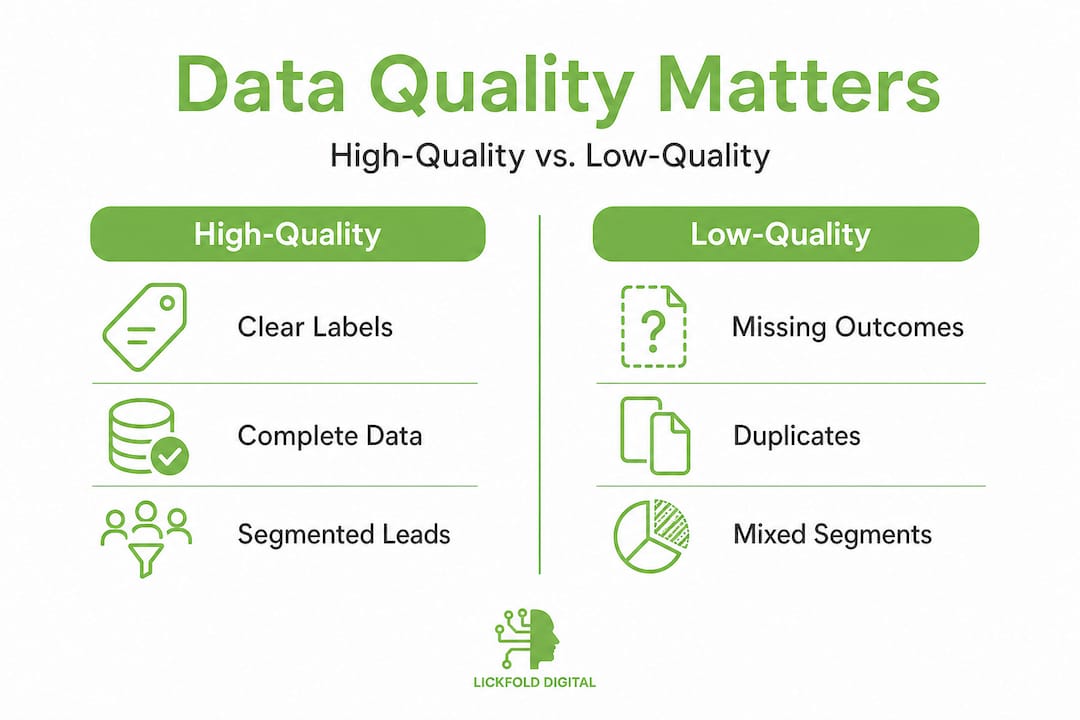
The impact of poor digital contact capture practices cascades directly into model accuracy. If contacts are collected with missing fields or inconsistent formatting, the model treats them as noise.
Common mistakes teams make include mixing leads from completely different market segments without flagging the segment, leaving “nurture” leads in a perpetual gray zone with no clear win/loss label, and pulling in unverified data from third-party list brokers without validation. For teams newer to the process, this lead management for beginners guide outlines foundational data hygiene steps that directly support model readiness.
A 2023 Salesforce study found that poor data quality costs businesses an average of 12% of their revenue. For predictive models, that loss compounds because bad training data produces bad scores, which lead reps to pursue the wrong accounts, which generates more bad outcome data.
Pro Tip: Before connecting any predictive scoring tool, audit your CRM for lead outcome completeness. Set a strict threshold: if fewer than 80% of closed leads have a clear win or loss label with at least three populated firmographic fields, clean the data first. A model trained on clean data with 800 records will outperform one trained on messy data with 8,000.
Also consult your predictive sales automation guide to understand how automation can reinforce good data collection habits at scale, reducing the manual burden of data hygiene over time.
Key components and workflows of predictive lead generation
Understanding the mechanics helps you manage the process intelligently rather than treating it as a black box. Predictive lead generation runs on recurring jobs, not one-time setup. Adobe confirms that the system involves ongoing scoring jobs that recalculate scores and feed back into profiles and segmentation for action.
Here’s how the daily and weekly workflow typically looks in a functioning B2B operation:
- Ingest and cleanse data. Pull lead records from CRM, marketing automation, and third-party enrichment sources. Validate completeness and standardize field formats.
- Train or refresh the model. Feed cleaned outcome data into the machine learning model. Initial training requires a significant batch; subsequent runs use incremental updates.
- Apply scoring. The model scores every active lead or account in your database, assigning a probability score and segment tier (hot, warm, cold).
- Segment and alert teams. High-scoring leads trigger alerts in your CRM or marketing automation platform. Sequences, ad audiences, or rep tasks update automatically.
- Monitor and retrain. Track score accuracy against actual outcomes. Schedule retraining as new closed deals and disqualified leads accumulate.
Typical data fields used in predictive models
| Feature category | Example fields | Why it matters |
|---|---|---|
| Firmographic | Company size, industry, revenue, location | Identifies fit with your ideal customer profile |
| Behavioral | Email opens, page visits, content downloads | Signals intent and buying stage |
| Engagement recency | Days since last interaction, frequency of contact | Distinguishes active buyers from cold contacts |
| Technographic | Tech stack, tools in use | Indicates compatibility and switching intent |
| Demographic | Job title, seniority, department | Confirms decision-making authority |
Pro Tip: When integrating scoring outputs with your existing CRM or marketing automation system, map model tiers directly to rep queues and email sequences. A “hot” score should automatically trigger a high-priority follow-up task, not just update a field that reps have to manually check. Automation bridges the gap between model output and human action.
For practical guidance on building this into your tech stack, the AI prospecting automation resource walks through workflow design in detail. You can also explore modern AI sales automation tools that integrate natively with major CRM platforms.
Choosing and deploying predictive lead generation tools
The market for predictive scoring tools has expanded rapidly, and the options range from built-in modules within existing CRMs to standalone AI platforms and full-service solutions. Evaluating them correctly requires knowing what questions to ask.
Microsoft and Oracle are two of the most established enterprise-grade options. Both vendors stress data requirements and the importance of regularly retraining and revalidating predictive models, so any vendor who glosses over those requirements should raise a red flag.
Checklist for evaluating predictive lead generation software:
- Does the platform integrate natively with your current CRM and marketing tools?
- What minimum data volume does the vendor require before scores are reliable?
- How transparent is the model? Can you see which features are driving scores?
- How frequently does the model retrain, and can you trigger retraining manually?
- Does the vendor provide model performance reporting (accuracy, lift, precision)?
- Can scoring outputs trigger automated workflows within your existing systems?
- What does onboarding and data migration support look like?
- Is the vendor willing to run a pilot on your actual historical data before you commit?
That last point is critical. Vendor demos always use clean, idealized datasets. Insist on testing with your real lead data to see actual model performance before signing a contract.
Beyond enterprise platforms, B2B teams with leaner budgets have strong options among newer AI-driven tools. For a current comparison, review this roundup of LeadsFinderAI alternatives to see how different platforms stack up on features and pricing. Teams focused on maximizing prospecting output should also review these AI-driven prospecting tips for context on how different tools fit different outbound strategies. Emerging AI automation platforms are also worth evaluating for teams looking to combine scoring with automated outreach in a single workflow.
Best practices to optimize predictive lead generation results
Predictive lead generation only performs as well as the team operating it. Technology is the engine, but processes and habits are the fuel. Here are the practices that consistently separate high-performing teams from those that stall after initial deployment.
The most important habit is continuous data hygiene. Schedule monthly audits of lead outcome labeling. Ensure that every closed opportunity, whether won or lost, gets categorized correctly before the data feeds back into the model. Stale or ambiguous records drag accuracy down over time.
Marketing and sales alignment on outcome definitions is equally critical. If marketing defines a “qualified lead” differently than sales does, your labeled data will reflect that inconsistency, and the model will too. Sit both teams down and agree on a shared vocabulary before any training run.
Treat model outputs as a starting point for segmentation, not a final verdict. Use score tiers to shape how you message different segments: high-intent prospects get direct, concise outreach; mid-tier leads get educational nurture content; low-score contacts move into longer-term sequences until behavioral signals change.
As Adobe confirms, continuous optimization, including daily scoring and adjusting segments based on score movement, yields the best results.
Pro Tip: Block time on a recurring calendar to review model performance reports. Look for drift: if your “hot” tier conversion rate drops significantly over two months, it’s a signal that the model needs retraining or that your ideal customer profile has shifted. Treat this review like a pipeline meeting, not optional admin.
Must-follow best practices:
- Run monthly data quality audits and enforce outcome labeling standards
- Align marketing and sales on lead definitions before each model training cycle
- Use score movement, not just static scores, to trigger outreach sequences
- Retrain models at least quarterly or after any significant market shift
- Measure model performance against actual conversion rates, not just engagement metrics
These habits also reinforce the broader goal of building sustainable lead generation systems that grow more accurate and efficient over time, not ones that decay from neglect.
Why most teams underestimate ongoing optimization
Here’s the uncomfortable truth: most B2B teams treat predictive lead generation like a software installation. They go live, celebrate the launch, and then let the system run untouched for six months. By the time they check in, scores have drifted, conversion rates have dropped, and they blame the technology.
The technology was never the problem. The model needs feeding. Markets shift. Buyer behaviors change. The personas that converted 18 months ago may not be the ones converting today. A model frozen in time will keep optimizing for yesterday’s buyer while today’s opportunity walks past unscored.
What top-performing teams do differently is simple but demanding: they schedule weekly score reviews, assign someone to own model performance, and treat retraining as a recurring operational task. One example we see consistently is teams that set up weekly “score movement” alerts, tracking which accounts jumped from mid to high tier in the past seven days. Those accounts get immediate outreach. That single habit, reviewing weekly drift rather than just static scores, has driven step-change improvements in pipeline velocity for teams running sophisticated AI prospecting strategies.
The teams losing ground are those who expected AI to remove human judgment from the process. The best use of AI in lead generation is not to replace thinking but to direct it more precisely. The model tells you where to look. Your team still has to show up and engage.
Ready to transform your lead generation with AI?
Predictive lead generation is one of the most effective tools available to B2B marketing and sales teams, but only when it’s implemented with the right data, the right workflows, and the right commitment to ongoing optimization. If your team is ready to stop guessing and start targeting with precision, Lickfold Digital can help you get there faster.
Lickfold Digital builds AI-driven prospecting systems that identify, score, and engage decision-makers who match your ideal customer profile, without generic templates or wasted outreach. From infrastructure setup to human-qualified lead delivery, the entire process is designed for B2B teams who need a predictable, scalable pipeline. If you’re serious about applying predictive AI to your growth strategy, reach out to the team to discuss what a tailored solution looks like for your market.
Frequently asked questions
How does predictive lead generation differ from traditional lead scoring?
Predictive lead generation uses AI models regularly retrained with outcome data to continuously refine which prospects are most likely to convert, while traditional scoring relies on static rules assigned by humans without learning from actual results.
What types of data are most important for predictive lead generation?
Clean outcome labeling and rich behavioral engagement details are essential. As Microsoft confirms, attribute and outcome data volume directly affects predictive model performance, so completeness and accuracy matter more than raw record volume.
Which teams should own predictive lead generation workflows?
Both marketing and sales must collaborate closely to update lead definitions, provide outcome feedback, and use AI-driven scores to guide prospecting. Neither team can run it effectively in isolation.
How often should predictive models be retrained?
Retrain at least monthly or as new outcome data accumulates. Microsoft confirms that patterns learned on outcome data should be refreshed periodically to keep accuracy high as audience behaviors shift.
Can predictive lead generation tools integrate with existing CRM or marketing platforms?
Yes, most leading predictive lead generation tools are designed for seamless CRM and marketing automation integration, allowing scores to trigger workflows, update segments, and queue rep tasks automatically.